Search This Blog

Tuesday, November 10, 2020

N.L. Holmes on Royal Egyptian Society and the Future of Archaeology | | BookTrib

https://booktrib.com/2020/11/10/n-l-holmes-on-royal-egyptian-society-and-the-future-of-archaeology/

N.L. Holmes on Royal Egyptian Society and the Future of Archaeology


While most people's impression of ancient Egypt is usually limited to spring holiday viewings of The Ten Commandments or grade-school museum field trips, our fascination endures. Anyone who has ever wondered about what life was like among the pharaohs will delight in the Lord Hani Mysteries by N.L. Holmes. The historical series kicks off with Bird in a Snare, a rich and revealing introduction to the political intrigue of royal Egyptian society.

Authenticity shines in this unique choice for a murder mystery. That's no surprise — N.L. Holmes is the pen name of a professional archaeologist who has participated in excavations in Greece and Israel and taught ancient history and humanities at the university level for many years. 

The protagonist of Bird in a Snare is Hani, a scribe, emissary and self-anointed "minor functionary." He finds himself dispatched to a northern vassal state to perform a year-long murder investigation on behalf of the king, Amen-hotep III. Each of the suspects Hani considers offer both motive and alibi, and includes the commissioner, various nobles and even the king of Egypt's son and heir. Talk about a delicate situation!

Hani is a family man with little ambition other than to provide for his brood, but when the king dies and his only son is recruited by fanatical religious leaders, he finds himself torn by divided loyalties. Can he solve the mystery and protect those he loves? For more on the book, read our review here.

In this Q&A, Holmes tells us more about writing Bird in a Snare, and what makes ancient Egypt so fascinating even today.

Q: Why did you choose the reign of the Egyptian pharaoh Akhenaten as a setting for a mystery series?

A: It's a period of unimaginable changes and upheaval, which makes an exciting backdrop. And there are mysteries — in some cases we're not even sure who the rulers are, or how they're related, or even if they're male or female. That leaves a lot of wiggle space for a fiction writer. Plus, we have the Amarna Letters, a series of foreign correspondences in which the real Hani figures frequently. Ready-made adventures!

Q: Lord Hani is a really warm and touching character, especially in terms of his attachment to his family. How historically accurate is this? Is he an aberration, or does he embody the spirit of the age? 

A: The Egyptians were very devoted to their families. Children were loved, and families were often large. Women were far more respected there than in most ancient societies. Although it was patriarchal, women had equal rights under the law and entered many professions; they could be in charge of men or even be kings. That being said, there must have been people who were not good family men. Lord Ptah-mes's broken family is an example of the other end of the spectrum.

Q: Your characters seem incredibly alive, and I'm wondering about your process. As you write, do you focus more on plot or character?

A: I absolutely focus on character. The plot unrolls because the characters act in a certain way — because they're that kind of person. In the one novel where I ended up with a wholly failed plot, it was because I never had a grip on the characters. They were a little caricaturish, and so they couldn't lead me along. That one needs rewriting completely.

Q: Can you tell us about your wildest experience on an actual archeological dig? Did any of your real-life experiences inform this plot?

A: Wild experiences (ahem)? I guess hiking and hitchhiking all over the island of Crete, which gave me a sense of how laborious travel was in the old days. I once spent the night in the Kamares Cave on the top of Mt. Ida, which had been a Minoan sanctuary. But the only thing that really plays into the plot of any of the Lord Hani novels is a shipping vase we found that may have had orpiment in it. That's an arsenic crystal ground into a yellow pigment.

Q: What artifacts do you hope future archeologists will find from the historical era of your series, and what conclusions do you hope they'll draw from them?

A: I hope we find the tomb of Akhenaten, and more objects that clarify the murky succession. What little we know has been pieced together from small archaeological finds that mention regnal dates or something. Let's find a clear statement about whether Akhenaten and his father ruled jointly for a while. Or when the episode about a widow seeking a Hittite to marry took place, so we know which queen it was. There's so much to be learned.


About N.L. Holmes:

N.L. Holmes is the pen name of a professional archaeologist who received her doctorate from Bryn Mawr College. She has excavated in Greece and Israel, and taught ancient history and humanities at the university level for many years. She has always had a passion for books, and in childhood, she and her cousin (also a writer today) used to write stories for fun. She splits her time between Florida and northern France, where she gardens, weaves, plays the violin, dances and occasionally drives a jog-cart. And reads, of course.

--   Sent from my Linux system.

Thank you, Pennsylvania


Egypt to announce biggest archaeological discovery in 2020 in few days - Ancient Egypt - Heritage - Ahram Online

http://english.ahram.org.eg/NewsContent/9/40/391380/Heritage/Ancient-Egypt/Egypt-to-announce-biggest-archaeological-discovery.aspx

Egypt to announce biggest archaeological discovery in 2020 in few days

The number of coffins exceeds that of the discovery announced in early October

Nevine El-Aref , Monday 9 Nov 2020
discovery
Egypt's Ministry of Tourism and Antiquities will announce the biggest archaeological discovery in 2020 at a press conference in the Saqqara Necropolis in the next few days.

Excavations conducted by the Egyptian archaeological mission working in the Saqqara Necropolis resulted in the discovery of new shafts containing a huge number of intact, painted anthropoid coffins.

The number of coffins exceeds that of the discovery announced in early October.

The shafts were closed for more than 2,500 years.

A number of gilded artefacts were also found, including wooden statues and coloured and gilded masks.

The Egyptian archaeological mission made throughout the past years a number of important archaeological discoveries in Saqqara, the last of which was unearthing 59 painted coffins with mummies in a good condition of top officials and priests from the 26th Dynasty.

The discovery was announced in an international press conference in early October. 

discovery

discovery
Short link:


--   Sent from my Linux system.

Monday, November 9, 2020

Getty Conservation Institute Field Projects: 3 cases: Tutankhamun, Mosaikon, Peru | UCLA Cotsen Institute of Archaeology

https://www.ioa.ucla.edu/content/getty-conservation-institute-field-projects-3-cases-tutankhamun-mosaikon-peru?utm_source=Cotsen+Newsletter&utm_campaign=2bad36c85b-EMAIL_CAMPAIGN_2020_11_04_10_01&utm_medium=email&utm_term=0_0664bbf692-2bad36c85b-370132615

Event: Getty Conservation Institute Field Projects: 3 cases: Tutankhamun, Mosaikon, Peru


Date & Time

November 20, 2020 - 11:00am to 12:00pm
Save to your calendar

Contact Information

Jennifer McGough
jenmcgough@g.ucla.edu

Location

Online

Event Type

Cotsen Public Lecture

Event Details

Jeanne Marie Teutonico
Associate Director, Strategy and Special Initiatives
Getty Conservation Institute
Friday November 20th, 11:00am - 12:00pm (PT)
Please note, this talk will not be recorded.

Register here

The Getty Conservation Institute (GCI) is best described as a private, international research organization that is part of a larger philanthropic enterprise dedicated to the understanding, conservation and enjoyment of the visual artsIn this, the GCI is somewhat unique in the constellation of not-for-profit organizations operating in the heritage sector. 

The presentation will provide an introduction to the Getty Conservation Institute – its mission, strategic priorities and methodological approach to heritage conservation. Select examples of GCI field work (in Egypt, Peru and the Mediterranean) will be used to illustrate diverse conservation contexts and challengesand to reflect on the evolution of conservation practice over the last twenty years.

The presentation will conclude with some consideration of future challenges both global concerns and specific issues facing the heritage conservation field.

Jeanne Marie Teutonico is currently Associate Director, Strategy and Special Initiatives,atthe Getty Conservation Institute (GCI) in Los Angeles where her responsibilities include the development of strategic priorities for the Institute and oversight of GCI publications. An architectural conservator with over thirty years of experiencein the conservation of buildings and sites, she holds an A.B. (Hons) in art history from Princeton University and an M.Sc. in historic preservation from Columbia University, Graduate School of Architecture, Planning and Preservation. Prior to joining the GCI in 1999, Jeanne Marie was a conservator and educator on the staff of the International Centre for the Study of the Preservation and Restoration of Cultural Property (ICCROM) in Rome andlaterof English Heritage in Londonwhere she led a large technical research and publications program. She is published widely and maintains research interests in the conservation and sustainable use of traditional building materials. She was an invited Resident at the American Academy in Rome in 2008 and is a Fellow of the Association for Preservation Technology, the Society of Antiquaries, and the International Institute for Conservation.


Figure 1. Conservation of the wall paintings in the burial chamber of the Tomb of Tutankhamen in the Valley of the Kings, Egypt. The Getty Conservation Institute, in collaboration with Egypt's Ministry of Antiquities, has recently completed a multi-year project that included study and conservation of the tomb's wall paintings, environmental and infrastructure improvements, and training for future care of the site.


Figure 2. Training regarding the conservation and management of archaeological sites and mosaics at the ancient site of Paphos in CyprusOver the last ten years, the Getty Conservation Institute has collaborated with the Getty Foundation, ICCROM and the International Committee fortheConservation of Mosaics(ICCM) in an initiative known as MOSAIKON with the aim of improving the conservation, presentation and maintenance of archaeological mosaics in the Mediterranean region. Activities have included education and capacity building, the development of locally sustainable conservation practices, model field projects, and the dissemination of information in a variety of forms.


Figure 3. The church of Santiago Apóstolin Kuño Tambo, Peru. This seventeenth century earthen building, located in a remote village high in the Andes, is richly decorated with wall paintings and has been in continuous use as a place of worship since its original construction. As part of its Earthen Architecture Initiative, the Getty ConservationInstitute, in collaboration with the School of Science and Engineering at the Catholic University in Lima and the Peruvian Ministry of Culture, has developed and implemented seismic retrofit techniques that will enhance the building's performance without negatively impacting the significant decorative finishes.

--   Sent from my Linux system.

Saturday, November 7, 2020

Visit Ancient Egyptian City Luxor Through Evocative New Drama Starring Andrea Riseborough

https://www.forbes.com/sites/joanneshurvell/2020/11/06/visit-ancient-egyptian-city-luxor-through-evocative-new-drama-starring-andrea-riseborough/?sh=4f8d584630fd

Visit Ancient Egyptian City Luxor Through Evocative New Drama Starring Andrea Riseborough

Luxor, a captivating new romantic drama starring Andrea Riseborough (Birdman, Battle of the Sexes, Shadow Dancer) and Karim Saleh (Counterpart, Munich, Transparent), had a sold-out UK premiere in London this week and is now available for online viewing. Written and directed by Zeina Durra, the film premiered at Sundance in January 2020 and will open in the United States December 4th.

It has been a decade since Zeina Durra's first feature The Imperialists Are Still Alive! premiered at Sundance to rave reviews. Luxor is a followup that was certainly worth waiting for. The story about a doctor who reassesses her life and rekindles a lost love, while on leave from a war zone, is subtle, engaging and beautifully shot. Exceptional cinematography by Zelmira Gainza brings the Valley of Kings and the extraordinary city of Luxor, with its ancient ruins and temples wonderfully to life. The film acts as a powerful travelogue, sure to tempt the viewer to visit the burial place of King Tut.

Luxor presents the existential journey of Hana (Andrea Riseborough) who arrives at the glorious Winter Palace hotel (the former winter residence of the Egyptian royal family and where Agatha Christie wrote Death on the Nile) for an indefinite leave from her work on the Jordanian-Syrian border as a doctor in a war trauma unit. No details of her stressful work are revealed in the film apart from a comment that no one should have to see what she's seen. While there are no flashbacks to war-torn Syria, Hana's body language and facial expressions make the horrors she's witnessed abundantly clear. While trying to seek mental solace and to work out what to do next, Hana tours the city and visits ancient monuments. By chance, while on a ferry, she encounters Sultan (Karim Saleh), an archaeologist with whom she had a relationship twenty years ago and clearly hadn't forgotten about.

The film includes many scenes without dialogue where Hana appears alone, in taxis, or wandering the streets and historic monuments of Luxor. Hana's solitude is emphasised by the camera and the viewer must pick up the visual clues to understand her mindset. Even when she visits ancient sites where Karim is working, there are often extended periods of silence. Contemplation is central in this film; the image tells the story and is driven forward by Riseborough's and Saleh's remarkable acting ability. Director Zeina Durra explains that she "felt that the imagery of the digs and sites, was a strong non-verbal way of addressing Hana's existential crisis, something that will stay in the audience's subconscious. I wanted to make a film that transports people to this amazing place but I didn't want them to escape into some kind of orientalist fantasy, I wanted the themes of our times to be present."

Zeina Durra has a Bosnian–Palestinian mother and Jordanian–Lebanese father and this heritage made her comfortable setting her film in an Arab country. Her background no doubt helped with the incredibly tight schedule; the entire film was shot in eighteen days and at some locations, scenes had to be completed in less than 30 minutes. Luxor is a city of archaeology. The excavation of the ancient sites is so similar to psychoanalysis and works in a very visual way, the digging up, the excavation. The pain that Hana carries after witnessing atrocities in Syria first hand, weighs her down and makes her ask a lot of existential questions. So what better place to find answers than in one of the world's oldest civilizations. Durra says that "the unsettling darkness of our times" made her want to write a "story set in a place which is a monument to past civilisations whose central beliefs, temples and obsession with the afterlife, were all rooted deeply in the idea of light overcoming darkness." Beautiful and evocative, Luxor deserves to be seen at the cinema on a large screen but with the current global pandemic in play, this of course isn't possible. In the meantime, online viewing is essential and rewarding.

Modern Films' UK release of Luxor is online 6 November. The film will be released digitally by Samuel Goldwyn in the United States 4 December.

Follow me on Twitter or LinkedInCheck out my website
--   Sent from my Linux system.

Egypt’s Giza Pyramids are getting a revamp to boost tourism

https://www.euronews.com/2020/11/06/egypt-s-giza-pyramids-are-getting-a-revamp-to-boost-tourism

Egypt's Giza Pyramids are getting a revamp to boost tourism

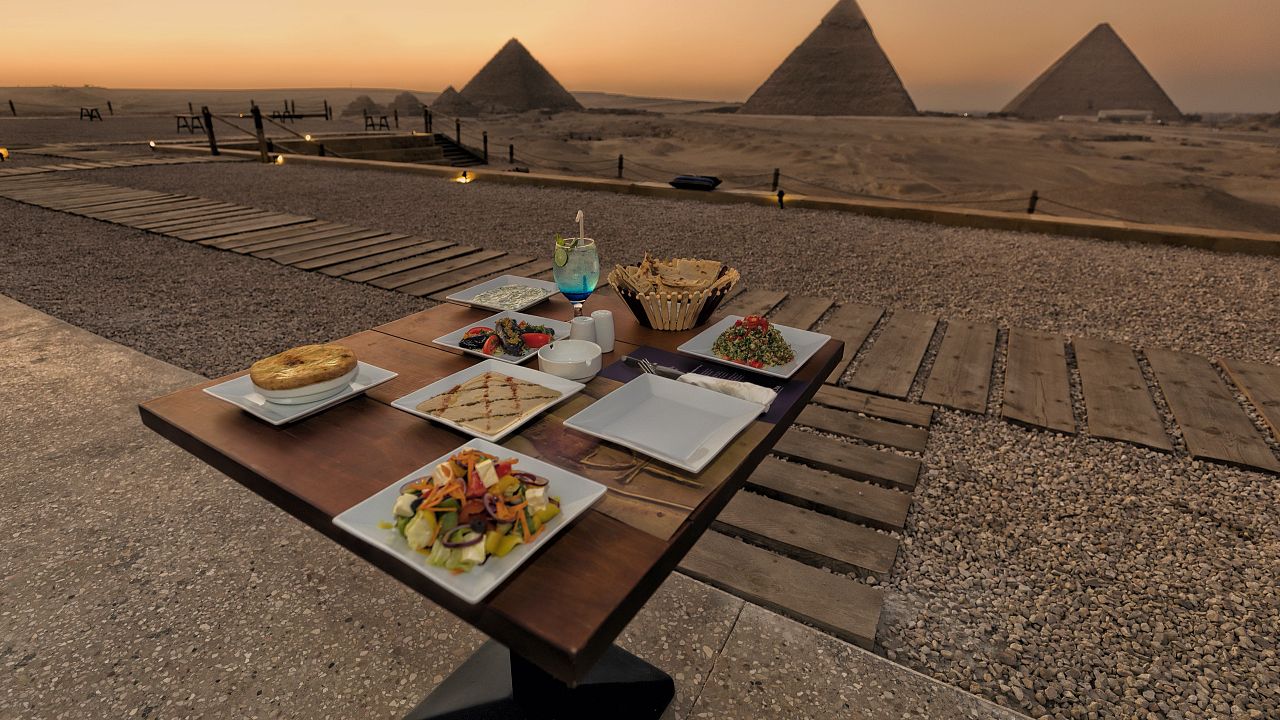
The famous Pyramid                      Plateau has just got its first-ever restaurant.
The famous Pyramid Plateau has just got its first-ever restaurant.   -   Copyright  Fadi Taher


The Great Pyramids of Giza are one of the most recognisable tourist attractions in the world. The ancient Egyptian pharaohs built them to last forever and now, 4,500 years later, they're getting a revamp.

With the goal of making the country's most popular heritage site more accessible to tourists, a 17 million euro renovation is underway. The refurbishment is centred on the Giza Plateau, which houses the Sphinx and three pyramids, including the oldest and tallest masonry structure, the Great Pyramid of Khufu.

The ambitious project includes a new visitor centre, an environmentally-friendly electric bus and the first restaurant ever to be located on site.

The Pyramid Plateau gets its first-ever restaurant

Tourists exploring Egypt's Giza Pyramids can now enjoy a great meal afterwards, with the opening of the first-ever restaurant on Pyramid Plateau.

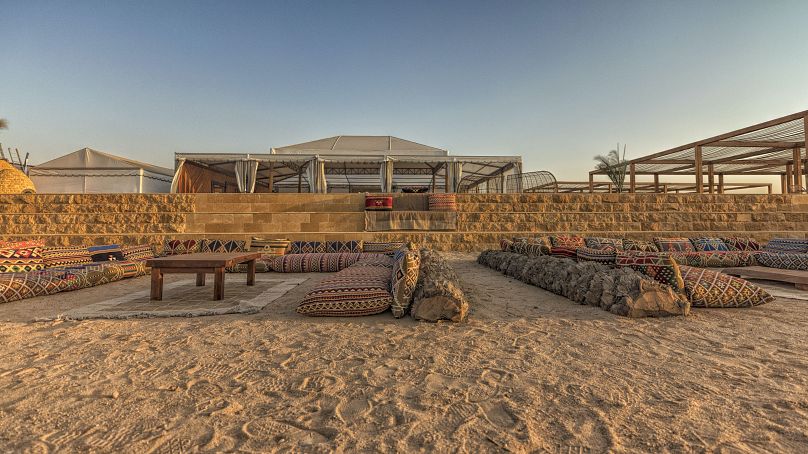
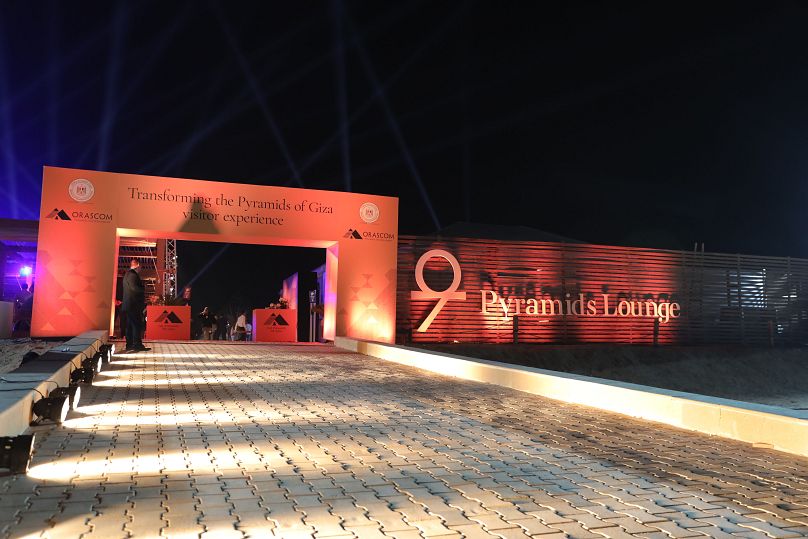
The 9 Pyramid Lounge, which opened in late October, is designed to mimic a traditional Bedouin camp in the desert. At 1,341 square meters, the complex has plenty of options for diners - who can choose between eating al fresco on the Bedouin-style cushions scattered about the place, or under the canopy where chairs and tables are available.

The complex was built with all natural materials to blend in with its surroundings and to demonstrate the project's commitment to sustainable tourism in the area. In addition to the restaurant, a fleet of electric busses and golf-carts have been trialed with the aim of these becoming the only modes of transport on the site.

Fadi Taher
Egypt's Pyramid Plateau gets its first-ever restaurantFadi Taher

The restaurant was financed by Mr Naguib Sawiris, Chairman and CEO of Orascom Investment Holding, in partnership with the Supreme Council of Antiquities in Egypt. Mr Sawiris is Euronews' majority shareholder.

He explained the thinking behind the new venture: "Our main objective was to upgrade the services provided to the visitors to be able to level up to the greatness of Egyptian civilisation and the magnificence of this historical site, while preserving this area from all forms of pollution, and creating a fascinating experience for its visitors."

A 'one of a kind' view

Sawiris added: "The breathtaking view of 9 Pyramids is one of a kind in the whole world. This is in addition to two fine dining restaurants and a café to be launched in early 2021 in the old engineering administration building on the Northwestern side - which has been completely modernised and redesigned to serve as a restaurant complex."

Boosting tourism in Egypt

9 Pyramid Lounge is one of a number of projects designed to boost tourism in and around Egypt's capital, Cairo.

Tourism accounts for more than 12 per cent of Egypt's gross domestic product (GDP), according to government statistics. The new facilities at the Giza plateau are part of a wider effort to develop key tourist sites in the country. The Grand Egyptian Museum, which will become the world's largest archaeological museum, is set to open next year.

Dr Khaled El-Enany, the Minister of Tourism and Antiquities, said at the unveiling of 9 Pyramids Lounge that Egypt is keen to transform the tourism map of Cairo.

Mohamed moussa
Millions of euros are being spent on improving Egypt's tourism sector.Mohamed moussa

For years, locals selling souvenirs and camel rides have been part of the experience when visiting the famed site. But now the sole remaining wonder of the ancient world can be viewed in a calmer setting as a new souk regulated by permit holders will be launched at the start of next year.

The plan to renovate the ancient site has been in motion for the past 15 years, but the project was put on hold in 2011, after the revolution that ousted long-time ruler Hosni Mubarak.

The years of political unrest that followed and a deadly terrorist attack on a Russian passenger plane in 2015 saw the country's tourism industry a heavy hit . But lately, the industry has begun to bounce back. Last year, 13.6 million people visited Egypt and before Covid-19 struck, 2020 was expected to exceed 15 million.


--   Sent from my Linux system.

Egypt’s Mostafa Waziri inspects work at Kebbash road - EgyptToday

https://www.egypttoday.com/Article/4/93955/Egypt%E2%80%99s-Mostafa-Waziri-inspects-work-at-Kebbash-road

Egypt's Mostafa Waziri inspects work at Kebbash road

BY

Fri, 06 Nov 2020 - 05:01 GMT


File: Mostafa Waziri at Kebbash road.

File: Mostafa Waziri at Kebbash road.

CAIRO - 6 November 2020: Egypt's Secretary General of the supreme council of antiquities Mostafa Waziri inspects work at Kebbash road during his visit to Luxor and Karnak temple which started on November 5 and ended on November 6.


Waziri announced that about 70 percent of Kebbash road was completed.


The Pharaonic Kebbash Road is to become the longest gangway and open museum in the world. 

The renovation of the Pharaonic Kebbash Road is considered a monumental moment for Luxor, as the project will bring the great road to life again. 

Its new design is set to change Luxor's position on the touristic map, as it will become the longest gangway and open museum in the world. 

It is expected that the new makeover of Kebbash Road will attract tourists the world over and play a vital role in pushing the Egyptian tourism forward. 

Kebbash Road will be reopened after its renovation. 

In Ancient Egypt, Kebbash Road connected the Karnak Temple Complex with the Luxor Temple.  

During the time of the Pharaohs, the road was one of the most important, as it hosted ceremonies and festivals. 

The road was opened to the public in March 2013 by the Minister of Tourism. 

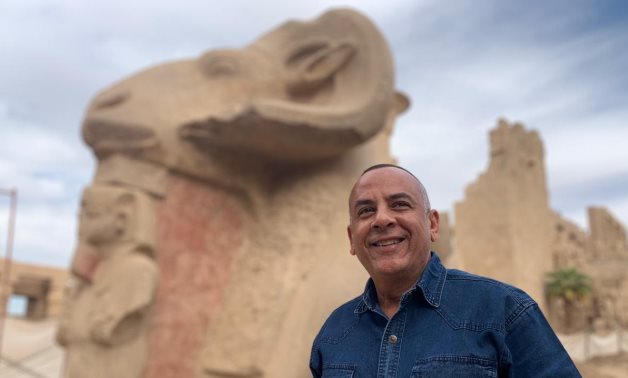
Although Kebbash Road is 2.7 kilometers long, a walk through it is enjoyable as there are around 1,200 statues lining one side of the road, each resembling the Sphinx (where the head is that of a ram and the body is that of a lion) and sculpted from sandstone. 

This meaningful decoration is dedicated to Amun, as the head of the statues are in the form of the god's while the rest of the statue — the body of a lion — is a means of protecting the temples from looters.

--   Sent from my Linux system.

Friday, November 6, 2020

Special Lecture on Ancient Egypt - Dr. W. Raymond Johnson new findings about King Tutankhamon

The Institute of Egyptian Art & Archaeology at the University of Memphis presents:
 
The William J. Murnane Memorial Lecture will be an eEvent this year. 
 
  You are invited to a very special eEvent!  
  
  Please join us on YouTube tomorrow, Friday evening, November 6th, starting at 7:00 p.m. CST. 
 
The Fifteenth Annual William J. Murnane Memorial lecture  
"Tutankhamun's Life, Death, and Afterlife: New Evidence from Thebes,"  
presented by Dr. W. Raymond Johnson.  
   
Log on the event here: https://youtu.be/JuHCL88qpFw 
  
    This lecture will remain on YouTube for only two weeks after its premiere so please remember to log on during this window that closes on November 21st!  
 
    W. Raymond Johnson, PhD, is Director of the Epigraphic Survey of the Oriental Institute of the University of Chicago in Luxor, Egypt, and Research Associate Professor in the Department of Near Eastern Languages and Civilizations of the University of Chicago and the Oriental Institute.  He is an internationally known and respected Egyptologist who has worked in Egypt for more than 40 years. The art of the Amarna period has been his life-long passion. 
 
    In recent years, new archaeological material has emerged in Luxor (ancient Thebes) that enriches our knowledge of the life of one of Ancient Egypt's most enigmatic kings, Tutankhamun, revealing the luxurious court in which he lived, his extraordinary building activities, and the circumstances of his death. In his presentation, Dr. Johnson will share some of these new discoveries and analyze for us the light they shed on that golden moment in Egyptian history. 
 
     For more information, visit the IEAA web site at https://www.memphis.edu/egypt/events.php  or contact the IEAA at 901.678.2225. 


Thursday, November 5, 2020

Egypt's tourism & antiquities min. to open restoration project of Siwa Oasis village of Shali - EgyptToday

https://www.egypttoday.com/Article/4/93905/Egypt-s-tourism-antiquities-min-to-open-restoration-project-of

Egypt's tourism & antiquities min. to open restoration project of Siwa Oasis village of Shali

BY

Thu, 05 Nov 2020 - 12:33 GMT

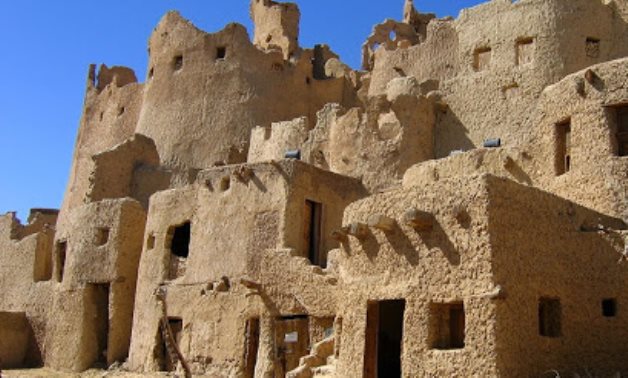
FILE - Shali Fortress in Siwa Oasis, Egypt

FILE - Shali Fortress in Siwa Oasis, Egypt

SIWA, Egypt, Nov 5 (MENA) - Tourism and Antiquities Minister Khaled Anani and EU Ambassador in Cairo Christian Berger will open on Friday a project on renovating and reviving the archaeological village of Shali in Siwa Oasis of the Mediterranean governorate of Matrouh.

 
Matrouh Governor Khaled Showeib will also attend the event which comes two years after the commencement of the restoration operation which was backed by the European Union.
 
This coincides with directives of President Abdel Fattah El Sisi to develop Siwa Oasis while maintaining its distinctive heritage.
 
The development is meant to promote the economic and investment position of the oasis and promote it as a unique tourist destination.
 
In statements to MENA, Head of the Shali restoration project Emad Farid said Shali is one of the most important Islamic archaeological sites in the Western Desert.
 
He noted that Egypt and the EU renovated Shali's ancient fortress to be placed on the UNESCO's World Heritage List.
 
He referred to the restoration of Tetnady Mosque which was opened in 2018.
 
He added that the Shali Castle which was built of kershif - a traditional Siwan building technique using natural materials - was about to vanish due to climate factors, therefore this massive restoration project was launched with an EU financial support estimated at 0.5 million euros. (MENA)
--   Sent from my Linux system.

Egypt recovers part of sarcophagus from Italy - Ancient Egypt - Heritage - Ahram Online

http://english.ahram.org.eg/NewsContent/9/40/390136/Heritage/Ancient-Egypt/Egypt-recovers-part-of-sarcophagus-from-Italy.aspx

Egypt recovers part of sarcophagus from Italy

In 2018, Egypt was able to recover 195 artefacts and 21, 660 coins that were illegally smuggled to Italy

Nevine El-Aref , Thursday 5 Nov 2020
Egypt
After almost two years, Egypt has received - from Italy - a part of a sarcophagus that was stolen and illegally smuggled out of the country. 

Egypt's Ambassador to Italy Hisham Badr received the artefact on Thursday at the headquarters of the anti-cultural property unit of the Italian gendarmerie "Carabinieri", and it will soon be returned back to its homeland.

Supervisor General of Antiquities Repatriation Department, Shaaban Abdel-Gawad said that the piece has been seized by the relevant security authorities in the Cagliari region in Italy in 2018, and as soon as the piece was seized by the Italian authorities, all necessary measures were taken between the ministry of tourism and antiquities and the international cooperation office at the Egyptian attorney general's office. A request for legal aid was then sent to the Italian authorities.

The recovered piece is part of a wooden coffin lid. It appears to be the middle part of the body of a coffin covered with a layer of plaster. It is decorated with four bands of hieroglyphic writing with black ink dating back to the 'Late Period'. 

In 2018, Egypt was able to recover 195 artefacts and 21, 660 coins that were illegally smuggled to Italy.

Egypt
Views: 588


Search Keywords:
Short link:
--   Sent from my Linux system.

Egypt-German archaeological mission resumes conservation and documentation of Temple of Esna - Ancient Egypt - Heritage - Ahram Online

http://english.ahram.org.eg/NewsContent/9/40/390113/Heritage/Ancient-Egypt/EgyptGerman-archaeological-mission-resumes-conserv.aspx

Egypt-German archaeological mission resumes conservation and documentation of Temple of Esna

The mission's work began in 2018, but was disrupted due to the coronavirus outbreak

Nevine El-Aref , Thursday 5 Nov 2020
Egypt
A joint Egyptian-German archaeological mission is resuming the conservation and photographic documentation work on the Temple of Esna, on the west bank of the Nile some 55km south of Luxor. 

The mission's work began in 2018, but was disrupted due to the coronavirus outbreak, and resumed in September. 

Over the centuries, the temple suffered from the accumulation of thick layers of soot, dust and dirt. Bird droppings and wasp nests covered the temple's Inscriptions and salt crystals affected the colors of the temple and caused some flaking of the reliefs.

Hisham El-Leithy, head of the Documentation Centre, said that "since December 2018, the mission has conducted five conservation and documentation campaigns. The conservation team cleaned mechanically layers of soot, dust and dirt, and the bright colours of the inscriptions can now be appreciated, especially the astronomical decoration of the ceiling of the temple."

Egypt
Temple of Esna

The mission expects the current campaign to conclude its task in the early months of 2021.

The Temple of Esna dates back to the Roman period. Construction began during the reign of the Roman Emperor Claudius, and its decoration was finished during the time of Emperor Decius, between 249-251 CE. The temple  is dedicated to the ram god Khnum and his divine consorts.

Egypt
Temple of Esna

During the 19th and 20th centuries the Temple of Esna suffered from urban encroachment, and houses of the villagers were built all around it. The temple was in fact accessed through one of the houses.

The temple was reported to have been used as a storage facility for the villagers' cotton crop during the reign of Mohamed Ali Pasha. 

Egypt
Temple of Esna
Short link:
--   Sent from my Linux system.