Search This Blog

Monday, April 30, 2018

Enter the realm of ancient Egypt at the Royal BC Museum - Monday Magazine


https://www.mondaymag.com/entertainment/enter-the-realm-of-ancient-egypt-at-the-royal-bc-museum/

This sandstone head of Queen Hatshepsut, the rare female pharaoh from the 18th Dynasty of ancient Egypt (circa 1479-1458 BCE) is one of the treasured artifacts to be displayed during the Egypt: The Time of Pharaohs exhibition at the Royal BC Museum, opening May 18. Photo by Jürgen Liepe/courtesy RBCM

Enter the realm of ancient Egypt at the Royal BC Museum

Ambitious exhibition set to open May 18 in Victoria, running to Dec. 31

Artifacts from ancient Egypt never seem to go out of style.

The mysterious pyramids, the sphinx and the lifestyles of queens and pharaohs continue to captivate us, which is no doubt a big reason why these topics remain part of our grade school curriculum.

With the Royal B.C. Museum preparing to open the doors May 18 for its newest feature exhibition, Egypt: The Time of Pharaohs, museum CEO Jack Lohman is excited to give RBCM visitors a glimpse into the lives and objects used by everyday Egyptians, including their religious practises and their reverence for the dead.

"We want to arouse their curiosity," he says, calling this exhibit "once in a generation. "I think there's always a fascination with ancient Egypt, partly because they produce such wonderful monumental architecture, when you think of the great temples; but they also left behind an extraordinary relationship with the spirit world."

Lohman has direct connections to Egypt, having been a visiting professor in Cairo and served as a technical advisor for the newly opened Grand Egyptian Museum. "I come with a particular passion for Egyptology," he says.

The RBCM hosted Eternal Egypt back in 2006. The new exhibition, with 350 pieces and eight large models, includes a headpiece representing "Queen Pharaoh" Hatshepsut, jewelry and artwork, sarcophagi and other artifacts. The items were selected from a exhibition previously shown in Germany with material on loan from collections in Berlin, Aberdeen, Hildesheim and others. It is in North America for the first time.

"We've reselected objects, such as the mummified cat, and in a sort of way we've repurposed it. It's a way to make it our own," Lohman says. "We've written the narrative in a way to make it so that it fits with our audiences."

A sarcophagus dating from the 12th dynasty of ancient Egypt (circa 1991 BC to 1802 BC) and discovered in 1987 is what Lohman calls "the star of the show," as it features illustrations and text on both the outside and inside of the coffin.

Preparations done in house by museum artisans

Getting the museum's temporary exhibition space ready for this amazing collection of Egyptian artifacts is no small feat. The RBCM is fortunate to have its own carpentry and artisan studio, where many of the display and supporting elements required in staging such complex exhibits can be built.

In the case of the Egypt exhibition, RBCM staff set out to create not one, but two entranceways to welcome the tens of thousands of visitors expected to move through the displays during the show's duration.

While the inside pieces and displays are the jewels of this exhibit, the grand entrance to the second-floor galleries, as well as the pyramid-style gateway to the exhibit itself, are designed to heighten visitors' excitement and curiosity about what they are about to experience.

"That's our ability to kind of create a look and a feel and give you a first impression and once you get into the space you're really focused on the pieces and the space," says Joel Blaicher, RBCM exhibit fabrication specialist.

The hieroglyphics on the main sandstone-look entranceway roughly translate to "Welcome to the treasure house of Victoria," or more generally, "welcome to the museum of Victoria," he says.

The direct entrance to the exhibit has two doors, one for little ones, complete with a peek-a-boo window with a small display, and another for full-sized visitors. They appear as carved-out blocks at the base of a pyramid, again thanks to the magic of RBCM craftspeople.

"The emphasis is really to give you this sense of entering into this very confined space," Blaicher says. "The temples have some wide open spaces in them, but the pyramids, some of the passageways in them are very, very narrow."

Steve Lewis, one of the museum's exhibition designers, conceptualized the entrances using photographs of real temples and creating scale models. He said seeing the ideas brought to life by Blaicher and his team is gratifying.

"It's always cool to see something you see in a scale model become massive and real and touchable," he says.

Egypt: The Time of Pharaohs has a long engagement, running through Dec. 31 of this year. Admission is included in ticket prices for the museum. For more information, visit royalbcmuseum.bc.ca/egypt

Return of the King

In conjunction with the May opening of the Egypt: The Time of Pharaohs exhibit at the Royal BC Museum comes the return, in a digitally remastered 4K format, of the beloved Mysteries of Egypt short documentary at the National Geographic IMAX Victoria theatre.

Narrated by beloved Egyptian actor Omar Sharif, the film takes viewers to the Nile River, the Valley of the Kings, the great pyramids of Giza and more. Audiences get a broad view of ancient Egypt and its iconic structures, with a special focus on the life and death of the boy king, Tutankhamun, and the discovery of artifacts in the shadowy burial chambers in which he was entombed.

For a schedule, visit imaxvictoria.com/showtimes or call 250-480-4887.

editor@mondaymag.com


Joel Blaicher, Royal BC Museum exhibit fabrication specialist, looks over floor plans for the Egypt: The Time of Pharaohs exhibition opening May 18. Don Descoteau/Victoria News


--   Sent from my Linux system.

Friday, April 27, 2018

EMINA (Egyptian Mummies in North America)


http://www.egyptologyforum.org/EMINA/

On 04/26/2018 01:19 PM, Charles Jones wrote:
EMINA: Egyptian Mummies in North America [First posted in AWOL 19 April 2014, updated 26 April 2018]

EMINA: Egyptian Mummies in North America
http://www.egyptologyforum.org/EMINA/images/emina.jpg

EMINA is a searchable database of Egyptian mummy resources in North America, compiled by S.J. Wolfe (Mummies in Nineteenth Century America; Ancient Egyptians as Artifacts; McFarland, 2009) from thousands of digitized articles in newspapers, periodicals and books, as well as web sites, personal recollections, correspondences, and regular print resources.

The database will be continually expanding and changing as new information is added. Updates will be loaded on a monthly basis unless it becomes expedient to upload more often.

The database consists of two tables.

  • I. The mummy database Search the mummy database
  • II. Database of bibliographic sources to Egyptian mummy references (not yet available online)
The researcher will be able to choose among different search strategies based on access points and/or keyword indices. 

I encourage questions, comments, additions and corrections to the databases and these should be directed to me (S.J. Wolfe) at eminadb@gmail.com. Please include the word "mummy" in the subject line.

The database is sponsored through the kindness and courtesy of the Egyptologists' Electronic Forum, and the technical details for the web version are provided by Kathleen M. Haley, Caroline W. Stoffel and John Stoffel.


--   Sent from my Linux system.

Wednesday, April 25, 2018

April’s News from the Conservation Lab: El Kurru 2018 Season Retrospective | Kelsey Museum


https://kelseymuseum.wordpress.com/2018/04/25/aprils-news-from-the-conservation-lab-el-kurru-2018-season-retrospective/

El Kurru 2018 Season Retrospective | Kelsey Museum

On 04/25/2018 01:45 PM, smullersman wrote:
April's News from the Conservation Lab: El Kurru 2018 Season Retrospective

BY SUZANNE DAVIS, Curator of Conservation

Last month, I returned from fieldwork at El Kurru, the Kelsey's excavation project in Sudan. It was a good season overall, but also a bit odd. It felt to me like a season where almost nothing worked out the way we'd planned. For example, the conservation worklist included stabilization of cracked columns in the funerary temple with a lime-based mortar. I've done work like this on many other projects and expected it to go smoothly, but it didn't. Amaris Sturm — conservation intern this year at El Kurru, and a National Endowment for the Humanities Fellow in conservation at the Winterthur/University of Delaware Program in Art Conservation — ended up testing twenty-six (!) different grout mixtures before hitting on one we were happy with. For other team members, equipment was delayed or couldn't get through customs, supplies didn't arrive, and work plans had to be altered mid-season.

In retrospect, it was a season of significant progress on multiple fronts, but at the time … at the time, I often felt like nothing was working and it was seriously frustrating. When I think about it now, my time onsite this year was a small lesson in persistence and a demonstration of the power of kaizen. This philosophy (which originated in the U.S. but became popular in Japan following WWII) advocates continuous improvement by making small changes or taking small steps. In Arabic, people often say, "shwaya-shwaya" to mean, "a little bit," or "little-by-little." For me, it was a shwaya-shwaya season, and in the end we accomplished most of what we'd set out to do.

April cons post_photo

Amaris Sturm at work in the El Kurru funerary temple. Photo by Suzanne Davis.


--   Sent from my Linux system.

Sudan unearths bones from pyramid for DNA testing | The Citizen


https://citizen.co.za/news/news-africa/1906596/sudan-unearths-bones-from-pyramid-for-dna-testing/

Sudan unearths bones from pyramid for DNA testing

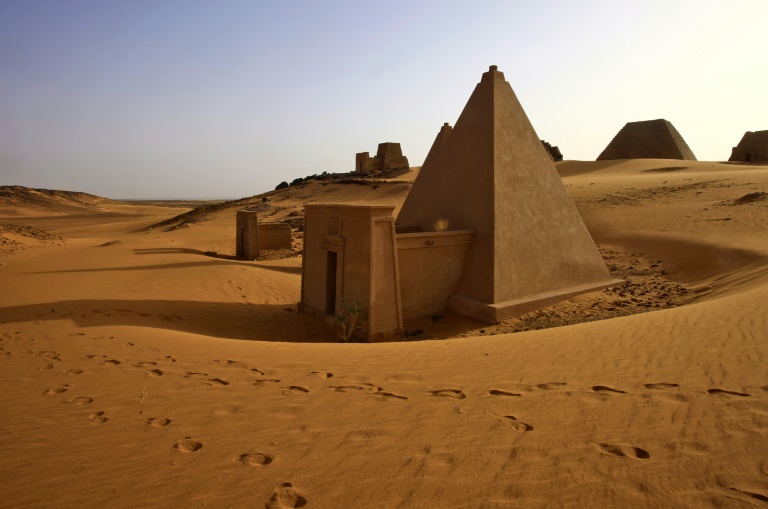
This picture taken on April 24, 2018, shows Meroitic            pyramids at the archaeological site of Bajarawiya, near Hillat            ed Darqab, some 250 kilometers northeast of Khartoum

This picture taken on April 24, 2018, shows Meroitic pyramids at the archaeological site of Bajarawiya, near Hillat ed Darqab, some 250 kilometers northeast of Khartoum

Archaeologists in Sudan have reopened an ancient pyramid and extracted bones and artefacts, in order to carry out further examination including DNA tests.

The items were found in one of three burial chambers in Meriotic pyramid number 9 in Bajarawiya, a UNESCO World Heritage site where a king from the Nubian period is believed to be buried.

"Pyramid number 9 belongs to King Khalmani who reigned between 207 BC and 186 BC," Mahmoud Suleiman, the head of a team of archaeologists, told journalists in Bajarawiya, about 250 kilometres (155 miles) north of Khartoum, late Tuesday.

The bones so far discovered are believed to have belonged to more than one person and have been shown to journalists, including an AFP reporter, by a team of archaeologists in Bajarawiya.

DNA tests should shed light on the relation between the bones, while further items are expected to be recovered from another of the pyramid's chambers, the team said.

"In the coming days we will open" another of the three burial chambers, said Murtada Bushara, a second archaeologist from the team.

This chamber "contains a coffin," Bushara added.

The dig is raising hopes that the remains of King Khalmani himself may be uncovered.

This is not the first time the pyramid has been the site of significant activity. American archaeologist George Reisner presided over a dig in 1923 and took artefacts back to Boston.

Sudan's remote pyramids are not as grand as their better-known cousins in Egypt.

The first archaeological digs in Sudan took place only about 100 years ago, much later than in Egypt or Greece.

--   Sent from my Linux system.

Egypt's camel bone sculptors gather to sustain ancient art


https://www.al-monitor.com/pulse/originals/2018/04/camelbone-carvers-try-to-maintain-their-niche-1.html
Egypt Pulse

Egypt's camel bone sculptors gather to sustain ancient art


Article Summary
The historic Egyptian art of camel bone sculpture is threatened in modern Egypt, where the carvers are fast disappearing.

CAIRO — Sculpting with camel bones is a handicraft that has been practiced in Upper Egypt for thousands of years, since the Pharaonic era, but the trade is fast disappearing.

Sahar Mubarak is one of the few remaining carvers in Qus, a city in Qena governorate. She told Al-Monitor that the most important reason for the disappearance of this ancient art was economic: The camel bones are getting more expensive after the international trade of ivory was banned, as camel bones have become a popular substitute. Like ivory, the bones are rigid and retain their whiteness for thousands of years.

Camel bones are used in sculptures, which Europeans and Russians tend to buy, and necklaces and rosaries, favored by tourists from Gulf and Arab countries.

"There are some initiatives that help protect this historical craft, such as the nonprofit Egyptian Initiative for Integrated Development, also known as El-Nidaa. This NGO [nongovernmental organization] has provided us with the necessary funds to purchase bones and have craftsmen from the Egyptian market Khan al-Khalili come and provide workshops for us. There are currently a limited number of master craftsmen in Cairo's Khan al-Khalili bazaar, along with the 27 women at the center in Qus," said Mubarak.

Ahmed Issa, a professor of Egyptology at Cairo University, told Al-Monitor that the first sculptures made of animal bones date to prehistoric Egypt, before unification at the hands of King Narmer in 3200 B.C.

He pointed out that primitive sculptures using animal bones remained common in Egypt until the era of King Djoser (2686-2600 BC), when granite was introduced in the carving of temples and mosques and the construction of pyramids and huge statues. He said that during the Pharaonic era, it was common for Egyptian women to sculpt animal bones to decorate their homes. Camel bones were also commonly used in the wake of the Persian occupation, which brought camels to Egypt in 530 BC.

Mohamed Al-Shorbaji, a professor of sculpture at Mansoura University, told Al-Monitor, "Sculpture in animal bones is important because it shows that Egyptians, regardless of their social or economic class, are fond of art. Even in ancient times, when Egyptians had only animal bones, they would sculpt them to decorate their homes." He added, "Sculpting animal bones, especially camels, is one of the most difficult types of sculpture, which makes it more valuable."

Asked about the rest of the problems facing the art form and the women who practice it, R.M., one of the women who practices the handicraft at the workshop at Qus, told Al-Monitor, "The craft is facing a major problem with distribution because of the decline in tourism in Egypt. Most people who used to buy it were foreigners. There must be an alternative such as exporting sculpted products or organizing international exhibitions for our products because most of those who have mastered the craft have decided to quit due to the low financial return."

She called on the government to organize a program to protect handicrafts, especially camel bone sculpture, saying there have been several initiatives to protect the craft and support workers, but government neglect led to failure.

Four years ago, the nongovernmental Society Development Association organized workshops to train 12 women and girls from the Karate Center in Qena Governorate to sculpt camel bones. However, there was no news of the continuation of the training program or of any exhibitions aimed at selling or distributing workshop products.

El-Nidaa's director Heba Handoussa told Al-Monitor that her association is keen to see sustainable dialogue with the government about protecting crafts and providing a source of income for poorer families, especially in Egypt's countryside and Upper Egypt. She pointed out that the Egyptian government has so far failed to pay the craft the necessary attention because of the economic crises that have afflicted Egypt since 2015.

A source at Luxor's provincial council told Al-Monitor on condition of anonymity, "The governor has already begun to show interest in handicrafts by encouraging civil society organizations to organize trainings for artisans, create training centers and organize exhibitions. The council is also seeking to facilitate the procedures for artisans to obtain the loans they need to finance their projects and establish workshops. It is also looking to establish permanent channels of communication with the concerned ministries to promote and distribute the products of these workshops."

Found in: Cultural heritage

N.A. Hussein has worked for a number of Egyptian newspapers, including Elwatan, and is now working as a freelance journalist. She is interested in women's rights, as well as legal and political issues.

--   Sent from my Linux system.

'Support Egypt' observes reaction to merging move - Egypt Today


https://www.egypttoday.com/Article/2/48600/Support-Egypt-observes-reaction-to-merging-move
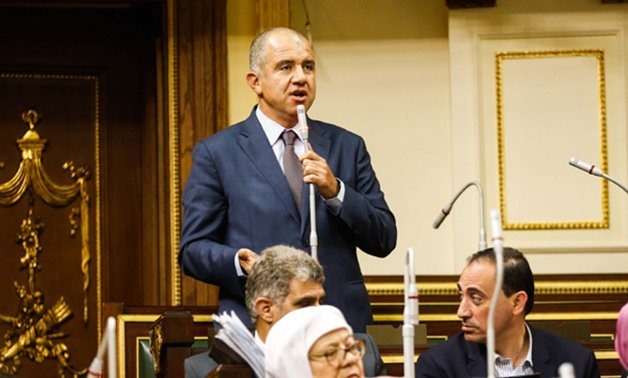
FILE: Member of Parliament and head of FILE: Member of Parliament and head of "Support Egypt" coalition, Mohamed Al-Sewedi

'Support Egypt' observes reaction to merging move

Wed, Apr. 25, 2018

CAIRO – 25 April 2018: The head of the Parliament's majority Support Egypt coalition, Mohamed Al-Sewedi, met on Tuesday at the coalition headquarters members of the Parliamentary bloc's offices in all of Egypt's governorates.

Members of the Egyptian parliament's majority bloc has been putting out feelers lately to see how the Egyptian citizens will react to the suggestion of merging all parties within the coalition into a unified party.

The meeting came to provide the members of the Support Egypt coalition with updates on the Egyptian political spectrum, also to review the coalition's future plan.

"Everyone has heard of the coalition's plans to transform into a unified party, a step needed to fill the Egyptian political vacuum despite the numerous existing political parties," said Al-Sewedi during the opening speech of the meeting.

"The coalition's general Assembly will make a final decision regarding the issue after studying the legality of the process," added MP Al-Sewedi.

The head of the Support Egypt coalition revealed that the bloc's legal experts are sorting out the current legislative controversy over the merging suggestion.

Article 110 of the Constitution stipulates that Members of Parliament may be stripped of their legislative seat if they lose the conditions for membership on the basis of which they were elected.

The article also explains that stripping the membership of a parliamentarian needs the approval of two thirds of the Parliament members; the Support Egypt coalition holds around 400 of 597 seats in Parliament.

Al-Sewedi refuted all claims that the expected party will act as a new National Democratic Party (NDP).

"We cannot repeat the past and expect a different result, the current economic reformation requires a serious political reformation as well," said MP Al-Sewedi during the meeting.

The coalition is facing another obstacle coming from three of its parties, the Homeland Defenders Party, Conference Party and Nation's Future Party.

Seemingly refusing the move, the three parties shared deep reservations about the merging of the coalition's parties and members into a unified party.

The head of the Conference Party, Omar El Mokhtar, said in press statements that the merging move will face several legislative hurdles.

El Mokhtar added that it will be hard for his party to forsake its name and independent structure. However, the party preserves its commitment to its alliance with the coalition inside the Parliament, El Mokhtar continued in a press statement.

In the same context, the head of the Nation's Future Party, Ashraf Rashad told Al Watan Newspaper that the merging move will probably cause a disagreement among the coalition's parties.

Rashad added that his party has not received an official statement from the Support Egypt coalition concerning the suggestion.

The deputy head of the Homeland Defenders Party, Mohammed El Ghobashy, said in press statements that his party is not willing to give up its existing entity and its activities in the political theatre.
--   Sent from my Linux system.

Take Two® | Audio: Getty Museum to Cleopatra: 'It's not all about you' | 89.3 KPCC


http://www.scpr.org/programs/take-two/2018/04/24/62611/getty-museum-to-cleopatra-it-s-not-all-about-you/

Getty Museum to Cleopatra: 'It's not all about you'


About Take Two®
Relief with Ptolemy VIII and Cleopatra II or III Making          Offerings, Ptolemaic, 170–116 BC; from Thebes, Egypt; sandstone.          Staatliche Museen zu Berlin, Ägyptisches Museum, und          Papyrussammlung.
Relief with Ptolemy VIII and Cleopatra II or III Making Offerings, Ptolemaic, 170–116 BC; from Thebes, Egypt; sandstone. Staatliche Museen zu Berlin, Ägyptisches Museum, und Papyrussammlung.
bpk Bildagentur / Staatliche Museen zu Berlin, Ägyptisches Museum und Papyrussamlung / Art Resource, NY

"The overarching goal of this exhibition is for visitors to understand Egypt, Greece, and Rome not as monolithic, separate entities but as cultures that shared and exchanged aspects of their religion, artistic traditions, languages, and customs in an evolving milieu."

--  Jeffrey Spier, Getty Museum senior curator of antiquities and co-curator of "Beyond the Nile: Egypt and the Classical World"

We all know one detail about Ancient Rome's dealing with Egypt: Her name was Cleopatra. KPCC Cultural Correspondent Marc Haefele says a new exhibit at the Getty digs a lot deeper than the Hollywood treatment of this ancient land.

Cleopatra (properly Cleopatra VII Philopator of Egypt) was the last member of the last Egyptian Dynasty, not to mention assassin of her siblings, admiral, general, author, and lover of two of history's most famous men, Anthony and Caesar. We know her because of Hollywood: first with Claudette Colbert in "Cleopatra'' of 1934:

Then the most famous of all, with Elizabeth Taylor; in 1963, which was then the most expensive movie ever made...

And there was even an obscure 1989 Rolling Stones song, "Blinded by Love:"

The queen of the Nile
She laid on her throne
And she was drifting downstream
On a barge that was burnished with gold
Royal purple the sails
So sweetly perfumed
And poor Mark Antony's
Senses were drowned
And his future was doomed
He was blinded by love

But Cleopatra -- handsome, murderous and brilliant as she was -- is only a portion of the Getty's mighty new 2,300 year show: "Beyond the Nile."

Hippopotamus, Roman, AD 1–100; found in Rome, red marble.            Ny Carlsberg Glyptotek, Copenhagen.
Hippopotamus, Roman, AD 1–100; found in Rome, red marble. Ny Carlsberg Glyptotek, Copenhagen.
Ole Haupt

How about this roly-poly dawn-red hippopotamus, small enough to fit in your back yard, big enough for the kids to ride, charmingly cute and beautiful, who extends his right foot in welcome. Carved in stone 2,000 years ago by a craftsman unknown, he signals the juncture of the mightiest civilizations of the ancient Western world.

Detail of
Detail of "The Green Caesar," by unknown Roman artist in green slate, made 100 BC and 100 AD
bpk Bildagentur / Antikensammlung, Staatliche Museen zu Berlin - Preußischer Kulturbesitz / Art Resource, NY

A thousand years before Homer, as commerce spread around the Mediterranean, civilizations like Crete and Mycenae's artistic and cultural influences intermingled with that of the great Nile kingdom. Getty director Tim Potts says this exhibit shows how much the Mediteranean lands owe one another.

"The important part about these cultures is they didn't develop in a bubble. There is, in fact, even in the ancient world just as there is today, this huge interchange between cultures, in languages, in the arts, in forms of government, in bureaucracy. All these things were interconnected."

-- Tim Potts, director of The J. Paul Getty Museum

 
Bust of Antinous, Roman, AD 131–138; found in Hadrian's            Villa, Tivoli, Italy; marble. Musée du Louvre, Paris,            Département des Antiquités grecques, étrusques et romaines.
Bust of Antinous, Roman, AD 131–138; found in Hadrian's Villa, Tivoli, Italy; marble. Musée du Louvre, Paris, Département des Antiquités grecques, étrusques et romaines.
© Musée du Louvre, Dist. RMN-Grand Palais / Daniel Lebée, Carine Déambrosis / Art Resource, NY

As the Bronze Era collapsed somewhere around 1200 BC, Egypt was civilization's sanctuary. When the Greeks returned around 700 BC, they found much to admire, and in the Getty show you can see the deep Egyptian roots of classical Greek art and architecture.

After Alexander the Great, Egypt was ruled by the Greek Ptolemy dynasty for 300 years; and the arts, culture, religion and even the sciences flourished.

After Cleopatra, Rome ruled Egypt, and Egyptian imagery and culture flooded the Roman world -- much as the West became obsessed with Egypt after the opening of King Tut's tomb in the 1920s.

The show's astounding paintings, statues (including that hippo) and mosaics come from Pompeii, Herculaneum, Palestrina, and other Italian sites. They portray crocodiles, hippos, parties of pygmies along the Nile, as well as the gods and heroes of Egypt. Even Roman furniture evoked Egyptian themes.

Fresco with the Arrival of Io in Egypt, Roman, AD 62–79;            found in the Temple of Isis, Pompeii; plaster and pigment.            Museo Archeologico Nazionale, Naples.
Fresco with the Arrival of Io in Egypt, Roman, AD 62–79; found in the Temple of Isis, Pompeii; plaster and pigment. Museo Archeologico Nazionale, Naples.
Pedicinimages. Napoli, Museo Archeologico Nazionale

But the most astounding Roman borrowing was Egyptian religion. First there was the goddess Isis, of whom there is a particularly sexy statue on display from around 100 BC. Isis joined the Ptolomaic Serapis cult, which Roman Soldiers carried to the far corners of the empire. This religion, with its own trinity - complete with nursing mother - competed with Christianity until outlawed by the newly Christian Empire in 380 AD. The devotional statues at the Getty suggest an alternate history of modern religion.

By odd coincidence, there are three noteworthy displays of ancient Egyptian art in LA right now: the King Tut road show at the California Science Center, a selection of LACMA's Egypt treasures at the Vincent Price museum in East LA, and this broad-spectrum spectacle at the Getty Center.

See them all, if you can.

"Beyond the Nile" is at the Getty Center through September 9.

"King Tut: Treasures of the Golden Pharaoh" is at the California Science Center for a limited time.

"Passing Through the Underworld," with items from LACMA's collection, is at the Vincent Price Art Museum through December 8.

(Correction: The on-air introduction for this feature incorrectly stated that the Getty exhibit puts a "spotlight" on Cleopatra.)

A portrait in gold of a Ptolemy on a ring. The disc is            3/4
A portrait in gold of a Ptolemy on a ring. The disc is 3/4" high, and was made by an unknown Egyptian artist c.186–145 BC
--   Sent from my Linux system.

Moving 55 historic mosques’ pulpits raises questions - Egypt Today


http://www.egypttoday.com/Article/4/48620/Moving-55-historic-mosques'-pulpits-raises-questions
FILE- Abu Bakr Mazhar Mosques' pulpit FILE- Abu Bakr Mazhar Mosques' pulpit

Moving 55 historic mosques' pulpits raises questions

Wed, Apr. 25, 2018

CAIRO – 25 April 2018: After the Antiquities Ministry announced moving more than 55 mosque pulpits from their current places inside Egypt's ancient mosques to the National Museum of Egyptian Civilization, a lot of controversy was stirred,especially since the announcement came following several complains about robberies at some mosques.

Earlier this month, parts of the copper pulpit belonging to Abu Bakr Mazhar Mosque were reported to be stolen. The incident was announced to be investigated by the government; however, days later, the Antiquities Ministry announced moving 55 pulpits, which raised a lot of questions about the safety of ancient mosques.

Protecting Egypt's ancient Islamic mosques is considered to be the Ministry of Awqaf's (Religious Endowments) responsibility, which raises part of the controversy regarding the Ministry of Antiquities announcement.

Later, during a questioning by Egypt's Parliament regarding the reason behind moving the pulpits from their current places, Antiquities Minister Khaled El-Anani said that not all of the pulpits will be moved, and that each and every one will be studied as a separate case before deciding whether or not to move to the museum.

Some of Egypt's fine artists slammed the decision, saying that protecting the pulpits can't be through storing them in the museum. "We are destroying and erasing our identity and the historic places,"artist Hamdy Sadek Abou Elmaati wrote on his Facebook page.

Earlier in April, British Ambassador to Egypt John Casson announced launching the "Saving the Mamluk Sultanate-era pulpit" project. This was considered to be the first restoration project of historic Cairo mosques with British funding.

The pulpits that are supposed to be restored, according to Casson, belong to the Bayt Al-Razzaz and Ibn Tulun mosques.

In the same context, Abdul Ghani Hendi, a member of the Supreme Council for Islamic Affairs, stressed that belongings of ancient mosques will be moved in accordance with their size and shape as large ones will be left in mosques and the other small belongings will be moved.

In this regard, he remarked that chandeliers of historic mosques and Islamic lamps will be transferred as they could be stolen or broken easily like those of Al-Refai Mosque, which will be presented in the Museum of Islamic Art.

Regarding the large holdings, Hendi stressed that they would be left in the historic mosques to keep their ancient features without being used, referring that the three pulpits found in the Mosque of Amr Ibn Al-As will not be moved, but another alternative pulpit will be used during Friday speeches to protect the historic ones.

--   Sent from my Linux system.

The Equine Herald of a New Age | The UCSB Current


http://www.news.ucsb.edu/2018/018903/equine-herald-new-age

The Equine Herald of a New Age

A paper co-authored by a UCSB archaeologist details the discovery of a horse buried in Sudan nearly 3,000 years ago
Wednesday, April 25, 2018 - 04:15
Santa Barbara, CA


Stuart Tyson Smith

Stuart Tyson Smith

As they had for more than a decade, Stuart Tyson Smith and his colleagues were excavating a tomb in what was Upper Nubia in their years-long UC Santa Barbara-Purdue University mission to understand the history of an ancient village on the fringes of Egyptian dominance.

But rather than finding mummified human remains, they unearthed the skeleton of a horse so well-preserved it had hair on its legs. It had been covered with a burial shroud, and among the items found with it was a piece of iron that appeared to be a cheek piece from a bridle.

Smith, a professor of archaeology in UCSB's Department of Anthropology, called the find "a complete surprise. I was not expecting to find that. We had this nice pyramid tomb and we were going down the shaft expecting to find a few human burials, and there we were about half-way down the shaft and here's this horse."

The horse turned out to be much more than an unexpected oddity. In their paper "Symbolic Equids and Kushite State Formation: A Horse Burial at Tombos," in the journal Antiquity, Smith and his collaborators — lead author Sarah Schrader, horse specialist Sandra Olsen and co-director of the expedition Michele Buzon — argue that the horse represents a shift away from Egyptian governance and towards a Kushite rule in which the animal was embraced as central to the state's identity.

"One of the interesting things about our horse is that it foreshadows the later development where these Nubian kings are really into horses," Smith said. Indeed, when the Kushite king Piankhi put down a rebellion in northern Egypt he was said to be enraged that his horses there had been starved in his absence. "His complaint was not that they had rebelled against him, but they had mistreated his horses," he said.

Using radiocarbon testing, the Tombos horse was dated to about 950 BC, in the Third Intermediate Period, when the Kushites of Nubia took advantage of strife in Egypt to coalesce into a political, economic and military power.

The horse was buried about 100 years after the colony began to break away in 1070 BC. The burial, Smith said, was a new development in the village at the Third Cataract of the Nile. Buried in an older tomb that had been adapted for the task, the horse was laid to rest in sacred ground.

"It's gorgeous, and the bones are a nice, rich brown color that you don't see in other contemporary horse burials," Smith noted. "All the pieces are there, everything's intact. It even had some fur left on it. As a result, because of the preservation, it's one of the most complete skeletons, and best preserved, of any of these early horses that have been found in northeast Africa."

The Tombos horse, which was determined to be female, was carefully lain on its side. Close inspection of the skeleton also revealed it suffered from arthritis and degeneration associated with wearing a chariot saddle harness. Curiously, Egyptian art always depicted chariot horses as stallions.

"It makes a certain amount of sense that they would emphasize stallions in the art," Smith said, "because they're fierce in warfare and that sort of thing. But it is interesting that in reality they were using mares as well. It's just that the artwork emphasizes the stallion as the pre-eminent chariot horse."

Among the more intriguing items found with the horse was the piece of iron that Smith said radiocarbon testing dates to around 950 BC. "This is a very early date for iron," he noted. "For a long time people had thought that iron production in Nubia really didn't ramp up until about 500 BC."

Smith, who owns a horse, said he quickly recognized the artifact as a cheek piece for a bridle, and co-author Olson has since confirmed the assessment. "It's rare to find iron like that in a good context," he said, "where you can really pin the date down.

"It also counters the narrative that Nubians were backwards somehow, that anything good they got they got from Egypt," he continued. "But they seem to have been going out and seizing what they needed. They had the latest military technology in the form of iron weaponry like we found, but also these iron trappings from the horse."

Smith and Buzon have been excavating Tombos, just east of the Nile River in Sudan, since 2000. It was founded by the Egyptians as an administrative center in Nubia around 1450 BC. Their work there has unraveled what they term "cultural entanglement," the process by which colonizing powers and indigenous people influence one another and change over time.

"You can see this long, entangled history of the horse weaving its way through all these different cultures until it comes to Nubia," Smith said. "But then, horses were important in Egypt, but we have very few horse burials there. If it was a widespread practice you'd expect to see more of them."

The Nubians, who would conquer Egypt and establish the Kushite Dynasty in 728 BC, proved to be adept at adapting Egyptian practices and technology and making them their own.

"For Nubians, they really elaborated on Egyptian materials and practices in a way that you don't see in Egypt," Smith said. "That's the case with a lot of these features that Nubians were borrowing. They often take something they really like, like horses, and they make it much more elaborate, through ritualized burial, than the examples that you have in Egypt."

Lead author Schrader, an assistant professor of archaeology at Leiden University in The Netherlands, focuses her research on bioarchaeological reconstruction; Olsen, of the University of Kansas, specializes in the history of horse domestication; and Tombos project co-director Buzon, a professor of anthropology at Purdue University, focuses her research on bioarchaeology. Principle funding came from National Science Foundation grants BCS-0917815 and 0917824.

--   Sent from my Linux system.

Tuesday, April 24, 2018

Antiquities min. reviews progress of Avenue of Sphinxes - Egypt Today


http://www.egypttoday.com/Article/9/47995/Antiquities-min-reviews-progress-of-Avenue-of-Sphinxes
FILE: Avenue of Sphinxes, January, 2011 –          Wikimedia/Ianpudsey FILE: Avenue of Sphinxes, January, 2011 – Wikimedia/Ianpudsey

Antiquities min. reviews progress of Avenue of Sphinxes

Mon, Apr. 16, 2018
CAIRO – 16 April 2018: Minister of Antiquities Khaled El-Enany visited the Avenue of Sphinxes in Luxor on Monday to follow up on the latest updates of the project being implemented to excavate and restore the avenue.

The Avenue of Sphinxes is the road that connects Luxor Temple to Karnak Temple. It is about 2,700 meters long and 76 meters wide. Chairman of the Armed Forces' Engineering Authority Kamel al-Wazir and Luxor Governor Mohamed Badr accompanied Enani during his tour.

In an interview with Egypt Today earlier in April, Enany said that a new place has been determined for an evangelical church on the side of the road that is set to be removed.


From left, Chairman of the Armed Forces' Engineering Authority Kamel al-Wazir, Luxor Governor Mohamed Badr, Minister of Antiquities Khaled El-Enany head a group of officials in a tour in Luxor to follow up the updates of the Avenue of Sphinxes project


It is noted that only the back part of the Virgin Mary Church located on the side of the road will be removed. In addition, some houses around the avenue have been demolished in order to excavate it.

Badr said earlier that people would be compensated for the demolished properties and that new houses would be constructed for them in other places.

In an interview with Egypt Today last May, the head of the projects' sector at the Ministry of Antiquities, Waheed Abou el-Ela, said the road will be paved to allow easy access for visitors, in addition to moving utilities like electricity and water.

The project also includes the development of the floors, the completion of the excavation and repairs to the collection of ram-headed sphinxes on the sides of the avenue.


From left, Luxor Governor Mohamed Badr, Minister of Antiquities Khaled El-Enany and Chairman of the Armed Forces' Engineering Authority Kamel al-Wazir, head a group of officials in a tour in Luxor to follow up the updates of the Avenue of Sphinxes project


The project to excavate and restore the Avenue of Sphinxes began in 2005, and about LE 600 million ($34 million) have been spent on the project. The project was halted after the January 25 Revolution in 2011 and was resumed in 2017 after President Abdel Fatah al-Sisi gave his instructions to complete the project as soon as possible.


Luxor Governor Mohamed Badr, Minister of Antiquities Khaled El-Enany and Chairman of the Armed Forces' Engineering Authority Kamel al-Wazir, head a group of officials in a tour in Luxor to follow up the updates of the Avenue of Sphinxes project


Luxor Governor Mohamed Badr, Minister of Antiquities Khaled El-Enany and Chairman of the Armed Forces' Engineering Authority Kamel al-Wazir, head a group of officials in a tour in Luxor to follow up the updates of the Avenue of Sphinxes project


Luxor Governor Mohamed Badr, Minister of Antiquities Khaled El-Enany and Chairman of the Armed Forces' Engineering Authority Kamel al-Wazir, head a group of officials in a tour in Luxor to follow up the updates of the Avenue of Sphinxes project


Luxor Governor Mohamed Badr, Minister of Antiquities Khaled El-Enany and Chairman of the Armed Forces' Engineering Authority Kamel al-Wazir, head a group of officials in a tour in Luxor to follow up the updates of the Avenue of Sphinxes project

--   Sent from my Linux system.

Dominican archaeology in Egypt - Al Ahram Weekly


http://weekly.ahram.org.eg/News/24309.aspx

Dominican archaeology in Egypt

An exhibition highlighting 10 years of Dominican archaeology in Egypt has been inaugurated at the Egyptian Museum in Cairo's Tahrir Square, reports Nevine El-Aref

Dominican archaeology in Egypt

An exhibition entitled "10 Years of Dominican Archaeology in Egypt: Excavations at Taposiris Magna" has been inaugurated in the foyer of the Egyptian Museum in Tahrir Square. The exhibition celebrates a decade of excavation by the Dominican Republic at the site of Taposiris Magna north of Alexandria and in search of the tombs of the Ptolemaic queen Cleopatra and her Roman lover Mark Antony.

The exhibition was inaugurated by Minister of Antiquities Khaled El-Enany and the Dominican ambassador to Egypt. It displays a unique array of objects discovered at the site, all of which are on display for the first time. 

Kathleen Martinez, head of the Dominican mission, said the exhibition put on show more than 300 pieces arranged by the locations in which they were found, reinforcing the site's importance during the reign of Cleopatra and also before and after her rule.

"The strong evidence that Taposiris Magna was a crucial site to Cleopatra is represented through the many depictions of the queen, among them the statues of Isis, coins and inscribed stelae amongst other objects," Martinez said. She said the masterpieces that had been found were testimony of the administrative, religious, royal and social activities that had thrived at the end of the Ptolemaic Period in Egypt. 

Following the death of Alexander the Great, who conquered Egypt in 332 BCE and established the city of Alexandria, the Macedonian dynasty of the Ptolemaic Period began as his conquests were divided among his former generals. Ptolemy I, one of the generals, was the first of many Ptolemaic kings to rule Egypt until 30 BCE, when Cleopatra VII was defeated and the Romans took the territory as a province. 

In the approximately 300 years of Ptolemaic rule, Egypt thrived and became a terrain where Greek and Egyptian art, religion and language mingled. Temples took the chief god Serapis, a god combining aspects of Apis, Ptah and Osiris under Hellenistic guise, into their pantheons. The ancient Egyptian goddess Isis was often likened to the Greek goddess Aphrodite, and Horus became Harpocrates. 


Dominican archaeology in Egypt

Many other artistic changes were evident in trade objects, such as vessels and coins, as well as in religious rites and daily life. Alexandria, at the centre of this amalgam of cultures and influences, became a hub of knowledge and a thriving, cosmopolitan city.

Martinez believes that Cleopatra and Antony were buried inside the temple dedicated to Isis and Osiris at Taposiris Magna about 45km west of Alexandria. The religious and political significance of the temple, along with its location, would have made this temple a logical burial place for Cleopatra since she associated herself with Isis and Mark Antony with Osiris, she said.

The Temple of Taposiris Magna was described by the ancient Greek historian Plutarch as resplendent with Osirian mystery. The Roman writer Strabo also recorded that Alexander the Great stopped at the temple on his journey to the oasis at Siwa. As such, it would have been an important place for Cleopatra in life and perhaps in death. 


Dominican archaeology in Egypt

The mission resulted in various finds. One of the most important discoveries found inside the temple of Taposiris Magna is a unique stela inscribed in hieroglyphics and demotic script. This stela is dated to the reign of Ptolemy V, a famous ruler who issued the decree found on the Rosetta Stone that originally aided in the deciphering of hieroglyphics. 

The stela mentions gifts given by Ptolemy V to the priests of Isis. There are two other incomplete stelae similar to the one found erected inside the temples of Isis in Philae and Dendera in Upper Egypt. "Out of all three stelae, the one found at Taposiris Magna has the most complete text of the edict," Martinez said.

She added that another significant find was a bronze piece given by a Ptolemaic king to soldiers for bravery and dedication in battle. A great number of bronze coins with depictions of the figure of Isis on the front and on the back, as well as the name of Cleopatra, were also found. A large cemetery outside the temple complex dating to the Ptolemaic Period was found. Inside the tombs were mummies covered with gold, their heads directed towards the temple as if someone important was buried there. 

"The beauty of the objects in this exhibition serves as a continual reminder that there is still much more to unravel concerning the mystery of the burials of the Ptolemaic rulers, the ancestors of Cleopatra VII, and the mystery of Cleopatra's rule," Martinez commented.

--   Sent from my Linux system.

Archeologists open burial chambers in Sudanese pyramid - The Washington Post


https://www.washingtonpost.com/world/africa/archeologists-open-burial-chambers-in-sudanese-pyramid/2018/04/24/b3e7625e-47cc-11e8-8082-105a446d19b8_story.html?utm_term=.7d5424a5416d

Archeologists open burial chambers in Sudanese pyramid

CAIRO — Sudan's official news agency says archeologists have reopened burial chambers in an ancient pyramid north of the capital, Khartoum.

SUNA says Tuesday the chambers are located at a depth of 10 meters (about 33 feet) under a pyramid in the Meroe area. The UNESCO world heritage site is home to pyramids ranging from six meters (20 feet) to 30 meters (100 feet) tall.

It says archeologists from a Qatari mission discovered artifacts, including human and animal bones, inside the chambers.

The pyramids, with narrow bases and steep angles on the sides, were built by the ancient Nubian civilization between 720 and 300 B.C.

Qatar has pledged $135 million to renovate and support Sudan's antiquities.

Copyright 2018 The Associated Press. All rights reserved. This material may not be published, broadcast, rewritten or redistributed.

--   Sent from my Linux system.

Tourists to Egypt increased by 30% during first quarter of 2018: minister - Egypt Independent


http://www.egyptindependent.com/tourists-to-egypt-increased-by-30-during-first-quarter-of-2018-minister/

Tourists to Egypt increased by 30% during first quarter of 2018: minister


Minister of Tourism Rania Al-Mashat announced that the number of tourists visiting Egypt has jumped by 30 percent during the first quarter of 2018 compared to last year. The announcement came during a press conference on the sidelines of the Arabian Travel Market exhibition taking place in Dubai. Mashat added that tourism now represents 15 percent of the total sources of income for the national economy.

Mashat attributed the success to the latest campaign efforts for Egyptian tourism, adding that new methods will be followed to attract more tourists in the coming period. These new methods will include a new campaign to encourage flying to Egypt, in cooperation with the Minister of Civil Aviation Sherrif Fathy, as well as an elaborate social media campaign, that makes the best use of the internet to promote tourism.

The campaign will aim at showcasing Egypt and bringing "virtual happiness" to people, thereby encouraging them to visit. Another campaign will be launched in parallel targeting Arab tourists in the Gulf area in Ramadan to encourage them to visit Egypt during the feast, as well as during the rest of the summer.  She also added that Egypt now has eight international offices to promote tourism in different regions.

Mashat admitted that right now, Egypt is not making the best use of social media to promote tourism saying, "we have shortcomings in dealing with social media platforms, and our priority is to begin dealing with the issue".

She added that Egypt will begin targeting new regions for tourism such as Gabal Al-Galala in Al-Ein Al-Sohkna, as well as Al-Alameen in the North Coast.

Finally, Mashat expressed her happiness towards the resumption of Russian flights to Egypt after almost a two-year ban.

Egyptian aviation officials will hold a meeting with their Russian counterparts in May to discuss the return of Russian flights to Sharm El Sheikh and Hurghada after a two-and-a-half-year flight suspension. Russian flights were banned in Egypt following the downing of a Russian plane over the Sinai in 2015, killing everyone onboard.

In January 2018, Russian President Vladimir Putin signed a presidential decree to resume flights between Cairo and Moscow. Both countries have signed a joint civil aviation cooperation protocol.

Russian tourists formerly had the lion's share of tourism in Red Sea pearls Sharm El-Sheikh and Hurghada until the decision to suspend flights.

According to Russian state media outlet Russia Today, at least 3.16 million tourists are expected to visit Egypt following Russia's decision to lift a ban on direct flights to Cairo.

Minister of Tourism Rania Al-Mashat took office in January 2018. She is a leading expert in monetary policy and international economics, who has worked with leading international financial institutions.

Photo credit: Reuters

--   Sent from my Linux system.

Strange Brigade Battles Ancient Egyptian Evil in August | Shacknews


http://www.shacknews.com/article/104545/strange-brigade-battles-ancient-egyptian-evil-in-august

Strange Brigade Battles Ancient Egyptian Evil in August

The folks at Rebellion first introduced their latest game, Strange Brigade, back at E3 2017. It's a little different from the studio's Sniper Elite series, going a little farther back in time and embracing the supernatural. Now the co-op adventure has a release date.

A group of ragtag heroes is all that stands in the way of the resurrected Witch Queen and her quest for dominance. Players must venture to 1930s Egypt to face monsters, mummies, and all manner of dark creatures in trap-filled pyramids and temples.

But while Strange Brigade takes place in the 1930s, it wouldn't be a 2018 game without a Collector's Edition and pre-order incentives. pre-orders include the Secret Service Weapons Pack, which includes the Wilkers & White P19 pistol, the Stoudenmire 960 SMG, and the Gehrig-Delgane S1 rifle. This will also come with pre-orders of the Deluxe Edition, which will include the game's Season Pass.

The Collector's Edition comes in a special case, includes the aforementioned Secret Service Weapons Pack, an airship model, artbook, and exclusive suitcase design and sleeve.

Strange Brigade is set to release on PC, Xbox One, and PlayStation 4 on August 28.

--   Sent from my Linux system.

Egypt to fine people who pester tourists | World news | The Guardian


https://www.theguardian.com/world/2018/apr/24/egyptian-parliament-approves-fine-to-stop-tourists-being-pestered

Egypt to fine people who pester tourists

Law clamping down on people pushing services and trinkets aims to protect valuable but fragile tourism industry

For some tourists at Egypt's renowned archeological sites, being hectored to buy pieces of parchment, a camel ride or an alabaster statue is all part of the experience.

But the harassment might become a thing of the past, after parliament approved a law allowing authorities to fine up to EGP10,000 (about £405) anyone found to be pestering tourists "with the intention of begging or promoting, offering or selling a good or service".

The law is intended to clamp down on people offering services and selling trinkets to tourists ahead of the summer season. The government hopes to protect Egypt's fragile but valuable tourism industry, which makes up 12% of the economy.

An Egyptian tour guide based in Luxor, who declined to give his name, said the law would target people "fighting for food, fighting to feed their families".

"I've never really heard of the law achieving anything here," he added.

Some MPs and former officials felt that punishment should be far stricter, proposing fines of up to EGP20,000.

"A EGP10,000 fine is not enough," said former minister of antiquities Zahi Hawass, speaking on one of Egypt's nightly talkshows. "There should be both a fine and a prison sentence, because these people harm the income of the country."

Tourist numbers have fallen in recent years from a high of 14.7 million in 2010 due to the political turbulence of the 2011 revolution and 2013 military coup. All flights from Russia, and flights from the UK to the Sinai resort town of Sharm el-Sheikh, were suspended after terrorists downed a plane carrying Russian holidaymakers in October 2015.

However, Egyptian tourism showed clear signs of recovery in 2017, with arrivals jumping to 8.3 million compared with 5.4 million the previous year, according to the Oxford Business Group. Direct flights between Russia and Cairo resumed earlier this month.

--   Sent from my Linux system.