Search This Blog

Friday, May 7, 2021

Upcoming Egypt and Nubia Lectures, Northern California ARCE


American Research Center in Egypt (ARCE)
Northern California Chapter

Upcoming Lectures


ARCE’s Northern California Chapter is pleased to present the following lectures by renowned Egyptologists. Until further notice, all lectures are virtual, Sunday at 3 p.m. Pacific Time. Registration instructions will appear in upcoming posts. In normal times, most lectures take place on the University of California Berkeley campus.


King Akhenaten's Main Temple to the Sun God at Amarna: How Archaeology Is Revealing Its Development and Use
Aug. 15, 2021
Dr. Barry Kemp, Amarna Trust

Hand Unto Ethiopia: The First African-Americans to Visit Nubia
Sept. 12, 2021
Dr. Jeremy Pope, University of William and Mary

Virtual Saqqara
Oct. 10, 2021
Dr. Elaine Sullivan, UC Santa Cruz

Development of the Royal Titulary in Reflection of Important Prehistoric Sites
Nov. 14, 2021
Dr. Ronald Leprohon, University of Toronto

Topic TBD
Dec. 12, 2021
Dr. Stuart Tyson Smith, UC Santa Barbara

For more information, please visit https://facebook.com/NorthernCaliforniaARCE, http://arce-nc.org, https://twitter.com/ARCENCPostings, or https://khentiamentiu.org. To join the chapter or renew your membership, please go to https://www.arce.org/become-arce-member and select "Berkeley, CA" as your chapter when you sign up.


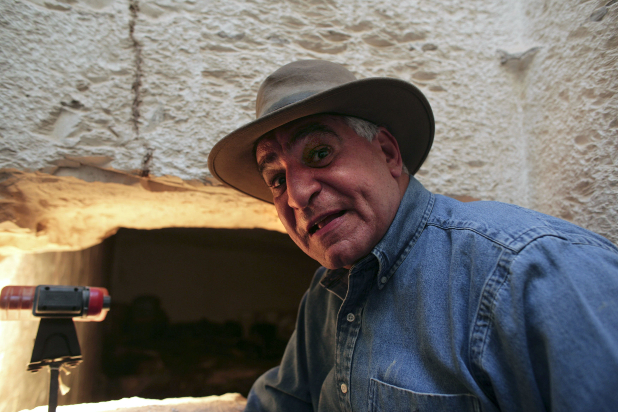
Zahi Hawass Digs Up a Lost Egyptian City in New Discovery+ Special

https://www.thewrap.com/zahi-hawass-finds-lost-egyptian-city-rise-of-aten-discovery-plus-special-video/

Zahi Hawass Dug Up a Lost, 3,000-Year-Old Egyptian City – and Discovery+ Got the TV Rights (Exclusive)

Must've been some shovel

Archeologist Zahi Hawass has done it again, and regular collaborator Discovery+ is (again) sharing the spoils. Hawass recently discovered an ancient Egyptian city in Luxor — The Rise of Aten — that was lost under the sands 3,000 years ago. The Discovery streaming service has obtained exclusive filming access and presentation rights to the dig, TheWrap has learned.

Discovery's cameras were already rolling during the excavation, which started last year, a person with knowledge of the mission and upcoming special told us. More filming will take place in the fall.

The lost city dates to the reign of Amenhotep III and continued to be used by Tutankhamun and Ay, according to the Discovery+ description. Artifacts, treasures and in-depth analysis of this new city will be featured in the upcoming special to be produced by At Land Productions' Executive Producer Caterina Turroni, and executive produced for discovery+ by Neil Laird.

"Every time we come to Egypt with Dr. Hawass, we come away with new insight into the incredible history of Egypt. This new city paints a picture of life in ancient Egypt that has never been seen and we are thrilled that Discovery+ will bring this ground-breaking discovery to our viewers around the world," Scott Lewers told TheWrap.

He's got a mouthful of a title: Lewers is "Executive Vice President of Multiplatform Programming, Factual & Head of Content, Science."

So he sounds important.

"Thanks to the support of discovery+ I can now concentrate all my efforts into this unique excavation, and one of the biggest discoveries of my career," Hawass added.

This isn't the first time Hawass and Discovery have excavated Egypt together. In April 2019, Discovery followed Hawass and his team as they uncovered a 2,500-year-old mummy of a high priest for the first time ever on live television. That special "Expedition Unknown: Egypt Live," also revealed two other mummies and various ancient antiquities, including a mysterious wax head.

Discovery also followed Hawass and his team on the biggest Egyptian excavation ever attempted to the rugged western Valley of the Kings, a great burial ground for the pharaohs, in a two-hour special streaming now on Discovery+.

--   Sent from my Linux system.

Thursday, May 6, 2021

ANE TODAY - 202105 - Glass: Lapis Lazuli from the Kiln - American Society of Overseas Research (ASOR)

https://www.asor.org/anetoday/2021/05/glass-lapis-lazuli/

Glass: Lapis Lazuli from the Kiln

By Andrew Shortland


Today glass is all around us, it is familiar to us all in windows, vessels, spectacles, a myriad of uses. However, when glass was first made in the Late Bronze Age (LBA) around 1500 BCE it was very different.

Firstly, it was almost always highly colored, indeed its color was one of the things it was prized for. Secondly, it was often opaque, with compounds specifically added to it to make so. Thirdly, glass was highly prized and valuable, not a utilitarian material at all, more like a precious stone such as lapis lazuli or turquoise which, with its strong color and opacity, it was deliberately made to closely resemble. Indeed, in Akkadian, glass was aban kûri, "stone from the kiln", emphasising these links. Glass also had magical powers, being capable of healing and warding off the evil eye, amongst other abilities. Thus, we need to adjust our mindset when thinking about glass, how it was used and what it meant to LBA people.

In contrast, in terms of composition, modern glass is very similar to this early glass. Both are made predominantly of silica derived from a clean quartz sand or quartzite pebbles. However, you cannot easily make glass from just quartz, because quartz melts at a very high temperature, in the region of 1700°C. While this is possible in some modern, advanced furnaces, it was impossible for the ancient glassmakers – an ancient furnace would itself melt and collapse long before it got even close to this temperature. Therefore, another compound, known as a flux, had to be added to the quartz to lower its melting temperature. Modern glasses also use fluxes, most commonly soda derived from artificially produced sodium carbonate. In LBA glasses, soda is also the flux, but it is derived from the ash of plants that are salt tolerant, living on the edges of deserts and coasts. Mixing some of this ash with the crushed sand or pebbles reduces the temperature necessary to melt it and create a glass to a more reasonable 1100°C – high, but possible.

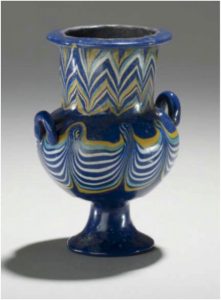
Extremely well-preserved, core-formed, glass vessel from Memphis, Egypt. 1393-1352 BCE, British Museum, EA4741. © The Trustees of the British Museum. (https://www.britishmuseum.org/collection/object/Y_EA4741)

To this melt, colorants derived from compounds containing elements such as cobalt and copper (for blues), antimony and lead (for white and yellow) and manganese (purple and black) are added. This brightly colored glass is worked into beads, amulets, inlays, other decorative elements and, perhaps most striking of all, vessels. Modern glass vessels are usually blown, but glass blowing was only discovered around the first century CE.

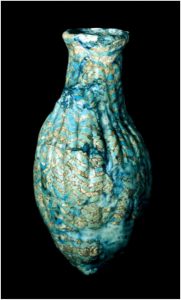
Kassite, core-formed, glass vessel showing weathering. Ur, 1200-1300 BCE, British Museum 120659. © The Trustees of the British Museum. (https://www.britishmuseum.org/collection/object/W_1928-1009-147)

Before this time, vessels were "core-formed". This is a rather laborious technique where a core of dung and clay is dipped into molten glass to completely cover it, and then decorated by trailing rods of contrasting colors across the body and adding handles, rims and feet, if desired (see the Corning Museum of Glass website for some excellent videos showing this technique being performed). On cooling, the core has to be carefully chipped out to create the vessel. These vessels are strikingly colored when well preserved, with an aesthetic that is still appealing now.

Where glass was first made is not clear – it appears in the archaeological record in quantity in both Egypt and the Near East simultaneously, as far as we can tell. Identified glassmaking sites of this period are very rare, indeed none have been conclusively identified in the Near East at all, although limited finds indicating glassworking are present. There are three that are reasonably well known in Egypt, the earliest of which is probably connected with the Palace of Amenhotep III (1338-1351 BCE) at Malkata, near Thebes, now Luxor.

One of the reasons for glass workshops being difficult to find and identify is that LBA glass is susceptible to weathering if left in contact with water or in otherwise damp conditions. Egypt is lucky in that much of the glass found there is recovered from very dry tombs dug into the edge of the Western Desert, almost perfect conditions for the preservation of the glass. Mesopotamia is not so fortunate, and the fertile, damp flood plains mean that the preservation of glass is, at best, patchy. Often the glass is weathered, which starts with an iridescent effect on the surface of the vessel, but often spreads through the entire object, turning it into a white and friable powder, which easily disintegrates on touch. This certainly means that we have lost a lot of the glass that was originally present in this area, and probably production sites as well.

Evidence for a local glass workshop at Nuzi, near modern Kirkuk. c.1350BC; (a) Head of a glass Ishtar figurine, still in its ceramic mould (1930.8.5); (b) Fragment of an ingot, about 55mm wide (1930.82.50). Both from Harvard Museum of the Ancient Near East.

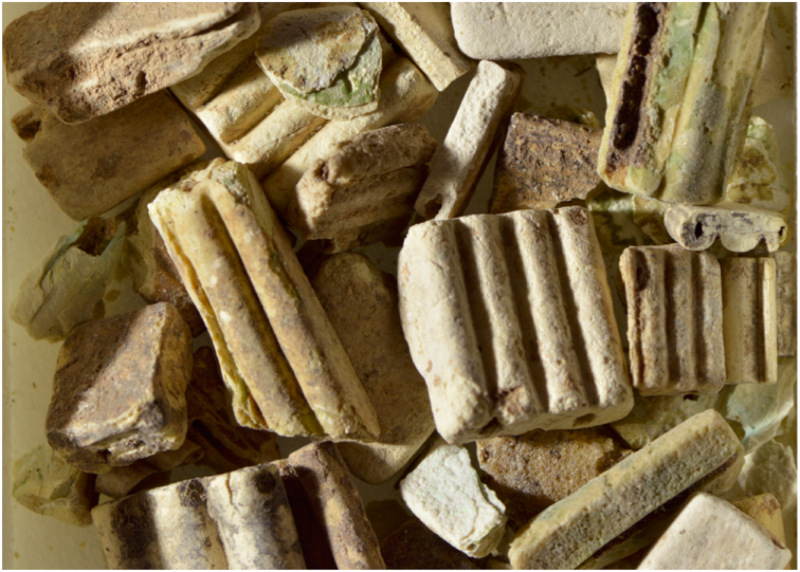
Weathering patterns on vitreous materials. Here spacer beads from the City of Nuzi are weathered by water to make them white and very delicate. They would almost certainly all have been a brilliant blue colour. From Harvard Museum of the Ancient Near East.

It is clear that the Near East did produce glass locally, and the evidence for this is derived from the analysis of the glass found in the Near East and in Egypt. Several techniques have been used in the past, but perhaps the best technique being used now is Laser Ablation Inductively Coupled Mass Spectrometry. LA-ICPMS uses a high-power laser to remove a very small sample from the glass object (typically only 0.1mm across, invisible to the naked eye). This sample is ionised in a plasma torch and then the ions of each of the elements it contains are counted by the mass spectrometer. The technique has the advantages of being able to analyse almost all the elements that are found in glass, plus it has very low detection limits – for many elements it can quantify down to one part in a billion – outstanding performance and very useful.

Glass from several sites in Egypt and the Near East has been analysed, including Amarna, Malkata, Nuzi and Tell Brak. What was revealed from the analysis was that, while the glasses found at all of these sites are very similar in their major and minor components, at trace levels, only really analysable by LA-ICPMS, there are some subtle but consistent differences. These differences are probably caused by using slightly different raw materials and/or a slightly different manufacturing techniques or tools. Analysis showed that almost all the glass from Egypt had one elemental "fingerprint", whereas all the glass from the Near East had another. It is therefore highly likely that there is production in both areas by one or more workshops. Using this technique, glass in the Levant, Greece and on the Ulu Burun shipwreck has been analysed, and shown to be either from Egypt, the Near East or both. LBA glass was therefore an important part of an exchange network, moving between the states, courts and kings.

There is textual and iconographic evidence that supports this exchange of glass. Glass is requested by the Egyptian king in the "Amarna letters", a diplomatic archive found in the eponymous city and dating mostly to the reign of Amenhotep III and his son, Akhenaten. There are tomb scenes where glass is being given to the Egyptian King and a striking relief in the Temple of Karnak where the Egyptian king offers baskets of glass to the Temple in thanks for his military victories in the Levant. This all emphasises the value of glass and its place in a complex world of competing states and kings. It is perhaps not really surprising therefore, that the study of ancient glass is one of the liveliest and most productive of all archaeomaterials subjects and more and more is learned yearly from modern analysis of both old collections and new excavations.

The Hall of the Annals in the Temple at Karnak, where a relief depicts Tjuthmosis III making gifts to the Temple. Amongst the gifts depicted are several baskets of semi-precious stone and glass (third register of offerings up, centre and right hand side, circular "ingots" in baskets). (https://i.pinimg.com/originals/ac/fb/0a/acfb0aa3871e046d67ec5aacdf031a5b.png)

Andrew Shortland is Professor of Archaeological Science and Director of Cranfield Forensic Institute at the Cranfield University.

For further reading:

Henderson, J., 2013. Ancient glass: an interdisciplinary exploration. Cambridge University Press.

Moorey, P.R.S., 1999. Ancient Mesopotamian materials and industries: the archaeological evidence. Eisenbrauns.

Shortland, A.J., 2012. Lapis lazuli from the kiln: glass and glassmaking in the late Bronze Age. Leuven University Press.

--   Sent from my Linux system.

Monday, May 3, 2021

Concepts Kyrie 7 “Horus” and “Feather of Maat” Collection | HYPEBEAST

https://hypebeast.com/2021/5/concepts-kyrie-7-horus-and-feather-of-maat-collection

Concepts Unveils Nike Kyrie 7 "Horus" and "Feather of Maat" Collection

https://image-cdn.hypb.st/https%3A%2F%2Fhypebeast.com%2Fimage%2F2021%2F05%2Fconcepts-kyrie-7-horus-and-feather-of-maat-collection-1.jpg?q=90&w=1400&cbr=1&fit=max

https://image-cdn.hypb.st/https%3A%2F%2Fhypebeast.com%2Fimage%2F2021%2F05%2Fconcepts-kyrie-7-horus-and-feather-of-maat-collection-2.jpg?q=90&w=1400&cbr=1&fit=max


https://hypebeast.com/image/2021/05/concepts-kyrie-7-horus-and-feather-of-maat-collection-21.jpg

Apparel, accessories and footwear inspired by Egyptian archaeology.

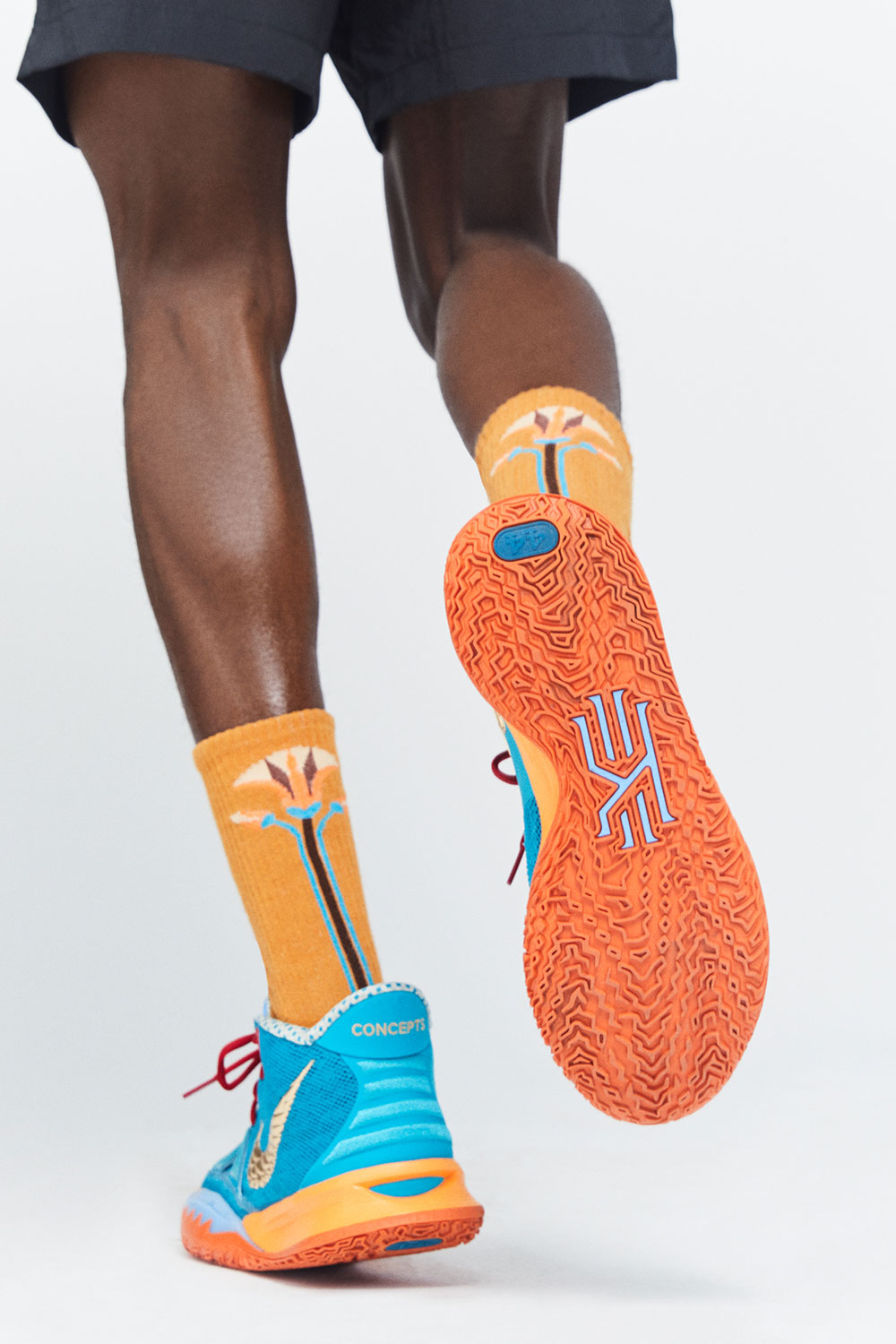
Concepts recently announced its latest collaboration with Kyrie Irving and his sister Asia on a new collection called "Feather of Maat" alongside a new partnership with Nike (NYSE:NKE +0.31%) on the Kyrie 7 silhouette entitled "Horus." The joint release was inspired by Irving's personal fascinations with Egyptian archeology, rituals and symbolism with graphic elements found across apparel, accessories and the collaborative footwear option.

"The mysteries of ancient Egypt are a source of endless fascination for Kyrie," said Concepts in a statement. For instance, the Kyrie 7 "Horus" gleans visual cues from glazed ceramics discovered in ancient Egypt. Moreover, blue hues throughout the multidimensional upper draw inspiration from tones of artifacts, and Egyptian symbols that are worked into the forefoot bands, heel, and Swoosh elements.

Coinciding with the sneaker is the "Feather of Maat" collection which continues to reference Egyptian archaeology such as rich turquoises and teals that recall Egyptian Faience. Contrasting those tones is an array of orange gradients that evoke "the desert sands fading into the sky before nightfall," the label added. "Symbols like the Ankh and Lotus flower — each reflecting the cycle of life — appear on crewnecks, hoodies, sweatpants, socks and T-shirts."

"This collection represents an evolution of the Concepts' brand. Our new apparel program allows us to take our storytelling full circle. The Ankh Crewneck is a piece we're really proud of — there are over 100,000 stitches in the embroidery — and is evidence of how we'll continue to explore fabrication as we grow," said Deon Point, Concepts' Creative Director, in a statement.

Check out the Nike Kyrie 7 "Horus" and "Feather of Maat" collection above and expect an official release for both on Concepts' website and stores starting May 7 at 11 a.m. EST.

Elsewhere in fashion, Supreme is officially opening a store in Milan on May 6.

--   Sent from my Linux system.

American Research Center in Egypt May 2021 Virtual Events


ARCE Don't Forget to Register!


alt_text

May 2021 virtual Events

*Members Only*

May 9, 2021

1PM EDT/ 7PM EET

Register Now

Sacred Baboons as engines of Egyptian trade and seafaring 

with Dr. Nathaniel Dominy 

This talk will focus on the bones and teeth of mummified baboons recovered from New Kingdom temples and Ptolemaic tombs. The isotope composition of these tissues is a valuable source of information about the life and lifeways of an animal. In some cases, our evidence points to captive breeding and a lifetime spent in Egypt. In other cases, we find evidence of importation from distant lands. So far, this evidence corroborates consensus on the location of Punt, putting it in the modern-day countries of Eritrea and northern Somalia.


*Public Access*

May 20, 2021 Hosted by ARCE 

Starts at 7 AM GMT

Register Now

Egypt and the Mediterranean World from the Late Fourth through the Third Millennium BCE Conference

ARCE is sponsoring this conference and is Hosting Day 2

*This is NOT an ARCE National Lecture

This conference will bring together the latest research on the interaction between Egypt and the Levantine and Aegean worlds in the late fourth – third millennium BCE. The event will be held on four days in May. Each  conference day will consist of two sessions of four 20min papers followed by a discussionRegistration is free for all presenters and attendees. All attendees and presenters must register to be accepted into the event and must register for each date separately.

To view each day of the conference, click HERE.


*Public Access*

May 29, 2021

1PM EDT/ 7PM EET

Register Now

Egyptian History and its Many Cuisines: An Exploration of Egyptian Food History 

with Dr. Mennat-Allah El Dorry

This lecture also includes a drink recipe to be made prior to the lecture and enjoyed during the Q&A. 

Click HERE for the recipe. 

This talk will explore the cuisines of each phase of Egyptian history, identifying some of the highlights or developments of each time period, starting with ancient Egypt and through to the 20th century. It will also investigate the transformations, and how these may or may not have had an impact on the face of today's Egyptian food.