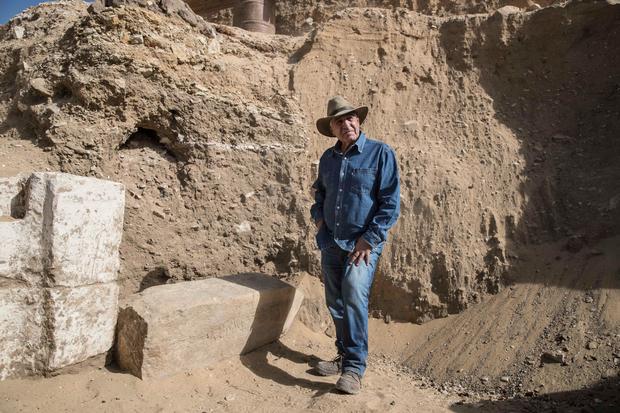
Egypt to announce new archaeological discovery in Luxor on Thursday
The library's Zahi Hawass Center for Egyptology will make the announcement, in cooperation with the Ministry of Tourism and Antiquities, in the Habo area of Luxor.
Nihal SamirComments Off on Egypt to announce new archaeological discovery in Luxor on Thursday
A new archaeological discovery in Luxor is set to be announced on Thursday, according to Mostafa El Feki, Director of the Bibliotheca Alexandrina.
The library's Zahi Hawass Center for Egyptology will make the announcement, in cooperation with the Ministry of Tourism and Antiquities, in the Habo area of Luxor.
The renowned Egyptologist Zahi Hawass had earlier exclusively told Daily News Egypt in an interview that he is leading excavations beside the temple of Mina Habu in Luxor, and will announce a major discovery there.
El Feki praised the efforts exerted by Hawass and the team of Egyptian archaeologists and workers, in light of the difficult climatic conditions in difficult desert areas.
They have been busy excavating the antiquities away from publicity, whatever the available facilities to discover the secrets and treasures of the Ancient Egyptian civilisation.
He stressed that, whilst most other countries of the world dig into the ground to produce water and oil, Egypt is digging to discover its history and civilisation.
El Feki added that this discovery will contribute to introducing the Ancient Egyptian civilisation and reveal the mysteries of different eras.
He explained that each new discovery removes the cover on a lot of information and knowledge that was previously unavailable, and that this will add value to Egyptian antiquities and the Alexandria Library.
El Feki said that the library is proud of the Zahi Hawass Center for Egyptology's affiliation, and that the current work in Luxor is an affirmation of Egyptian patriotism. It also emphasises the respect for heritage, and reverence for Egypt's national history in its various stages.
The American Research Center in Egypt, Northern California Chapter, and the Near Eastern Studies Department, University of California, Berkeley, invite you to attend a virtual lecture by Dr. Rita Lucarelli, UC Berkeley:
Ancient Egypt and Its Reception in Black America: From Afrocentrism to Afrofuturism
When: Sunday, April 18, 2021, 3 PM Pacific Time
Zoom Lecture. A registration link will be automatically sent to ARCE-NC members. Non-members may request a registration link by sending email with your name and email address to arcencZoom@gmail.com. Attendance is limited, so non-members, please send any registration requests no later than April 16.
About the Lecture:
Hartmut Geerken, Sun Ra Arkestra Performing at Heliopolis, Egypt, 1971, gelatin silver print, 5 x 7". From "Cosmic Communities: Coming Out into Outer Space—Homofuturism, Applied Psychedelia & Magic Connectivity."
The cultural imagining of Ancient Egypt and of its monuments, writing and religion has been at the basis of histories of Egyptology and especially of Western Egyptomania, which originated in Greece and Rome and continued to prosper in Europe and the West before and after Napoleon's campaign in Egypt (1798-99). What is often forgotten is the existence of a non-Western egyptomania, which has developed in philosophical, political, religious and cultural movements and trends in modern Egypt itself (Pharaonism) as well as in Africa, the Middle East and among the African-American communities in the US. This lecture aims at raising interest into and discussing elements of fascination and inspiration from ancient Egypt in modern and contemporary art, literature and music inspired by two main African-American cultural movements such as Afrocentrism and Afrofuturism.
About the Speaker: Dr. Rita Lucarelli
Rita Lucarelli studied at the University of Naples "L'Orientale," Italy, where she received her MA degree in Classical Languages and Egyptology. She holds her Ph.D. from Leiden University, the Netherlands. Her Ph.D. thesis was published as The Book of the Dead of Gatseshen: Ancient Egyptian Funerary Religion in the 10th Century BC. She worked as a Research Scholar and a Lecturer at the Department of Egyptology of Bonn University, where she was part of the team of the "Book of the Dead Project". She is an Associate Professor of Egyptology at UC Berkeley and Faculty Curator of Egyptology at the Phoebe A. Hearst Museum of Anthropology of the University of California, Berkeley and Fellow of the Digital Humanities in Berkeley. She is presently working at a project aiming at realizing 3D models of ancient Egyptian coffins, the "Book of the Dead in 3D". She is also completing a new monograph on demonology in ancient Egypt entitled "Agents of Punishment and Protection: Ancient Egyptian Demonology in the First Millenium BCE" and is one of the coordinators of the international project "Ancient Egyptian Demonology Project", or "Demon Things".
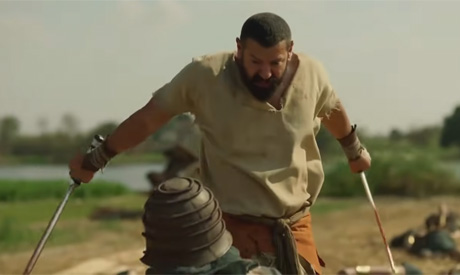
Production on ancient Egyptian TV drama 'The King' halted for review, but controversy continues
While the show has sparked fierce criticism from historians and social media users over perceived historical inaccuracies, others in the showbiz industry have defended the series
Screen Shot from the trailer of Egypt's Pharaos TV series 'The King'
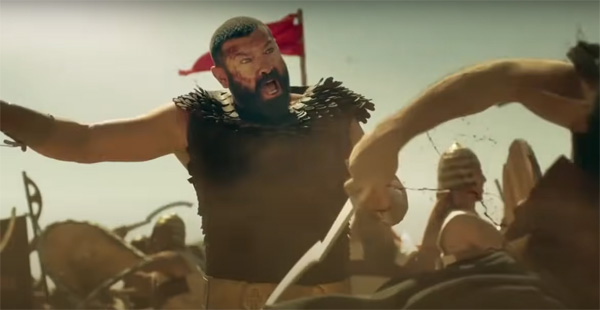
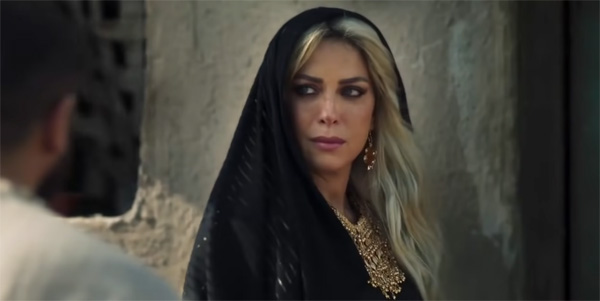
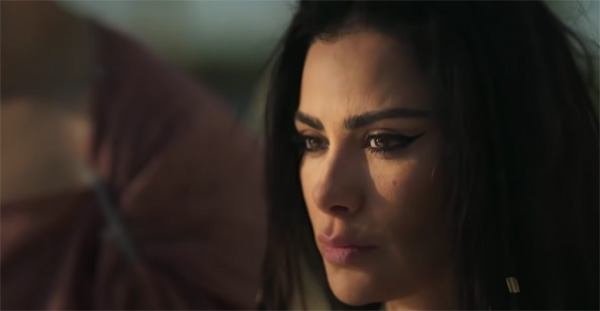
Work on Egyptian historical TV drama 'El-Malek' (The King) has been halted only a week before it was set to premiere for the Ramadan season, after its trailer caused a backlash on social media over perceived historical inaccuracies.
"The United Media Services has announced the stoppage of 'El-Malek' series, forming an urgent committee of specialists in history, antiquities and sociology to review the series and the entire screenplay… even if this results in the cancelation of the premiere in the upcoming Ramadan season," said a statement by the leading Egyptian production company on Sunday evening.
The screenplay is adapted from 'Kefah Tiba' (Thebes at War), the third book in a trilogy by Egyptian Nobel laureate Naguib Mahfouz that was published in the 40s.
The controversy with the series started early with the casting of green-eyed star actor Amr Youssef in the role of Egyptian King Ahmose I last year.
The King
'Pharaohs did not grow beards'
Produced by leading production company Synergy and written by Mohamed Diab, Khaled Diab and Shereen Diab, 'El-Malek' has been among the hottest topics last week after its first trailer caused widespread criticism and mockery.
Directed by Hussein El-Manbawy, whose Ramadan 2020's Al-Fetewa was among the most successful works of the season, El-Malek has been criticised for elements like casting, costume design, make-up, set design and even battle sequences, which are said to be produced by Hollywood professionals.
"I did not like the costume design at all," said prominent archaeologist and Egyptologist Zahi Hawass on TV last Friday, insisting that Egypt is full of qualified artists capable of designing convincing costumes.
"Egyptian kings did not grow beards and moustaches the way we saw," Hawass told TV host Ibrahim Eissa, who mockingly said that the beard fits Khalid ibn al-Walid more, referring to another cancelled historical series by the same production company and star about the famous Muslim military leader.
Screen Shot from trailer of Egypt's Pharaos TV series 'The King'
Blue skinned alien Pharaohs?
While many media personalities, artists, critics and commentators have praised the halting and reviewing of 'El-Malek', a few have said that it is unfair to judge a piece of art before watching it.
"Any art work has a creative license," said prominent director Amr Salama, among other defenders, adding that the creators have the right to even "portray pharaohs with blue skin, wings and alien outfits, just as the audience has a right to praise or condemn the art work."
Others have also pondered the fate of dozens of crewmembers that could be deprived of their pay checks due to the current situation.
Screen Shot from the trailer of Egypt's Pharaohs TV series 'The King'
Golden Parade success
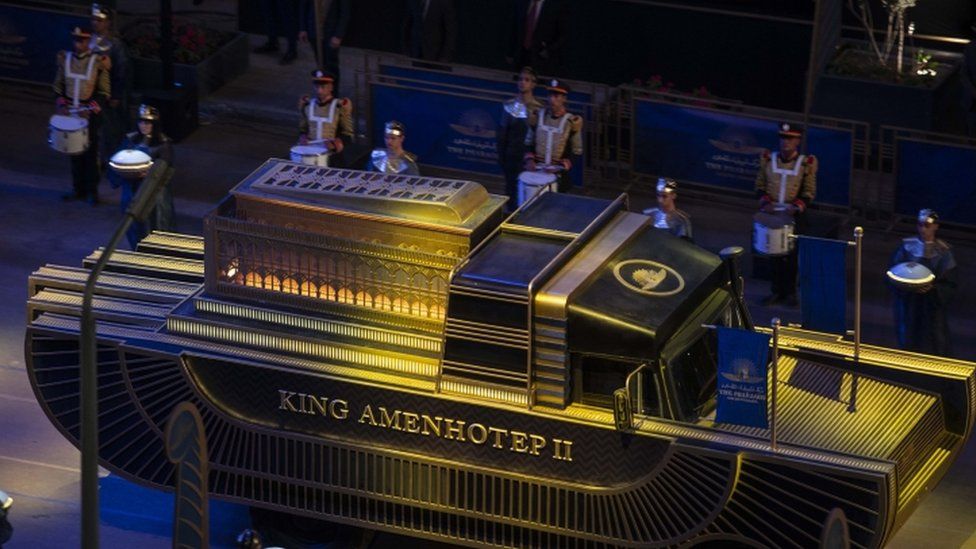
The backlash against the TV series comes on the back of Saturday's successful Pharaoh's Golden Parade, where 22 ancient Egyptian royal mummies – 18 kings and four queens – where transferred from the Egyptian Museum in Tahrir Square to the National Museum of Egyptian Civilisation in Al-Fustat.
Unlike the trailer for 'El-Malek', the parade saw widespread acclaim for its costumes, directing, lighting, orchestral music and other artistic elements.
Screen Shot from the trailer of Egypt's Pharaos TV series 'The King'
Egypt mummies pass through Cairo in ancient rulers' parade
By Wael Hussein BBC News, Cairo
Egyptians have been witnessing a historic procession of their country's ancient rulers through the capital, Cairo.
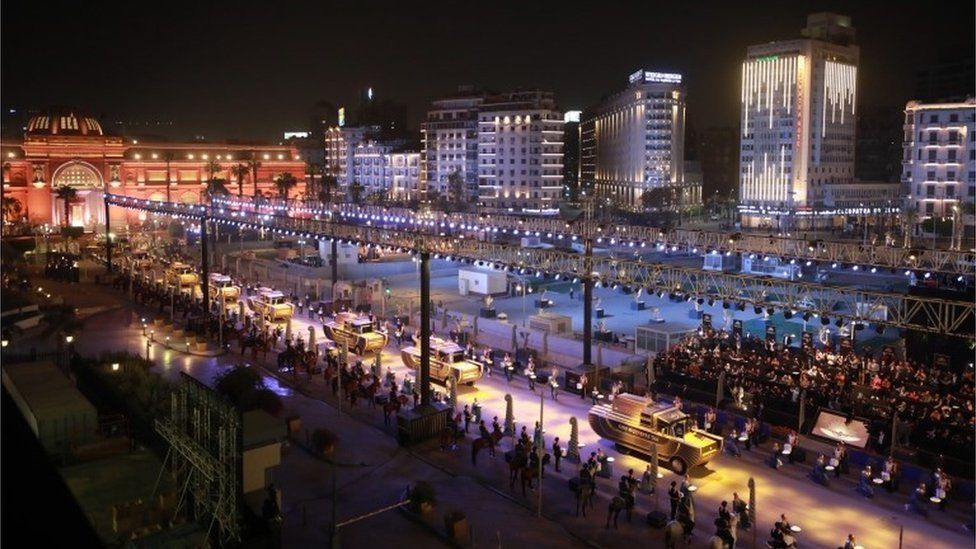
The lavish, multimillion-dollar spectacle saw 22 mummies - 18 kings and four queens - transported from the peach-coloured, neo-classical Egyptian Museum to their new resting place 5km (three miles) away.
With tight security arrangements befitting their royal blood and status as national treasures, the mummies were relocated to the new National Museum of Egyptian Civilisation in what is called The Pharaohs' Golden Parade.
They were transported with great fanfare in chronological order of their reigns - from the 17th Dynasty ruler, Seqenenre Taa II, to Ramses IX, who reigned in the 12th Century BC.
Egypt experienced a sharp rise in Covid-19 infections a year ago, but following a decline in the number of cases and deaths, restrictions on open-air gatherings were later lifted.
image copyrightReuters
image captionThe mummy of King Ramses II was among those to be transported
One of the main attractions of Saturday's event is King Ramses II, the most famous pharaoh of the New Kingdom, who ruled for 67 years and is remembered for signing the first known peace treaty.
Another is Queen Hatshepsut, or Foremost of Noble Ladies. She became ruler even though the customs of her time were that women did not become pharaohs.
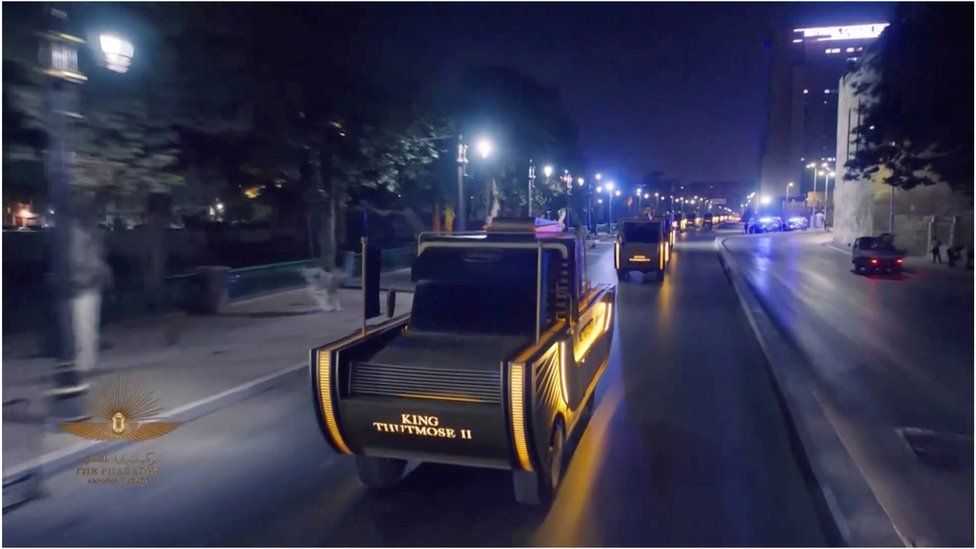
Each mummy was carried on a decorated vehicle fitted with special shock-absorbers and surrounded by a motorcade, including replica horse-drawn war chariots.
While ancient mummification techniques originally preserved the pharaohs, for the move they have been placed in special nitrogen-filled boxes to help protect them against external conditions. Roads along the route have also been repaved to keep the journey smooth.
"The Ministry of Tourism and Antiquities has done its best to make sure that the mummies have been stabilised, conserved, and are packed in a climate-controlled environment," said Salima Ikram, professor of Egyptology at the American University in Cairo.
image copyrightEPA
image captionThe mummies were transported from the Egyptian Museum on Cairo's Tahrir Square to their new home
The mummies were discovered in 1881 and 1898 in two caches in the ruins of Thebes, Egypt's ancient capital - modern day Luxor in Upper Egypt.
"They have already seen a lot of movement in Cairo and before that in Thebes, where they were moved from their own tombs to other sepulchres for safety," Dr Ikram pointed out.
While most of the ancient rulers' remains were brought from Luxor to Cairo via boat on the Nile, a few were transported in the first-class carriage of a train.
They were housed in the iconic Egyptian Museum and visited by tourists from around the world for the past century.
Valley of the Kings
Egypt's authorities are hoping that the new museum, which opens fully this month, will help revitalise tourism - a prime source of foreign currency for the country.
The industry has been battered by political turbulence over the past decade, and more recently by the pandemic.
image copyrightReuters
image captionSome of Cairo's streets were resurfaced to ensure the mummies had a smooth journey
Saturday's move of the mummies will be streamed online for all enthusiasts of ancient Egypt to watch.
The new exhibits will now be housed in the Royal Hall of Mummies and will go on display to the general public from 18 April.
The hall has been designed so that visitors will experience the illusion of being in the Valley of the Kings in Luxor.
Separately, a new Grand Egyptian Museum which will house the famous Tutankhamun collection is due to open next year, close to the Great Pyramids at Giza.
'Curse of the pharaohs'
While it is being seen as a grand - and even fun - event, Egypt's mummies have historically been associated with superstition and foreboding.
Recently, Egypt has had a string of disasters. Last week alone dozens of people were killed in a train crash in Sohag, Upper Egypt, while at least 18 people died when a building collapsed in Cairo.
image copyrightReuters
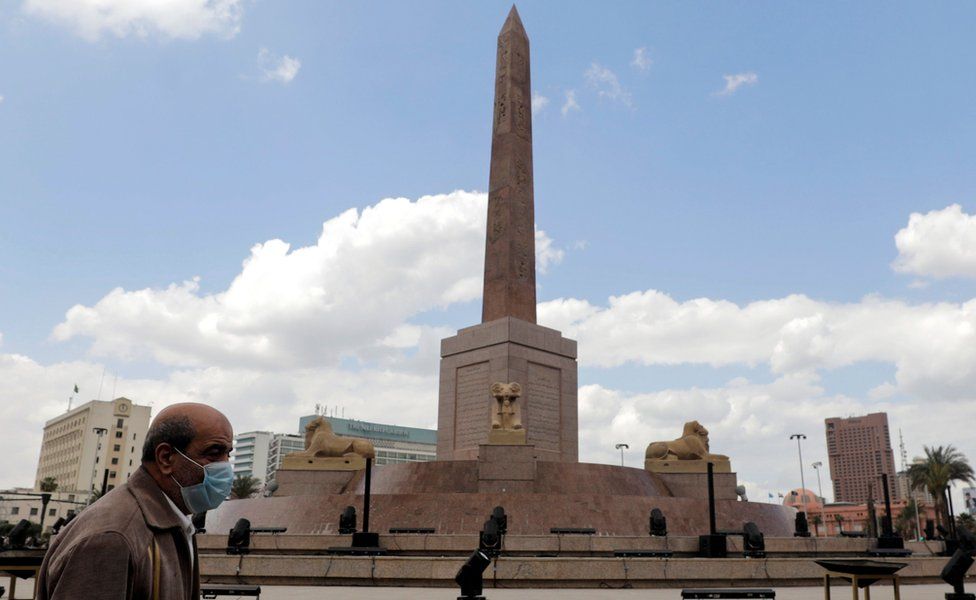
image captionThe Ramses II obelisk in Tahrir Square, dedicated to the most famous pharaoh of the New Kingdom
Social media users have questioned whether the myth of "the curse of the pharaohs" might be to blame.
The ethics of displaying ancient Egyptian mummies has long been debated. Many Muslim scholars believe that the dead should be treated with dignity and respect and not be exhibited as curiosities.
In 1980, President Anwar Sadat ordered the Royal Mummy Room at the Egyptian Museum closed, arguing that it desecrated the dead. He wanted the mummies to be reburied instead, though he did not get his wish.
image copyrightEPA
image captionThe mummies will now rest in the new National Museum of Egyptian Civilisation
Virtual tours have become more and more important for Egypt's tourism sector in the wake of the coronavirus pandemic
Monica Naguib, Friday 2 Apr 2021
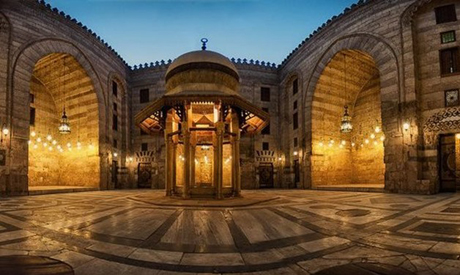
Mosque-Madrasa of Sultan Barqouq
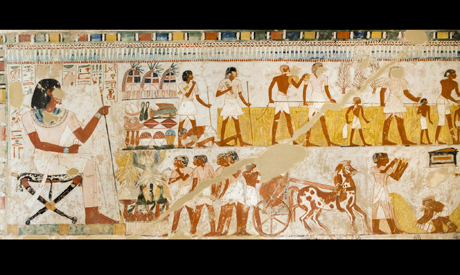
"What happened to Menna's face? Menna's face has been intentionally damaged throughout the tomb. The ancient Egyptians believed the soul of a person inhabited a painting of them and that destroying the face would 'deactivate' the image. Why did someone want to destroy the memory of Menna?"
The caption above is taken from a description of a scene showing the ancient Egyptian king Menna standing between a child and a woman with a destroyed face and is one of the captions used in a virtual tour of the king's tomb.
When virtual visitors click on the link for the virtual tour and enter the tomb, a long aisle covered with depictions on both sides appears. Each side has two white circles indicating clickable descriptions. Clicking on the ceiling of the virtual tomb produces the caption, "much of the elaborately patterned ceiling has been preserved, and the colours are still remarkably bright," for example.
Clicking on the floor towards the left leads to a room full of more depictions and information about the tomb.
Virtual tours have been on the rise worldwide as one way of trying to rescue the tourism industry in the wake of the travel restrictions intended to curb the spread of the Covid-19 pandemic. Egypt has jumped on virtual tours for the same reason, also using them to encourage people to visit the country in person when the pandemic is over.
About 100 million tourists visited Egypt between 2010 and the first quarter of 2020, according to the Central Agency for Public Mobilisation and Statistics (CAPMAS). According to the UN World Tourism Organisation (UNWTO), Egypt is among the world's fastest-growing tourist destinations, as the tourism sector witnessed 21 per cent growth in 2019, welcoming 13.6 million visitors.
Whereas experts expected that the number of tourists would reach more than 14 million in 2020, the pandemic has severely hindered Egypt's tourism. "After the lockdowns end, people will be hungry to travel again and to begin to cross borders. People feel as if they are in prison. When the airports reopen and tourism is back, we're expecting huge flows of tourists to come to Egypt," Assistant to the Minister of Tourism and Antiquities Enas Ehab told Al-AhramWeekly.
Until tourism thrives again, the ministry is taking steps towards sustaining Egypt's tourism, however, including the organisation of virtual tours. The advisor to the minister of tourism and antiquities, Soha Bahgat, told SkyNewsArabia TV channel that the supportive measures included institutions, investors, and entrepreneurs.
On 23 March 2020, the Ministry of Tourism and Antiquities shut down all archaeological sites across Egypt as part of preventive measures to control the Covid-19 pandemic. Although the Health Ministry carried out sanitisation measures, and workers at the sites received special training on protecting themselves, it was still too dangerous to allow visits.
Consequently, the authorities resorted to creative and practical solutions to cope with the lockdown.
On 3 April last year, the Ministry of Tourism and Antiquities cooperated with scientific and archaeological institutes to launch a series of free virtual tours around Egyptian museums and archeological sites.
A virtual tour is a sequence of photographs or video accompanied by text, sound effects, narration, or music to simulate a specific location. In 1994, UK Queen Elizabeth II opened an exhibition at the country's Dudley Castle showing a simulation of it in 1550 CE, for example, in one of the first ever virtual tours.
"I believe that there is no more appropriate time than today in the shadow of the Covid-19 pandemic to offer virtual tours of museums, archaeological sites, and safaris," Salah Marashi, a virtual tour creator and photographer, told the Weekly.
Today, tours whether 3D photographs or guidance videos, are shared on the ministry's website and social-media accounts like Facebook, Instagram, and Twitter. The slogan says "Experience Egypt from home. Stay home. Stay safe."
Descriptions are available in Arabic and English, but a spokesman from the media office of the ministry told the website Al-Monitor that there are plans to include material in all UN official languages, in other words English, Arabic, French, Chinese, Spanish, and Russian.
Menna Tomb
THE VIRTUAL TOURS: Organised in collaboration with the American Research Centre in Cairo, the first virtual tour explores the Menna Tomb in the Theban Necropolis. This is one of Luxor's most prominent tombs dating back to the 18th Dynasty.
A series of other video tours with narrated information on 20 pieces in the Egyptian Museum in Cairo's Tahrir Square was then made, including of such objects as the statue of king Akhenaten, the bust of queen Nefertiti, the gold collar of Psusennes I, and many more.
The Akhenaten statue, made of sandstone, was originally displayed in front of the temple of the god Aten in Karnak. It depicts the king with exaggerated features represented by narrow shoulders, a bulging belly, and full thighs and arms. He holds a wand and a flute. The statue also highlights the king's facial features, showing a long face and nose, narrow sloping eyes, and thick lips.
Similarly, the Nefertiti bust, made of quartz, shows the queen's elegant features.
The gold collar of Psusennes I was found around the neck of the mummy of king Psusennes I dating back to the 21st Dynasty. It is one of three necklaces belonging to the king made of 14-branched gold chains and ending in lotus flowers.
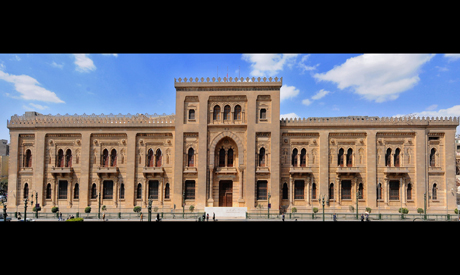
The virtual tour of the Egyptian Museum is of a building that now contains some 120,000 pieces, most of which are on display while the rest are in storerooms. Another highlighted museum of the virtual tours is the Museum of Islamic Art in Bab Al-Khalq in Cairo. This virtual tour was made to celebrate the 117th anniversary of its inauguration on 28 December last year.
The museum contains nearly 400 exhibits and a miscellaneous collection of Islamic artifacts dating back 12 centuries from countries such as Egypt, Saudi Arabia, and India.
The virtual tours also cover some of Old Cairo's heritage as well as archaeological sites from all over Egypt, including the Red Monastery, the Ben Ezra Synagogue, the Mosque-Madrasa of Sultan Barqouq, and the Kom Al-Shuqafa Catacombs.
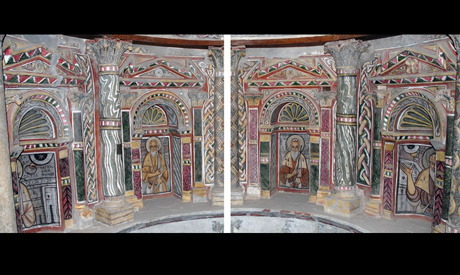
The Red Monastery in Sohag in Upper Egypt is one of the most important monasteries in Egypt and was built in early Christian times. It was established by a saint called Bishoy in the early fourth century CE and is called the Red Monastery as red brick was used as primary material in its construction.
The monastery was exposed to fire twice, leaving only the church, fortress and architectural remnants behind. The fortress, dating back to the era of the Byzantine empress Helena, is an almost square building. It contains a group of units that the monks would occasionally hide in from attackers, as well as a church, warehouses, and water sources.
The Ben Ezra Synagogue is located on Mar Girgis Street in Old Cairo. It was originally a church before the Coptic Orthodox Church sold it in 882 CE to the Jewish community in Cairo. Some believe that it marks the site where the Prophet Moses prayed to God to lift the plague then afflicting the ancient Egyptians.
The synagogue is built in the basilica style. On its northern side, there is the geniza, or storehouse, which was discovered in 1896. This is a room closed on all sides where books and papers were once stored. They were transferred to Cambridge University in the UK shortly after their rediscovery.
The Mosque-Madrasa of Sultan Barqouq, one of the UK newspaper TheGuardian's top 10 virtual tours of spectacular buildings around the world, was inaugurated in 1386 CE in Al-Muizz Street in Islamic Cairo. It is an architectural masterpiece with distinctive decorative elements including the use of colourful marble cladding and inscriptions of Quranicverses, indicating the name of the builder and the date of creation in Islamic naskhi script.
The Kom Al-Shuqafa Catacombs in Alexandria are among the best-preserved monuments from the Roman era in Egypt. They bring together a mixture of ancient Egyptian, Roman, and Greek cultures.
Thus, the ministry's virtual tours are not limited to one type of site, but extend to Pharaonic, Coptic, Islamic, and Jewish landmarks in Egypt. "The virtual tours target both international tourists and Egyptians. They serve the double purpose of promoting Egyptian tourism nationwide and increasing Egyptians' awareness of their own civilisation," a spokesman from the media office of the ministry told Al-Monitor.
The virtual tours can also help to raise awareness even when present circumstances change. Feedback has been very positive from both Egyptian and international tourists, the spokesman declared.
"Virtual tours are a great opportunity, and they can let the world see our awesome treasures as an invitation to people all over the world to visit Egypt's heritage sites," Angelina Gamal, a tourist guide, told the Weekly.
The White Monastery with red bolman niches
THE GRAND EGYPTIAN MUSEUM: The lockdown has also affected the Grand Egyptian Museum's (GEM) inauguration, which has been postponed to mid-2021, as announced by President Abdel-Fattah Al-Sisi this year.
In the meantime, the Ministry of Tourism has cooperated with the Ministry of Information to produce a new tour of the GEM and its Restoration Laboratory. The museum is the largest in the world and is dedicated to Egyptian civilisation from prehistoric until Greek and Roman times.
Overlooking the Pyramids on the Giza Plateau, the GEM will house an educational centre, a handicrafts centre, classrooms, a children's museum, and an area dedicated to solar boats. Covering an area of 18,000 square metres, 12 exhibition halls will display the ancient Egyptian civilisation.
The GEM will display more than 49,000 artifacts, including the complete collection of objects from the golden boy-king Tutankhamen's tomb for the first time. This includes more than 5,000 pieces, all exhibited in two halls of the GEM.
Other halls will show archaeological discoveries from the last two years. One hall, dedicated to the Asasif cache, will exhibit artifacts found by an Egyptian archaeological mission in the Luxor governorate in 2019.
Thirty-two closed sealed coffins found in December 2020 and belonging to priestesses and priests of the 22nd Dynasty will also be displayed. This discovery is one of the most significant ever made in Saqqara, and it includes 100 wooden coffins, gold masks, 42 wooden statues, and the coffins of senior statesmen and priests in addition to mummies of cats, lions, and crocodiles dating back to 2500 BCE.
All the coffins are decorated with hieroglyphic inscriptions and masks on the mummies' faces. The items were found in good condition, untouched by tomb robbers.
A virtual tour of the GEM shows parts of the museum's architecture and displays in order to promote the institution during the pandemic and before its grand opening.
While such virtual tours would not have existed had it not been for the coronavirus outbreak, they have been playing a very significant role in promoting Egypt's tourism abroad. Mohamed Al-Masoud, a member of Egypt's parliamentary committee on tourism and civil aviation, told Al-Monitor that virtual tours were one of the positive changes that have emerged from the crisis.
"The tourism sector is usually the hardest hit by crises and turbulence. But modern technology has now offered alternatives, [as] the virtual tours were launched during the coronavirus crisis, but they will last even after this crisis. They are one of the ministry's vehicles to promote tourism to Egypt," Al-Masoud said.
In addition to the virtual tours, there are also other campaigns to meet the demands of the tourism market. "We used to depend on Europe, which is closed now, so we have to find alternatives, especially as we're approaching the summer season," Ehab said.
In the meantime, the Ministry of Tourism and Antiquities intends to keep its virtual tours free of charge. "But we're studying different solutions and visions. [For example], we have got many offers to use archaeological sites to showcase products in a virtual reality theme, like [showcasing] paintings in the Citadel," it said.
The Museum of Islamic Art
WORLD MUSEUMS: Virtual tours are also taking off in other countries, opening the door to evaluations of the Egyptian versions.
Ministry officials "are trying their best to be as advanced in terms of technology as other countries. We see this from the virtual tours of Luxor tombs and other museum virtual tours," Gamal said.
Even so, there are still famous museums worldwide that do not offer virtual tours.
But "this technology has become one of the basics for any Website concerned with providing archaeological information in a different way from regular photographs with descriptions," Marashi said.
Meanwhile, the Google Arts and Culture Museum collection provides street views and virtual tours of cultural heritage sites worldwide. Founded in 2007 and part of the technology used for Google Maps and Google Earth, Google Street View now offers interactive panoramic views of streets and archaeological sites.
Google Arts and Culture offers virtual tours of 2,500 museums and galleries around the world. Virtual tours are available for the British Museum, which features thousands of artifacts, including the famous Rosetta Stone and Egyptian mummies. The Musée d'Orsay in Paris, also available as a virtual tour, features artworks from French artists Monet, Cézanne, and Gauguin.
Germany's biggest museum, the Pergamon Museum in Berlin, offers a virtual tour of the Pergamon Altar, the Ishtar Gate of Babylon, and other items. The Van Gogh Museum in Amsterdam offers a virtual tour of 200 paintings, 500 drawings, and over 750 personal letters by artist Vincent van Gogh.
The Guggenheim Museum in New York is included, featuring western artworks from the impressionist, post-impressionist, modern and contemporary periods. The Rijksmuseum in Amsterdam features the works of Vermeer and Rembrandt. The J. Paul Getty Museum in Los Angeles features paintings, drawings, sculptures, manuscripts, and photographs. The Louvre in Paris also offers virtual tours on its website.
No one has a clear idea of how tourism will look after Covid-19. Some people claim virtual tours could be the future of tourism, while others disagree. "Part of the experience is to deal with the people of the country, and find out more about the culture, the food, the languages, even walk in the streets." Ehab said. These things cannot be had on a virtual tour.
Whether they will be the future of tourism or just a part of it, virtual tours are not just a port in a storm. They are very much needed at the current time, especially for Egypt.
"We have very good potential. Our position is better than that of competitors. This is our chance to attract as many tourists as we can," Ehab said. "The purpose is to maintain our connection with tourists and to let them know we're still there."
*A version of this article appears in print in the 1 April, 2021 edition of Al-Ahram Weekly
22 royal mummies, kings and queens who died more than 3,000 years ago, are going on parade in Egypt
By Ahmed Shawkat
/ CBS News
Cairo — This weekend, Egypt is putting on a parade for its royalty. But the guests of honor in this procession have all been dead for more than 3,000 years.
On Saturday, 22 royal mummies will be paraded through the streets of downtown Cairo. As the sun sets, the ancient monarchs will depart the Egyptian Museum in Tahrir Square in a grandiose parade, each of them on their own decorated vehicle surrounded by a festival-like motorcade, complete with music, lights, costumes and horses.
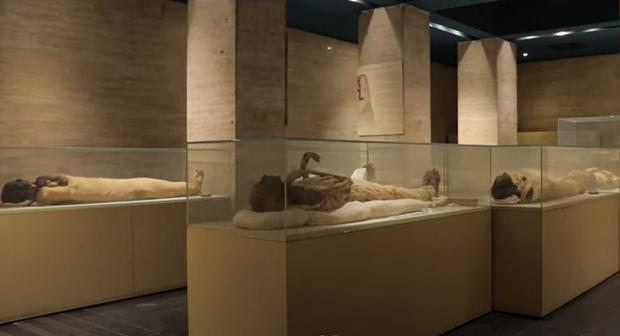
The mummies of Egyptian kings and queens, dating back more than 3,000 years, are seen at the Egyptian Museum in Cairo in an image from video posted online by the Experience Egypt tourism board. Experience Egypt
The "Pharaohs' Golden Parade" will move along the River Nile to Egypt's first Islamic capital, Al-Fustat, in old Cairo, until it reaches the National Museum of Egyptian Civilization (NMEC).
The group includes 18 kings and four queens from the 17th to the 20th dynasties of ancient Egypt — approximately 3,500 to 3,100 years ago. Most of the 22 kings and queens were discovered in two archaeological "caches" in Luxor in the late 1800s.
Grave robbers and a family feud
Years after these monarchs died, Egypt had become divided and weak, and grave robbery was rampant. Priests had to hide the royal mummies, moving them to hidden tombs to protect them from grave robbers.
Their efforts remained successful until the first cache in Luxor was discovered in the 19th century when, the story goes, a young man's goat went astray.
"In 1871 a member of the family of Abd al Rasul [who were tomb robbers] was leading goats. One of them ran away, up to the mountain south of the temple of Queen Hatshepsut," archaeologist Zahi Hawass told CBS News. "When the man ran after the goat, he found a shaft. When he entered, he found himself in front of mummies, coffins and gold."
The family kept the secret for 10 years, robbing the tomb, until royal artifacts started to surface for sale around the world. Officials arrested one of the family members and interrogated him for a month. The man said nothing. When he was released, he asked his family for a bigger share as compensation.
"They refused and began to fight. Another member of the family went to the police and told them about the cache," Hawass said.
From unwelcome, to presidential welcome
Ancient Egyptians had a very sophisticated set of religious beliefs, including a detailed explanation for what comes after someone's Earthly life, but they likely never saw this coming.
The mummies were loaded onto boats and transferred down the Nile from the dig site to Cairo. But when the long-dead kings and queens arrived in their country's new capital, they were denied entry. Cairo's customs inspectors of the late 19th century found that the word "mummy" did not appear within any category of goods permitted for entry.
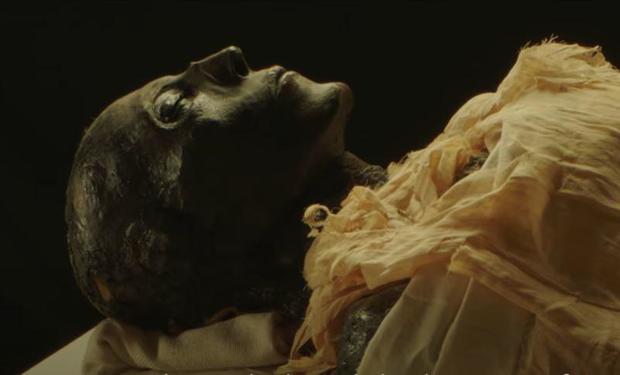
The mummy of Seti I, a pharaoh of ancient Egypt's 19th dynasty who died in 1279 BC, is seen at the Egyptian Museum in Cairo, Egypt, in an image from a promotional video posted online by the government's Experience Egypt tourism board. Experience Egypt
But as Hawass explained, they found a solution: The mummies were labeled "salted fish," and welcomed to Cairo. They were first taken to the Bulaq Museum, but later moved to the Egyptian Museum in 1902. They first went on public display in 1958.
This time around, the royal mummies will be welcomed to their new home in the capital by their contemporary counterpart — or the closest figure in present day Egypt, President Abdel Fattah el-Sisi.
But why move 22 royal mummies anyway, and what's the parade all about?
Why the move?
The once-thriving tourism industry is one of Egypt's primary sources of income, but it has suffered badly since the arrival of an uninvited guest last year. Thanks to COVID-19, the United Nations has described 2020 as the worst year in global tourism history.
Clearly the parade is seen as a way to reinvigorate interest in Egypt as a destination as the global travel industry eyes a rebound. Many Egyptians, including in the government, want this event to look good.
One talk show host went so far as to ask residents along the parade route hide junk on the roofs of their buildings, just for a day, for the sake of Egypt's public image, knowing their will be aerial footage of the royal procession.
The event will also include the unveiling of an obelisk and the unboxing of four sphinxes in the center of Cairo's famous Tahrir Square. The artifacts have been installed and waiting for their debut for several months now.
The entire parade will be live-streamed by Egypt's Ministry of Tourism and Antiquities.
Controversial attractions
Despite the obvious draw Egypt's ancient history offers its tourism industry, mummies are, after all, deceased human beings, and there has always been a simmering debate over whether they should simply be left buried, or at least reburied, rather than put on display for gawping visitors.
Digging up graves is forbidden in Islam, and Dr. Ahmad Karima, a professor of Islamic law at Cairo's Al-Azhar University, recently raised the issue again, arguing: "These are our accentors, we shouldn't have them displayed for some dollars and euros."
He said bodies should only be exhumed for scientific research, after which they should be promptly reburied.
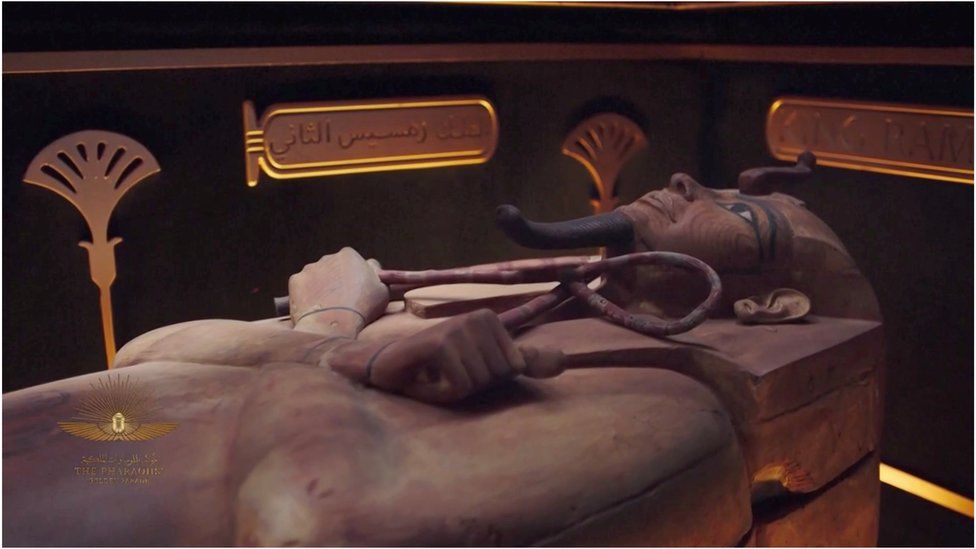
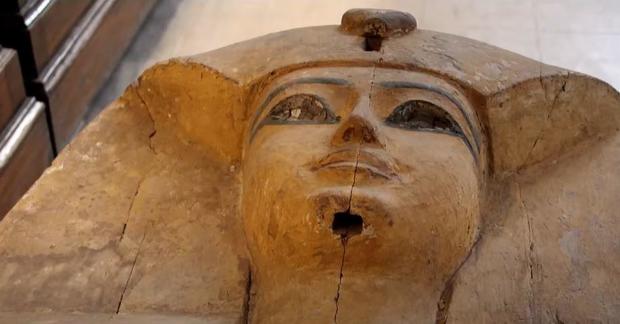
The sarcophagus that encased the mummy of pharaoh Sequenere Taa II, who ruled over ancient Egypt during the 17th dynasty until about 1555 BC, is seen in an image from a video posted online by the Experience Egypt tourism board. Experience Egypt
Former President Anwar Sadat, during a visit to the Egyptian Museum in the 1980s, ordered the closure of the Royal Mummies Hall, and it remained closed for seven years.
Archaeologists who oppose the hiding of mummies insist they aren't tomb robbers, noting that they preserve the ancient remains and protect them from being looted or destroyed — and they need to do their work to learn about the past. DNA tests and CT scans continue to change what we know about how ancient Egyptians lived, and died.
Who were these royals?
Of the 22 royal mummies taking up residence at the National Museum of Egyptian Civilization, 20 will be put on display and two, Queen Meritamun and Queen T, will be stored.
The 20 going on display, from oldest to youngest, are: Seqenenre TaaII, Ahmose Nefertari, Amenhotep I, Thutmose I, Thutmose II, Hatshepsut, Thutmose III, Amenhotep II, Thutmose IV, Amenhotep III, Seti I, Ramses II, Merenptah, Seti II, Siptah, Ramses III, Ramses IV, Ramses V, Ramses VI and Ramses IX.
"Every mummy has a story, every mummy is magic," Hawass told CBS News. He will be telling some of those stories at the event on Saturday — a day, he said, "that will be remembered."
Egyptologist Dr. Zahi Hawass poses during an event announcing the discovery by the archaeological mission he leads of a new trove of treasures at Egypt's Saqqara necropolis, south of Cairo, January 17, 2021. KHALED DESOUKI/AFP/Getty
"The new showroom is more like a one-way circle maze. All the walls are black, with spotlights on the mummies," Sayed Abu-El Fadal, a spokesman for the NMEC, told CBS News. "It is designed like the tombs in the Valley of the Kings."
The new display hall will include x-rays and scans of the mummies, and some of their belongings.
Over more than 3,000 years these kings and queens will have moved from one tomb to another, from one capital to another and from one museum to another. Hopefully, after Saturday they'll finally be allowed to rest in peace.
Call for Applications: Marie Buttery Memorial Student Grant
The Board of Directors of the American Research Center in Egypt, Northern California chapter, is offering one $1,000 grant to a qualified student. Deadline for submission is April 23, 2021 with the grant to be awarded in May. To qualify for this grant, the applicant must be an undergraduate or graduate student who is enrolled at a Northern California college or university (Monterey to the Oregon border) or who has a home address in this area. Applicants must be pursuing a degree that incorporates Egyptian anthropology, Egyptian archaeology or art, history, museum studies or language, or Coptic or Arabic studies in any period. Proof of enrollment may be required. Applicants are to submit 1) a brief summary (250-500 words) describing how they will use the grant and 2) a 1-2 page CV. The grant will be awarded by the Board based on merit. Applicants should email their materials (Word or PDF file) to ARCENorCal@gmail.com .