After years of closure, Boulaq's Royal Carriages Museum to reopen
The museum, established during the reign of Khedive Ismail, will exhibit a number of carriages, chariots and assorted accessories from before the 1952 revolution
With its distinguished early 20th century architectural style stands the Royal Carriage Museum in Boulaq. After years of closure the museum will open its doors to visitors to admire the exquisite royal carriages of members of the Mohamed Ali family.
Restoration and development work at the museum is in full swing to meet the deadline for reopening in December.
Prime Minister Mostafa Madbouly and Minister of Antiquities Khaled El-Enany embarked on an inspection tour to check the work underway. Some 80 percent of the work has been completed and the museum edifice is now ready to host the royal carriages.
Waad Abul-Ela, head of the projects sector at the Ministry of Antiquities, explains that the museum building, which was in a very poor condition of preservation, was rehabilitated, the walls and foundations consolidated, and facades and decorative elements restored. New lighting and security systems were installed.
The restoration work was started in 2001 but was halted. The work resumed in 2017.
Nevine Nizar, assistant to the minister of antiquities for museum affairs, said the museum would put on show a collection of royal carriages along with accessories and clothes of the horse guards. The items will be distributed across five halls. The first will exhibit the chariot that French Empress Eugenie gifted to Khedive Ismail on the occasion of the official opening of the Suez Canal, while the second hall will display rare types of chariots known as Alay and Half-Alay.
Nizar said the third hall is the main core of the museum and will display ceremonial chariots that were used by royal family members in wedding and funerary occasions, and for promenades. Painted portraits depicting members of the royal family will be also exhibited.
The fourth hall will be dedicated to the uniforms of chevaliers and horse riders, while the fifth and last hall will show accessories used to decorate the chariots and horses, such as the horseshoes, bridles and saddles.
The museum was established during the reign of Khedive Ismail. At first it was called the Department of the Khedive Carriages. Then the name was modified to the Management of the Royal Stables. After the 1952 revolution, the building was named the Royal Carriages Museum.
The museum was originally created not only to display royal carriages, but also horses of the Khedive Ismail and those owned by members of the royal family.
Experts and veterinarians were brought from across the world to take care of the horses. Valuable cars from world-class brands like Citroen, Ford and Cadillac were also exhibited.
In 1969, Cairo governorate took around three quarters of the museum and transformed it into a garage.
A glimpse behind the scenes of Giza's Grand Egyptian Museum
Egypt's vast, much-delayed museum is scheduled to open in 2020. But while Tutankhamun's treasures are being readied for tourists, some critics see the building as a vanity project. (Click on the above link to read the arcticle.)
Professional training for archaeologists, as well as for museum and heritage management professionals
Raising the awareness about cultural and natural heritage
Archaeology and heritage-related projects
Non-destructive methods for the study, documentation and conservation of archaeological assets
Capacity building and promotion of distinguished scholars in the fields of Egyptology and heritage conservation
Vision
The center aims to conduct research, provide education and training on both national and regional levels. Additionally, the center focuses on raising public awareness about archaeological heritage and means of conservation.
Tomb of Paätenemheb, New Kingdom, 18th Dynasty . Rijksmuseum van Oudheden, Leiden / Photo by rob coopman, Flickr, Creative Commons
Harper's songs were lyrics composed in ancient Egypt to be sung at funeral feasts and inscribed on monuments.
By Dr. Joshua J. Mark Professor of Philosophy Marist College
Introduction
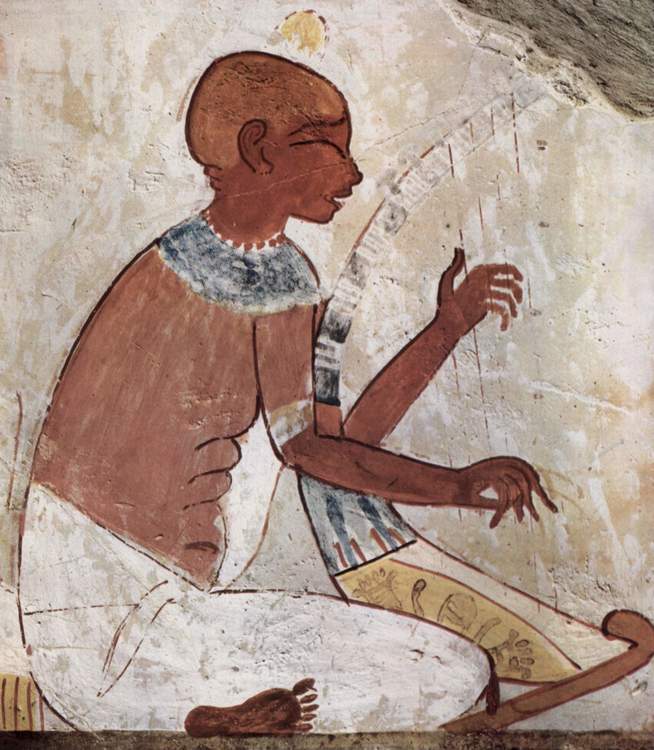
Harper's songs were lyrics composed in ancient Egypt to be sung at funeral feasts and inscribed on monuments. They derive their name from the image which accompanies the text on tomb or chapel walls, stelae, and papyri in which a blind harper is shown singing his composition to the deceased and sometimes the family of the departed. They appear in a rudimentary form in the Old Kingdom (c. 2613-2181 BCE), where they are brief salutations to the deceased, who is embarking on the next phase of existence, and praise for the certainty of the afterlife but were more fully developed during the Middle Kingdom (2040-1782 BCE) when they underwent a significant change.
The best-known harper's song from the Middle Kingdom is The Lay of the Harper which originally appeared in the tomb-chapel of a king named Intef (though which Intef this was is unknown since a number of kings from the period took that same throne name) and expresses a novel skepticism of the traditional view of the afterlife in ancient Egypt. The Lay of the Harper explores a carpe diem theme, encouraging people to enjoy life while they can because what comes afterwards is unknown, and focuses on present pleasures.
This theme is refuted in the New Kingdom (c. 1570 – c. 1069 BCE) by the best-known harper's song of that period, A Harper's Song from the Tomb of Neferhotep, which dismisses the skepticism as nonsense. This piece questions what good can come from doubting eternal life in The Field of Reeds and directs an audience to rejoice and have hope in the traditional view of the afterlife. The New Kingdom is the last period in which harper's songs were composed.
Although the harper's songs have routinely been interpreted as reflecting the eras they were composed in, this claim has, and should, been challenged. A far more certain interpretation is that they reflect the age-old divide between religious faith and skepticism which expresses itself in the modern day in very much the same way as in ancient Egypt or in any culture from any period.
Egyptian Funerary Rites
Contrary to popular opinion, the ancient Egyptians were not obsessed with death. Rather, they valued life so greatly that they wished it to continue forever. The concept of the survival of bodily death was already part of cultural belief in the Predynastic Period in Egypt (c. 6000 – c. 3150 BCE) as evidenced by grave goods included in burials and was fully developed by the time of the Old Kingdom when the famous pyramids at Giza were constructed.
The traditional view of death held that it was not the end of life but only a transition to the next phase of the soul's eternal journey. The soul of the deceased would awake in its tomb, be led to the Hall of Truth by the god Anubis, and be judged by Osiris in the presence of Ma'at, Thoth, and The Forty-Two Judges. If the soul was found worthy, it was justified and continued on to The Field of Reeds where it would find all that it thought had been lost at death, would reunite with loved ones who had passed earlier, and would then live eternally in paradise in the presence of the gods.
In order for any of this to happen, however, funerary rituals had to be carefully adhered to. The body needed to be preserved in order for the soul to continue to receive sustenance and the tomb had to be prepared so the soul could bring with it all the provisions it would need on its journey to paradise. The body would be prepared by the embalmers and would then be transported to the place of burial. This procession would include professional mourners (always women) known as The Kites of Nephthys, imagined as birds of the goddess who comforted the dead, who would wail loudly to encourage others to express their grief.
It was thought that the dead could also hear the mourners and the soul would be enlivened in the knowledge they had lived a good life and would be missed. The mourners would sometimes recite the poem The Lamentations of Isis and Nephthys, a work probably composed during the Middle Kingdom, in which two female singers dramatically reenacted the grief of the goddesses over the death of Osiris.
Papyrus of Nesmin; sheet 2 with cols. 5-8. Hieratic text, found in Thebes, Egypt, dating to the Ptolemaic Period. The 'Songs of Isis and Nephthys' are cols. 1–17 / British Museum, Creative Commons
The Lamentations was sung to the accompaniment of musical instruments but it, like the hymns and prayers of the priests, was ritualized. Whether it was performed at a funeral or a festival, The Lamentations was always performed the same way because it was associating an audience – whether the living or the deceased – with Osiris' death, resurrection, and eternal life. Works like The Lamentations encouraged the traditional view of death as a new beginning and a harper's song was supposed to do the same.
Once the deceased was sealed in the tomb, the funeral guests would celebrate the departed with a feast and it is thought that this was when the harper would sing his song. Unlike The Lamentations, each harper's song was different, tailored specifically to the individual, but all – initially – emphasized the promise that death was not the end and life was only one part of an eternal journey.
Harper's Songs in the Middle Kingdom
This Old Kingdom paradigm was continued in the Middle Kingdom as evidenced in harper's songs such as the one from the Stela of Nebankh (a steward of the king) of the 13th Dynasty. On the stela, the deceased is pictured sitting at a table while the harper squats, lower than he, to sing the song:
The singer Tjeniaa says:
How firm you are in your seat of eternity,
Your monument of everlastingness!
It is filled with offerings of food,
It contains every good thing.
Your ka is with you,
It does not leave you,
O Royal Seal-bearer, Great Steward, Nebankh!
Yours is the sweet breath of the north wind!
So says his singer who keeps his name alive,
The honorable singer Tjeniaa, whom he loved,
Who sings to his ka every day. (Lichtheim, Middle Kingdom, 194).
The ka was one aspect of the soul and needed to be sustained in order for the transformed soul to continue in the afterlife. Families would hire ka-priests to tend the tomb, if they had not the time, who would recite prayers for the deceased, bring food and water, and keep their name alive. As the Stela of Nebankh shows, this same was accomplished through a harper's song even though a ka-priest would probably also have been employed if one could afford it.
A mural of a blind musician playing a harp, from the tomb of the ancient Egyptian scribe called Nakht. c. 1422-1411 BCE / The Yorck Project, Wikimedia Commons
The song of Tjeniaa emphasizes the beauty of the tomb as a "seat of eternity" and "monument of everlastingness" and promises Nebankh will live forever not only through the goods in the tomb but through the health of his ka, his soul, which Tjeniaa will keep alive through his song. The tomb was one's eternal home to which the soul would return to be refreshed and visit earth, drawn by statues and images of one's likeness and, of course, the body. One did not need to fear death or cling to life because one would live on through other people's remembrance and the justification by the gods who had recognized one's virtue as well as one's tomb which would be attended by the living and would last forever.
This vision is presented quite differently in the better-known Lay of the Harper from the tomb of King Intef:
Fortunate is this prince,
For happy was his fate, and happy his ending.
One generation passes away and the next remains,
Ever since the time of those of old.
The gods who existed before me rest now in their tombs,
And the blessed nobles also are buried in their tombs.
But as for these builders of tombs,
Their places [tombs] are no more.
What has become of them?
I have heard the words of Imhotep and Hardedef [sages of the Old Kingdom]
Whose maxims are repeated intact as proverbs.
But what of their places?
Their walls are in ruins,
And their places are no more,
As if they had never existed.
There is no one who returns from beyond
That he may tell of their state,
That he may tell of their lot,
That he may set our hearts at ease
Until we make our journey
To the place where they have gone.
So rejoice your heart!
Absence of care is good for you;
Follow your heart as long as you live.
Put myrrh on your head,
Dress yourself in fine linen,
Anoint yourself with exquisite oils
Which are only for the gods.
Let your pleasures increase,
And let not your heart grow weary.
Follow your heart and your happiness,
Conduct your affairs on earth as your heart dictates,
For that day of mourning will surely come for you.
The Weary-Hearted does not hear their lamentations,
And their weeping does not rescue a man's heart from the grave.
Enjoy pleasant times,
And do not weary thereof.
Behold, it is not given to any man to take his belongings with him,
Behold, there is no one departed who will return again. (Simpson, 332-333)
This piece dismisses the idea that the dead can hear anything (the Weary-Hearted do not hear the mourner's lamentations) or that one's tomb guarantees continued existence. Further, since no one has come back from the dead to give proof of an afterlife, there is no reason to set one's hopes too high on the goodness and mercy of the gods and one would do better, the poet says, to follow one's heart and enjoy life as much as possible.
The Lay of the Harper is not the only piece of Middle Kingdom literature to express this view. Another famous work is A Dispute Between a Man and his Soul which makes the same point. The recognition that one's tomb will crumble, could easily be forgotten and lost, and so is no guarantee of eternal life, is expressed in yet another work, A Ghost Story (sometimes translated as Khonsemhab and the Ghost). In this piece, a ghost appears to Khonsemhab, High Priest of Amun, complaining that his tomb has fallen into ruin and no one remembers him anymore. Consequently, he is starving in the land of the dead and wanders without a home. Khonsemhab promises he will restore the ghost's tomb, and keeps his word, but an audience is still left to wonder about the many other tombs which fell and were not restored and the fate of those they were built for.
Harper's Songs in the New Kingdom
Scholars continue to debate whether these Middle Kingdom texts honestly reflect the Egyptian culture of the time or were literary conceits and personal opinions. Since harper's songs or short fiction like A Ghost Story were not ritual texts, scribes had freedom of expression to explore whatever theme they were interested in. An individual scribe might doubt the existence of the afterlife or the gods and express that in writing, but this does not mean Egyptians in general felt the same way.
This 18th-Dynasty papyrus contains a collection of literary texts. On the recto is a series of love songs, comprising a first cycle (1.1-4.1), a second cycle (4.1-6.2) followed by the Harpist's Song from the mansion of Intef (6.2-7.3), a third cycle (7.3-8.3), and a fourth cycle (8.3-8.12). On the verso are two Late Egyptian stories: 'The Capture of Joppa' (1.1-3.14) and 'The Doomed Prince' (41.-8.14). / British Museum, Wikimedia Commons
Still, some scholars have pointed out that New Kingdom literature, for the most part, refutes the cynicism of Middle Kingdom literature, and this argues for a cultural backlash against an earlier collective skepticism. The best-known refutation of the view expressed in The Lay of the Harper is A Harper's Song from the Tomb of Neferhotep of the New Kingdom which encourages the traditional view of the eternal paradise awaiting after death:
All ye excellent nobles and gods of the graveyard,
Hearken to the praise-giving for the divine father,
The worship of the honored noble's excellent ba,
Now that he is a god everlasting, exalted in the West;
May they [the praise] become a remembrance for posterity,
For everyone who comes to pass by.
I have hard those songs that are in the tombs of old,
What they tell in extolling life on earth,
In belittling the land of the dead.
Why is this done to the land of eternity,
The right and just that has no terrors?
Strife is abhorrent to it,
No one girds himself against his fellow;
This land that has no opponent,
All our kinsmen rest in it
Since the time of the first beginning.
Those to be born to millions of millions,
All of them will come to it;
No one may linger in the land of Egypt,
There is none who does not arrive in it [death].
As to the time of deeds on earth,
It is the occurrence of a dream;
One says: "Welcome safe and sound",
To him who reaches the West [afterlife]. (Lichtheim, New Kingdom, 115-116)
This scribe emphasizes the brevity of life ("it is the occurrence of a dream") which cannot possibly matter when compared with the eternal paradise which waits beyond death. Everyone will be there ("all our kinsmen rest in it") and, as the last line makes clear, every justified soul is welcomed home, safe and sound.
The New Kingdom was the period of Egypt's empire when the country was expanding, the economy was booming, and the citizens had every reason for optimism, and so it may be supposed that this type of harper's song is a response to that. Some scholars have pointed this out, claiming that the prosperity of the country was reflected in its art. The Middle Kingdom, however, was equally prosperous – considered by many scholars and historians to be Egypt's Golden Age – and so, if one accepts the prosperity=optimism theory, Middle Kingdom poetry should be as bright and hopeful as that of the New Kingdom.
It has also been suggested that Middle Kingdom poets were reacting to the chaos of the First Intermediate Period (2181-2040 BCE) which preceded it, but this makes no sense for two reasons. The First Intermediate Period was not that chaotic and was, in fact, a time of artistic diversity and cultural growth, and, if the Middle Kingdom's cynical poetry was a response to a difficult past, then New Kingdom scribes had much better reason to pen much darker verse since The Second Intermediate Period (c. 1782 – c. 1570 BCE) has a better claim to being chaotic than the First in every way.
Further, not all New Kingdom literature adheres to the traditional, hopeful, view of the afterlife. The piece known as The Immortality of Writers points out that tombs crumble and monuments fall but a writer's work guarantees immortality as the author lives on through an audience. The Immortality of Writers, in fact, makes the same point as The Lay of the Harperor A Ghost Story in that one's tomb can be forgotten but what one does in life will always be remembered – and most certainly if one is a scribe.
Conclusion
Far from only serving as a barometer for the culture's values, harper's songs are individual expressions of faith – or the lack of it. As noted, this genre was not ritualized and one was free to compose whatever one wanted, within reason. The central value of ancient Egypt was ma'at – harmony – which kept the individual and the community in balance. Too much of any given thing, whether a line of thought or type of behavior, could throw that balance off and cause problems.
A belief in the afterlife and the gods was encouraged because of the stability it offered but nowhere in Egypt's history were the pleasures of life or their pursuit, in moderation or at the proper times, condemned. The Lay of the Harper leans too far in one direction while A Harper's Song from the Tomb of Neferhotep too far toward the other: the one disparages eternity; the other life on earth. Neither of these views are a reflection of Egypt's values in any period; they are the views of the artists who composed them and continue to resonate today because they reflect the eternal question of how best to live one's life.
A sarcophagus of the pharaoh Tutankhamun at a Paris exhibition that has broken French attendance records (AFP Photo/STEPHANE DE SAKUTIN)
Paris (AFP) - A major show of artefacts found in the tomb of Egyptian pharaoh Tutankhamun in Paris has smashed visitor records for a French exhibition, after being extended to cope with huge crowds.
The La Villette hall in northeast Paris has sold more than 1.3 million tickets for "Tutankhamun: Treasures of the Golden Pharaoh", organisers said Tuesday.
The largest number of Tutankhamun artefacts ever to have left Cairo are on display in the show, which has been described as a "once in a generation" event about the young Egyptian monarch.
The exhibition, which opened on March 23, is set to close on September 22 after a one-week extension.
King Tut was also the subject of the previous attendance record for a French art exhibition, a 1967 show at the Petit Palais in Paris that attracted 1.2 million visitors.
After Paris, the show travels to the Saatchi Gallery in London in November, and then continues touring other cities until 2024.
More than 150 treasures from the boy king's tomb -- including 60 which have never left Egypt before -- were assembled for the Paris exhibition.
The unparallelled collection is being transferred to the enormous new Grand Egyptian Museum near the pyramids at Giza, which is due to open next year.
The Louvre in Paris has also loaned one of its top Tutankhamun pieces to the show, a statue of Amon, the king of the gods, protecting the pharaoh.
The Egyptian antiquities ministry is sharing in the proceeds of the show.
One of Egypt's oldest museums reopens after 19 yrs
Closed for restoration, collections from different eras
02 September, 17:22
CAIRO - The museum of the Egyptian city of Tanta has reopened after being closed for 19 years for restoration.
Inaugurated in 1913 in the capital of the Gharbiyya governorate, 90 kilometres from Cairo and in the heart of the Nile Delta, Tanta was at that time the first museum in the province. Over the years it has been closed and reopened several times.
In 2000 it was closed for restoration works rendered necessary by the precarious condition of the structure. The building has been enlarged over the years it was closed, too, in order to create space for its enormous collection. After these 19 years and 13 million Egyptians liras of investment (over 700,000 euros), the restored museum was finally inaugurated in the presence of Minister of Antiquities Khaled el-Enany, Gharbiyya governor Hisham Al-Saeed and Secretary for the Supreme Council of Antiquities Moustafa Waziri.
''The investment in the Tanta museum,'' the minister said, ''is part of a government plan to renovate, develop and reopen all museums at the national level to make them more of a tourist attraction and to enrich the archaeological baggage of Egyptians.'' To this end, he said, entrance to the museum will be free for 15 days to celebrate its new opening. The five-storey museum has 2,500 exhibits from several different epochs: the Roman, Greek and Pharaonic, for example, with a statue of the god of medicine Imhotep, an icon of the Virgin Mary and a statue of the god Osiris. Some 1,208 coins from almost all historical epochs of Egypt are also on exhibit. On the first floor, visitors can make use of the services offered by the museum, while the second and third levels were designed to host archaeological finds and the collections. On the fourth floor is the conference hall and administrative offices are on the fifth. The third floor of the museum focuses on the beliefs of ancient Egyptians concerning the afterlife and their attention to funerary chambers as the first phase of the resurrection of corpses. The collection on this floor also includes replicas of doors, sculptures and reliefs that show the relationship between the dead and divinities, a collection of vases of various sizes, shapes and materials that were used to preserve food and perfumes.
(MENAFN - Brazil-Arab News Agency (ANBA)) From the Newsroom
São Paulo – The University of São Paulo (USP) is hosting from September 9 to 11 the1st International Egyptology Symposium , at the Nicolau Sevcenko Auditorium at the School of Philosophy, Language and Human Sciences (FFLCH), in São Paulo. Scholars on the subject from across Brazil and elsewhere, including researchers from universities in the United Kingdom and Argentina.
The event will be themed Ancient Egypt in space and time according to material and written sources. For the keynote conference, María Violeta Pereyra of the University of Buenos Aires will discuss Egyptology in Latin America and the challenges of the 21st century. She holds a doctorate degree and leads Argentinian archaeological excavations in Luxor, Egypt.
María will go over the advent of Egyptology as a field of study in the 19th century, following a French expedition to the Valley of the Nile; its spread in Europe; and its arrival in Latin America during the early 20th century. Contact between researchers from around the world will also be addressed by the researcher, according to a summary of her lecture released by the USP. María will also speak on other occasions throughout the symposium.
Subjects covered will include the study of diets in Ancient Egypt, by Brazil's Cintia Gama Rolland, who holds a doctorate in Ancient Egyptian Religion from École Pratique des Hautes Études at Paris' Sorbonne, and Egyptian mummy studies in Brazilian collections, with Centro Universitário Campos de Andrade (Uniandrade) archaeologist and professor Moacir Elias Santos.
In addition to scholars from several USP Schools, the symposium will feature professors from the Federal University of Espírito Santo (Ufes), Federal University of Amazonas (Ufam), Federal University of Rio de Janeiro (UFRJ), Uninter, Federal University of Rio Grande do Norte (URFN), the Pontifical Catholic University (PUC), the University of the Joinville Region (Univille) and the University of Campinas (Unicamp).
Also slated to speak are professors from: Federal University of Triângulo Mineiro (UFTM), Federal University of Pará (UFPA), Centro Universitário FMU, Londrina State University (UEL), Federal University of Santa Catarina (UFSC) and Santo Amaro University (Unisa). Non-local institutions will also include Universidad de La Plata, Argentina, and Oxford and Cambridge universities, in the UK.
Anyone can register; the cost is BRL 15, and participants will get a certificate at the end of the event. Prior registration is required (see information and link below). The Symposium will run from early morning to late afternoon on all three days.
Quick facts
1st USP International Egyptology Symposium September 9-11 Nicolau Sevcenko Auditorium – FFLCH – University of São Paulo Avenida Prof. Lineu Prestes, 338 – Butantã, São Paulo – São Paulo Find out more: Register here
Translated by Gabriel Pomerancblum
-- Sent from my Samsung Galaxy Tab S4 running Ubuntu Linux.
Roundup: Egypt to display coffin of famous ancient queen for 1st time
Source: Xinhua| 2019-08-31 05:06:12|Editor: yan
CAIRO, Aug. 30 (Xinhua) -- Egyptian Ministry of Antiquities decided on Friday to display the coffin of ancient Queen Tausert, the last ruler of Egypt's 19th Dynasty, to the public for the first time since its discovery two decades ago.
In a statement, Secretary General of Egypt's Supreme Council of Antiquities (SCA) Mostafa Waziri said that the coffin will put on display within the few coming days at the Luxor Museum in Upper Egypt.
He explained that the coffin has already been transferred on Thursday from the place of its discovery, at the closed tomb of King Bay in Luxor's west bank, to the Luxor Museum.
Waziri added that the transfer took place under the supervision of a team of archaeologists from the ministry, who made a report about the status of the coffin to prove the state of preservation before the transfer process.
Another team of restorers made initial restoration work before packaging and transferring the coffin to the museum, the official pointed out.
The six-ton coffin is made of pink granite and is decorated with a collection of drawings depicting the four sons of Horus, who are a group of four gods in ancient Egyptian religion, as well as inscriptions of prayers for the deceased.
The 19th Dynasty of Egypt is classified as the second Dynasty of the Ancient Egyptian New Kingdom period, lasting from 1292 B.C. to 1189 B.C.
The 19th Dynasty and the 20th Dynasty furthermore together constitute an era known as the Ramesside period. This Dynasty was founded by Vizier Ramesses I, whom Pharaoh Horemheb chose as his successor to the throne.
Also on Friday, the Antiquities Ministry announced that eight blocks of one of Ramses II's obelisks that were found in his temple at San Al-Haggar archaeological site in Zagazig, arrived in Cairo, where they will be restored, assembled and erected in the capital's renowned Tahrir Square.
According to official Ahram Online news website, Mostafa Waziri, the transportation of the parts of the obelisk was carried out under tight security by the tourism and antiquities police, within the framework of the government's plan to beautify and develop Tahrir Square as part of the Historic Cairo Development project.
The obelisk is carved in red granite and decorated with scenes depicting Ramses II standing before the gods with his different titles written alongside. After restoration and assembly, the obelisk will be 17 meters tall and weighs 90 tons, according to Ahram Online.
The Antiquities Ministry completed the first phase of the development project at San Al-Haggar archaeological site last September, Ahram Online quoted Mohamed Al-Saeidy, director of the SCA's Technical Office, as saying.
A collection of two obelisks, two colossi and two columns from the temple of Ramses II were restored, assembled and re-erected in their original location, he said.
He added that the ministry has started the second phase of the project, which aims to restore, assemble and re-erect more obelisks, colossi and columns.
Ramses II, also known as Ramses the Great, was the third pharaoh of the 19th Dynasty. He ruled ancient Egypt about 3,300 years ago, leaving behind a rare legacy of monuments including his well-known great temple in the Nubian village of Abu Simbel village in Aswan province in southern Egypt.
CAIRO – 31 August 2019: The director of Antiquities Museum at Bibliotheca Alexandrina and the supervisor of Zahi Hawass center for Egyptology Hussein Abdel Baseer revealed that the famed ancient Egyptian Queen Hatsheput died because of cancer at the age of 50 and was a diabetes patient as well.
Abdel Baseer announced that in a lecture entitled ''Egyptian Queens..Drama of Love and Power'' at Zahi Hawass center for Egyptology.
Hatshepsut the eldest of two daughters was born to King Thutmose and Queen Ahmse. After her father's death, Hatshepsut married her half brother Thutmose ll.
Thutmose ll, the son of her father from one of his secondary wives, became King after his father's death around 1492 B.C.
He and Hatshepsut had one daughter, Neferu-Ra. Thutmose died young in 1479 B.C, but he had another son, Thutmose lll, from also a secondary wife.
The throne went to his son but he was very young to rule. Hatshepsut took over and acted as a regent until her stepson came of age.
According to Ancient History website, "in the seventh year of her regency, though, she changed the rules and had herself crowned Pharaoh of Egypt. She took on all the royal titles."
Marc Van de Mieroop, a professor of Ancient Near Eastern history at Columbia University, noted on Ancient History website that Hatshepsut had been represented as a woman in earlier statues and relief sculptures, after her coronation as king though, she started appearing with male dresses and gradually became represented with male physique.
Hatshepsut felt that she had the right to rule Egypt like any man. Her male appearance wasn't meant to manipulate the people in believing that their Pharaoh was a man. She was showing that she also was a Pharaoh.
Hatshepsut lived a peaceful life; she built many temples and focused on Egypt's economy by conducting highly profitable trading activities.
However, not everyone was fond of her achievements. Upon her death, Thutmose lll reclaimed the throne. He became a great Pharaoh and was also known as 'The Napoleon of Ancient Egypt' for his military victories.
He destroyed almost everything Hatshepsut built. He had all the evidence of her existence destroyed.
According to the "Story of Hatshepsut" article, she built two obelisks of red granite and her name appeared on them. Thutmose lll destroyed one of the obelisks. She remained largely unknown until the 19th century.
Hatshepsut accomplished what no other woman had before her. She ruled the most powerful civilization for over 20 years.
In an attempt to develop Tahrir Square and to show the whole world Egypt's unique civilisation, eight blocks of one of Ramses II's obelisks, found in his temple at San Al-Haggar archaeological site in Zagazig, arrived in Cairo on Friday.
They will be restored, assembled and erected in Tahrir Square.
Mostafa Waziri, secretary general of the Supreme Council of Antiquities (SCA), said that the transportation of the parts of the obelisk was carried out under tight security by the tourism and antiquities police, within the framework of the government's plan to beautify and develop Tahrir Square as part of the Historic Cairo Development project.
The obelisk is carved in red granite and decorated with scenes depicting Ramses II standing before the gods with his different titles written alongside. After restoration and assembly, the obelisk will be 17 metres tall and weight 90 tonnes.
Mohamed Al-Saeidy, director of the SCA's Technical Office, said that the antiquities ministry completed the first phase of the development project at San Al-Haggar archaeological site last September.
A collection of two obelisks, two colossi and two columns from the temple of Ramses II were restored, assembled and re-erected in their original location.
Now, he continued, the ministry has started the second phase of the project, which aims to restore, assemble and re-erect more obelisks, colossi and columns.
In collaboration with the French Institute for Oriental Archaeology in Cairo (IFAO), the antiquities ministry has recently launched a project to upgrade the facilities and services provided to the site's visitors, including the establishment of a visitor centre, the installation of signage, and the development of a website for the site.
ARCE's Northern California Chapter is pleased to present the following lectures by renowned Egyptologists. All lectures take place on the University of California Berkeley campus.
Ouch! Pain, Emotion and Foreigners in Ancient Egyptian Art September 15, 2019 - 3:00 PM - Room 20 Barrows Hall Dr. Tara Prakash, Metropolitan Museum of Art
The Mystery of the White Wall: New Discoveries at Memphis October 13, 2019 - 3:00 PM - Room 20 Barrows Hall Dr. Galina Belova, Centre for Egyptological Studies of the Russian Academy of Sciences
Wadi el-Hudi Expedition to the Eastern Desert November 3, 2019 - 3:00 PM - Room 20 Barrows Hall Dr. Kate Liszka, California State University, San Bernardino
December Lecture To Be Determined December 8, 2019 - 3:00 PM
The American Research Center in Egypt, Northern California Chapter, and the Near Eastern Studies Department, University of California, Berkeley, invite you to attend a lecture by Tara Prakash, Metropolitan Museum of Art:
Ouch! Pain, Emotion and Foreigners In Ancient Egyptian Art
Sunday, September 15, 3 pm Room 20 Barrows Hall UC Berkeley Campus
(Near the intersection of Bancroft Way and Barrow Lane)
Pectoral of Amenemhat III, courtesy Wikimedia Commons
About the Lecture: While pain may be something that all human beings encounter, the ways in which people react to and understand it are not universal. Indeed, culture strongly impacted the experience and significance that pain had in Egyptian society and culture. Pain was frequently depicted in Egyptian art, but artists employed iconographic and compositional cues to visualize it rather facial expressions. Moreover, the representation of pain was limited to certain contexts and individuals. This lecture will particularly focus on images of foreigners in pain, considering how and why the Egyptians depicted this and what other emotions were present in these images.
Photo Courtesy of Tara Prakash
About the Speaker:
Dr.
Tara Prakash received her PhD from the Institute
of Fine Arts, New York
University. Her dissertation was the first
comprehensive study of the prisoner statues, a
series of Old Kingdom statues of kneeling,
bound foreigners, and she is preparing a book
manuscript on this topic. She
is a Mellon postdoctoral fellow in the Egyptian
Department at the Metropolitan Museum of Art in New
York. She was a postdoctoral
fellow in the Near Eastern Studies department at
Johns Hopkins University, and has also taught
courses at the City College of
New York. Dr.
Prakash has worked with archaeological projects at
Saqqara and Abydos in Egypt
and at Tel Kabri in Israel. Her
personal research focuses on issues of ethnicity
and identity, foreign
interactions, artistic agency, and the
visualization of pain and emotion in ancient Egypt.
Parking
is available in UC lots after 5 p.m. on weekdays and
all day on weekends for a fee. Ticket dispensing
machines accept either $5 bills or $1 bills, and
debit or credit cards. The Underhill lot can be
entered from Channing way off College Avenue. Parking
is also available in lots along Bancroft, and on the
circle drive in front of the Valley Life Sciences
building.
Children Will Soon Be Learning Ancient Hieroglyphics in Egyptian Schools
"The Need To Read the History of our Ancestors, the Pharaohs", is a campaign organized by the Egyptian Ministry of Antiquities in cooperation with Egyptian Association for Culture and Community Development libraries. The goal of this campaign is to implement a hieroglyphics' education in schools so that young Egyptians can learn to read their ancestors' alphabet.
Egyptian Association for Culture and Community Development has opened its doors to host all activities and teach the young children hieroglyphics, as the goal of this initiative is to make young people feel connected to their ancient civilization. This initiative is seen as a practical stepping stone to implement and incorporate the ancient symbols into the curriculum in the coming years.
About the Interesting Egyptian Initiative The initiative came in cooperation between the two departments of Cultural Development and Community Communication at the Ministry of Antiquities, with the libraries of the Society of Egypt last year. The programs presented included the defining exactly what Egyptian heritage is about, how it unfolds throughout the ages, and how the Hieroglyphics language originated.
The Goal of Teaching Hieroglyphics in Egypt The "Hieroglyphics for Children" campaign targets library-goers from ages 7 to 15, who use library collections as an access to archaeological compendiums, according to what Rasha Esmat, head of programs at the Egyptian Society for Culture and Community Development, had stated. Activities for teaching young children will comprise teaching the basics of hieroglyphics, including writing their names, and identifying their symbols.
-- Sent from my Samsung Galaxy Tab S4 running Ubuntu Linux.
CAIRO - 29 August 2019: Egypt is preparing to open an archaeological museum in the New Administrative Capital in the upcoming months to tell the history of Egyptian capitals in different eras.
The museum will tell the history behind the Egyptian capitals from prehistoric eras to modern times to clarify why the New Administrative Capital of Egypt was created.
The Egyptian Ministry of Antiquities and Almasa Group signed a cooperation protocol to establish the new museum in the new capital's City of Arts and Culture. The cooperation protocol was signed on Aug. 27 at Almasa Hotel in downtown Cairo.
"This protocol was signed after the approval of the Board of Directors of the Supreme Council of Antiquities, according to the Law on the Protection of Antiquities and its amendments, with the aim of establishing an archaeological museum. The museum will feature a variety of artifacts that reflect the richness of Egypt's civilizational and cultural history," said Secretary General of the Supreme Council of Antiquities Mostafa Waziri during the protocol signing ceremony.
The Supreme Council of Antiquities will administer and supervise the museum's antiquities. It will also select the artifacts to be displayed, prepare the design of the showcases and provide full security of the artifacts.
Moreover, the City of Arts and Culture is responsible for the construction of the museum and the services it includes, including providing modern lighting, fire insurance, theft insurance and general cleanliness.
In press statements on the sidelines of the ceremony, Minister of Antiquities Khaled al-Anani stated, "The protocol provides the Ministry of Antiquities' collection of artifacts to the museum of the New Administrative Capital for a period of 10 years, which is renewable. The profits will be shared by the ministry and Almasa Group."
"This is a new policy pursued by the Ministry of Antiquities in light of the lack of resources that hinder the establishment of new museums. The ministry enters into partnerships with other entities to build museums. The ministry is mainly responsible for displaying, securing and preserving the antiquities," Anani continued.
Located on an area of 8500 square meters the New Administrative Capital museum consists of two floors. It includes a main exhibition hall and sub-galleries.
"The Museum of Antiquities in the City of Arts and Culture will feature a thousand artifacts that tell the history of Egypt through different historical eras. Its entrance is decorated with two Egyptian obelisks, which were brought from the eastern San Hajar area in Sharqiya. It will also house the newly discovered Toto cemetery, which was recently dismantled and relocated from Sohag to the Administrative Capital Museum," Waziri revealed.
The New Administrative Capital's City of Arts and Culture includes an opera house built on an area of 86,000 square meters. The main hall of the new opera theater can accommodate up to 2,200 individuals. The city also has a central library standing on 9,000 square meters.
Numerous buildings for music, cinema, painting and sculpture will be prepared in the city, in addition to a wide range of restaurants and various services for visitors.
"The establishment of the City of Arts and Culture in the New Administrative Capital came at the request of President Abdel Fatah al-Sisi, where the establishment of the city started more than a year ago. Fifteen thousand workers participated in the construction operations. The timetable for the establishment of the city was 7 years, and it was pressed to 2 years as directed by the president," said Walid Samy, the general manager of Almasa Group.
-- Sent from my Samsung Galaxy Tab S4 running Ubuntu Linux.