Search This Blog

Monday, June 1, 2015

Who was Amelia Edwards? | OUPblog


http://blog.oup.com/2015/06/amelia-edwards-archaeologist/?utm_source=feedburner&utm_medium=feed&utm_campaign=Feed%3A+oupblog+(OUPblog)

Who was Amelia Edwards?

Surprisingly few people have heard of Amelia Edwards. Archaeologists know her as the founder of the Egyptian Exploration Fund, set up in 1882, and the Department of Egyptology at University College London, created in 1892 through a bequest on her death. The first Edwards Professor, Flinders Petrie, was appointed on Amelia’s recommendation and her name is still attached to the Chair of Egyptian Archaeology.

Edwards did more than anyone in the late nineteenth century to encourage interest in ancient Egypt. During a trip along the Nile in 1873, at the age of 42, she was so excited by doing a little amateur digging at Abu Simbel that she returned to England determined to devote the rest of her life to promoting Egyptology as a scientific discipline. She read up on the subject and she taught herself hieroglyphics. In 1877 she published a lengthy account of her trip, A Thousand Miles up the Nile, which was readable, as well as scholarly, and beautifully illustrated with her own watercolours. The book marked a turning point in women’s travel writing by concentrating on the traditionally masculine sphere of history and research and mostly ignoring female domestic life, which Amelia said she had very little opportunity to study.

Abu Simbel drawn by Amelia B. Edwards, 1870. Public domain via Wikimedia Commons.

Within a decade Amelia Edwards had become such a specialist on ancient Egypt that she was regularly contributing to academic journals. She was also canvassing professional and popular support for excavation and for the systematic and accurate recording of monuments. She had enormous energy and physical stamina as well as a talent for public speaking which was brilliantly displayed in 1889 when she embarked on an extraordinary lecture tour to the United States. For five months she criss-crossed the continent, sometimes speaking to audiences of over two thousand people. When she broke her arm a few hours before a lecture in Columbus she found a surgeon to set the bone and went ahead with the event. She was awarded three honorary degrees from American universities.

Not surprisingly, Edwards’ life is remembered in the context of archaeology. But she was a polymath. The trip up the Nile was a mid-life journey undertaken when she had already made her name as a travel writer with an account of a trek through the Dolomites. Published in 1873, Untrodden Peaks and Unfrequented Valleys is still one of the best travel books ever published on the region and an exuberant and witty introduction to the glorious beauty of the mountains and their previously isolated communities. Unlike the Alps, the region was not overcrowded with tourists. There were plenty of opportunities for sketching, botany, and mountain-climbing. Yu might even hear Verdi arias, perfectly performed in a village inn by local tenor. For Edwards, a talented singer herself, this was a bonus.

Amelia B. Edwards, 1890. Public domain via Wikimedia Commons.

By the time she made the trip to the Dolomites, Edwards was also a well-known novelist. She wrote articles, poems, and mystery stories for several journals including Charles Dickens’s Household Words, and she was one of the first contributors to the feminist English Woman’s Journal, launched in 1858. Her best-selling novel, Barbara’s History, touches on edgy but popular Victorian themes of bigamy and infidelity, while its eponymous heroine is feisty, well-travelled, and erudite.

Amelia Edwards later became a vice-president of the Society for Promoting Women’s Suffrage. She was one of a number of multi-talented European women who changed the nature of women’s travel writing. Jane Dieulafoy, Ella Sykes, Isabella Bird, Lady Anne Blunt, and Gertrude Bell all contrived in their different ways to break the conventional boundaries of female travel. Whether single or married, they no longer accepted that their interests and writing should be confined to literary and domestic subjects in order to guarantee publication. Although they sometimes differed in their attitude towards the women’s suffrage campaign, they all asserted their right to be taken seriously in the masculine world of science, geopolitics and diplomacy.

Archaeologist? Travel writer? Novelist? Journalist? Musician? Linguist? Fund-Raiser? Feminist? Amelia Edwards was more than equal to any task. After her death, at the age of 60, her cousin, Matilda Betham-Edwards, said that if she had lived longer Amelia would probably have thrown Egyptology to the winds and embarked on a new project with equal success. “Who knows? She might have thrown herself heart and soul into the Women’s Rights agitation … Not only might we have had in her a powerful statesman and party leader, but a lady Prime Minister.”

Headline image: Abu Simbel. Photo by Dennis Jarvis. CC BY-SA 2.0 via Wikimedia Commons.


Renowned art conservator Laura Mora dies at 85 | Egypt Independent


http://www.egyptindependent.com//news/renowned-art-conservator-laura-mora-dies-85
Renowned art conservator Laura Mora dies at 85

Mon, 01/06/2015 - 14:44


A renowned Italian art conservator, Laura Mora, passed away on Sunday at the age of 85, following a 10-year struggle with Alzheimer's disease.
 
Mora, along with her husband, participated in restoring a number of world-famous antiquities, such as the Egyptian tomb of Queen Nefertari, on which they worked between 1986 and 1992.
 
According to Francis Amin, an archaeologist from Luxor, Mora transferred her expertise to a team of Egyptian and foreign conservators. “During her six-year work in the tomb, we became very close. She told then that the restoration of the Nefertari tomb had been her dream since 1968,” he told Al-Masry Al-Youm,adding that she was very happy when the restoration was approved.
 
The tomb of Nefertari, wife of King Ramsis II, is one of the most beautiful toms in Egypt, as it still preserves its original colors. It was discovered by Ernesto Schiaparelli in 1904.
 
 
Edited translation from Al-Masry Al-Youm

Attempt to smuggle Islamic artefacts foiled in Egypt's Damietta - Islamic - Heritage - Ahram Online


http://english.ahram.org.eg/NewsContent/9/43/131600/Heritage/Islamic/Attempt-to-smuggle-Islamic-artefacts-foiled-in-Egy.aspx
Attempt to smuggle Islamic artefacts foiled in Egypt's Damietta
Nevine El-Aref, , Sunday 31 May 2015
Egypt foiled a smuggling attempt of 135 Islamic artefacts at Damietta port which were headed for the United States


Egypt's Antiquities and Tourism Police foiled an attempt to smuggle a collection of 135 artefacts that date back to the Mohamed Ali Pasha era before they left the country from Damietta port en route to the United States.

The artefacts were found within abatch of wooden furniture that was to be exported to the United States.

According to Ahmed Al-Rawi, head of the Smuggling Antiquities Unit, the antiquities include 97 ceramic vases, plates and chandeliers, as well as 38 wooden objects that have been traced back to the era of Mohamed Ali Pasha in the 19th century.

All the objects have been confiscated and the owner of the Alexandria based import and export organisation is under investigation.


http://english.ahram.org.eg/News/131600.aspx


Palaeolithic rock art at risk: New discoveries in Wadi Abu Subeira, Upper Egypt | Per Storemyr Archaeology & Conservation


http://per-storemyr.net/2015/05/22/palaeolithic-rock-art-at-risk-new-discoveries-in-wadi-abu-subeira-upper-egypt/

Palaeolithic rock art at risk: New discoveries in Wadi Abu Subeira, Upper Egypt

Late Palaeolithic rock art in Wadi Abu Subeira: A headless bovid, a hippo and, below (upright), perhaps a suckling calf? Photo by Per Storemyr

The number of discovered Late Palaeolithic rock art sites in Wadi Abu Subeira (Upper Egypt) is ever-increasing, now with finds also outside of the wadi, at el-Aqba el-Saghira. Archaeologist Adel Kelany of the Ministry of Antiquities in Aswan has just published an overview paper, now listing ten sites, most with several rock art panels. The largest site has a much as a hundred ones. As previously noted on this blog, this world-class rock art is under heavy pressure from modern mining, though efforts to protect the sites have shown some effect recently.

Adel Kelany (right) and Dirk Huyge discussing the rock art in Wadi Abu Subeira. They are slightly competing now: Who finds the most Palaeolithic rock art? Adel at Subeira and Saghira? Or Dirk at Qurta and el-Hosh? Photo by Per Storemyr

Although the finds in Wadi Abu Subeira itself is by far the more spectacular, the new Late Palaeolithic rock art in el-Aqba el-Saghira is arguably the most important find over the last couple of years. Saghira is a wadi some three kilometres to the north of Subeira, and it ties in not only with the Subeira rock art, but also with the well-known rock art of a similar age at Qurta and el-Hosh further downstream of the Nile. This rock art has been thoroughly investigated by the Belgian archaeological mission, headed by Dirk Huyge. Thus, we now have four Late Palaeolithic rock art locations in Upper Egypt, all from the hyper-arid period some 15-20.000 years ago. It is very likely that there will be more.

Newly discovered Late Palaeolithic panel at el-Aqba el-Saghira: A duck, perhaps a monkey (turn your head and you will see a long tail) and unidentified animals. Photo by Adel Kelany

At el-Aqba el-Saghira most of the late Palaeolithic rock art has probably been destroyed by modern mining, but there are panels left, on boulders having tumbled down the hillside.

Adel Kelany summarises the situation, stating that the “whole of this region turns out to be rich in rock art ascribed to the Upper Palaeolithic, which leads to a complete overhaul of our knowledge. It is extremely important to protect these exceptional testimonies.” Adel and his team of largely Egyptian archaeologists deserve all the support they can get in their hugely important work. For they are rewriting history.

The pressing question is, of course, what relationship there is between the Late Palaeolithic rock art in Upper Egypt and in Europe. It has a similar, naturalistic style, so different from later rock art.

Here’s the link to Adel’s recent paper

  • Kelany, A. (2014): Late Palaeolithic Rock Art Sites at Wādi Abū Subeira and el-’Aqaba el-Saghira, Upper Egypt, Cahiers de l’AARS, 17, 105-115. View at academia.edu

Previous papers, and articles on the Subeira Late Palaeolithic rock art on this website

Mapm (To view the map, please go to the web page online. Glenn)

About Per Storemyr

I work with the archaeology of old stone quarries, monuments and rock art. And try to figure out how they can be preserved. For us - and those after us. For the joy of old stone!

Hidden Secrets of Ancient Egyptian Technology | The Metropolitan Museum of Art


http://www.metmuseum.org/about-the-museum/now-at-the-met/2015/ancient-egyptian-technology

Hidden Secrets of Ancient Egyptian Technology

Anna Serotta, Independent Conservator; and Federico Carò, Associate Research Scientist, Department of Scientific Research

Posted: Friday, May 22, 2015

Fig. 1. Fragment with working traces, ca. 1353–1336 B.C. Egyptian, New Kingdom, Amarna Period, Dynasty 18. Indurated limestone; H. 8 x W. 7 x D. 6.3 cm. The Metropolitan Museum of Art, New York, Harris Brisbane Dick Fund, 1957 (57.180.142)

Archaeological objects and works of art in museum collections are not only treasured for their aesthetic qualities, but are also repositories of invaluable information, often concealed at a first sight, about the civilizations that created them. Among the many beautiful pieces in the collection of the Met's Department of Egyptian Art, it is interesting to note one modest stone fragment (fig.1), the scientific investigation of which has provided a clue that could solve a long-time debate among Egyptologists and historians of technologies: the use of high-performance abrasives.

Ancient Egyptian craftsmen were exceptionally skilled and prolific in extracting and shaping a wide variety of stones (fig. 2). For millennia, soft and hard stones were quarried, cut, drilled, carved, and polished using a variety of tools and techniques, and it is generally agreed that abrasives played a significant role. Both saws and core drills used particulate abrasives, and the finishing of sculptures and architectural elements was likely carried out with a combination of rubbing stones and abrasive slurries.[1]

Fig. 2. Fragment of right eye and brow from head of king or queen, ca. 1353–1336 B.C. Egyptian, New Kingdom, Amarna Period, Dynasty 18. Indurated limestone; H. 9.1 x D. 7.5 cm. The Metropolitan Museum of Art, New York, Purchase, Fletcher Fund and The Guide Foundation Inc. Gift, 1966 (66.99.107)

The composition of the abrasive materials used has been extensively debated, particularly in relation to the working of hard stones.[2] Were stones such as granite, diorite, and quartzite shaped and polished using solely quartz-based abrasives, or did Egyptian craftsmen have access to harder materials? It has been demonstrated through archaeological evidence and experimental data[3] that corundum and emery—mixtures of minerals with great hardness—were employed by craftsmen in the ancient Mediterranean and Near East, but were these materials part of the Egyptian tool kit?

Although some scholars posited the use of emery abrasive powder,[4] the absence of direct evidence for the use of this material in Egypt, as well as the lack of known sources of emery in Egypt and the presence of quartz sand embedded in ancient drill holes, led others to dismiss the use of emery by Egyptian craftsmen.[5]

The small fragment of indurated limestone in question from the Met's collection was excavated from a pit outside the southern wall of the Great Temple of the Aten at Amarna in 1891–92, measuring just eight centimeters in height and seven centimeters in width. The fragment is mostly shapeless, has nearly unrecognizable carved features, and no aesthetic appeal. However, it does contain important information needed to uncover the secrets of ancient Egyptian technology—one which is almost invisible to the naked eye.

This fragment has several vestiges of what resemble drill holes, cut at slightly different angles. The main drill hole is about one centimeter wide and has a protruding stump at the bottom left by a broken drill core. Lightly consolidated material, the possible remains of an ancient abrasive powder, is deposited around the stump. To the naked eye, it consists of a fine-grained, whitish powder speckled with dark, slightly coarser grains. The whole material is stained light green (fig. 3).

Fig. 3. Close-up photograph of the protruding stump of the broken tubular drill core, surrounded and partly covered by the granular material that provided the sample for analysis.

Scientific analysis, using scanning electron microscopy and energy dispersive X-ray spectroscopy (SEM-EDS), identified the material as a mixture of predominant angular grains of corundum (aluminum oxide, Al2O3) with jagged edges and a few other minerals such as quartz, rutile, feldspar, apatite, ilmenite, augite, biotite, and chromite, usually smaller in size and with high angularity (figs. 4–5). Very fine particles of calcite surround the bigger particles, which are most likely remains of the indurated limestone that had been drilled. Several particles of corroded bronze and green copper corrosion products are intimately dispersed among the above-mentioned particles, imparting the light green color.

Fig. 4. Back-scattered electron (BSE) image of the sample from the bottom of the drill hole taken at 200x. At this magnification it is possible to distinguish several angular particles 50–200 μm in size, surrounded by much finer particles <10 μm.

Fig. 5. An X-ray elemental map showing the distribution of aluminum (Al, yellow), silicon (Si, blue), and calcium (Ca, red) in the abrasive sample. The yellow particles are corundum fragments.

The presence of abundant corundum particles conveys high abrasive efficiency to this material, and strongly suggests that this mixture was deliberately used in the drilling process of the hard limestone fragment. Remains at the bottom of the drill hole thus consist of a mixture of the abrasive, the powdered limestone, and corroded fragments of the bronze drilling tool. All together, these findings suggest the use of a bronze tubular drill[6] in conjunction with a corundum-rich abrasive mixture.

Although the use of corundum would appear to be established, it is still quite difficult at this time to indicate where and how such abrasive material was obtained, although the assemblage of minerals identified can help to narrow down its plausible origin. Most of the historically exploited abrasive was in the form of emery—a complex mixture of different minerals that includes abundant corundum. The major source of abrasive in the ancient Mediterranean, located on the Greek island of Naxos, was indeed an emery deposit.[7] However, the minerals so far identified on the Amarna fragment differentiate this material from usual emery and pose some questions regarding its source, manufacture, and possible recycling history.

Among possible sources of abrasive other than emery, byproducts from the mining of gem-sized crystals could have potentially provided corundum-rich loose material with a technical and economic value of its own.[8] In Egypt, the only known corundum deposit of this type is located in the southern part of the Eastern Desert, at Hafafit.[9]

This scientific investigation continues. In order to verify the consistency of these first findings, new samples from other worked objects will need to be found and analyzed. Additionally, samples from corundum-bearing deposits, including both the well-known historical emery deposits and the lesser-known Egyptian source of Hafafit, should be analyzed for comparison.

The full report about this research was published in the spring issue (14) of Horizon, the Amarna Project and Amarna Trust newsletter.


Notes
1. A. Lucas, Ancient Egyptian Materials and Industries, 4th ed., rev. J. R. Harris (London: Edward Arnold and Mineola, New York: Dover, 1962), 66–67.

2. Summaries of this debate can be found in Lucas, 72–4; L. Gorelick and A.J. Gwinnett, "Ancient Egyptian Stone Drilling," Expedition 25 (1983): 40–47; D. Stocks, Experiments in Egyptian Archaeology: Stoneworking Technology in Ancient Egypt (London: Routledge, 2003), 105–11.

3. W. Heimpel, L. Gorelick, and A.J. Gwinnett, "Philological and archaeological evidence for the use of emery in the Bronze Age Near East," Journal of Cuneiform Studies 40/2 (1988): 195–210; L. Gorelick and A.J. Gwinnett, "Minoan versus Mesopotamian seals: comparative methods of manufacture," Iraq 54 (1992): 57–64; L. Lazzarini, "I vasi in pietra minoici di Festòs: primi dati sulla natura e provenienza dei materiali lapidei," Atti dei convegni Lincei, I cento anni dello scavo di Festòs (Rome: Accademia Nazionale dei Lincei, 2001), 575–96.

4. W. M. F. Petrie, The Arts and Crafts of Ancient Egypt (Edinburgh and London: T.N. Foulis, 1909), 74, 79. Lucas also lists other scholars who previously proposed the use of emery, including Borchardt (1905), Hölscher (1912), Junker (1951), and Reisner (1931). B. C. Aston, J. A. Harrell, and I. Shaw, "Stone," Ancient Egyptian Materials and Technology, ed. P. T. Nicholson and I. Shaw (Cambridge: Cambridge University Press, 2000), 65 (mention, in passing, emery as an abrasive).

5. Lucas, 73–4; Stocks, 110–11.

6. This tool was likely consistent with the drills described by Lucas, 66–67, and Stocks, 112–6.

7. J. J. Urai and A. Feenstra, "Weakening associated with diaspora-corundum dehydration reaction in metabauxites: an example from Naxos (Greece)," Journal of Structural Geology 23 (2001): 941–50.

8. John Twilley, personal communication.

9. El Shazly, et al., "Mineralogical study of corundum, zincian hercynite and andalusite from pegmatites of Hafafit, Egypt," Egyptian Journal of Geology 19 (2) (1975): 153–68.

Related Links
Met Blogs: Blog posts related to the Department of Scientific Research and the Department of Objects Conservation


The Mummy Returns! | Garstang Museum of Archaeology


https://garstangmuseum.wordpress.com/2015/05/20/the-mummy-returns/

The Mummy Returns!

The Garstang Mummy in his new home

Over the past few months we have been busy arranging the move of the ‘Garstang mummy’ to a new climate controlled display case in the museum. The mummy, which dates to c.1000BC was brought back to England with Professor John Garstang, with the base of the coffin of a roman woman.

Moving the Garstang Mummy from his home in Anatomy

A peaceful afterlife in the Institute of Archaeology was interrupted in 1941, when the Blitz struck Liverpool. Much of Liverpool was destroyed beyond recognition, including parts of the University. A bomb dropped on the Abercromby Square area damaged a number of buildings where the Sydney Jones Library now stands. The artifacts held within the collection of the Institute were dispersed, with some even being kept at the house of Professor Garstang. Our mummy was evacuated to the Department of Anatomy.

However, he was in safe hands. After the war, the Department of Anatomy was at the forefront of the scientific examination of mummified remains. In 1968 Professor Ronald Harrison performed the first x-ray of the mummy of King Tutankhamun. Professor Harrison and his then post-doctoral student Dr Bob Connolly, went on to examine a great number of mummies.

All wrapped up and ready to move. The blue cover is designed for patients in a CT scanner (keeping them completely still).

While investigating the mummy of Tutankhamun, the Garstang mymmt was used for trials of new techniques, before they were performed on royal mummies. Thanks to the work of the Department of Anatomy we know a lot about him; he was in his late 20s when he died, though the cause of death is unknown. He lived well, which is reflected in the good condition of his teetth: often the poor of ancient Egypt had worse teeth due to a higher quantity of sand in their bread.

The Curator Gina and Assistant Curator Dan ready to move the Garstang Mummy into his new case.

Following the Blitz, the Garstang mummy spent the next 74 years in the Department of anatomy. He was on display within their Departmental museum for a short time. However, with the redevelopment of the Garstang Museum it was agreed that he would return to the museum, to be housed in the funerary gallery. A grant was secure, to purchase a custom-made climate controlled display case, thanks to the generosity of the ‘Friends of the University of Liverpool’.

Making the final adjustments

We would also like to thank National Museums Liverpool, Victoria Gallery and Museum and the Institute of Ageing and Chronic Disease, for all their help in making this project a reality.

 DP

Dr Bob Connolly reunited with the Garstang Mummy. we have Bob to thank for much of the scientific information we have about the Garstang Mummy

LightNight at the Garstang Museum

Assistant Curator Dan explaining the history of the Garstang Mummy


Question of the week: How do we find out about clothing in Ancient Egypt? | UCL Researchers in Museums


http://blogs.ucl.ac.uk/researchers-in-museums/2015/05/20/question-of-the-week-how-do-we-find-out-about-clothing-in-ancient-egypt/

Question of the week:

How do we find out about clothing in Ancient Egypt?

By Ann E M Liljas, on 20 May 2015

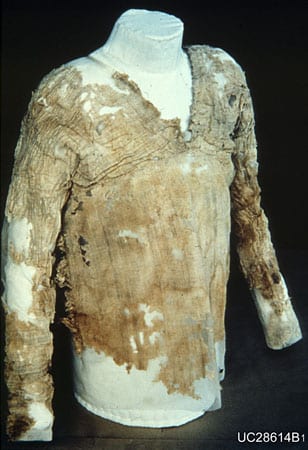
At Petrie Museum you find one of the oldest garments from Egypt on display in the world, the Tarkhan dress (pictured below) made of linen from around 3000 BC. There is also a reconstructed bead net dress that may have been worn for dancing in Dynasty 5 (c. 2400 BC). A visitor who was fascinated by these two garments asked me: how do we learn about Egyptian clothing? One of the most common ways to find out how people were dressed in the past is to study clothing in art. This quickly gives us a good idea of what people probably wore. However anyone interested in the actual materials used would have to investigate the physical remains of textiles from that time. Such studies can also help us understanding how the clothes were worn. For example, two large rectangular pieces of linen (displayed at museums outside the UK) have been recognised as dresses thanks to analyses of the stress marks and areas of wear on them which were identical to other pieces of clothes that were wrapped several times around the body.

If you’re interested in finding out more about research on the textiles that have survived I would recommend the book Pharaonic Egyptian clothing by Gillian Vogelsang-Eastwood (1993).


2015 | In the Artifact Lab: Treasures from Egyptian storage; The treatment of (half of) a yellow coffin


http://www.penn.museum/sites/artifactlab/2015/

Treasures from Egyptian storage

If you have visited the Artifact Lab in the last couple weeks, you may have noticed that we have a few more objects out than usual, and often, an additional conservator working in here.

A few objects (stone, cartonnage, ceramics) that were brought to the Artifact Lab recently for conservation treatment before they are moved off-site.

The new objects were recently brought up from Egyptian storage by conservator Alexis North, who was previously here as a graduate intern, and now is working as the new Project Conservator for the inventory and move of our Egyptian collections to an off-site facility.

Due to construction that will be happening at the Hospital of the University of Pennsylvania (HUP), which is adjacent to the museum, certain storerooms and galleries will be affected and as a result, the entire Egyptian collection in storage (with some exceptions) must be moved off-site for the duration of the project. This move requires a new inventory of the collection and also that everything be examined and stabilized, through conservation treatment and/or packing solutions, which will benefit the collection greatly. In addition, emptying the Egyptian storerooms will allow us to carry out a much-needed renovation of these areas, so that when the collections return, they will be housed in a much better protective environment.

We will try to feature some of the more interesting objects that come up to the lab as a part of this project on the blog, but if you do have a chance to stop by the Artifact lab this summer, you’ll be in for a treat, I assure you, because we will be working on some pretty amazing things.

This faience beaded collar is just one of the beautiful beaded objects that came into the lab recently as part of the move project.


The treatment of (half of) a yellow coffin

This week, we finally finished the treatment of the lower half of our 21st/early 22nd Dynasty yellow coffin.

A view of the interior of the coffin before (left) and after (right) conservation treatment.

The treatment mostly involved cleaning the interior surfaces to remove dust using a soft brush and HEPA-filtered vacuum, and cosmetic sponges. Here’s another view to give you a better sense of just how much grime had accumulated in the interior of the coffin:

A detail of the head of the interior of the coffin before (left) and after (right) conservation treatment.

There was also a fair amount of flaking and lifting paint, which needed to be stabilized. We used 1-2% methylcellulose in 50:50 water/ethanol to consolidate flaking paint, and Japanese tissue paper and 5% methylcellulose to fill gaps.

In the course of the treatment, I have also continued to research the significance of the holes drilled into the bottom of the coffin, which can clearly be seen in the overall images at the top of this post, but here is another look:

An overall shot of the coffin bottom, with a detail of 4 of the holes.

I’m anxious to start working on the lid of this coffin, which will inevitably provide more information about this object and it’s history. We should be able to bring the lid from storage up to the lab sometime this summer, and I’ll post images of it as soon as it arrives. In the meantime, I have enjoyed researching these types of coffins and finding images of similar ones in other collections (like this one at the Petrie Museum, this one at the Houston Museum of Natural Science, and this “remuddled” coffin at Stanford University) which is helping me gain a better understanding of these coffins and the contexts in which they were made.


Excavation and Restoration at the Temple of Millions of Years of Thutmose III in LuxorBY MYRIAM SECO ÁLVAREZ


http://www.drhawass.com/wp/excavation-and-restoration-at-the-temple-of-millions-of-years-of-thutmose-iii-in-luxorby-myriam-seco-alvarez/

Excavation and Restoration at the Temple of Millions of Years of Thutmose III in Luxor

BY MYRIAM SECO ÁLVAREZ

The excavations of the temple of Millions of Years of Thutmosis III in Luxor began in 2008, the result of a collaboration between the Academy of Fine Arts of Santa Isabel de Hungría of Seville and the Egyptian Ministry of Antiquities. Botin Foundation, Santander Bank and Cemex sponsor this project.

Aerial View, Temple of Millions of Years of Thutmosis III © Thutmosis III Temple Project

Although it was the temple of one of the most famous pharaohs of Egyptian history, dedicated to the preservation of the memory of the so-called Egyptian Napoleon, it had been barely studied. Some archaeologists such as Daressy, Weigall and Ricke previously investigated this monument, but it had never been excavated in its entirety. Due to its state of deterioration, the focus was directed towards other monuments which were better preserved. After 1938 nobody was interested anymore in this site, and with the passing of time, the temple fell into oblivion and was once again covered with sand.

When the Egyptian-Spanish joint project started the work in 2008, it looked like it was completely abandoned. The first thing we found was a storage room built by Weigall in 1906. It was located within the temple proper and inside was piled up a great quantity of fragments found during his excavations. This same storage room was used during the 30s of the previous century by Ricke, also to store part of the excavated objects. Due to this discovery, whose location did not appear in any document, the beginning of our work was characterized by a great activity in documenting all the stored material, which stood for so many years without any record. There we found parts of reliefs which decorated the limestone walls of the sanctuary’s chapels. Today we are making an epigraphic survey of all the fragments to see if we are able to rebuild some of the walls of this monument’s chapels.

This temple was partially excavated inside the hill and built on three terraces at different levels, with ramps to access from one to the other. It presents many similarities with the famous temple of Queen Hatshepsut at Deir el Bahari. The precinct is surrounded by a great enclosure wall of mud brick built with great perfection and it has a monumental pylon as main entrance, also in mud brick. The road that leads to the Valley of the Kings runs over the first courtyard of the temple, thus it is divided in two halves. There are also some houses-dwellings, “alabaster factories”, located over the south part of the pylon and which we have been dismantling since we have started our work.

Until now we have excavated and restored the northern, southern and eastern enclosure walls. This completely changed the aesthetics of the site, since the remains of the walls were completely covered and its monumentality was not apparent. In the course of our work we could clear the exterior area of the southern wall, where we found remains of a very interesting construction attached to the temple, and which is being studied. Likewise, in the exterior part of the northern enclosure wall, we found a great quantity of pottery vessels, evidencing the importance that this sacred place had for many years.

  • Documentation work in process © Thutmosis III Temple Project
  • Limestone blocks from the wall of the chapels © Thutmosis III Temple Project
  • View of the Pylon from the East © Thutmosis III Temple Projec
  • View of the second court of the Temple © Thutmosis III Temple Project
  • View of the Pylon from the West, entrance to the Temple © Thutmosis III Temple Project
  • Jewelry found in Tomb XIV © Thutmosis III Temple Project

The other area in which we concentrated our efforts was the pylon. This was found partly covered by rubble produced by the alabaster factories. It is one of the few pylons of this material which is preserved and that can give us a large amount of information regarding this type of construction. There were two trees that flanked the entrance, considering the two large holes where they were planted.

Inside the temple we worked in different sectors, such as, for example, on the ramp accessing the upper terrace. In addition, we excavated part of the upper terrace, the area of the sanctuary, hypostyle hall and peristyle hall. Another area of the temple that we investigated was the second courtyard, which is almost completely excavated. This has given us very interesting and, until now, unknown information about this monument. In the courtyard there used to be 8 large trees, placed in a symmetrical fashion on both sides of the ramp.

The northeast corner of the temple was also of great interest, since we found remains of a later occupation, later than the time of Thutmosis III. Thanks to the material found we know that the figure of the famous pharaoh was worshipped and memorialized by the priests of the Ramesside period. We found a complex from the time of Ramses II which belonged to the priest Khonsu “High Priest of Menkheperra (Thutmosis III)”. Among the most remarkable materials found, we should mention: two lintels on which was depicted the figure of the priest Khonsu worshipping the cartouches of Thutmosis III and two lower parts of black granite statues, one of the pharaoh himself, and the other of an official.

Another factor that enhances the importance of the site is its location between the hills of the “Khokha” and the “Assassif”. This area is a huge necropolis. Thus, underneath the temple there are tombs. Since 2010 we have been finding burials, of mainly two types: tombs comprising of a shaft, through which we access one or various funerary chambers, and tombs comprising of hallways excavated in the hill with shafts and funerary chamber. Therefore, it is as if we are excavating two sites at the same time, on one side the temple and underneath an entire necropolis of a previous era.

In addition, even though these are tombs that were looted in antiquity, in many of them we could still find materials and artefacts of great interest. Most of the tombs date back to the Middle Kingdom and some to the Second Intermediate Period. During our seventh excavation season in 2014, we found a lady buried with all her jewels.

Once the cleaning of the funerary shaft of the tomb no. XIV, which had already been looted in antiquity, was finished, the excavators could determine that in one of the chambers part of the roof had already collapsed before the desecration by ancient tomb robbers, which in turn nourished hopes that this particular part of the sepulchre had not been plundered in the past. As the cleaning of the debris went on, it became clearer and clearer that indeed these hopes had not been misleading.

Location of tombs XIV and XV © Thutmosis III Temple Project

A large boulder, which had fallen down before the tomb was looted, had crushed and buried a previously untouched coffin with all its contents. Thus, the raiding of the valuable artefacts attached to the mummy inside was prevented. When removing the aforementioned boulder, the excavators discovered vestiges of a wooden coffin completely destroyed and an utterly destroyed female mummy, which, however, still wore the marvellous jewellery attached to it during the process of mummification and subsequent burial. A preliminary analysis of the pottery found in the tomb allows for a reliable dating of the ensemble to the Middle Kingdom.

The female owner of the tomb was buried with a cylindrical amulet made of amethyst stones and gold plates, and a pendant in the form of a finely wrought golden shell weighing over 20 grams. She also carried two golden bangles on her arms, each formed by two pieces of twisted wire connected to each other with a reef knot, and silver bracelets on both ankles. The golden shell and the two golden bangles were found in a perfect state of preservation, while the silver ankle bracelets had suffered heavy damage. These spectacular findings confirm that under the Temple of Millions of Years of Thutmosis III there is an elite necropolis, in which wealthy and important individuals of the Middle Kingdom and their families were buried.

At the end of the 2013 campaign another tomb, no. XI, was unearthed, containing the unfortunately badly preserved funerary equipment and fragments of a wooden coffin belonging to a person named Ikery. The tomb, that had been looted and reused in later times, preserved the bones of seventeen different individuals and, among other artefacts, fragments of wooden models, canopic jars and small figurines, among which there were about twenty fragments of so-called magical wands, made of ivory, which are especially important, and that relay important information about the beliefs of the Ancient Egyptians.

Year after year, the three-month campaigns in the temple of Millions of Years of Thutmosis III have provided interesting materials for the study of important periods of the ancient pharaonic civilization.
 

Myriam Seco Álvarez is the Director of the Thutmosis III Temple Project.
http://thutmosisiiitempleproject.org/
The views expressed in this article are the author's own and do not necessarily reflect Dr Hawass' views.