CAIRO, July 19 (Xinhua) -- Six people, including a woman, were killed on Tuesday while illegally digging for ancient antiquities in southern Egypt's Qena province, a security source said.
The accident happened in Al-Araqqy village in northern Qena when two neighboring families tried to excavate antiquities beneath one of their houses, Mossad Abu Sikeen, chairman of the Qena security directorate told Xinhua, adding that an excavating hole collapsed which suffocated the victims.
The illegal digging for antiquities across Egypt, especially in the villages of the southern provinces, has more than doubled since the outbreak of the COVID-19 pandemic, as the sharp rise in unemployment has in large part fostered "the myth of easy wealth," Adel Abdel-Azeem, former assistant to the interior minister in the Upper Egypt region, told Xinhua in a previous interview.
Unfortunately, most of such excavations inside the old houses, deep and ill-considered, result in the collapse of homes, killing and wounding people, according to Abdel-Azeem. Enditem
East of the royal tombs in the Valley of the Kings are the tombs of the officials, courtiers, and even workmen who once served the ancient Egyptian Pharaohs, writes Zahi Hawass
People are always eager to hear more about the mysteries of the Valley of the Kings.
News from this hidden canyon where the Pharaohs of Egypt were buried during the New Kingdom (ca. 1550-1100 BCE) is reported enthusiastically by the media and devoured avidly by the public.
The spectacular discovery of the tomb of Tutankhamun in 1922 is, of course, to a large degree responsible for the fascination that the valley holds for the general public. But many people do not know that the foothills of the Theban massif just east of the royal tombs are also filled with unique tombs belonging to the people who served the Pharaohs.
Buried here are viziers, officials, courtiers, and even the workmen who carved and decorated the tombs. To date, approximately 800 tombs have been unearthed, and many more surely remain hidden in the rocky hills.
Some of the Theban tombs are well-known and contain familiar scenes. Others have been lost almost completely to the eyes of the world. Many are accessible but are closed to the public and visited only sporadically by scholars. Others have been hidden under villages built above them over the past centuries.
Of these modern villages, the most famous is Al-Qurna just west of the Ramesseum, where local people began to construct houses soon after foreign adventurers came to the Luxor area and began to rediscover the royal and private tombs. A number of the more notorious inhabitants of Al-Qurna have been well-known antiquities dealers, since one of the reasons that houses were built on top of the tombs was so that they could be robbed in secret.
Some years ago, we went with the police to one of the houses in this village and found that the owner had built it over the beautifully decorated tomb of Amenhotep Huy, viceroy of Nubia under Tutankhamun. Another person had dug a tunnel from his house to a nearby private tomb so that he could use it to store stolen antiquities. Others use the tombs beneath their houses as animal pens.
In 2007, the construction of a modern village called Al-Tarif to the north of the Valley of the Kings was finished. The villagers from Al-Qurna were moved to new homes here and their old houses were torn down, with 25 left as testimony to the unique history of this area. It should come as no surprise to learn that when the old houses were removed a number of tombs were discovered beneath them.
EGYPT'S GOLDEN AGE: Comprising dynasties 18 to 20, the New Kingdom, beginning in around 1550 BCE and lasting for four centuries, was a golden age for ancient Egypt.
It began when the Theban prince Ahmose succeeded in driving out the Hyksos, foreign princes who had occupied much of Egypt for the previous century, and founded the 18th Dynasty. He began what was to be several centuries of foreign wars by chasing the invaders into their homeland to the northeast and beginning to claim the Nubian lands to the south of Egypt, once controlled by the monarchs of the Middle Kingdom.
Ahmose was followed on the throne by his son Amenhotep I, who continued his father's expansionist policies. These early pharaohs also began what was to be a tradition for the next four centuries of building monuments in the Theban area to honour their ancestral god Amun.
Merged with the sun god Re, Amun-Re became the head of the Egyptian pantheon. Each king made offerings to the cult of this god in thanks for their victories abroad, and the power and wealth of the Amun priesthood eventually came to rival that of the monarchy.
Thebes remained for most of the New Kingdom the religious capital and one of the key political and administrative centres of the country. The kings were buried in the Theban hills surrounded by their families, their courtiers, and their high officials.
After Amenhotep I, the direct line died out and the reins of power were passed to Thutmose I, an army general who is believed to have been married to an Ahmosid princess. Thutmose I marched the armies of Egypt all the way to the Euphrates in the northeast and to the Fourth Cataract of the Nile in the south.
Many illustrious Pharaohs ruled during the 18th Dynasty. Some of the most famous are Hatshepsut, who held power for two decades, and her stepson Thutmose Ill, remembered as one of Egypt's greatest warriors.
Thutmose Ill's great-grandson was Amenhotep Ill, the "Sun King", who in turn engendered the "heretic Pharaoh" Akhenaten. The reign of this latter king is the most vigorously debated period of ancient Egyptian history. Ruling with his beautiful queen Nefertiti beside him, Akhenaten overturned the traditional religion of Egypt in favour of the Aten, the immanent disc of the sun.
Akhenaten was in all likelihood the father of Egypt's most famous monarch, the boy-king Tutankhamun. Most people know only of this king's fabulous treasure, but before his death and burial he ruled for almost 10 years during a period of great change in Egypt and chaos in the Near East. Populations were on the move, and Egypt's golden empire was under pressure from the new superpowers that were on the rise. Tutankhamun and his two successors all died without issue, and the 18th Dynasty came to an end.
The first Pharaoh of the 19th Dynasty was an army general named Paramesses, who became Ramses I. He was succeeded by his son Seti I, and then his grandson Ramses II, known to posterity as Ramses the Great. Under this long-lived and charismatic king, Egypt succeeded in retaining much of its original empire and made peace with its most powerful foes to the northeast, the Hittites.
After five more reigns (including that of one queen-regnant), power passed to a new line, the 20th Dynasty. The most famous king of this era is Ramses III, best known for having driven back a coalition of displaced marauders known as the "People of the Sea" who had allied themselves with Libyan tribes from the west.
Succeeding Ramses III were eight more kings named Ramses (IV through XI), and then the New Kingdom came to an end.
THE THEBAN NECROPOLIS: Built to serve as the eternal homes of the officials and nobles who were buried within them, the New Kingdom private tombs at Thebes span an area from north to south at the edge of the Western Desert.
Modern scholars have divided this swath of rocky land into five cemeteries. Farthest north is Al-Tarif, where most of the tombs date to the Middle Kingdom and early Second Intermediate Period. Just south of Al-Tarif is Dra Abu Naga. This was the burial place of the princes of the 17th Dynasty, the royal line that culminated in Ahmose. There are approximately 80 tombs here, dating from the 17th through to the 20th dynasties.
To the south and west, near the great memorial temple of Hatshepsut at Deir Al-Bahari is the Assasif, where about 40 tombs from the New Kingdom and later have been discovered to date. South of the Assassif is Al-Khokha. This cemetery was first used during the Old Kingdom and is also home to over 50 tombs from the 18th and 19th dynasties.
The necropolis that lies west of Al-Khokha is called Sheikh Abdel-Qurna. It contains more than 140 tombs, primarily dating to the 18th Dynasty. The southernmost Theban private cemetery is Qurnet Murai, where 17 tombs, mainly from the Ramesside period, have been excavated.
The rock-cut tombs of the New Kingdom elite all follow a basic plan consisting of cult chapel above and burial chambers below. Within these sacred spaces, the deceased were transformed into blessed spirits, able to live eternally in an ideal land beyond the earth.
While the cults were active, the relatives of the deceased could come to make offerings and say prayers to their honoured ancestors, and the tombs thus also served as liminal zones where the worlds of the living and the dead came together.
VALLEY OF THE NOBLES: The tombs cover the full span of the New Kingdom and include the final resting places of many of the most important players in the cosmopolitan world of the Pharaohs.
They exemplify the various architectural styles and developments of this period, and their superb decoration illuminates the various themes chosen by the tomb owners to commemorate their lives on earth and guarantee themselves a blessed afterlife. Both well-known and "lost" tombs illuminate the history of this fascinating era and the magical functions of these miniature temples to the cult of the dead.
The decoration of the Theban private tombs covers the walls of each tomb, most often the upper chapel but in some cases also of the burial suites. It was planned and executed carefully, designed to serve both to honour and preserve the memory of the deceased among those still living and to guarantee his or her transition to and eternal existence in the afterlife.
As a result, the scenes and texts within these tombs, which vary somewhat over time and from tomb to tomb within a specific period, provide us with important information about both life on earth and the religious beliefs of the ancient Egyptians. Some might say that these scenes can even help us write the history of Egypt.
Although these types of scenes serve specific magical functions within the context of the death and resurrection of the tomb owner, they also provide a window to the daily and official lives of the nobles and their families. Many tomb scenes show the deceased in relationship to the Pharaoh and also depict the activities for which the official was responsible during life.
For example, a granary official might show scenes of agriculture, so that the process of preparing the soil, planting the grain, and harvesting the crops would be eternally under his competent supervision. A vizier might choose a scene of foreign tribute, providing us with information about the physical features, clothing, and typical trade goods of neighbours to the south, north, northeast, and west of Egypt.
From the tomb of a military official might come scenes of army parades. For very special service to the king, an official could receive collars of gold in a public ceremony; this would certainly be depicted on the walls of his tomb, to be repeated in perpetuity.
Other scenes show sporting activities, such as hunting in the desert and fishing and fowling in the marshes, which carry significant ritual overtones, representing at one level the triumph of the proper order of the Egyptian world over the chaos that was believed to surround and threaten it.
Scenes connected directly to religious and cult activities include images connected with mummification and funerals, including the rituals carried out in front of the tomb itself. Among the other scene types are images of purification rites, pilgrimages to the sacred sites of Abydos, and the deceased with the gods.
A major theme that falls into this category is the offering scene, essential for making sure that the deceased is provided with a perpetual supply of food and equipment. At the centre of these images are the tomb owner and his family seated at tables piled high with fabulous food. Surrounding these core icons, which date back to the beginning of Egyptian history, can be seen rows and rows of offering bearers and relatives performing the cult.
Finally, there are images from religious texts such as the Book of Coming Forth by Day, commonly known as the Book of the Dead.
Although both ancient and modern tomb robbers have taken away the vast majority of the equipment buried with the New Kingdom elite at Thebes, enough remains to give Egyptologists a good idea of the important items that the ancient Egyptians considered they needed for the afterlife.
The nobles' tombs, like the burials of the kings, were robbed in antiquity, and almost every tomb that was not robbed in ancient times has been violated in the modern era. Only a few tombs have survived to be excavated by archaeologists, although even the robbed tombs have stories to tell the expert eye.
Modern pressures and external factors such as tourism and neglect threaten these tombs today, and without a major campaign to save the Valley of the Nobles, many of the tombs will be destroyed within the next century or less.
The New Kingdom tombs of the nobles are a rich source of imagery and information, but only a few of the hundreds of these spectacular tombs are known to the public. Selected scenes from these tombs, exquisite ones to be sure, are used over and over again to illustrate particular scene types or to represent this group of tombs as a whole.
Many beautiful and interesting tombs are often overlooked. In addition, such scenes are generally shown out of context, without reference to the purpose they were meant to serve.
*A version of this article appears in print in the 21 July, 2022 edition of Al-Ahram Weekly.
ARCE's Northern California Chapter is pleased to present the following lecture schedule of renowned Egyptologists. All lectures are at 3 p.m. Pacific time. Unless otherwise noted, the lectures will be in-person at UC Berkeley. Consumed by Raging Fire: Cremation Burial in Ptolemaic Alexandria August 28, 2022 Dr. Thomas Landvatter, Reed College, Portland, OR This lecture is virtual, a Zoom lecture. If you are not a chapter member, email arcencZoom@gmail.com to request a registration link.
Funerary Papyri as Social Reflections Of the Living and the Dead September 11, 2022 Dr. Marissa Stevens, UCLA
Akhenaten's Sudden Monotheism: Where Did All the Deities Go? And Why? October 9, 2022 Dr. Arielle Kozloff, Cleveland Museum of Art
Iron in the Sky: Words and Conceptions of Iron and Meteorites in Ancient Egypt November 13, 2022 Dr. Victoria Almansa-Villatoro, Brown University
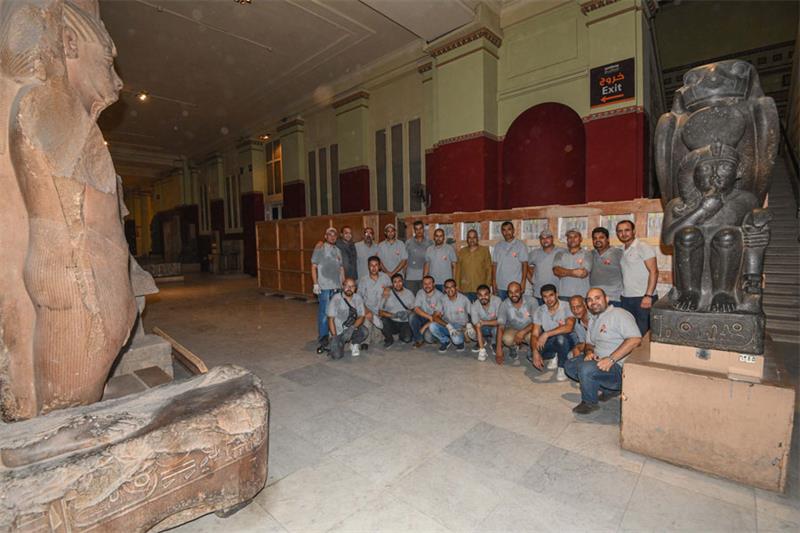
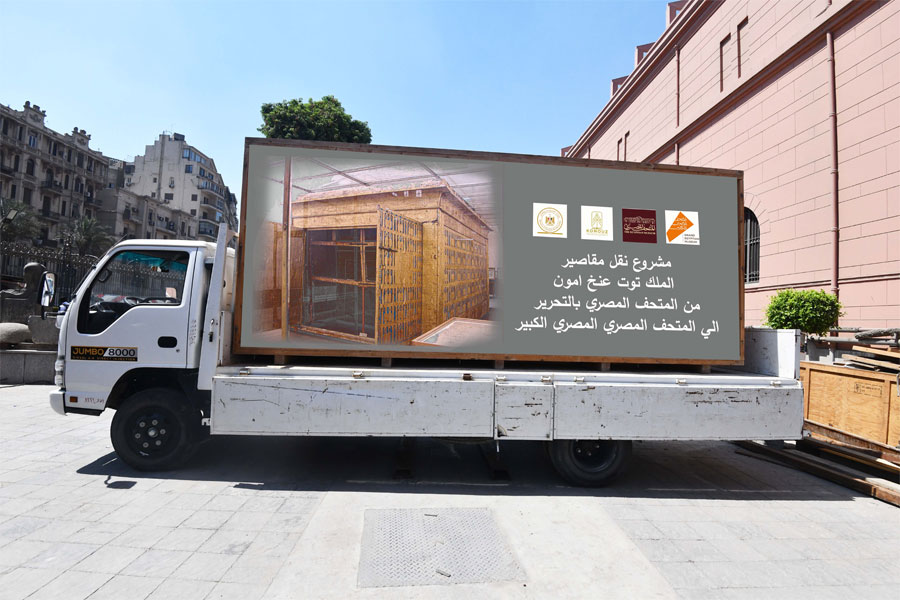
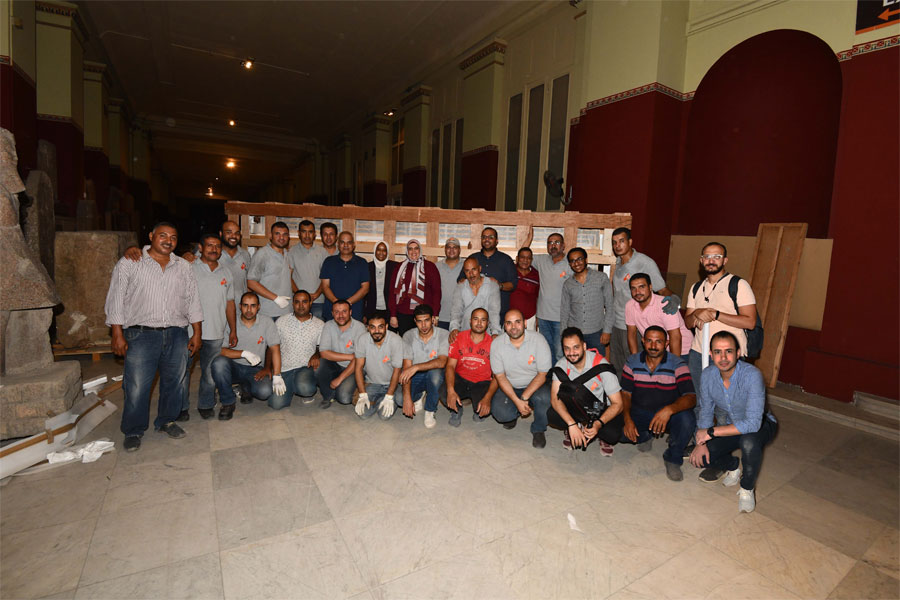
A few months after receiving the fourth, third and second shrines of Tutankhamun, the Grand Egyptian Museum (GEM) received the first and biggest shrine and placed it in its permanent location at the boy king's gallery.
Atef Moftah, supervisor-general of the GEM and the surrounding area, said the process of disassembling and transferring the shrine took eight days of continuous and hard work.
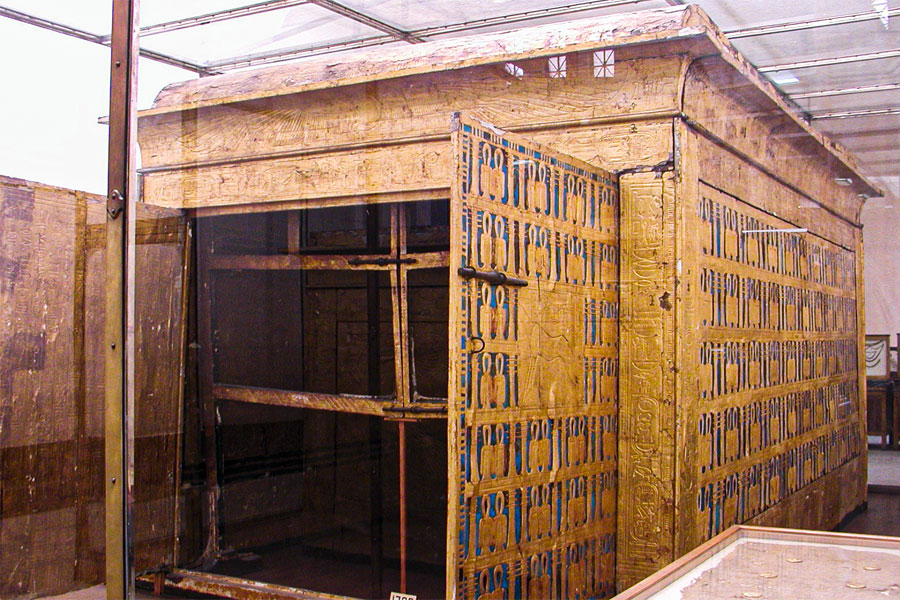
El-Tayeb Abbas, assistant minister of tourism and antiquities for archaeological affairs at the GEM, said the GEM has recently received three shrines of the boy king, and this last one is the biggest artefact from his treasured collection. It is carved in gilded wood and was discovered in November 1922 in the boy king's tomb in the Valley of the Kings on Luxor's west bank, along with the other shrines and the king's treasure collection.
Abbas added that the rest of the king's shrines will be transferred to be the GEM and displayed in the 7,200-square-metre gallery dedicated to the king's treasures. These are equipped with state-of-the-art display technology with the environmental control of temperature, humidity and lighting, in addition to labels with graphics and explanatory cards for each piece.
"More than 95 percent of Tutankhamun's collection were restored and put on its permanent display," he added.
Moamen Osman, head of the museums sector, asserted that the transfer was carried out amid security measures by the Tourism and Antiquities Police under the supervision of restorers and museum curators.
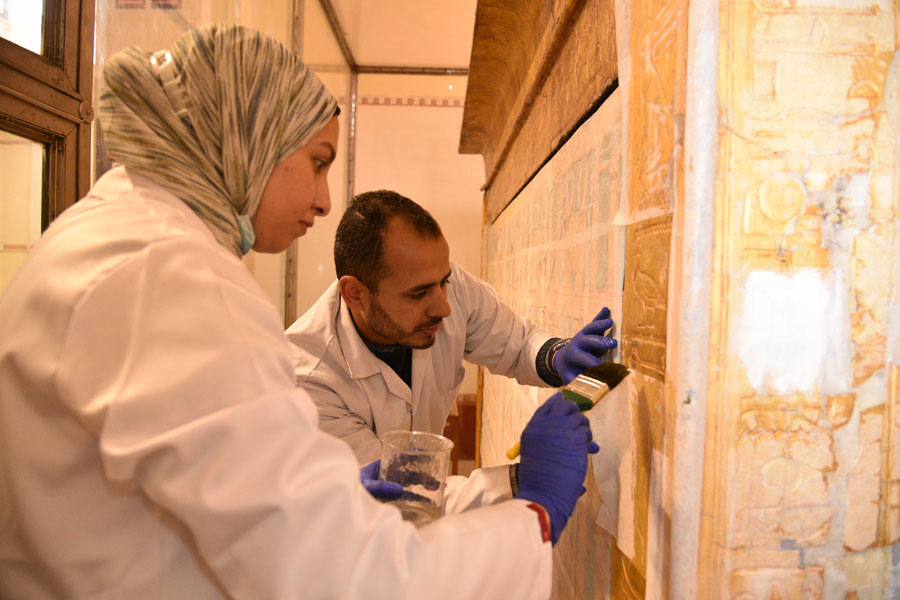
The shrine was dismantled and reassembled according to scientific and archaeological criteria, using the same techniques used by ancient Egyptians.
The shrine was dismantled into 20 pieces, each wrapped separately, Osman said, adding that the Egyptian Museum in Tahrir had restored the first shrine before its transport to the GEM.
Eissa Zidan, director of the restoration and antiquities transfer at the GEM, said a detailed report about the condition of the shrine was produced prior to the transfer. Each piece of the shrine was transferred in inner and external boxes using acid-free materials, he added.
Sabah Abdel Razek, director general of the Egyptian Museum in Tahrir, explains that this shrine was the first artefact to be seen inside Tutankhamun's tomb upon its discovery in 1922. The shrine is decorated with gilded layer decorated with faience tiles covered with Isis node and Jed sign with hieroglyphic texts.
A new stop on Egypt's Holy Family Trail will soon be inaugurated in the Upper Egyptian governorate of Minya after development and restoration work.
the rock-hewn Monastery and Church of the Virgin Mary
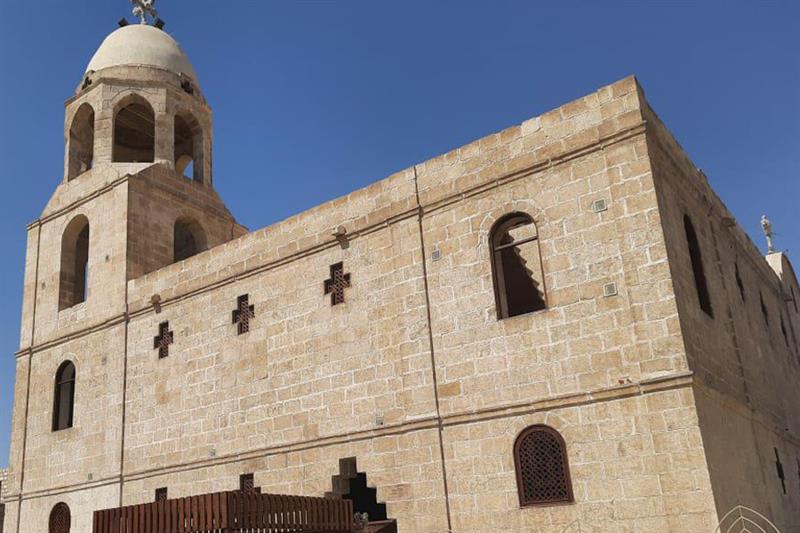
On top of the Gabal Al-Teir cliffs in the Upper Egyptian governorate of Minya stands the rock-hewn Monastery and Church of the Virgin Mary, with its distinguished architecture and wonderful view of the Nile Valley giving onto carefully cultivated fields and lush palm groves.
According to tradition, the area is called Gabal Al-Teir, meaning Mountain of the Birds, because of the thousands of birds living and nesting in the cliffs. It is one of the locations the Holy Family visited and stayed in for three days during their journey in Egypt in the early first century CE.
According to historian of Christian monasteries and churches in Egypt Abul-Makarim, while passing by the place in a small boat during the Holy Family's visit, the Virgin Mary noticed an enormous rock coming loose from the mountain and about to fall on the boat.
But the infant Jesus extended his hand and stopped the rock from falling, and the shape of his palm was imprinted on the rock. In 1168 CE, the then ruler of Jerusalem removed the part of the rock bearing the imprint and took it with him to Syria.
Osama Talaat, head of the Islamic, Coptic, and Jewish Antiquities Sector at the Ministry of Tourism and Antiquities, said that the Church of the Virgin Mary at Gabal Al-Teir was built in 328 CE by the Byzantine empress Helena (mother of the emperor Constantine) in memory of the passage of the Holy Family in Egypt.
In 1938, Severus, the bishop of Minya, restored the church and removed the original stone roof in order to enlarge it.
The church consists of a nave with three sanctuaries and two side aisles and a western return aisle separated from each other by 10 rock-cut columns. On the south side of the church, the baptismal font is carved out of a column. The area in front of the middle sanctuary serves as a choir.
Hisham Samir, assistant to the minister of tourism and antiquities for archaeological projects, said that work on the restoration project at the monastery and church had begun in 2018 after the approval of the Permanent Committee of Islamic, Coptic, and Jewish Antiquities. The work was carried out in two phases, the first phase covering the western corridor and being completely finished. The second phase includes the southern corridor and is to be completed soon for the official inauguration.
The work has included the restoration of the walls and ceiling of the church, removing cracks, consolidating the walls, repairing the bell in the church tower, and its four arcades and domes. The façades of the church were mechanically cleaned, and the modern mosaic set up in 1987 on the eastern wall of its southern entrance has been replaced with another mosaic showing the journey of the Holy Family.
Fine restoration has been carried out on all the decorations and icons in the church as well as the icon frames. New lighting and fire-security systems have been installed as well as electronic gates. To enhance the visitor experience, new services have been provided, including information signs, new paths, sunshades and seats.
Facilities around the church are also being upgraded and infrastructure installed to assist visitors following the route of the Holy Family's sojourn in Egypt. The goal of the larger Holy Family Trail includes developing poorer areas and communities in the Delta and Upper Egypt, restoring archaeological sites, and creating suitable services for visitors at sites along the trail.
This is all part of the ministry's desire to develop spiritual tourism that can appeal throughout the year and not just during special seasons.
THE HOLY FAMILY IN EGYPT: The Holy Family travelled in Egypt for around three years and six months, with their sojourn in the places they visited varying from a few days to a few months.
The Holy Family's flight to Egypt is associated with archaeological sites from Sinai to the Delta and Assiut in Upper Egypt. The Ministry of Tourism and Antiquities in collaboration with Egypt's Coptic Church has carried out a number of restoration and development projects at churches and monasteries on the route.
These include the restoration and inauguration of the Abu Serga Church in Old Cairo, the St Abba Noub Church in Sammanud, monks' cells and other structures at the Wadi Al-Natroun Monasteries, and now the Virgin Mary Church at Gabal Al-Teir.
The late Coptic pope Shenouda III approved itineraries drawn up for Christian pilgrims visiting Egypt to follow the route in 2000. During an audience in St Peter's in Rome in 2017, Roman Catholic Pope Francis blessed an icon by a Vatican artist representing the Holy Family's flight into Egypt and effectively gave his blessing to the millions of Christians around the world who may want to follow in the Holy Family's footsteps.
The Holy Family's flight to Egypt is associated with many archaeological sites, Osama Talaat noted. They journeyed south from Palestine across the wilderness, avoiding main roads for fear of capture. They entered Egypt at modern-day Rafah, where a lone sycamore tree is said to have survived on the site since their visit.
The Holy Family reached Arish, and from there they followed the old Horus Road along the Mediterranean coast to Zaraniq, where the Byzantines later built three churches. They continued to Al-Mohamediya, and their last station in Sinai was on the northwest coast near the edge of the Delta at the city of Pelusium, now the sprawling ruin of Tel Al-Farama. Here, archaeologists have discovered traces of several Roman churches.
They then travelled south along the Pelusiac branch of the Nile, which has long since dried up. They stayed in the city of Bubastis, now the ruin of Tel Al-Basta near the modern city of Zagazig. They then went on to Mostorod, where the Virgin is said to have bathed Jesus. There is a church in Mostorod named after the Virgin Mary that was built in the 12th century and that has been recently restored.
They then turned north again towards the town of Bilbeis, travelling northwest across the Delta. When they reached Damietta, they embarked on a ferry which took them to Sammanud. The Holy Family then continued north to Borollos. The next stop was Sakha in the western Delta. Here, the Virgin Mary is believed to have held her son against a rock which retained his footprint. A relic in the church dedicated to the Virgin in the area bears this mark.
The Holy Family then moved on to the Western Desert, eventually reaching Wadi Al-Natroun, where monastic settlements were later established. They then headed for what is now Cairo, where they stopped at Ain Shams and Matariya, where they sheltered under a sycamore tree, now known as the Virgin Mary Tree. One story says that when the Virgin Mary sat there, a spring of water gushed out of the ground.
The next stop for the Holy Family was Al-Zeitoun, and then Al-Zweila. Travelling south, they reached Old Cairo and hid in a cave that is now the crypt of the Church of Saint Sergius. In what is now Maadi, they went to the place now named the Virgin's Church of the Ferry. From there, the Family took a ferry across to Memphis and embarked on a boat that carried them to Upper Egypt.
Their first stop there was on the west bank of the Nile near a village now called Ashnein Al-Nassara at a place called Al-Garnous where a monastery was later built. A church dedicated to the Virgin was built at Deir Al-Garnous in the 19th century, on the west side of which is a well that is believed to have provided the family with water.
The journey continued towards Al-Bahnasa, Samalout, and then Gabal Al-Teir, where a monastery now stands. The Holy Family took shelter in a cave that is now covered by an ancient church. They travelled to Al-Ashmounein, Armant, and Dairout, and then crossed the river again and reached the town of Al-Qusseya.
They travelled east into the desert to Mount Qussqam, perhaps the most important of all their stations, where they stayed for six months and 10 days. This place was later called Al-Muharraq, which means "burnt", as there was an abundance of grass there which had to be burned so food could be grown in its place.
Mount Qussqam is sometimes called "the second Bethlehem", and its church is held to be the first ever built in Egypt. The cave in which the family sheltered later became the altar of the Church of the Virgin Mary.
According to Ahmed Al-Nemr, a member of the ministry's scientific office, an angel of the Lord appeared to Joseph in Assiut and told him to return to Palestine because king Herod was dead. The family then went back through Assiut and then probably sailed down the Nile to Memphis, landing at what is now Al-Badrashin near the ancient capital.
Once again, they may have passed through Maadi, Babylon, and Heliopolis before crossing the desert to Palestine and finally reaching their home town of Nazareth. "Not all of these places are archaeological sites, but they all share religious, social, and cultural rituals which derive from the holy journey," Talaat said.
The places at which the Holy Family stopped that house archaeological sites are the Virgin Mary Tree in Matariya, the Church of St Sergius in Old Cairo, the Monasteries of Wadi Al-Natroun, the Church of the Virgin Mary at Gabal Al-Teir in Minya, and the Al-Muharraq Monastery in Assiut.
*A version of this article appears in print in the 7 July, 2022 edition of Al-Ahram Weekly.
0 Comment(s)
Print
E-mail Xinhua, July 19, 2022