|

|
|
|
The Ministry of Tourism and Antiquities launched a new website for the Egyptian Museum in Tahrir, Cairo, marking the museum's 119th anniversary.
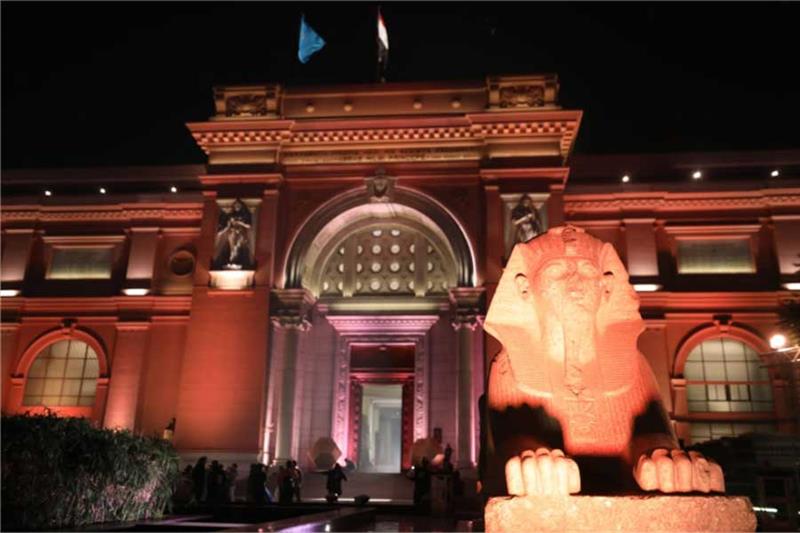
The website is part of the ministry's development project for the museum and its overall digital strategy.
The website was designed by an Egyptian digital company with funds from the European Union.
Work on the website began in April in collaboration with international experts, said Khaled Sherif, assistant to the minister of tourism and antiquities for digital transfer.
The website contains information about the museum, its collections, and services, he added.
Photo galleries on the website show the museum during its construction and shortly after its official inauguration. There are also photos depicting distinguished artefacts as well as a digital plan of the museum's halls and sections.
Tickets to the museum are sold on the website, he stated.
The Egyptian Museum in Tahrir was inaugurated in 1902 to house a treasured collection of ancient Egyptian artefacts, a library for rare books and a conservation centre. The museum is now under development with a new lighting system, new displays, and visitor's services. Late last month new electronic gates were installed.
-- Sent from my Linux system.
Studies of living and mummified baboons hint at why ancient Egyptians revered these pesky primates and uncover the probable location of the fabled kingdom from which they imported the animals
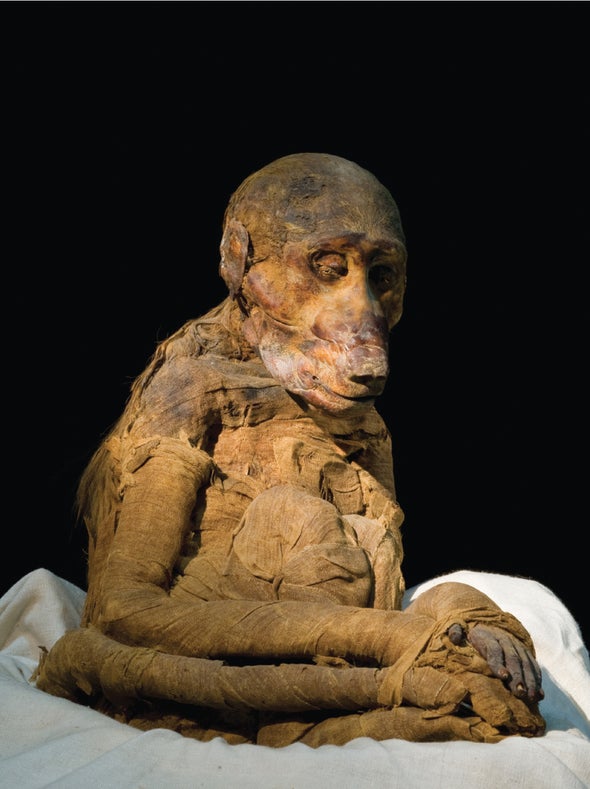
In the collections of the British Museum in London, a mummy known simply as EA6736 sits in eternal repose. Recovered from the Temple of Khons in Luxor, Egypt, it dates to the New Kingdom period, from 1550 B.C. to 1069 B.C. Clues to the identity of EA6736 emerge after close inspection. Its painstakingly wrapped linen bandages have disintegrated in some places, revealing fur underneath. Stout toenails poke out from the bandages around the feet. And x-ray imaging has revealed the distinctive skeleton and long-snouted skull of a primate. The mummified creature is Papio hamadryas, the sacred baboon.
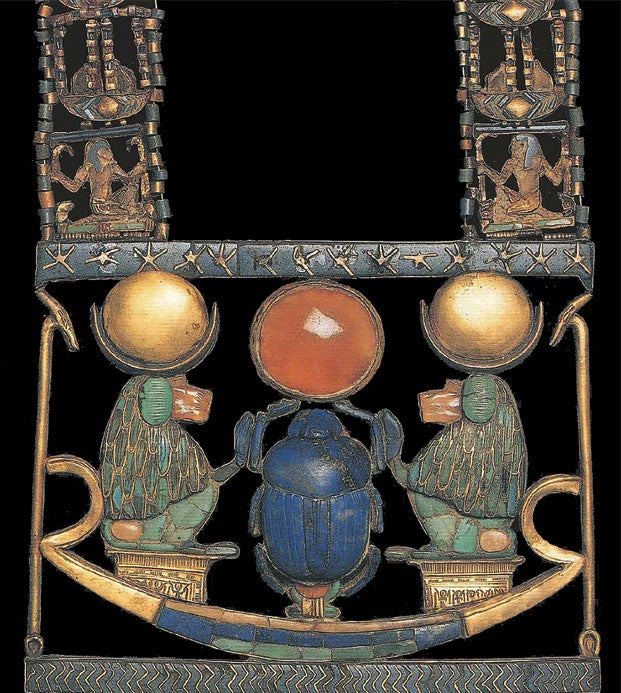
EA6736 is just one of many examples of baboons in the art and religion of ancient Egypt. Appearing in scores of paintings, reliefs, statues and jewelry, baboons are a recurring motif across 3,000 years of Egyptian history. A statue of a hamadryas baboon inscribed with King Narmer's name dates to between 3150 B.C. and 3100 B.C.; Tutankhamun, who ruled from 1332 B.C. to 1323 B.C., had a necklace decorated with baboons shown adoring the sun, and a painting on the western wall of his tomb depicts 12 baboons thought to represent the different hours of the night.
Egyptians venerated the hamadryas baboon as one embodiment of Thoth, god of the moon and of wisdom and adviser to Ra, god of the sun. The baboon is not the only animal they revered in this way. The jackal is associated with Anubis, god of death; the falcon with Horus, god of the sky; the hippopotamus with Taweret, goddess of fertility. Still, the baboon is a very curious choice. For one thing, most people who routinely encounter baboons regard them as dangerous pests. For another, it is the only animal in the Egyptian pantheon that is not native to Egypt.
Archaeologists have long puzzled over the prominence of the hamadryas baboon in ancient Egyptian culture. In recent years my colleagues and I have made some discoveries that bear on this mystery. Our work points to a biological explanation for the deification of the species. It also shows how the Egyptians obtained these exotic animals. Intriguingly, our insights into the sourcing of sacred baboons illuminate another enduring enigma: the likely location of the fabled kingdom of Punt.
"Baboons!" is an unwelcome cry at any six-year-old's birthday party. My family was living in Kenya when a troop of 20 baboons swaggered into our backyard, causing a great scattering of shrieking children. The invaders headed straight for the food table, which was neatly adorned with cupcakes, sliced fruit and juice boxes. They won the carb lottery that day, taking just minutes to fortify themselves with hours' worth of human labor. Setting aside my son's tears, the worst of it was watching the two males as they yawned in my direction. As a primatologist, I know that yawns are a pointed social signal, a way to advertise razor-sharp canine teeth that can cut a human limb to the bone with a single bite. In this context, however, the yawns seemed to convey not intimidation but full-bellied smugness.
When I recounted this tale to my Kenyan colleagues, it elicited knowing nods and a proverb: "Not all baboons that enter a maize field come out satisfied." Like many African proverbs, this one is layered with meaning. It alludes to the monkeys' insatiable crop raiding while simultaneously evoking sinister intent. Catherine M. Hill, a professor of anthropology at Oxford Brookes University in England, has found that baboons exact a devastating toll, reducing crop yields by half for some families in western Uganda. Indeed, baboons are the foremost pest for many subsistence farmers in Africa, and cultural aversions to the animals run deep. If erasure is the ultimate measure of contempt, then it is telling that in the art and handicraft traditions of sub-Saharan Africa, baboons are largely absent. This history makes the ancient Egyptians' worship of this creature—and its ubiquity in their art—deeply perplexing.
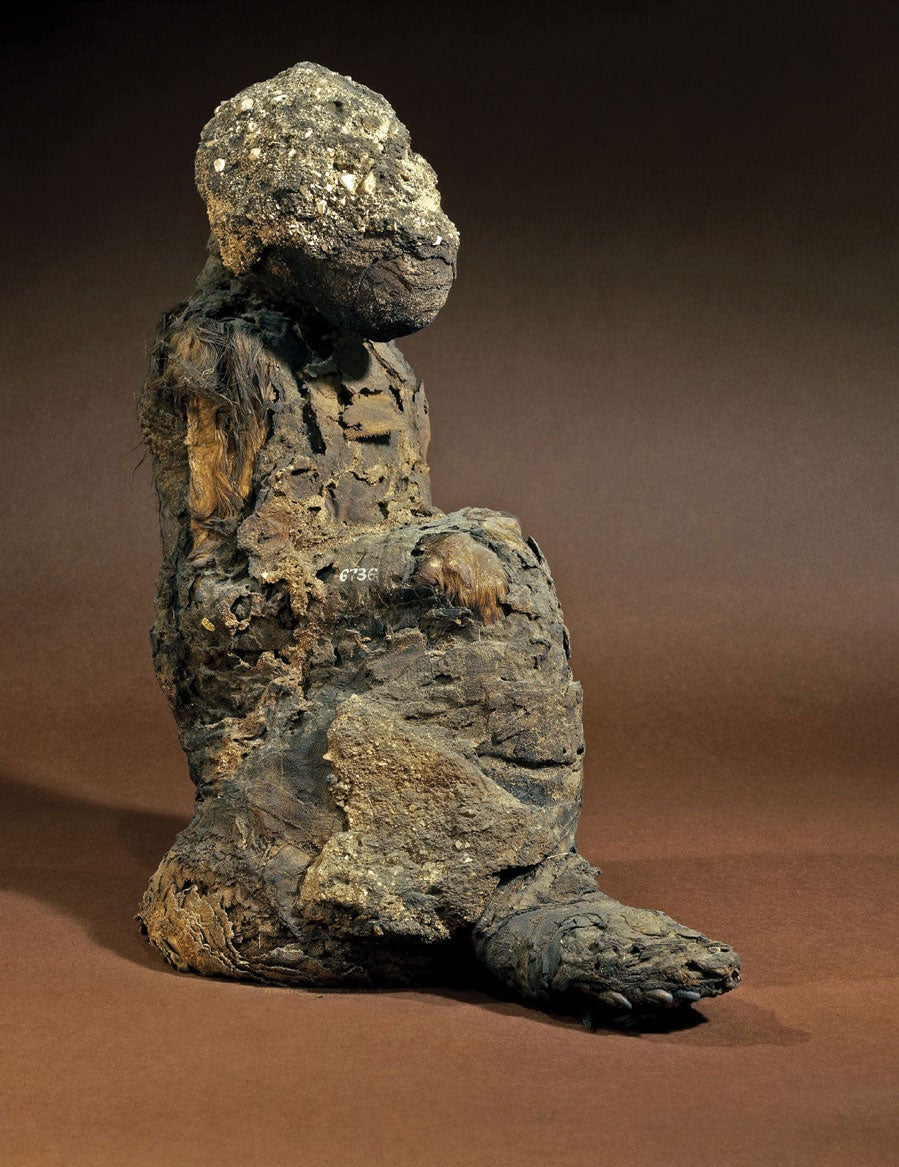
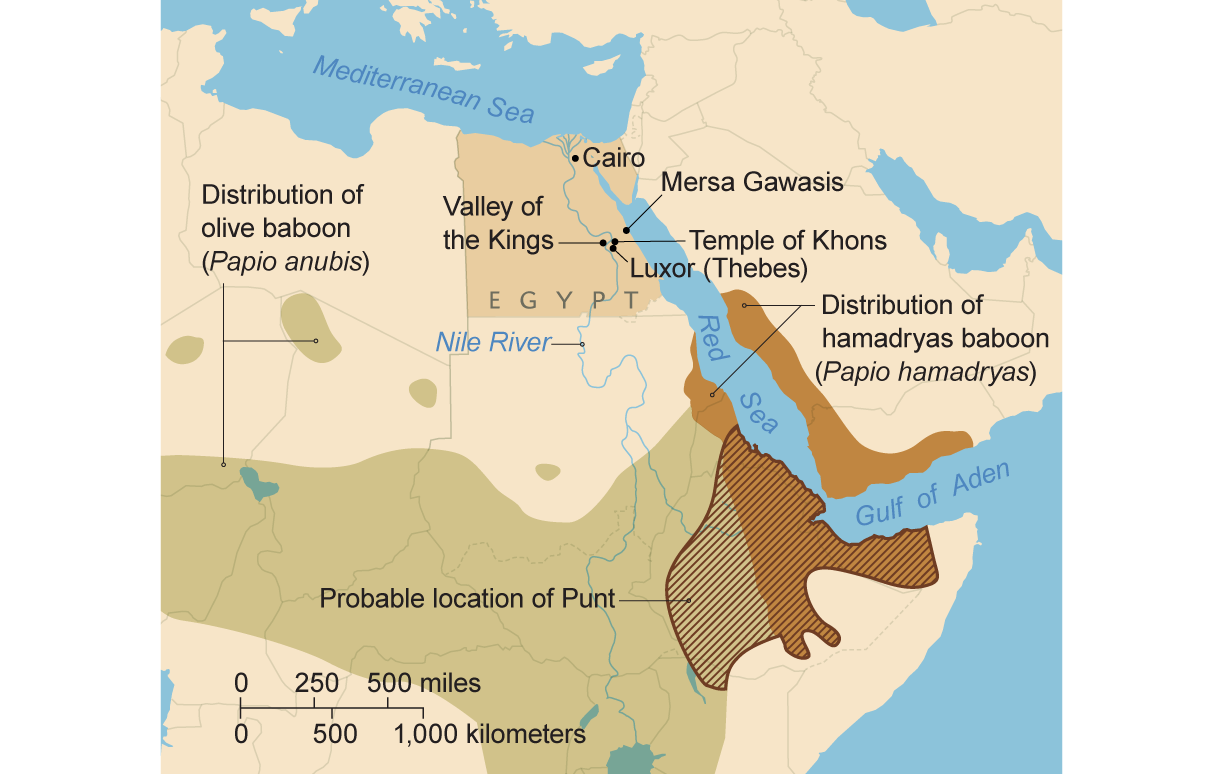
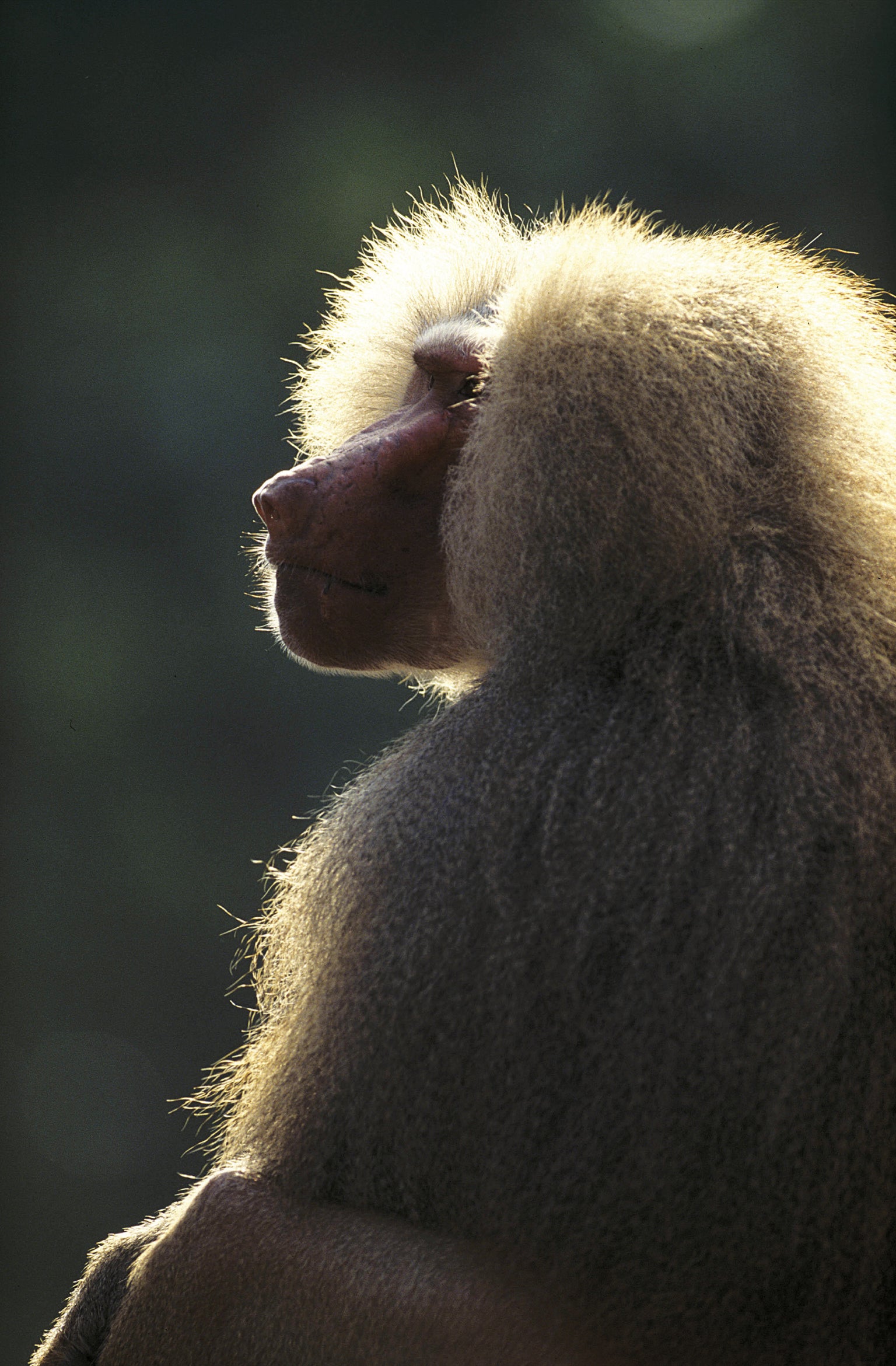
It is worth noting that modern baboons are typically divided into six species. All are native to sub-Saharan Africa and southwestern Arabia, and most people view them as pests. Researchers know from archaeological remains that the ancient Egyptians imported both Papio anubis, commonly known as the olive baboon, and P. hamadryas. But they deified only the hamadryas baboons, so any explanation for why the Egyptians revered baboons must account for their devotion to one species and not the other.
In their efforts to decode the significance of the hamadryas baboon, scholars have considered the way it is depicted in Egyptian art, noting two iconic forms. In the first, a male baboon sits on the thickened skin of its buttocks with its hands on its knees, its tail curled to the right and a disk representing the moon placed over its head. In the second, termed the gesture of adoration, the male baboon's arms are raised with palms upturned toward Ra, the sun god. Numerous Egyptian texts link baboons to Ra. For example, the ancient funerary texts known as the Pyramid Texts describe the baboon as the oldest or most beloved son of Ra. The Egyptian Book of the Dead explains that a suitable pronouncement of a deceased and newly resurrected person is, "I have sung and praised the Sun-disc. I have joined the baboons, and I am one of them."
To explain this connection between baboons and Ra, Egyptologist Elizabeth Thomas suggested in 1979 that the ancient Egyptians could have seen baboons face the rising sun to warm themselves and interpreted the behavior as their welcoming the sun. Her idea got a big boost a decade later, when the late Herman te Velde, another Egyptologist, elaborated on it by emphasizing the accompanying vocal behaviors of baboons, which he believed could have been taken as verbal greetings to the sun. Texts from the Karnak temple complex near Luxor describe baboons as "announcing" Ra while "they dance for him, jump gaily for him, sing praises for him, and shout out for him." In te Velde's view, people probably thought baboons were sacred because they seemed to communicate directly with Ra. The Egyptians saw the jubilance and inscrutable language of baboons as evidence of religious knowledge, he surmised.
Thomas's and te Velde's notions about what attracted Egyptians to these animals are fascinating, but are they plausible? Do baboons actually pay special attention to the morning sun? And are hamadryas baboons distinctive in this regard? Neither Thomas nor te Velde had much knowledge of primate behavior, and no primatologist had evaluated their ideas. Recently, however, findings bearing on these questions have emerged.
Many animals bask in the sun, an activity most biologists view as a way to minimize the energy cost of rewarming the body after a cold night. The ring-tailed lemurs of Madagascar, for instance, often face the morning sun in a posture resembling the lotus position of yoga but with extended legs. The late primatologist Alison Jolly once noted that Malagasy legend describes lemurs as worshiping the sun, holding their arms out in prayer. In 2016 Elizabeth Kelley, executive director of the Saint Louis Zoo's WildCare Institute, found that sun basking in these primates was strongly correlated with low overnight temperatures. Kelley and her colleagues also discovered that the skin of the chest and abdomen in these lemurs contains more melanin than the skin on the back, a reversal of the prevailing mammalian skin-color pattern. Melanin is a light-absorbing pigment, and greater amounts in the abdominal area facilitate not only warming but also digestion.
Primate studies carried out over the past few years indicate that baboons reap similar digestive benefits from soaking up the sun. The microbes that live in primate intestines are vital to the digestion of plant matter. A rising body temperature spurs microbe activity, which in turn increases the intestines' absorption of nutrients. Thus, sun basking is a simple and effective way for animals to jump-start their microbes in the morning. The benefits are twofold. First, digestion itself generates heat—good for warming a body chilled by the night air. Second, if a cold night slowed digestion during sleep, then it is both efficient and prudent for a primate to finish digesting yesterday's meal before searching for a new one.
It stands to reason, then, that some primate species should bask in the sun more than others, depending on where they live and what they eat. Hamadryas baboons live in arid habitats across the Horn of Africa and parts of Arabia. The western edge of their geographic range meets the eastern edge of the range of P. anubis in the Awash River Valley of Ethiopia, a setting that has long invited comparisons of ecological and behavioral differences between the two baboon species. Feeding observations reveal that hamadryas baboons eat more leafy plant tissues than olive baboons do, which means their diet is higher in fiber.
In theory, given their distinct diets, hamadryas and olive baboons should differ in the abundance and types of microbes they need to digest plant foods. Recent studies of the gut microbiomes of the two species conducted by biological anthropologist Steven Leigh of the University of Colorado Boulder and his collaborators, including me, bear this prediction out. We found that the hamadryas baboon has more so-called cellulolytic microbes—which break down plant cell walls—than the olive baboon does, in keeping with its higher-fiber diet. The upshot of these findings is that the hamadryas baboon appears to have more to gain from early-morning sunbathing than the olive baboon has.
Our gut microbiome findings corroborate Thomas's hypothesis that Egyptians witnessed hamadryas baboons "welcoming the sun-disc." They may also explain why Egyptians venerated P. hamadryas over P. anubis: perhaps its dietary ecology produced morning behaviors that resonated more strongly with their religious beliefs.
Whatever the reason for their devotion to this species, ancient Egyptians went to great lengths to acquire living hamadryas baboons. Their demand for these animals, as well as for other luxury goods, including gold, incense and ivory, became a market force that shaped the course of world history.
In 1906 Theodore M. Davis, a colorful American lawyer and financier, discovered five mummies of P. hamadryas in the Valley of the Kings. The mummies came from tombs attributed to either Amenhotep II or King Horemheb, both of whom were members of the first dynasty of the New Kingdom, a period of great prosperity. The tomb of Amenhotep II's father, Thutmose III, contained a P. hamadryas skull that had apparently been unwrapped and then jettisoned by discriminating tomb raiders. Although baboons are depicted in older Egyptian art, these mummies represent the earliest-known physical remains of hamadryas baboons in Egypt. The abrupt appearance of P. hamadryas in these funerary contexts suggests that it was imported at great expense. Salima Ikram, a professor of Egyptology at the American University in Cairo, has argued that these baboons were cherished pets as well as exotic status symbols. Their presence in royal tombs and the high quality of their mummification—using prodigious lengths of the finest linen—speak to their value. Only the wealthiest Egyptians could afford this superior means of preserving bodies for the afterlife.
To determine where ancient Egyptians got their hamadryas baboons, my colleagues and I analyzed two mummies, one of which was EA6736. Both specimens had been purchased by Henry Salt, British consul general in Egypt from 1816 to 1827, and were later acquired by the British Museum. Although the ages of these mummies are not known as precisely as those of Davis's mummies, considering their style of wrapping and the fact that they came from Theban temples, they were probably mummified during the New Kingdom period.
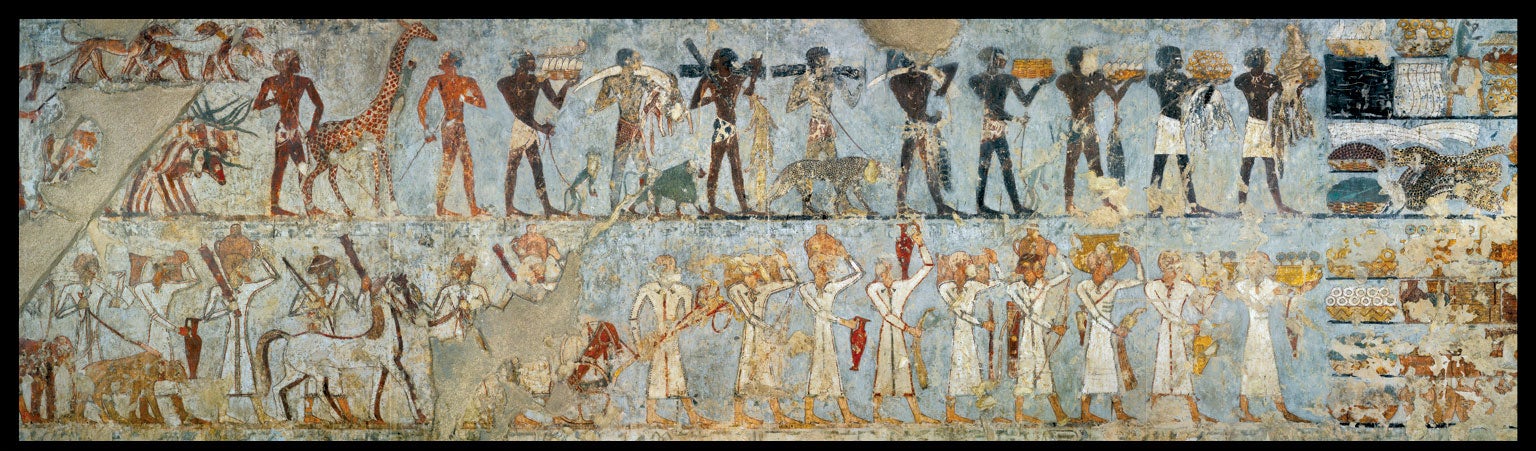
Texts and inscriptions from this time indicate that the Egyptians used their port at Mersa Gawasis to conduct maritime expeditions to the mysterious kingdom of Punt, a faraway realm of luxury goods that was said to exist "in God's land." The global historical importance of Punt is considerable. British historian John Keay described the sea route to Punt as the first long step in the spice route, a trade network that drove maritime technologies and shaped geopolitical fortunes for millennia. But there is a problem, as archaeologist Jacke Phillips observed in 1997: "Punt has not yet been located with certainty on any map, and no archaeological remains have ever been identified, even tentatively, as 'Puntite.'"
If Egyptians obtained hamadryas baboons from Punt, then tracing the geographic origins of the mummies more specifically might allow us to pinpoint the location of this legendary place.
Luckily, we can reconstruct the lifetime movements of the baboons that were mummified by examining the chemical compositions of their tissues. My colleagues and I focused on the element strontium because its composition in bedrock differs from place to place. The strontium is absorbed by the surrounding soil and water and enters the food chain when animals eat plants that grow in the soil and drink the local water. Strontium in an individual's teeth, which develop early, can thus reveal where it was born; strontium in bone and hair, which change throughout life, can show where it lived just prior to death.
We compared the strontium compositions of the mummies' bones and teeth with those of baboons living in various regions across Africa. Our spatial analysis of these chemical profiles indicates that the animals were born outside Egypt in the southern Red Sea region, which encompasses the modern-day countries of Ethiopia, Eritrea, Djibouti and Somalia. Gratifyingly, historians have previously highlighted these areas as potential locations for Punt on the basis of written accounts, as well as images of plants and animals on the walls of Egyptian temples and tombs. A great strength of our result is that it puts Punt within the natural distribution of P. hamadryas.
The revelation that baboons were imported alive from the southern tip of the Red Sea is a testament to the astounding reach of Egyptian mariners during the second millennium B.C., demonstrating that they could sail at least 1,300 kilometers each way in open boats without a keel or rudder. It must have been a treacherous journey, and it is perhaps no accident that one of the most famous narratives in Egyptian literature is The Tale of the Shipwrecked Sailor, which tells the story of an Egyptian sailor who washes ashore on a magical island in the Red Sea.
We still have much to learn about ancient Egyptian religious beliefs and trading practices. As we move forward, it would be useful to examine the morning behaviors and melanization patterns of hamadryas baboons and to see whether they support the hypothesis that this species is especially dependent on the morning sun. Our work also underscores the importance of searching Eritrea and neighboring countries for corroborating archaeological evidence, such as Egyptian products, that could speak to Punt's location.
One wonders what the Puntite traders thought of the Egyptians' obsession with baboons. It is tempting to speculate that they were only too eager to exchange a local pest for Egyptian trade goods. But we have that cultural idiosyncrasy to thank for illuminating one of the most important trade routes in human history.
This article was originally published with the title "Secrets of the Sacred Baboons" in Scientific American 325, 5, 46-53 (November 2021)
doi:10.1038/scientificamerican1121-46
-- Sent from my Linux system.
Some wigs on the 200 figures in Hatshepsut's tomb in ancient Egypt were intricately styled, some were crude and one figure was left bald, for instance: Archaeologists think they know what happened

Like all tombs of ancient Egypt's monarchs, the walls of Pharaoh-King/Queen Hatshepsut's mortuary temple are covered in reliefs. The 200 almost-identical figures carved into the soft limestone are all frozen mid-march, bearing a variety of offerings for the pharaoh.
"Almost" is a key word. Like in a game of Spot the Difference, there are subtle differences between the figures, such as retraced chisel lines and various wigs, suggesting a division of labor between masters and apprentices.
Assuming the ancient Egyptian artists weren't trying to intentionally depict a plethora of different hair styles, a recent article from the journal Antiquities postulates that these variations may indicate how ancient Egyptian artists crafted these massive friezes, and which tasks their apprentices tended to, messed up, or simply didn't finish.
The temple of Hatshepsut is the centerpiece of the Deir el-Bahari mortuary complex in Thebes on the western bank of the Nile River. The necropolis is nestled at the base of towering desert cliffs and was constructed in the 15th century B.C.E.
Excavations, conservation work, reconstruction efforts and epigraphic studies have been conducted in the chapel, including fully documenting these approximately 13-meter-long reliefs.
In this process of documentation, Anastasiia Stupko-Lubczynska from the Polish Center of Mediterranean Archaeology at the University of Warsaw studied the chisel marks and believes she has identified traces of almost all of the steps involved in crafting the reliefs.
She even found traces of the square grid used for dividing the wall into sections – one of the first steps in the relief making process.

The case of the missing wig
Stupko-Lubczynska believes these details and chisel patterns refute prior theories that only trained artists worked on significant architectural projects: it seems training was done there too, at least at the temple of Hatshepsut.
The operation was akin to a Renaissance workshop creating a statue, she posits: apprentices handled the easier parts requiring less attention, like broad torsos, and skilled craftspeople worked on technical subtleties such as facial expressions.
Analysis of differing chisel marks suggests there was a segment in one relief where the master or masters and trainees collaborated on wigs. Parts of some wigs in this section are crafted so well that Stupko-Lubczynska believes this is where the skilled workers demonstrated and taught their apprentices.
"Those wigs were done by this master sculptor because they are so perfectly done you can't observe it in other wigs," said Stupko-Lubczynska. "In this case, I believe he was showing off, 'look how perfect I am, look how you should do this,' because he is giving volume to those wigs, even though these are only rows of curls."

Varying degrees of quality between different baskets and jugs suggest that apprentices or at least less skillful workers were assigned some of these items, while the masters committed their efforts to more complex areas, like delicate facial features.
There are also many examples where it seems more skilled workers had to re-carve outlines likely messed up by apprentices.
One wig was largely left unfinished in the corner of the Chapel. Again, assuming they weren't intentionally trying to depict a wigless, bald Egyptian, it was likely an apprentice slacking because this unfinished head is in the collaborative section.

Stupko-Lubczynska speculates it was left undone because it was in a poorly lit corner. She points out that her study of the chisel marks is done with the help of electric light or under natural light because half of the roof is now gone, whereas the relief makers worked in a fully roofed, dimly lit structure and only had flickering torches. Even during the day, they would have worked in dark conditions without any natural light.
Little attention has been given to the process of ancient Egyptian wall décor, what we today call art, because of the general homogeneity of what they produced. This study, showing the mistakes and variations, gives us a rare glimpse at the process.
Egypt's glass ceiling is broken
The mortuary complex used to contain many more reliefs of royalty, but over the years many were shipped off to European museums. Fortunately, the Chapel of Hatshepsut survived the centuries relatively intact.
The 200 offering bearers, 100 on each side of the opposing chapel walls, previously ended at reliefs of Queen Hatshepsut (one on each side of the hall) but her likenesses were erased by her successor, former co-ruler, stepson and nephew Thutmose III or his successor. Some think it was out of hatred. Stupko-Lubczynska suspects the desecration was merely political.
In fact attempts to erase her images occurred throughout the empire, but according to Stupko-Lubczynska, they didn't occur immediately: it took about 20 years. In some places her likeness was replaced with that of her husband Thutmose II.
Some like Joyce Tyldesley of the University of Manchester think these efforts to expunge her rule from the record were because she was a female leader who claimed the title and responsibility of pharaoh-king instead of just waiting for her nephew to grow up.
This earliest known female leader led Egypt through a fragile time after the expulsion of the Hyksos, an immigrant people who rose to power, however briefly. She helped lay the foundation of classical Egypt and set a precedent for following dynasties, and her statues depict her wearing the same garb as male pharaoh-kings and sometimes even sporting a fake beard.

This may have been done to avoid granting legitimacy to a female leader, anthropologists suspect; and she lent a hand to this portrayal in order to legitimize her position as pharaoh. Depictions of her with things like her perfume — a flacon of which was found bearing her name in the Valley of the Kings —have never been found.
Identifying the mastermind
Now work is being done to preserve the reliefs in the Chapel of Hatshepsut, and Stupko-Lubczynska is trying to identify the artistic architect. She is trying to connect between the chiseling artists, their signature-like marks and the people who actually planned the relief.
"Those people who were executing the reliefs just colored coloring books," she says. "Someone had to figure out where and how to put all those texts and images, and there is meaning behind all of that."

She actually has a list of candidates from textual documentation and thinks there may be a way to identify an artist's calling card.
One option is the royal architect Senenmut who may, based on textual documentation, have been in charge of building the chapel, but Stupko-Lubczynska doesn't think he did it alone.
Another option could have been Puimre, the Second Prophet of Amun under Hatshepsut's rule. There are also remarkable designs in his tomb which had similarities to those in Hatshepsut's mortuary temple. Maybe the showoff worked on both projects.
-- Sent from my Linux system.
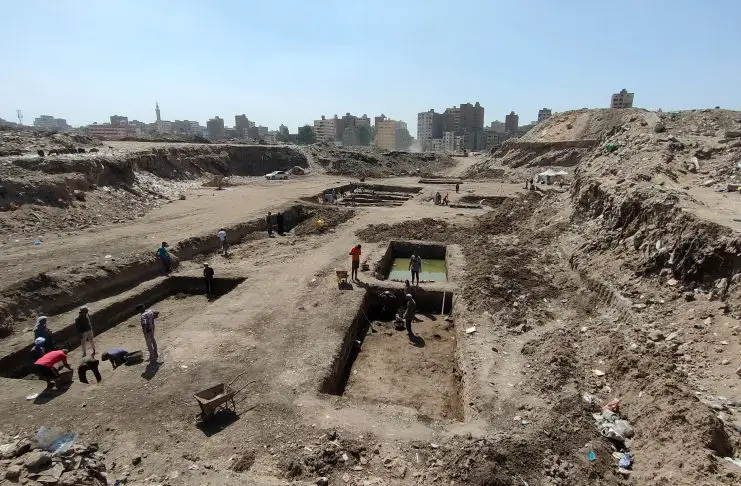
Heliopolis, meaning "City of the Sun" was one of the oldest cities of ancient Egypt that was occupied since the Predynastic Period. The city was the cult centre of the sun got Atum, who later became identified with Ra and then Horus.
A team of archaeologists from the Institute of Egyptology at Leipzig University, in combination with the Egyptian Ministry of Tourism and Antiquities, have excavated basalt reliefs and inscriptions from the Matariya temple built by Kheperkare Nakhtnebef, better known by his Hellenised name of Nectanebo I (380 to 363 BC) who founded the 30th dynasty.
A number of temple building components and statue fragments were also unearthed in the vicinity of the still-standing obelisk of Heliopolis, in addition to a fragments of quartzite statues of Rameses II, an obelisk fragment from the time of King Osorkon I, as well as a sanctuary for the deities Shu and Tefnut from the time of Psamtik II.
The researchers stated that the discovery gives new insight into the rise of the regions of Lower Egypt, including the representation of the region of Heliopolis itself.
Dr Dietrich Raue, curator of the Egyptian Museum at Leipzig University said: "The inscriptions provide an insight into the date when the temple was founded in the early summer of 366 BC, the dimensions of the temple, and the materials used. A number of unfinished blocks suggest that construction work abruptly ended following the king's death and did not recommence".
"This would make it one of the last, if not the final major structure built after a good 2400 years of continuous construction work by the kings of Egypt at the place where the world was created. Further architectural elements came from the time of Rameses II (1279 to 1213 BC) and his son Merneptah (1213 to 1201 BC)." Added Raue.
-- Sent from my Linux system.
 The American Research Center in Egypt, Northern California Chapter, and the Near Eastern Studies Department, University of California, Berkeley, invite you to attend a virtual lecture by Dr. Stuart Tyson Smith, UC Santa Barbara: The American Research Center in Egypt, Northern California Chapter, and the Near Eastern Studies Department, University of California, Berkeley, invite you to attend a virtual lecture by Dr. Stuart Tyson Smith, UC Santa Barbara: "Backwater Puritans"? Racism, Egyptological stereotypes and the intersection of local and international at Kushite Tombos Zoom Lecture. A registration link will be automatically sent to ARCE-NC members. Non-members may request a registration link by sending email with your name and email address to arcencZoom@gmail.com. Attendance is limited, so non-members, please send any registration requests no later than Friday, December 10. Glenn Meyer ARCE-NC Publicity Director Tombos panorama - 2017 (Photo courtesy of Stuart Tyson Smith) About the Lecture: Egyptological and more popular perceptions of Nubia and the Kushite Dynasty (c. 747-654 BCE) have framed Kush as a periphery to civilized Egypt, unsophisticated interlopers in Egypt and the broader Mediterranean world during the first millennium. Depictions of Nubians from earlier periods of Egyptian history, like Tutankhamen's painted box, reinforced these ideas of Nubian inferiority compared to Egypt and the Near East. But to what extent was Nubia a "backwater" to "effete and sophisticated" Egypt as John Wilson once asserted? For the Persians, depictions of Nubians and other foreigners presenting gifts at Persepolis represented the diversity of the empire paying homage to the Persian king as an all-lord whose rule encompassed numerous peoples. Archaeological evidence supports the more cosmopolitan Persian view of Kush against older racist Egyptological stereotypes of "barbaric" Nubians. It is clear from recent archaeological work at Tombos and elsewhere that Nubia was not an unsophisticated backwater. Objects with Egyptianizing motifs in the international style asserted a cosmopolitan social status that connected their owners to an international elite culture that spanned Nubia and Egypt, and extended across the Mediterranean during the Iron Age. Yet consumption of this material culture was mediated by cultural preference, and balanced by objects like pyramids and black topped pottery that reflected ties to an Egyptian colonial and deeper Nubian past. The Kushite civilization that flourished for a thousand years was not an imperfect imitation of ancient Egypt, as some Egyptologists have asserted. Instead, features taken from Egypt and the Mediterranean world were adapted and thoroughly integrated with local practices and belief systems. About the Speaker:  Stuart Tyson Smith received his PhD in Archaeology from UCLA, and is Professor of Anthropology and Director of the Institute for Social, Behavioral, and Economic Research at the University of California, Santa Barbara. Smith's research centers on the civilizations of ancient Egypt and Nubia with a theoretical focus on the social and ethnic dynamics of colonial encounters and the origins of the Napatan Kushite state, whose rulers became Pharaohs of Egypt's 25th Dynasty. He has published on the dynamics of Egyptian imperialism and royal ideology, the use of sealings in administration, death and burial in ancient Egypt and Nubia, and the ethnic, social and economic dynamics of intercultural interaction between ancient Egypt and Nubia. He has participated in and led archeological expeditions to Egypt, and since 1997, to Sudanese Nubia, where he co-directs the UCSB-Purdue University Tombos expedition to the third cataract of the Nile with bioarchaeologist Prof. Michele Buzon and Prof. Mohamed Faroug Ali of Africa International University, Khartoum. In addition to fieldwork, he is engaged in a long-term study and write-up of the UCLA excavations conducted by the late Alexander Badawy at the fortress of Askut in Sudanese Nubia. In a new line of research, Smith applies a postcolonial approach to modern scholarly and popular views of ancient Egypt as not truly African and Nubia as its subordinate, confronting the intersection between racism and longstanding academic and political bias. In 1993, he took a break from academia as Egyptological Consultant for the hit MGM movie 'Stargate,' commenting on the script and recreating spoken ancient Egyptian for the film. He returned to Hollywood consulting in 1998 and 2000 for the Universal remake of 'The Mummy' and its sequel, 'The Mummy Returns,' and most recently for 2018's web production 'Stargate Origins: Catherine.'
For more information, please visit https://facebook.com/NorthernCaliforniaARCE/, https://arce-nc.org/, https://twitter.com/ARCENCPostings, or https://khentiamentiu.org. To join the chapter or renew your membership, please go to https://www.arce.org/general-membership and select "Berkeley, CA" as your chapter when you sign up. |
-- Sent from my Linux system.


