Search This Blog

Friday, December 28, 2018

AWOL - The Ancient World Online: Some recent Dissertations from the University of California


http://ancientworldonline.blogspot.com/2018/12/some-recent-dissertations-from.html
On 12/28/2018 06:20 AM, Charles Jones wrote:
Some recent Dissertations from the University of California Some recent Dissertations from the University of California
  • Thesis
  • Peer Reviewed

Elite Theban Women of the Eighth-Sixth Centuries BCE in Egypt: Identity, Status...

The roles and status of women in ancient Egyptian society remain imperfectly defined particularly in the Third Intermediate and Late Periods. Egyptology has generally examined women from the perspective of fertility and sexuality, thus defining the social roles of...
Cover page:                    Elite Theban Women of the Eighth-Sixth Centuries BCE                    in Egypt: Identity, Status and Mortuary Practice
  • Thesis
  • Peer Reviewed

Raising the Dead: The Bioarchaeology of the Saite and Roman Period Wall of the...

This dissertation examines the extent to which sociopolitical changes from the Saite to Roman periods of Egyptian history affected the lives of a non-elite population from the Memphite region in Lower Egypt. This examination is accomplished through a...
Cover page:                    Raising the Dead: The Bioarchaeology of the Saite and                    Roman Period Wall of the Crow Cemetery in Giza
  • Thesis
  • Peer Reviewed

Transfiguring the Dead: The Iconography, Commemorative Use, and Materiality of Mummy...

The mummy shrouds, often overlooked or dissected into dichotomous parts because of their Hellenistic and Egyptian hybrid pictorial nature, provide unparalleled insight into religious and social facets of life and death in Roman Egypt. Moving beyond the aesthetic properties of these objects and focusing...
Cover page:                    The Provincial Cemeteries of Naga ed-Deir: A                    Comprehensive Study of Tomb Models Dating from the                    Late Old Kingdom to the Late Middle Kingdom
  • Thesis
  • Peer Reviewed

Gods Who Hear Prayers: Popular Piety or Kingship in Three Theban monuments of...

For the past 50 years, Thutmose III's and Ramesses II's Eastern Temples at Karnak and the Eastern High Gate of Ramesses III's mortuary temple at Medinet Habu have been accepted as monuments that fulfilled the religious needs of the general populace of...
Cover page:                    Gods Who Hear Prayers: Popular Piety or Kingship in                    Three Theban monuments of New Kingdom Egypt
  • Thesis
  • Peer Reviewed

The Use of Egyptian and Egyptianizing Material Culture in Nubian Burials of the...

The ancient Nubian Classic Kerma culture remains understudied despite the excavation of the burials of the main community at the Kingdom's capital at Kerma almost one-hundred years ago. The finds and associated archive from this historical excavation remain...
Cover page:                    The Use of Egyptian and Egyptianizing Material Culture                    in Nubian Burials of the Classic Kerma Period
  • Thesis
  • Peer Reviewed

The Theology of Hathor of Dendera: Aural and Visual Scribal Techniques in the...

The Ptolemaic temples are some of the best-preserved examples of Egyptian religious architecture; they represent the culmination of a long line of development, reflected in an increase in the number and polyvalency of hieroglyphic signs and iconographic elements...
  • 1 supplemental PDF
Cover page:                    The Theology of Hathor of Dendera: Aural and Visual                    Scribal Techniques in the Per-wer Sanctuary


--   Sent from my Linux system.

Egypt- Mit Rahina Museum | MENAFN.COM


https://menafn.com/1097889745/Egypt-Mit-Rahina-Museum
img

Egypt- Mit Rahina Museum


(MENAFN - Daily News Egypt) Although Memphis is located in Giza governorate, with people always visiting the Giza Pyramids, yet most of them know nothing about this town.

Memphis, which is currently known as Mit Rahina, has many mesmerising monuments. It is such a waste for tourists and people to go all the way to Giza, without visiting this amazing, yet forgotten place.

Mit Rahina Museum

The Mit Rahina is an open Egyptian museum, with several ancient Egyptian artefacts discovered on site.

Memphis city is the centre of Badrasheen in Giza. Memphis was the capital of the first Old Kingdom in ancient Egypt, since the unification of the north and south by King Narmer, until the year 2,200 BC.

Narmer was an ancient Egyptian king of the Early Dynastic period. He was considered the unifier of Egypt, and the founder of the First Dynasty, and in turn the first king of a unified Egypt.

Meanwhile in the New Kingdom, the city of Thebes was the capital, while Memphis was the centre of the political power and government, as it had the rulers' palaces.

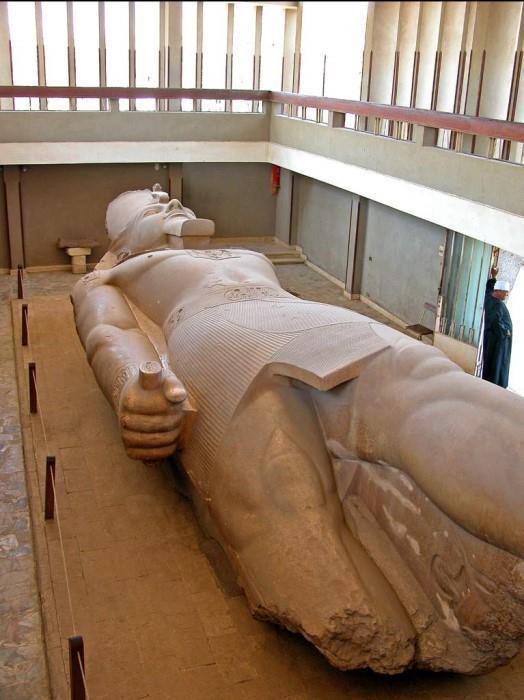
Most of the pieces in the museum date back to the New Kingdom of ancient Egypt. The museum was built around a statue of Ramses in order to protect it. The statue was discovered in the same place as where it currently stands.

The museum consists of two parts, the indoors museum, and the outdoors museum. The indoors area contains that statue of Ramses II, and the ancient columns and statues of dwarfs. On the other hand, the outdoor area contains the Ramses Sphinx, and the Triad of Memphis statue.

The Ramses Sphinx

This Sphinx was fashioned to imitate the original Sphinx at the Giza Pyramids. Yet, the head of this Sphinx represents the face of Ramses II, rather than King Khufu, with the lion's body constant.

The statue of the Triad of Memphis

The Triad of Memphis consists of Ptah, Sekhmet, and their son Nefertem. The three Gods' centre of worship was in Memphis. In Egyptian mythology, Memphis was believed to be under the protection of the God Ptah.

Ptah is the God of craftsmen and architects. Sekhmet was Ptah's wife and the mother of Nefertem, the Lotus God. Sekhmet, meaning strong, was always represented as a lady with the head of a lioness sitting on the throne adorned by the sign of unification of the north and south of Egypt, topped by the sun disk and the Cobra snake.

Ramses II statue

The statue of Ramses II was discovered in 1820 by the Explorer Giovanni Batista Cavellia, near Memphis in Egypt.

Ramses II was the third pharaoh of the 19th Egyptian dynasty. He is regarded as the greatest, most celebrated, and most powerful pharaoh of the New Kingdom, who ruled for the longest time any pharaoh did.

There are protective cartridges on the shoulders of the statue, with Ramses wearing a dagger, and two heads representing Horus.

The statue's hand is closed to represent intensity and strength, while the statue's smiling face represents mercy and tolerance.

The ancient columns

The museum also contains columns representing the late age of the ancient Egyptian civilisation, through displaying the lotus flower.

The other columns represent the Christian era with the columns displaying the acanthus leaf, which are inspired from grapes, with the grape juice representing Jesus's blood.

The statues of dwarfs

These dwarfs appeared in the New kingdom of ancient Egypt, when they came from Africa.

During this period, the dwarfs had two roles, either as court jesters to entertain the king, or as educated dwarfs serving as scribes and mufflers of royal secrets.

MENAFN2712201801530000ID1097889745

--   Sent from my Linux system.

Part one ... 2018: The year of archaeological discoveries - Egypt Today


http://www.egypttoday.com/Article/4/62723/Part-one-2018-The-year-of-archaeological-discoveries
An An "exceptionally well-preserved" tomb belonging to a Fifth Dynasty royal priest was discovered at Saqqara by an Egyptian archaeological mission on Saturday - Egypt Today.

Part one ... 2018: The year of archaeological discoveries

Fri, Dec. 28, 2018
CAIRO – 28 December 2018: Early 2018, Egyptian minister of Antiquities Khaled Anany announced 2018 as the year of archaeological discoveries. Anany added that every week and every day in some cases, an archaeological discovery is revealed; hence, Egypt should be introduced to the global stage in a positive way.

Egypt Today provides readers with a timeline of 2018's archaeological discoveries.

January

January 2: Remains of mud-brick walls, four furnaces and various other assorted artifacts were uncovered at the ancient city of Buto in Kafr El-Skeikh Governorate.

The first of the artifacts uncovered are fragments of an unknown royal statue, possibly belonging to King Psmatik I. Carved in black granite, the statue is missing all of its limbs and head, and depicts the unknown king wearing the royal kilt, or Shendit, the tell-tale sign that this was a statue for royalty. Other uncovered artifacts include a quartzite statue of the god Hur, the remnants of a sculptured hand, a variety of pottery, fragments of the Menat Necklace which represents the Goddess Hathor.

January 8: A part of a statue for Amenhotep III made of black granite was found in Sohag Governorate. The discovered part showed clearly that the statue was presented by the left foot forward, which is a tradition, shown in the statues of the kings of ancient Egypt. Also, in front of the right foot, there is a collection of Hieroglyphic writings about the coronation and birth of King Amenhotep III.

January 10: a number of archaeological elements and remains of tombs, dating back to the Greco-Roman era, were uncovered during excavations carried out in the eastern section of the Hellenistic cemetery. The most important of these discoveries is a tombstone that was once used to close one of the burial shafts. These remains are a collection of offering vessels and lamps decorated with scenes of deities.

January 11: There were two massive archaeological discoveries in Aswan. The first discovery was an administrative complex that dates back to the fifth dynasty of ancient Egypt. The unearthed complex is considered the oldest archaeological discovery in Tell Edfou site. This discovery was special because it sheds light on the history of the fifth dynasty, and how ancient Egyptians used internal architectural structures to store goods, raw material, and gemstones. More than 200 artifacts which belonged to King Djedkare Isesi, in addition to many tools used in trade campaigns to Africa were also discovered.

The second discovery was a statue of a man and his wife while doing some religious rituals, and a statue made of sandstone of a seated man, in addition to two statues of god Horus in the shape of a raven at the temple of Kom Ombo in Aswan

January 13: A stela of 19th Dynasty King Ramses II was discovered at the San Al-Hagar archaeological site in the Sharqiya governorate. The discovered stela is carved in red granite and depicts King Ramses II presenting offerings to an ancient Egyptian deity.

January 17: A tomb dating back to the second century has been uncovered at the Al-Alamein archaeological site. The discovered tomb contains a rock staircase leading down into the main chamber of the tomb, where burial holes known as "Locauli" are prominent. The southern part of the tomb contains a Greek decoration on the wall, depicting a horn with a basin surrounded by drawn on leaves and flowers.

February

February 4: An Old Kingdom tomb was discovered in the Western Cemetery located in the Pyramids area in Giza belonging to an ancient Egyptian woman named Hetpet. The tomb dates back to the Fifth Dynasty, about 4,400 years ago. Hetpet was a woman with a high social position in ancient times; a top official in the royal palace during the end of the Fifth Dynasty. Hetpet has a number of cognomens among which is the priest of the goddess Hathour.

Hathour is a pharaonic goddess who symbolizes the principles of joy, feminine love, and motherhood. El Waziry announced that Hetpet played important roles at that time especially in the agricultural field.

February 24: 8 tombs that contain about 40 coffins of Pharaonic priests and more than 1000 Ushabti statues were discovered in Tuna el-Gebel area in Minya Egyptian governorate. The discovered tombs are full of jewelleries, potteries and pharaonic jars.

This discovery as described by the Minister of Antiquities Khaled Anany was one of the largest and most important archaeological discoveries unearthed in recent times. This archaeological discovery is documenting some issues related to the live of ancient Egyptians in Minya province tens of centuries ago. The most prominent finds in these tombs were a gold mask, coffins, mummies and statues.

February 28: New parts of the statue of Ramses II were found in the Temple of Kom Ombo in Aswan. The importance of this discovery lies in finding new proof of the existence and use of this temple in the modern state era. Before this discovery, the only proof was represented in Tuthmosis III, where there is a visible part in the statue that depicts King Ramses II accompanied by God Sobek and God Horus, the main gods of the Temple of Kom Ombo.

March

March 1: the oldest figurative tattoos in the world on the upper arms of two 5,000-year-old Egyptian mummies were uncovered.

Tattoos depicting a wild bull and a Barbary sheep were found on the upper arm of a male mummy, while the shoulder and upper arm of a female mummy bore "S"-shaped motifs.

"The location of these tattoos suggests they were designed to be highly visible on the upper arm and the shoulder. T discoveries push back by 1,000 years evidence for tattooing in Africa.

April

April 4: The remains of a Graeco-Roman temple was uncovered at the Al-Salam archaeological site. The outer wall of the temple leads to a front courtyard with entrances to chambers.

April 11: An assortment of 4500 fragments from King Psamtek I's colossus were uncovered at Souq el-Khamis area in Matariya. The discovered fragments helped to confirm that the colossus depicts a standing king, with his left arm in front of the body while the right one is extended to the back.

April 22: Two important exceptional discoveries occurred. The first is the discovery of a marble head of Roman Emperor Marcus Aurelius in Aswan and an Osirian temple in Luxor.

The head is of Emperor Aurelius with wavy hair and beard. The Roman emperor's head was described as rare, because in general, statues of Roman rulers are extremely scarce.

The second discovery was the Osirian temple which was uncovered at the southern side of Karnak Temples' tenth pylon. The temple contains architectural elements of a late-period shrine dedicated to the god Osiris-Ptah-Neb.

The temple, which was found in a good state, consists of an entrance, foundation remains, columns, inner walls and ruins of a third hall located at the eastern side. The Osirian temple also houses paving stones from the shrine floor, along with other extension structures built during ancient times.

The shrine is not located on the eastern or northern side of the Amun-Re temple according to ancient Egyptian belief, which makes this discovery a highly important one. The shrine was discovered on the southern side, indicating the accuracy of the Osirian belief at that time.

Also among the discovered items were a collection of clay pots, remains of statues and a winged frame relief decorated with offering tables bearing a sheep and goose. The relief holds the names of the kings Taharka and Tanut Amun.

April 30: An ancient royal celebration hall dating back to the era of Ramses II was discovered at Matareya district.

"The Hall was unearthed below the soft-brick buildings and commercial residential areas that date back to the third transition period, particularly the 22nd and 23rd dynasties' eras. The discovered hall has a rectangular floor of 2.9 m × 1.9 m, consisting of limestone tiles, rising 80 cm from the ground.

The discovered hall, which was used to hold royal celebrations such as the Jubilee feast, is considered the first of its kind in the New Kingdom era. This discovery revealed that such celebrations took place in the Re Temple at this specific area. The hall was discovered inside the palace used to host royal celebrations.

A group of brick walls of a multi-story building were also uncovered, showing the three phases of construction dating back to the era of King Ramses II.

The discovered items include the main building, a layer of the third transition era and the late era, as well as the royal celebration hall.

A number of valuable artifacts were also uncovered such as five stone blocks carved from the reign of King Ramses II, a painting of the high priests of the Sun Prince Nept Ma Raa, in addition to some pottery figures dating back to the 27th Dynasty, one of which was a small dog-shaped statue.

A human amulet with a human head for a person named Thi from the Roman era is considered one of the most important pieces discovered.

The lower part of a statue for a priest from the Ramses era was also unearthed during the digging work.

This is the first of three articles that will uncover archaeological discoveries in Egypt during 2018.
 
--   Sent from my Linux system.

Vietnamese tourists die in terror attack near Egypt's Giza pyramids | Africa Times


https://africatimes.com/2018/12/29/vietnamese-tourists-die-in-terror-attack-near-egypts-giza-pyramids/

Vietnamese tourists die in terror attack near Egypt's Giza pyramids

By AT editor - 29 December 2018 at 12:28 am
Vietnamese tourists die in terror attack near Egypt's Giza          pyramids

At least four people have died following an attack on a tourist bus near the Egyptian pyramid site of Giza.

The attack happened about 6:15 p.m. Friday when the bus carrying 14 people, including a driver and Egyptian tour guide, passed an improvised explosive device on the road from Cairo to the antiquities site, according to a statement from the Egyptian Ministry of Interior.

Three of the dead are Vietnamese tourists, while one was Egyptian. At least nine other people suffered injuries and were taken to the hospital as emergency workers and security services descended on the scene. Four of those injured had fractures while others had bruises and minor injuries, according to hospital sources speaking with Al Arabiya news.

While Islamic State has claimed responsibility for terrorist attacks in Egypt in the past, there was no immediate acknowledgment from any organization.

This was believed to be the first attack on tourists in Egypt since a July 2017 knife attack at Hurghada, a Red Sea resort popular with foreigners, claimed two lives. In January 2016, three European tourists were attacked while staying at a four-star hotel in Hurghada.

The country's tourism ministry, led by Rania Al Mashat, has stepped up efforts to boost the tourism economy this year alongside Minister of Antiquities Khaled El Enany. New reforms in the tourism sector call for additional investment and modernization with hopes of creating Egyptian jobs, but the vision is perennially threatened by security fears that date back at least to the 1997 attacks at Luxor, which claimed 62 lives.

Egypt routinely deals with terrorist attacks on its own people and institutions, particularly in the Sinai where 305 people died in a November 2017 mosque attack.

--   Sent from my Linux system.

The ABC Murders: will there be more Agatha Christie adaptations on BBC? - Radio Times


https://www.radiotimes.com/news/tv/2018-12-28/bbc-confirms-more-agatha-christie-dramas-will-air-in-2019/

BBC confirms more Agatha Christie drama to come in 2019

The ABC Murders screenwriter Sarah Phelps will hand over adaptation duties to Gwyneth Hughes, who is writing a version of Death Comes As the End for 2019

John Malkovich will star as famous Belgian          detective Hercule Poirot – although he will sport a neat goatee          beard rather than the waxed moustache made famous by David          Suchet (BBC)

This Christmas the BBC unwrapped The ABC Murders, a frenetic mystery starring John Malkovich as the legendary Hercule Poirot. But work is already afoot for more Agatha Christie adaptations in 2019…

The BBC has confirmed that the author's spooky ancient Egyptian story Death Comes as the End will be the next work to be adapted for TV.

Expected to be another three-part drama, this series will mark a departure of sorts from previous adaptations.

For one thing, it's Christie's only novel not set during the 20th century. Instead, the story is set in Thebes in Ancient Egypt in 2000 BC, and features entirely non-European characters.

RadioTimes.com understands that screenwriter Sarah Phelps – who has adapted previous Agatha Christie dramas including The ABC Murders, Ordeal By Innocence and The Witness for the Prosecution – will not write the script for Death Comes As The End.

Instead, the series is being written by Vanity Fair scriptwriter Gwyneth Hughes.

A BBC source confirmed that Hughes is working on a Death Comes as the End adaptation but said it "will be a very different proposition from the recent BBC Agatha Christie adaptations". The BBC source was unable to confirm whether Death Comes as the End will air in Christmas 2019.

"Transmission for this is to be confirmed and Gwyneth has always been the writer attached to this title," they confirmed

However, this does not mean that The ABC Murders will be Phelps's last Agatha Christie adaptation.

"Sarah is not 'stepping aside' from Agatha Christie," the BBC source told RadioTimes.com. "In fact [production company] Mammoth Screen is currently in discussion with Sarah about her next 20th century-set title that she will tackle."

--   Sent from my Linux system.

Thursday, December 27, 2018

AWOL - The Ancient World Online: Open Access Publications from The University of Arizona Egyptian Expedition


http://ancientworldonline.blogspot.com/2018/12/open-access-publications-from.html
On 12/13/2018 01:12 PM, Charles Jones wrote:
Open Access Publications from The University of Arizona Egyptian Expedition Open Access Publications from The University of Arizona Egyptian Expedition
Valley of the Sun Kings new explorations in the tombs of the pharaohs: Papers from the University of Arizona International Conference on the Valley of the Kings Edited by Richard H. Wilkinson
Copyright © 2013 by the University of Arizona Egyptian Expedition 

The temple of Tausret the University of Arizona Egyptian Expedition Tausret Temple Project, 2004-2011 Edited by Richard H. Wilkinson
Copyright © 2013 by the University of Arizona Egyptian Expedition
ARCHAEOLOGICAL RESEARCH IN THE VALLEY OF THE KINGS AND ANCIENT THEBES:Papers Presented in Honor of Richard H. WilkinsonEdited by Pearce Paul Creasman
Wilkinson Egyptology Series, volume I
Copyright © 2013 by the University of Arizona Egyptian Expedition

Image and voice in Saite Egypt : Self-presentations of Neshor named Psamtikmenkhib and Payeftjauemawyneith By Hussair Bassir
Wilkinson Egyptology Series, volume 2
Copyright © 2014 by the University of Arizona Egyptian Expedition 


--   Sent from my Linux system.

Egypt Exploration Society | Sounds of Roman Egypt


https://www.ees.ac.uk/Event/sounds-of-roman-egypt

Sounds of Roman Egypt

The Petrie Museum has a range of sound-making artefacts from Roman Egypt. These include bells, reed panpipes, pottery rattles, cymbals, and wooden clappers. The exhibition demonstrates how researchers used laser-scanning technology to create 3D virtual models. These models were then 3D printed in plastic to create replica objects. Some of the models were also used to create craft replicas in materials like ceramic, wood, and bronze. All these replicas form an integral part of this exhibition together with 3D digital models based on the laser scans.

Visitors can see the original Roman instruments displayed alongside the modern replicas, and learn about how they were used in the Roman period. The exhibition reveals how different instruments were used to create particular experiences, for instance the role of instruments within religious and ritual activities, in the Egyptian home, and in processions and performances. Sound-making objects were important not only for entertainment, but also had practical uses in everyday life, for instance as toys, protective amulets, and to make alert or alarm sounds.

Some replicas are also available to be handled and played, with additional sound recordings providing an evocative illustration of the sounds of Roman Egyptian life. The sound recordings have been created using computer software that mimics the acoustic qualities of specific interior and exterior spaces. Information about Roman-period buildings, from archaeological remains in Egypt, is used in the software to allow us to hear the sounds of the instruments as though they were being played within these ancient spaces. Further evidence from ancient sources, such as musical texts from papyri documents, has allowed authentic tunes, rhythms and scales to be replicated.

There will be a series of associated workshops based around replica instruments aimed at both families and the general public. The workshops provide an opportunity to try out the full range of replica objects, hear live demonstrations, and learn how to play some ancient rhythms. A Key Stage 2 schools learning pack with additional materials will be made available to download from the Petrie Museum website.

This exhibition forms part of the AHRC research project "Roman and Late Antique Artefacts from Egypt: Understanding Society and Culture". The project reveals the social and cultural activities and relationships from daily life in Roman Egypt, through the direct study of artefacts from the Petrie Museum's collection. The artefacts under study are not just musical instruments, but range from weaving tools, to personal jewellery, figurines, shoes, toys, and domestic tools. By assessing details such as materials, wear, repair, and modification on these artefacts, the project seeks to demonstrate the role such objects held – both practically and in terms of sentimental value – in everyday experiences in Roman Egypt. The project also has its own blog where regular research updates are posted: https://blogs.kent.ac.uk/egypt-artefacts/blog/ 

Start:

Location: Petrie Museum of Egyptian and Sudanese Archaeology, Malet Place, London, WC1E 6BT

--   Sent from my Linux system.

World's Oldest Village and Perfume Factory Found in Egypt


http://cairoscene.com/Buzz/oldest-village-and-perfumery

World's Oldest Village and Perfumery Found in Egypt

Queen Cleopatra was a regular customer to the village's perfumers.


History's oldest village

In the northern Dakahlia governorate, a US excavation mission has dug up an ancient Pharaonic settlement which is being dubbed history's oldest village. The head of the mission, Jay Sleifer Stein, announced the news on Wednesday, in attendance of Dakahlia's Governor Kamal Sharobim and Dean of Tourism Faculty at Mansoura University Dr. Amina Shalaby.

The village belonged to the era of Ptolemy III, the third king of the Ptolemaic Dynasty, who ruled Egypt from 246 to 222 BC. The mission was able to confirm that the village was brought to ruins amidst a great war or fight, evident in the discovery of weapons scattered across its streets as well as remains of dead soldiers.  

Even more interestingly, Dr. Stein said that the village had history's oldest perfume factory. The mission found special perfume-making ovens and murals that demonstrate how workers extracted liquid scents out of flowers. The village was a world-renowned perfume-making center, shipping their bottled products to be sold all around the world as well as the rest of Egypt, as further explained by Dr. Stein.

"We could know the types of plants they used to take flowers to make perfumes, and we are currently collecting them in America to produce the same quality of perfumes used by the Egyptians," said Stein.

The US mission to Tamei Al Amdeed began working in the area in 2007, after being asked by Egypt's Ministry of Antiquities to assess the historical value of the site in fear of damage to the area's monuments on account of rapid urban expansion.


--   Sent from my Linux system.

The Latest Discoveries in Egyptology (November-December 2018) - Nile Scribes


https://nilescribes.org/2018/12/22/latest-discoveries-november-december-2018/

The Latest Discoveries in Egyptology (November-December 2018)

Every two months, the Nile Scribes bring you summaries of the latest news and discoveries in Egyptology, both from the field and the library. We introduce you to the newest archaeological finds or rediscovered artefacts from museum collections, plus other new theories stirring in the Egyptological Zeitgeist. This winter has seen a wealth of new discoveries with much excitement generated by a beautifully preserved tomb of an Old Kingdom official and a collection of mummified scarab beetles, both from Saqqara.

Did you read our last edition of Discoveries from September?

The Egyptian Ministry of Antiquities publishes a very helpful round-up of recent discoveries, events, and projects in Egypt in an accessible PDF format. The latest issue was published in November 2018 (English or Arabic).

The site of Matariya has been in the news often over the            last year (Photo: Ministry of Antiquities)
The site of Matariya has been in the news often over the last year (Photo: Ministry of Antiquities)

Inscription fragments uncovered at Temple of the Sun (November 6 – Egypt Today)

Nile Scribes: The area around Matariya finds itself in the news yet again: a significant number of fragments of inscriptions and statuary were found within the Temple of the Sun. The dates given for these artefacts range from the Middle Kingdom all the way until the end of the New Kingdom.

"An Egyptian–German archaeological mission uncovered a number of inscription fragments and fragments of smaller statuary at the Temple of the Sun in Matariya, in piles close to lime burning installations. The discovered fragments date back to the 12th and 20th dynasties as well as the Third Intermediate Period, according to Ayman Ashmawy, head of the Ancient Egyptian Antiquities sector at the Ministry of Antiquities and head of the Egyptian side of the mission."

An Eighteenth Dynasty white sarcophagus recently found at            North Asasif in Luxor (Photo: Ministry of Antiquities)
An Eighteenth Dynasty white sarcophagus recently found at North Asasif in Luxor (Photo: Ministry of Antiquities)

Sandstone panel, sarcophagus unearthed in Luxor (November 8 – Egypt Independent)

NS: Working near the tomb of Petamenope in Luxor's North Asasif, a French archaeological team has uncovered a limestone stela steleand anthropoid sarcophagus dating to the Eighteenth Dynasty and belonging to a man named Pouia. The stela bears the names of two officials: Tetiankh and Ineni.

"The French Institute for Oriental Archaeology's mission has unearthed a sandstone panel and a wooden ark [sarcophagus] dated back to the 18th Dynasty of Pharaonic Egypt in the northern area of El-Assasif Necropolis in Luxor. The mission found the ark [sarcophagus] and the panel in good condition. It only lost part of the leg, Secretary General of the Supreme Council of Antiquities Mostafa Waziri said."

Over a hundred cat statues were found at Saqqara recently            (Photo: Ministry of Antiquities)
Over a hundred cat statues were found at Saqqara recently (Photo: Ministry of Antiquities)

Cats, beetles, other mummified animals found—along with a sealed door (November 11 – Ars Technica)

NS: Among dozens of mummified cats found at Saqqara were reports of mummified scarab beetles, an exceptionally rare find. Two large beetles, in one instance, were found wrapped in linen and placed within limestone sarcophagi decorated with images of beetles.

"Along with the mummified cats and scarabs, the Saqqara tombs contained more than a hundred gilded wooden cat statues and one of solid bronze, all dedicated to Bastet, as well as gilded statues of lions, a cow, and a falcon. Archaeologists also found painted wood sarcophagi containing a mummified crocodile and two mummified cobras, as well as an assortment of amulets, canopic jars, writing instruments, and papyri, all of which could help reveal more about life and death in Egypt's Old Kingdom."

The sad discovery of a pregnant woman and her fetus            provides rare glimpse into childbirth in antiquity (Photo:            Ministry of Antiquities)
The sad discovery of a pregnant woman and her fetus provides rare glimpse into childbirth in antiquity (Photo: Ministry of Antiquities)

Skeletons Of Pregnant Egyptian Woman And Fetus Found By Archaeologists Suggest Death In Childbirth (November 16 – Forbes)

NS: The Ministry of Antiquities recently announced the remarkable discovery of the skeleton of a pregnant woman buried with her unborn fetus near Aswan. This discovery sheds fresh light on deaths during childbirth as such examples are quite rare.

"Dating back 3,700 years, the burial represents an important find for the growing understanding of reproduction and childbirth in the ancient world. This new discovery, announced Wednesday by Dr. Mostafa Waziri, Secretary-General of the Supreme Council of Antiquities, was found in the region between Aswan and the site of Kom Ombo, well know for its unique Ptolemaic-era double temple dedicated to two gods. This region is currently being investigated by the Aswan-Kom Ombo Archaeological Project (AKAP), directed by Dr. Maria Carmela Gatto of the University of Leicester and Dr. Antonio Curci of the University of Bologna."

The Ramesside period tomb is decorated with scenes of the            deceased and his family (Photo: Ministry of Antiquities)
The Ramesside period tomb is decorated with scenes of the deceased and his family (Photo: Ministry of Antiquities)

Tomb of mummification shrine overseer uncovered in Luxor (November 24 – Ahram Online)

NS: The Ramesside tomb of Thaw-Rakht-If, who worked at the Precinct of Mut as the overseer of the mummification shrine, has been discovered in Luxor. Unfortunately, the tomb's two burials date to a later period rather than to the original tomb owner.

"Inside the tomb, two huge wooden anthropoid sarcophagi were found, but studies revealed that they do not belong to the owner of the tombs, but rather to a son and daughter from a later period, Padiset and Nesmutamu. Anany described the well-preserved sarcophagi inside the tomb as "magnificent", with eyes inlaid with golden sheets. Mostafa Waziri, Secretary General of the Supreme Council of Antiquities told Ahram Online that the tomb was buried under 300 meters of debris, and that the mission also uncovered two wooden statues of the deceased, five painted wooden funerary masks, and a collection of ushabti figurines made of faience, wood, burnt clay."

Several mummified remains were found at Dahshur, some of            which were covered in beautifully painted plaster (Photo:            National Geographic)
Several mummified remains were found at Dahshur, some of which were covered in beautifully painted plaster (Photo: National Geographic)

Ancient Egyptian mummies discovered near much older pyramid (November 28 – National Geographic)

NS: Brightly-painted cartonnage has been discovered along with several mummified remains near the pyramid of Amenemhat II at Dahshur. The site of Sneferu's two earlier pyramids, the unearthed finds actually date to the Late Period, some thousand years later.

"Eight mummies were discovered during excavations near a pyramid in Dahshur, Egypt, the country's Ministry of Antiquities announced today. Dating from the Late Period (664-332 B.C.), the mummified remains were each covered in painted cartonnage (a sort of paper-maché made from plaster and papyrus or linen) and buried in a limestone sarcophagus. Only three of the mummies were in good condition, according to Mostafa Waziri, secretary-general of Egypt's Supreme Council of Antiquities."

A sandstone figure found in the Fayoum (Photo: Ministry            of Antiquities)
A sandstone figure found in the Fayoum (Photo: Ministry of Antiquities)

Egyptian Mission Discovers Middle Kingdom Burial Well In Fayoum (December 10 – NILE FM)

NS: A Middle Kingdom burial well with three burial chambers was recently found by an Egyptian archaeological team working in the Fayoum. Though heavily looted, the chambers contained some ceramic finds and a sandstone figure.

"An Egyptian archaeological mission discovered a burial well dating back to the Middle Kingdom in the al-Khalwa area, Fayoum. The well contained three burial chambers, one of which had part of a 40-cm tall statue of a person with his hand on his chest made from sandstone. Another had the mid-section of a basalt statue at 30-cm tall."

High groundwater levels have made access to this            undecorated tomb at Gebel el-Silsila difficult (Photo: Gebel            el-Silsila Project)
High groundwater levels have made access to this undecorated tomb at Gebel el-Silsila difficult (Photo: Gebel el-Silsila Project)

Swedish mission discovers 18th Dynasty tomb in Upper Egypt's Aswan (December 13 – Ahram Online)

NS: The list of remarkable discoveries continues in 2018 (from aged cheese to a sewage-water drowned sarcophagus) as archaeologists at Gebel el-Silsila in Upper Egypt have announced the discovery of a mass burial of 50-60 individuals from the Eighteenth Dynasty, half of whom were children. The tomb is now filled with ground water, a possible factor in keeping the grave intact until today.

"A Swedish archeological mission has discovered an ancient tomb dating back to the 18th Dynasty in Upper Egypt's Aswan governorate, a Ministry of Antiquities statement said on Thursday. The mission, operating in Gabal Al-Selsela area in Kom Ombo, Aswan, announced that the tomb was located five metres underground and consists of a burial chamber and two sided rooms without any decoration."

Wahtye's tomb has been preserved in excellent condition            for over four thousand years (Photo: Ministry of Antiquities)
Wahtye's tomb has been preserved in excellent condition for over four thousand years (Photo: Ministry of Antiquities)

Egypt tomb: Saqqara 'one of a kind' discovery revealed (December 15 – BBC)

NS: The discovery of the tomb of Wahtye, an official during the reign of the Fifth Dynasty ruler Neferirkare, provides us with important insight into the administration and bureaucracy of the Old Kingdom state. Its beautiful preservation has captured the attention of the world this month as the internet has been flooded with gorgeous photos of the tomb's interior.

"Mostafa Waziri, secretary-general of the Supreme Council of Antiquities, described the find as "one of a kind in the last decades". The tomb, found in the Saqqara pyramid complex near Cairo, is filled with colourful hieroglyphs and statues of pharaohs. Decorative scenes show the owner, a royal priest named Wahtye, with his mother, wife and other relatives. Archaeologists will start excavating the tomb on 16 December, and expect more discoveries to follow – including the owner's sarcophagus."

Mud sealing from Kom Ombo bearing the name of King            Userkaf (Photo: Ministry of Antiquites)
Mud sealing from Kom Ombo bearing the name of King Userkaf (Photo: Ministry of Antiquites)

Old Kingdom's Kings Names Discovered in Kom Ombo (December 20 – Luxor Times)

NS: An Egyptian-Austrian team have announced the discovery of cylinder seals bearing the names of two Fifth Dynasty kings, Userkaf and Neferirkare, at Kom Ombo – the first time they have been attested at the site. The team's finds continue to illuminate the activities of the Fifth Dynasty kings in southern Egypt.

"Dr. Irene Forstner-Müller, director of the Austrain Archaeological Institute mission at the site said "The mission started working at the site in 2018 to investigate the history of the town of Kom Ombo. The first season of survey and excavation brought to light a First Intermediate Period Cemetery with the town of the Old Kingdom below it as well as a seal of King "Sahure"."

--   Sent from my Linux system.