Search This Blog

Monday, August 11, 2025

Sabu Disk: A mysterious 5,000-year-old Egyptian stone sculpture that looks like a hubcap | Live Science

https://www.livescience.com/archaeology/ancient-egyptians/sabu-disk-a-mysterious-5-000-year-old-egyptian-stone-sculpture-that-looks-like-a-hubcap

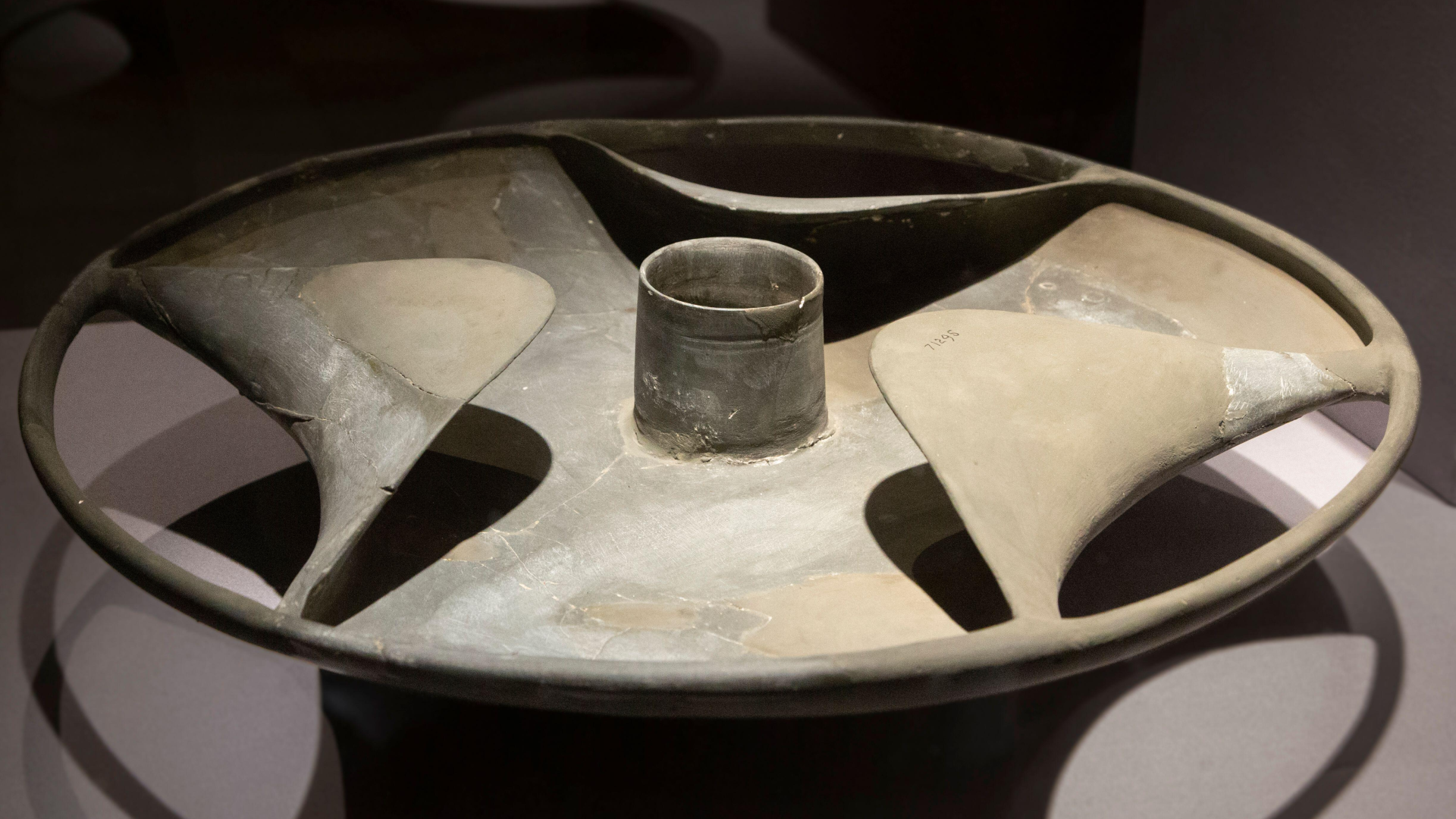
Sabu Disk: A mysterious 5,000-year-old Egyptian stone sculpture that looks like a hubcap

This stone object was discovered in the tomb of Sabu in the Saqqara necropolis in Egypt. (Image credit: Alain Guilleux / Alamy)

QUICK FACTS

Name: Sabu Disk

What it is: A stone vessel

Where it is from: Saqqara necropolis, in Egypt

When it was made: Circa 3100 to 2900 B.C.

This delicate stone vessel was discovered in 1936 in the tomb of Sabu, an ancient Egyptian official buried in the Saqqara necropolis during the first dynasty period. When it was found, the disk was in pieces. It has since been reconstructed and is in the collection of the Egyptian Museum in Cairo.

Sabu's mastaba, a rectangular tomb with sloping walls and a flat roof, was excavated by British Egyptologist Walter Emery. In his publication describing the Saqqara tombs, Emery wrote that the burial chamber had been looted for its jewelry and precious metals. But Sabu's skeleton was intact inside a wooden coffin, and his tomb was filled with dozens of stone and pottery vessels, flint and copper tools, the remains of two oxen, and a unique bowl.

Emery described the Sabu Disk as an ornamental tri-lobed bowl that measured 24 inches (61 centimeters) in diameter and 3.9 inches (10 cm) tall. The bowl was carved out of metasiltstone, a sedimentary rock that has undergone some metamorphism.

According to Egyptian archaeologist Ali El-Khouli, flat and wide stone bowls were common in the first to third dynasties of ancient Egypt. But this particular bowl found in Sabu's tomb is unusual because of the three thinly carved and curving wings that rise from the edge of the disk. When viewed from above, this decoration is suggestive of a modern steering wheel, propeller or hubcap.

The Sabu Disk's unique design has led to numerous theories about the item's purpose, ranging from part of a water turbine to a piece of a hyperdrive from an alien spaceship. One recent theory even suggests the disk was used as a "mash tun," a vessel that holds grain and hot water for making beer.

But the most likely explanation is that the Sabu Disk had a similar purpose as other wide, flat bowls in ancient Egyptian culture: It probably held food or oil. The delicate nature of the metasiltstone and carving, though, suggests that the bowl was not for everyday use and may have been placed in Sabu's tomb as an offering for the afterlife.

--   Sent from my Linux system.

Sunday, August 10, 2025

Egypt recovers 13 smuggled artefacts from UK and Germany - Ancient Egypt - Antiquities - Ahram Online

https://english.ahram.org.eg/NewsContent/9/40/550991/Antiquities/Ancient-Egypt/Egypt-recovers--artefacts-smuggled-to-UK-and-Germa.aspx

Egypt recovers 13 smuggled artefacts from UK and Germany

Nevine El-Aref , Sunday 10 Aug 2025

Egypt has successfully recovered 13 ancient Egyptian artefacts which were smuggled to the United Kingdom and Germany, as part of its continued efforts to safeguard its cultural heritage.

`

The Supreme Council of Antiquities (SCA) officially received the artefacts on Saturday at the Ministry of Foreign Affairs' headquarters in the New Administrative Capital. 

The recovery of the artefacts was carried out in collaboration with British and German authorities.

Minister of Tourism and Antiquities Sherif Fathy said the return of these artefacts reflects Egypt's commitment to protecting its unique heritage.

He commended the "fruitful cooperation" between Egyptian ministries and expressed gratitude to the British and German governments for their role in facilitating the return, highlighting the importance of joint efforts to combat the illicit trade in cultural property.

According to Mohamed Ismail Khaled, secretary-general of the SCA, the recovery followed a police operation in London that seized and confiscated the artefacts after confirming their illegal export by an international antiquities smuggling network. 

In Germany, Hamburg city authorities contacted the Egyptian embassy in Berlin, offering to return the items from the city's museum once their unlawful provenance was verified.

Director of the Antiquities Repatriation Department Shaaban Abdel-Gawad said that the repatriated collection spans various periods of ancient Egyptian history.

He said the items returned from London include a New Kingdom limestone funerary stela depicting a Paser, overseer of builders, in a devotional scene with the god Osiris, goddess Isis, and the four sons of Horus; a red baboon-shaped amulet symbolizing divine protection; and an 18th Dynasty green faience vessel and blue faience funerary flask.

Add to this a bronze crown fragment featuring a feather, serpent, and ram's head from a large statue of Osiris dated between the 22nd and 26th Dynasties; a beaded funerary mask from the 26th Dynasty; and several faience and black stone amulets.

The items returned from Germany include a skull and hand from an unidentified mummy, along with an ankh-shaped amulet — the ancient Egyptian symbol of life.

All recovered artefacts have been transferred to the Egyptian Museum in Tahrir for conservation and restoration before being displayed in a dedicated exhibition of recently repatriated treasures.


Short link:


--   Sent from my Linux system.

Monday, August 4, 2025

Northern Cal. Egyptology Lecture August 24: Pakhet of Speos Artemidos


The American Research Center in Egypt, Northern California chapter, and the UC Berkeley Department of Middle Eastern Languages and Cultures invite you to attend a lecture by Beatrice De Faveri, UC Berkeley


Pakhet of Speos Artemidos:
An exercise in divine and demonic ontologies

Sunday August 24, 2025, 3 PM  Pacific Daylight Time
Room 254 Social Sciences Building, UC Berkeley

This is an in-person lecture and is not virtual. No registration is required.
The lecture will be recorded.


The rock cut temple of Pakhet by Hatshepsut in Speos Artemidos. (Courtesy of Wikimedia Commons).

About the Lecture:

The lioness goddess Pakhet, worshiped inside the Middle Egyptian rock-cut sanctuary known as the Speos Artemidos, is renowned within the ancient Egyptian pantheon for her fearsome qualities. Usually depicted as a lion-headed woman, her theonym can be translated as "The Slasher", a vivid image alluding to her aggressive nature. Despite her various theological associations with more benevolent deities the likes of Hathor and Isis, most of Pakhet's titles and epithets consistently emphasize the inherent violence of her figure, along with her animal features. While this is rather common for the divine lionesses taking on the role of guardians of the sun god, Pakhet's attributes allow for an argument about her standing at the intersection between the category of the divine (nTry) and the elusive notion of the demonic. The identification of demonic ontologies within the ancient Egyptian religious thought remains a famously daunting task, mostly due to systemic discrepancies between emic and etic definitions of what can be described as a "demon". Nevertheless, the analysis of textual sources of the Middle and New Kingdom related to the goddess offer some valuable insights for reconstructing Pakhet's individual position with respect to the taxonomy of the divine and the demonic. This paper attempts to discuss some previously overlooked aspects of her conceptualization, examined through the lens of the relation between Pakhet and the sphere of ancient Egyptian magic.


About the Speaker:

Beatrice De Faveri, CPhil, a fourth-year PhD student in Egyptology, received her BA in Classical Archaeology from the University of Padua, Italy. She then graduated from the University of Bologna, Italy with an MA in Civilizations and Cultures of the Ancient World focusing on Egyptology. Since 2019, she has been the second leading archaeologist of the IFAO (Cairo) - Museo Egizio (Turin) excavation in the Upper Egyptian site of Coptos (Quft).
As for her current research interests, she specializes in ancient Egyptian magical texts, and harbors a special interest in collections of spells for which a ritual purpose can be identified. Her research extends to the relation between magical and ritual texts and the material culture they generate. As an adjacent interest, she has engaged in the investigation of the category of the 'demonic' in ancient Egyptian religious texts and practices. 


Parking is available in UC lots all day on weekends, for a fee. Ticket dispensing machines accept debit or credit cards. Parking is available in lots around the Social Sciences Building, and in lots along Bancroft. A map of the campus is available online at http://www.berkeley.edu/map/ .

About Northern California ARCE:

For more information, please visit https://www.youtube.com/@NorthernCaliforniaARCE, https://www.facebook.com/NorthernCaliforniaARCE, https://arce-nc.org, https://bsky.app/profile/khentiamentiu.bsky.social, and https://khentiamentiu.org. To join the chapter or renew your membership, please go to https://arce.org/membership/ and select "Berkeley, CA" as your chapter when you sign up.