Search This Blog

Saturday, April 12, 2025

Life Under Pharaoh Akhenaten: New Discoveries Shed Light on Egypt's Lost City - GreekReporter.com

https://greekreporter.com/2025/04/12/life-pharaoh-akhenaten-new-discovery-egypt-lost-city/

Life Under Pharaoh Akhenaten: New Discoveries Shed Light on Egypt's Lost City

Statue of Akhenaten in the collection of the Egyptian Museum, Cairo
Statue of Akhenaten in the collection of the Egyptian Museum, Cairo. Credit: Prof. Mortel / CC BY 2.0

Recent archaeological discoveries in Egypt are revealing new details about life under Pharaoh Akhenaten, offering a rare glimpse into a city frozen in time.

More than 3,000 years ago, Pharaoh Akhenaten made a decision that uprooted an entire population. The ruler of ancient Egypt ordered citizens of So'oud Aten to seal their homes and move, leaving their belongings and everyday lives behind. The move was part of his effort to replace Egypt's long-standing polytheism (worship of many gods) with monotheism, the worship of a single deity—Aten, the sun god.

"This is the pharaoh," Egyptologist Zahi Hawass said in an interview with NBC News, "When the king makes a decision, everyone has to obey the decision."

Archaeologists uncover daily life treasures in Egypt

Archaeologists recently unearthed So'oud Aten near Luxor, close to monuments like the Colossi of Memnon and the Ramesseum. The city, buried for millennia, has quickly become one of the most significant archaeological finds in recent history. Experts say it thrived during Egypt's golden age.

Excavations reveal a city frozen in time. Workers appear to have dropped tools mid-task. Pottery, jewelry, sandals, children's toys—even baking tools resembling modern-day pizza peels—were found scattered across homes and workshops.

"It's a snapshot in time," said Salima Ikram, professor of Egyptology at the American University in Cairo. "Their stuff is lying around. They're in the middle of making, you know, pegging out a cowhide. They're cutting out sandals, and suddenly, all of this."

The city's layout indicates a well-organized community. Recent excavations have uncovered buildings that may have served administrative functions, including structures resembling an early town hall or police station. Hawass noted that the city offers rare insight into daily life and suggested that its artisans and workers lived comfortably. He said, "We found many showers inside the houses."

Mysteries of Egypt

One unusual discovery—a fish covered in gold—remains unexplained. "Nobody really can explain it," Hawass said, adding that archaeologists have also recovered about 500 statues of Sekhmet, a goddess associated with healing.

The site's religious significance continues to stir debate. A sun symbol found on a workshop wall suggests a turning point in belief. Akhenaten's push to focus on Aten marked a break from the past.

Yasmin El Shazly, deputy director of the American Research Center in Egypt, said "We know that during the reign of Amenhotep lll (Akhenaten's father), the religion became increasingly solar. There is evidence of the Aten, but there are other deities as well. So we know that it was not monotheistic at the time." she said.

New discoveries in ancient Egypt

Akhenaten eventually built a new city, now known as Tell el-Amarna, 200 miles south of Cairo. He called it "Rise of Aten." Experts believe Queen Nefertiti joined him in this religious shift, walking the new capital's streets at his side.

Even after his death, the city continued to be used by rulers like Tutankhamun, whose tomb was famously discovered in 1922. However, the feelings of those forced to leave So'oud Aten remain unknown.

They sealed their homes, said Hawass. Maybe they thought they would return. "No one can talk to the king," he said.

After Tutankhamun's death, his successors abandoned the reforms initiated by Akhenaten. The capital was moved back to its former location, Thebes (known today as Luxor), and the traditional religious practices were restored. The city built by Akhenaten fell into disrepair and was eventually abandoned. Efforts were made to erase the memory of Akhenaten's reign, with monuments and temples dedicated to the Aten being destroyed.

--   Sent from my Linux system.

3,400-year-old ancient Egyptian town discovered by Alexandria — a New Kingdom settlement connected to Nefertiti's daughter | Live Science

https://www.livescience.com/archaeology/ancient-egyptians/major-ancient-egyptian-town-discovered-and-it-has-a-jug-stamped-with-the-name-of-nefertitis-daughter

'Major' ancient Egyptian town discovered — and it has a jug stamped with the name of Nefertiti's daughter

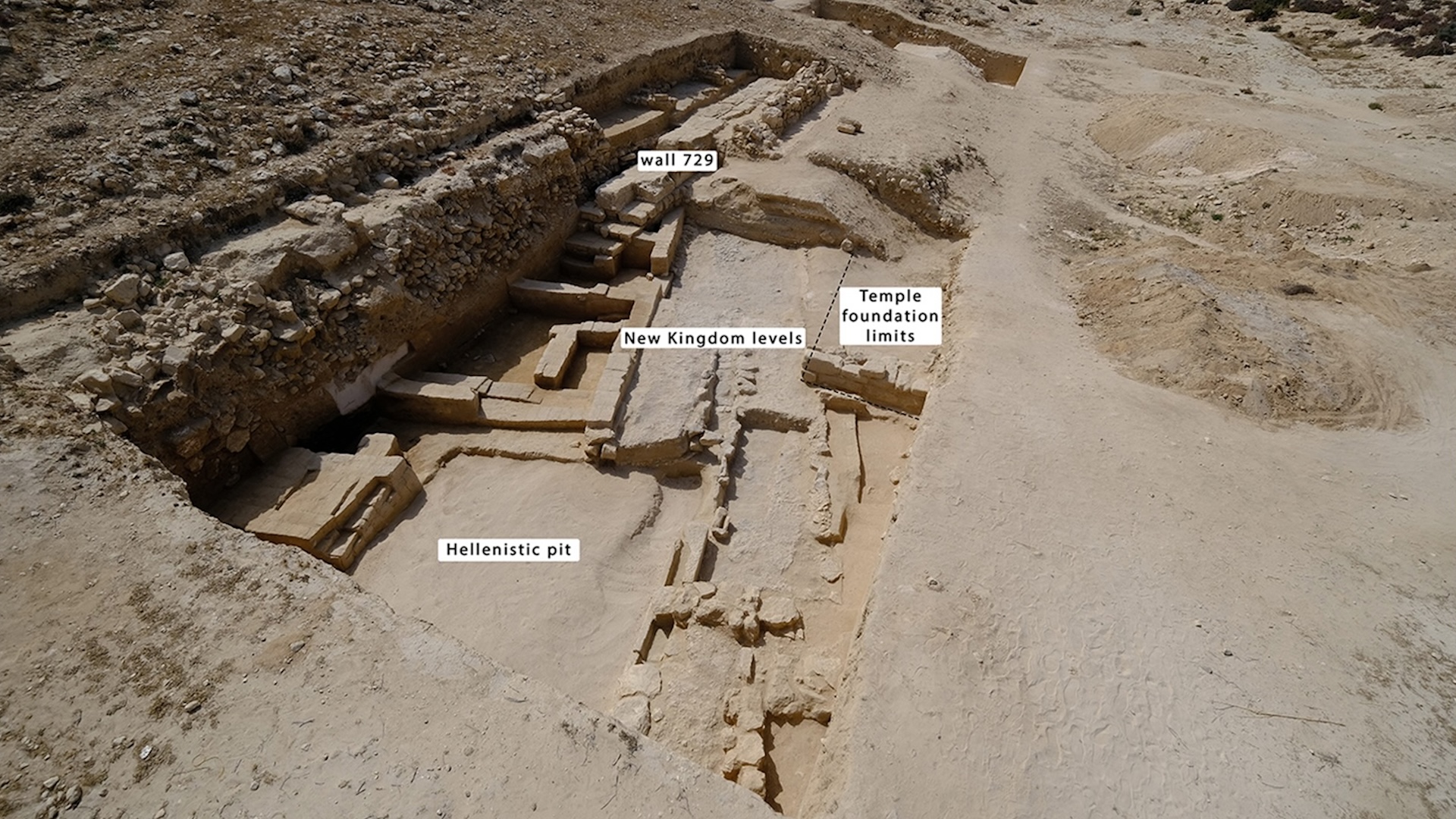
Part of the newly discovered Egyptian settlement, which dates to around 3,400 years ago. (Image credit: Sylvain Dhennin)

Archaeologists in Egypt have uncovered the remains of a "major" 3,400-year-old town dating to the New Kingdom that was possibly built by King Tutankhamun's father and later added to by Ramesses II, a new study finds.

The settlement was found at the site of Kom el-Nugus in northern Egypt, about 27 miles (43 kilometers) west of Alexandria on a rocky ridge between the Mediterranean Sea and Lake Mariout. Previously, Egyptologists thought the site was not inhabited until later times, when the Greeks founded their own settlement and necropolis there around 332 B.C., during Egypt's Hellenistic period.

Researchers found the older ancient Egyptian settlement while they were studying the Greek one. An unexpected discovery of mudbrick dating to the New Kingdom (circa 1550 to 1070 B.C.) revealed the earliest known Egyptian settlement north of Lake Mariout, according to the study, which was published Jan. 23 in the journal Antiquity.

It's not clear exactly how large the settlement was, "but the quality of the remains, their planned organization around a street, could suggest a fairly large-scale occupation," study author Sylvain Dhennin, an archaeologist with the French National Center for Scientific Research (CNRS), told Live Science in an email. The street was designed to drain surface water and protect buildings from water erosion.

"There was a temple, built by King Ramses II, as well as private funerary chapels, which mention military personnel," said Dhennin, who is leading excavations at the site. "If the settlement was indeed military in nature, it's possible that there was also a fortified wall and administrative buildings."

One particularly interesting find is a stamp on part of an amphora jar that has the name of Merytaton (also spelled Meritaten) on it. Merytaton was the daughter of the pharaoh Akhenaten (reign 1349 to 1336 B.C.) and his wife Nefertiti. Akhenaten unleashed a religious revolution that tried to focus Egypt's religion around the worship of Aten, the sun disk. His son, King Tutankhamun (ruled circa 1336 to 1327 B.C.), later brought back Egypt's traditional polytheistic religion.

"The presence of this stamp probably indicates the production of wine belonging to a royal estate" that dates back to the time of Merytaton, Dhennin said. "The vineyards on the margins of Egypt were probably protected by the military and formed part of a pioneering front to occupy this region towards the desert," he said, noting that it's possible that this settlement was founded during the reign of Akhenaten.

Roger Forshaw, an honorary lecturer at the KNH Centre for Biomedical Egyptology at the University of Manchester who was not involved with the research, praised the team's work and noted that the "the presence of a temple underscores its strategic and cultural importance."

Forshaw also noted the sophisticated design of the street. "This street was ingeniously designed with a water-collecting system to drain surface water and protect the fragile mudbrick walls," Forshaw said.

Excavations at the site are ongoing, and Dhennin said they may help reveal how large the settlement was and when exactly it was founded. Another question is what Egyptians called the settlement in ancient times.

--   Sent from my Linux system.

Friday, April 11, 2025

Join Us in San Francisco for the 2025 Annual Meeting of the American Research Center in Egypt!

ARCE
alt_text

We're just weeks away from the ARCE 2025 Annual Meeting in San Francisco, and we can't wait to see you there! Register today to join us for for three days of in-person presentations and networking opportunities. Share your expertise and be a part of the vibrant scholarly community that comes together to explore the wonders of Egyptian history, heritage, fieldwork and technological advances in the largest Egyptology annual conference in the United States!

Register

If you are a member and attending the Annual Meeting, do not forget about the General Members Meeting on April 26, 2025 from 6:30 PM - 8:30 PM PT in the Grand Ballroom of the Westin St. Francis San Francisco in San Francisco. 

2025 Board Slate

If you are a member and do not plan on attending the general members meeting, please fill out the proxy form and email it to boardclerk@arce.org by April 21, 2025. To learn more about the proxy form, click HERE

If you have any questions, please contact AMhelp@arce.org

Thursday, April 10, 2025

PBK - Joint Statement in Support of the National Endowment for the Humanities

https://www.pbk.org/statement-neh-support

Joint Statement in Support of the National Endowment for the Humanities           

April 3, 2025 - The American Council of Learned Societies, the Council of Graduate Schools, and The Phi Beta Kappa Society are deeply concerned by the April 2 notices cancelling grants made by the National Endowment for the Humanities (NEH) and by the reported plans to dramatically reduce its staff. As the organizations who played a critical role in helping to establish the nation's cultural endowments, we urge the administration to reconsider this direction and ask Congress to protect this vital independent federal agency.

In 1963, our organizations jointly convened a National Commission on the Humanities to assess the need for federal support. The Commission concluded that "expansion and improvement of activities in the humanities are in the national interest and consequently deserve financial support by the federal government." Acknowledging the values of free inquiry as essential for democracy, the founding of the NEH in 1965 with strong congressional support signaled America's belief that a truly great society invests in the humanities.

The Commission's findings are as true today as they were decades ago. Critical thought, cultural memory, and wisdom fostered by the humanities remain crucial to a vibrant democracy. The NEH has upheld these values since its founding.  For less than the cost of a postage stamp to every American, the NEH's thoughtful grantmaking helps community and scholarly life thrive.

Cultural vibrancy builds strong economic returns while deepening civic ties. According to the most recent data, the nation's $1.17 trillion cultural industry supported 5.4 million jobs and accounted for 4.2 percent of the country's GDP. This is why Members of Congress on both sides of the political aisle have defeated overwhelmingly legislative proposals to eliminate NEH funding in recent years. Deep cuts to the programs and staff of the NEH will deprive local communities in every state of resources that enhance their quality of life, enrich their students' education, support their economies, and preserve and celebrate local history. It will diminish teaching and silence thousands of scholars. It will signal the federal government's turn away from the civic values it has long espoused.

We hold steadfast to the belief that sparked the creation of the NEH: that "the humanities are not merely our, but the world's best hope." We stand by the National Humanities Alliance in their request to prevent funding cuts to this critical agency.  We call on the administration and on Congress to uphold our nation's historic commitment to these cherished values and activities in American communities.

The Phi Beta Kappa Society
1606 New Hampshire Avenue
NW Washington, DC 20009
Sent from my Linux system.

Wednesday, April 9, 2025

Tutankhamun: plain-looking mud trays in pharaoh’s tomb have been key part of complex afterlife rituals

https://theconversation.com/tutankhamun-plain-looking-mud-trays-in-pharaohs-tomb-have-been-key-part-of-complex-afterlife-rituals-253479

More than 100 years after the discovery of the tomb of Tutankhamun in the Valley of the Kings, new interpretations of the burial are still emerging. A recent article published in the Journal of Egyptian Archaeology proposes that a set of seemingly plain, functional objects are in fact a key part of the complex rituals which would ensure the transformation and regeneration of the young king in the afterlife.

Tutankhamun inherited a throne tainted by the shifts in religious and political practices implemented by his father, Akhenaten. His reign had been hallmarked by the move from the capital city of Thebes to a new city, Akhetaten ("the horizon of the Aten").

Under Akhenaten, the solar deity Aten was elevated above all others, including the principal state god Amun. This resulted in the king being the sole high priest and beneficiary (along with his family) of the Aten. The resulting disconnection between state and religion severely reduced the power and influence of priests and members of the royal court. But on Akhenaten's death, these were restored by his son.

Tutankhamun was named Tutankh-aten ("the living image of Aten") at birth, but took the name of Amun back when Thebes was restored as the capital city of Egypt after his accession. This time (known as the Amarna period after the modern name of Akhenaten's city) and its changes mean that it is more challenging to understand matters such as burial practices, religious rites and so on because it was not necessarily a "typical" time.

Therefore, while we have learned much about funerary practices from Tutankhamun's tomb, there are objects which are still being reinterpreted.

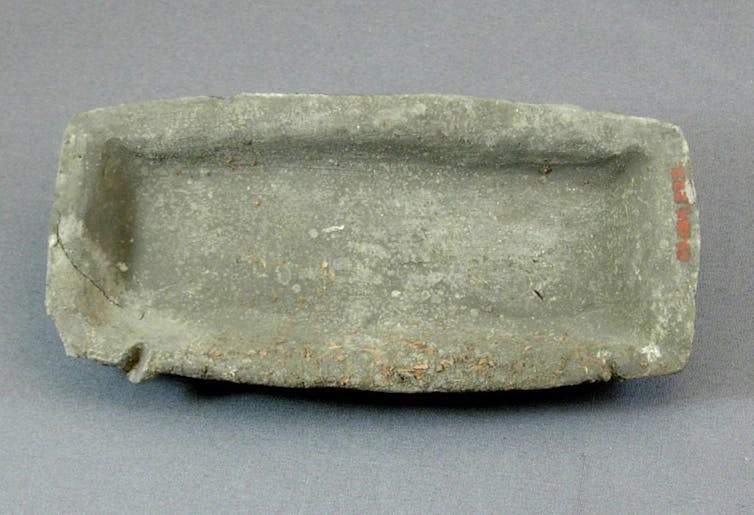
The artefacts in focus are a set of four clay trays, approximately 7.5 x 4.0 x 1.2cm, plain in design and apparently quite utilitarian.

This type of artefact is known from other funerary contexts including elsewhere in the Valley of the Kings. They have been described in various ways as mud trays, earthen dishes or troughs. The lack of consistency in terminology and suggestions on function illustrate the difficulty in understanding their precise role in the tomb.

Along with the clay trays are a set of wooden staves, just over a metre long, with a slight angle, and covered with gesso (a white pigment and binder mixture) and gold. In spite of the difference in materials, they were assumed by the man who uncovered the tomb, Howard Carter, to be directly associated with the trays. He believed they were probably intended as bases for the staffs to stand upright.

A plain clay tray, in the shape of a modern loaf tin
One of the clay trays. Timeless Moon Public Archive

However, it is clear that they have an even greater function to fulfil as, contextually, everything in the tomb has symbolism and meaning, even down to the wooden boxes for preserved meats, which were intended to sustain Tutankhamun in the afterlife.

The care with which the trays and staff were laid out on matting indicates that they were important for the king's burial. We might expect a royal burial to be filled with only the finest objects, made of the most valuable materials by elite craftsmen, with the association of materials such as gold with royalty and divinity. The richness of the rest of Tutankhamun's burial for the most part fulfils this expectation. But, nevertheless, the ordinariness of the clay trays in the light of such riches confirms rather than refutes their significance.

The restoration of order

Following the royal court's move back to Thebes in the wake of Akhenaten's death, the restoration of Amun and the other gods was set in motion. The cult centre of Amun at the Temple of Karnak regained its status. The name of Akhenaten and his imagery, along with that of the sun disk, were subjected to a campaign of removal.

Tutankhamun erected the so-called Restoration Stela with titles and epithets invoking the traditional gods, and statements on "having repaired what was ruined … having repelled disorder". The upheaval of the Amarna Period was reversed.

Discussions in academia on the dismantling of Akhenaten's regime have tended to focus on issues such as name changes and the destruction of his upstart city. But ancient Egyptian religion had countless centuries of recorded tradition and observance, so profound demonstrations of loyalty to the traditional gods were needed.

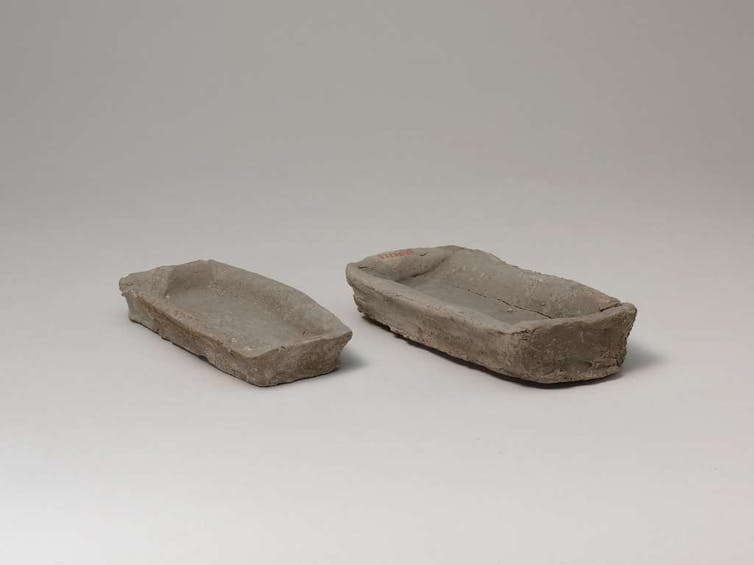
two very plain clay trays
Two more clay trays from Tutankhamun's tomb. Timeless Moon Public Archive

The mud trays are now thought to be part of a wider funerary ritual, which both invoked the god Osiris and permitted the transfiguration of Tutankhamun. As king, he was thought to be the embodiment of the god Horus in life, and to become Osiris in death – rejuvenated and resurrected.

Osiris is usually shown as a mummified king, with green or black skin to represent the fertility of the land and the new life which comes from it. It is not a coincidence that the trays are made of mud.

Other aspects of the placement of the trays within the tomb such as specific placement and orientation (including particular symbols in the decoration of the tomb) indicate that the trays had a specific role to play. This may have been as an offering tray for Nile water, once more underlining the role of the river in creating life.

Tutankhamun and his treasures are so familiar today that it is possible to overlook, or even forget, the fact that once the doors were sealed after his funeral they were meant to never be seen again. Some of his grave goods – particularly those made from gold – have outshone others. However, the ordinariness of the trays among all the riches suggests that they are crucial components of his burial. They confirm Tutankhamun as both renewed in death through Osiris, and the king who restored order to Egypt.

Enjoy The Conversation? Now you can listen to us as a podcast. Each week, scholars from around the world provide informed context on the biggest news headlines and explain fascinating new research on everything from new particle physics to Brazil's militarized democracy. Listen to a new episode of The Conversation Weekly every Thursday.

Gemma Ware
Host, The Conversation Weekly Podcast
--   Sent from my Linux system.

Controversy over Pyramid claims - Heritage - Al-Ahram Weekly - Ahram Online

https://english.ahram.org.eg/NewsContent/50/1207/544236/AlAhram-Weekly/Heritage/Controversy-over-Pyramid-claims.aspx

Controversy over Pyramid claims

Nevine El-Aref , Tuesday 8 Apr 2025

Claims that a vast underground city has been discovered beneath the Giza Pyramids have sparked controversy and rejection among Egyptologists, reports Nevine El-Aref

Controversy over Pyramid claims
Giza Plateau; a 3D image showing the shafts leading into two giant chambers beneath Khafre Pyramid; a visual representation of the structures and underground water system the researchers claim to have identified; and a 3D model created to display the newly discovered structures inside the central part of the Pyramid of Khafre

The Giza Plateau, home to the iconic Pyramids and the Great Sphinx, has long symbolised ancient ingenuity and human achievement. However, beyond its warm sands and weathered stone structures, a new controversy is beginning to unfold.

Late last month, two scientists, Filippo Biondi of the University of Strathclyde in Scotland and Corrado Malanga of the University of Pisa in Italy, claimed that using Synthetic Aperture Radar (SAR) technology they had identified what they described as a vast underground city stretching 2 km beneath the Giza Pyramids.

According to their findings, the subterranean complex includes eight distinct vertical, cylinder-shaped structures spanning over 610 m beneath the Pyramid of Khafre.

They also reported the presence of various unidentified structures detected at a depth of approximately 1,220 m, among them a structure containing a sarcophagus initially believed to be the tomb of a Pharaoh. These newly identified formations are said to be connected by underground pathways that lead beneath the surface and are believed to reveal hidden chambers and wells beneath the 4,500-year-old Pyramid complex.

The scientists claimed that electromagnetic signals were converted into phononic data, which revealed what they interpreted as extensive infrastructure reaching thousands of metres below ground. The eight large vertical features, speculated to be wells or shafts, are believed to stretch over 1,980 m across and extend to depths of 610 m.

The team also referenced the so-called "Halls of Amenti", a mythical feature in Egyptian lore, suggesting it could include the legendary Hall of Records, a secret chamber believed by some to lie beneath the Great Sphinx or elsewhere within the Giza Pyramid complex and containing ancient knowledge about Egypt's earliest civilisation.

The findings, made public through a reinterpretation of a scientific paper published in 2022 in the journal Remote Sensing and a video published on YouTube presenting the claim, had garnered thousands of viewers at the time of reporting, reflecting widespread public interest and speculation.

Social media platforms lit up with reactions to the alleged discovery, as users on X (formerly Twitter), Instagram, and TikTok shared archived posts expressing fascination and excitement. Many referred to the purported find as "a vast underground city".

Egyptologist and former minister of antiquities Zahi Hawass firmly rejected the claims, however, stating that the use of radar technology inside the Pyramid of Khafre was "completely false" and amounted to "fake news".

He emphasised that both researchers have never come to Egypt to do research, and the techniques cited in their report are neither scientifically approved nor validated by the archaeological community and radar experts. The findings were not peer-reviewed nor made publicly available in scientific journals, he said.

"No radar devices have been used inside the Pyramid," Hawass confirmed, adding that there is "no scientific evidence" to support the existence of the underground structures described. He explained that the ancient Egyptians had carved the base of the Pyramid directly from the natural bedrock to a height of approximately eight metres and that no columns or vertical shafts lie beneath it.

He wondered about the purposes behind the claims, suggesting that the researchers wanted to argue that the Pyramids were not constructed as royal tombs, but rather as components of a sophisticated ancient power-generating system and that they were built by aliens not the ancient Egyptians.

Hawass said that all the 120 pyramids stretching from Giza to Dahshour were built by the ancient Egyptians as royal tombs and national projects.

He said that the Wadi Al-Jarf papyri, considered the oldest papyri in the world, is strong evidence that the ancient Egyptians were the Pyramid builders. The papyri contain the diary of Merer, the overseer of workers at Wadi Al-Jarf, 24 km south of Zaafarana and 119 km south of Suez, during the reign of King Khufu, showing how they constructed the Great Pyramid on the Giza Plateau.

It tells how the workers transported stones from the Tora Quarry to the Plateau to build the Pyramids. "These claims are nothing more than an attempt to diminish the achievements of ancient Egyptian civilisation," Hawass stated.

CLAIMS: Mohamed Ismail Khaled, secretary-general of the Supreme Council of Antiquities (SCA), pointed out that the research was authored by two researchers, one of them with a background in electrical engineering and the second a specialist in industrial chemistry.

Their study was published in Remote Sensing, a journal issued by a Swiss-based publishing house headquartered in Basel. Neither author holds formal qualifications in Egyptology, archaeology, or even remote sensing, the core discipline of the journal in which their work appeared.

Khaled said that Remote Sensing is published by MDPI, a well-known open-access publisher. Under this model, researchers pay publication fees in exchange for making their work freely available to the public.

"While the journal claims to uphold a peer-review process, a closer look at the submission timeline raises questions," Khaled said, adding that the paper was submitted on 30 August 2022, underwent review by 28 September, and was accepted for publication on 12 October. This turnaround time of approximately six weeks is unusually short for comprehensive peer review, particularly for a paper exceeding 30 pages in length.

"Scholars across disciplines generally recognise that rigorous peer review often requires several months to ensure methodological and scientific soundness," Khaled said.  

An identical version of the paper can be found on the academic platform ResearchGate listed with a submission date of 7 October 2020. This earlier version lacks any indication that it underwent peer review, yet it mirrors the final published manuscript in both structure and content.

This raises the possibility that the research was published largely unchanged, without substantial input from reviewers or the revisions typically required in academic publishing.

"The use of satellite technology to detect deep subterranean structures, particularly beneath solid stone formations such as the Pyramid of Khafre, presents significant scientific and technical challenges," Khaled said.

He added that the claim that SAR was used to identify corridors and columns at extreme depths under the Pyramid is not only highly speculative but may be technically implausible.

"SAR technology, while effective in certain geospatial applications, does not possess the capability to penetrate dense stone to the degree required for such claims. Although it is theoretically possible to interpret minute ground movements caused by natural seismic activity using the Doppler effect, the practical application of such a technique in this context remains highly questionable," he said.

The study also opens with a number of controversial assertions, including the claim that the Great Pyramid was constructed entirely from granite blocks weighing approximately 2.5 tons each fitted with millimetric precision over a span of just 15 to 30 years. This assumption is fundamentally flawed, as the bulk of the Great Pyramid was constructed from limestone, with granite reserved primarily for interior chambers.

Even assuming the scientific methodology is theoretically sound, it must undergo thorough calibration and peer review to be considered valid. The input data used in the modelling software must also be rigorously verified, and both the data and processing methods must be made publicly available to allow independent validation.

Publishing only the visualised computer outputs, without disclosing the raw data or computational methodology, undermines the credibility of the findings. In other words, even scientifically robust techniques can produce misleading results if the data input is inaccurate or manipulated to fit a desired narrative, Khaled said.

CREDIBILITY: Egyptologists have raised concerns over the credibility of the findings for three reasons.

First, the original study was published in 2022 and received little attention at the time, an expected outcome given its lack of scientific rigour and limited relevance. The recent surge in interest appears to stem from viral social media posts in March this year, accompanied by mention of a press conference. However, no reputable academic or scientific institution has claimed involvement or responsibility for such a presentation.

Second, there is a significant inconsistency in citing a research paper focused on the Great Pyramid of Khufu within a video that claims discoveries related to the Pyramid of Khafre. If the same technique was used for both sites, despite the method not having been peer-reviewed or scientifically validated, questions arise regarding how the data was collected and why no separate peer-reviewed study was published specifically addressing Khafre's Pyramid.

Resorting to social media videos, rather than scholarly publication, further undermines the credibility of the claim.

Third, the claim involves the existence of eight cylindrical columns beneath the Pyramid of Khafre, each allegedly 648 m in height. This raises serious questions: how could such a high degree of precision be obtained using satellite imagery to examine what lies beneath the Earth's surface? Surrounding these columns are said to be spiral corridors, suggesting that the Pyramid resembles an oil-production platform resting on eight pillars, each extending 648 m deep, while the actual height of the Pyramid of Khafre above ground is only 136 m.

Furthermore, it is claimed that at the base of these columns are two massive chambers, each measuring 80 x 80 m, and that a network of corridors stretching two km connects the Giza Pyramids underground. How were such highly specific underground features measured with satellite technology? If the claims are accurate, which recognised scientific institution conducted this study? And why were these findings not published in a peer-reviewed scientific journal, but instead disseminated through videos on social media platforms?

According to Yasser Al-Shayeb, professor of Rock Engineering and its Applications in Archaeology and Heritage at Cairo University and deputy director of the Centre for Archaeological Engineering, dismissed the study as "neither accurate nor scientific".

"The geology of the Giza Plateau is well known, thoroughly documented, and understood," he said, adding that it consists of stratified limestone, which may include small voids or natural fissures, but the idea of massive columns or chambers hundreds of metres underground is scientifically implausible.

Furthermore, it is inconceivable that the ancient Egyptians could have excavated and engineered structures of such scale at such profound depths using the tools and techniques available at the time.

"There is no doubt the ancient Egyptians were master builders," Al-Shayeb acknowledged. "We have examples of underground chambers in Saqqara and the Valley of the Kings, particularly during the third and fourth dynasties. However, those structures were typically carved at much shallower depths and even those required incredible effort and planning."

He pointed out that beneath the Great Pyramid of Khufu the only known subterranean chamber lies just 30 m below ground, a far cry from the 600 claimed in the controversial paper.

"It's a small space, and there are no inscriptions or records to suggest the existence of vast rooms or pillars. The engineering tools and manpower of the time would not have allowed for the excavation of such extensive and deep systems beneath solid rock," he said.

While new technologies have significantly expanded our ability to explore ancient sites, Al-Shayeb cautioned that they have their limitations.

"We use techniques like thermal imaging, tomography, and geophysical surveys to study these monuments," he explained. "But they don't allow for high-resolution imaging at such depths. Even seismic or electrical surveys, as used in the oil industry, cannot detect specific underground objects with the accuracy being claimed."

He also stressed the importance of transparency and scientific rigour in publishing such findings.

"If these claims were legitimate, they should have been published in a credible, peer-reviewed archaeological journal, not disseminated via social media or speculative videos. Moreover, raw data, methodologies, and imaging should be shared with the wider scientific community for validation."

He expressed concerns that such speculative claims dilute the real achievements of Egyptian civilisation and distract from ongoing scholarly efforts.

"The Pyramids are not just monuments; they are a symbol of national pride and global heritage. It's our duty to protect the truth about them, Al-Shayeb concluded.

* A version of this article appears in print in the 10 April, 2025 edition of Al-Ahram Weekly

--   Sent from my Linux system.

Tuesday, April 8, 2025

4,000-year-old burial of elite woman with ostrich fan reveals world's oldest known evidence of head straps | Live Science

https://www.livescience.com/archaeology/4-000-year-old-burial-of-elite-woman-with-ostrich-fan-reveals-worlds-oldest-known-evidence-of-head-straps

4,000-year-old burial of elite woman with ostrich fan reveals world's oldest known evidence of head straps

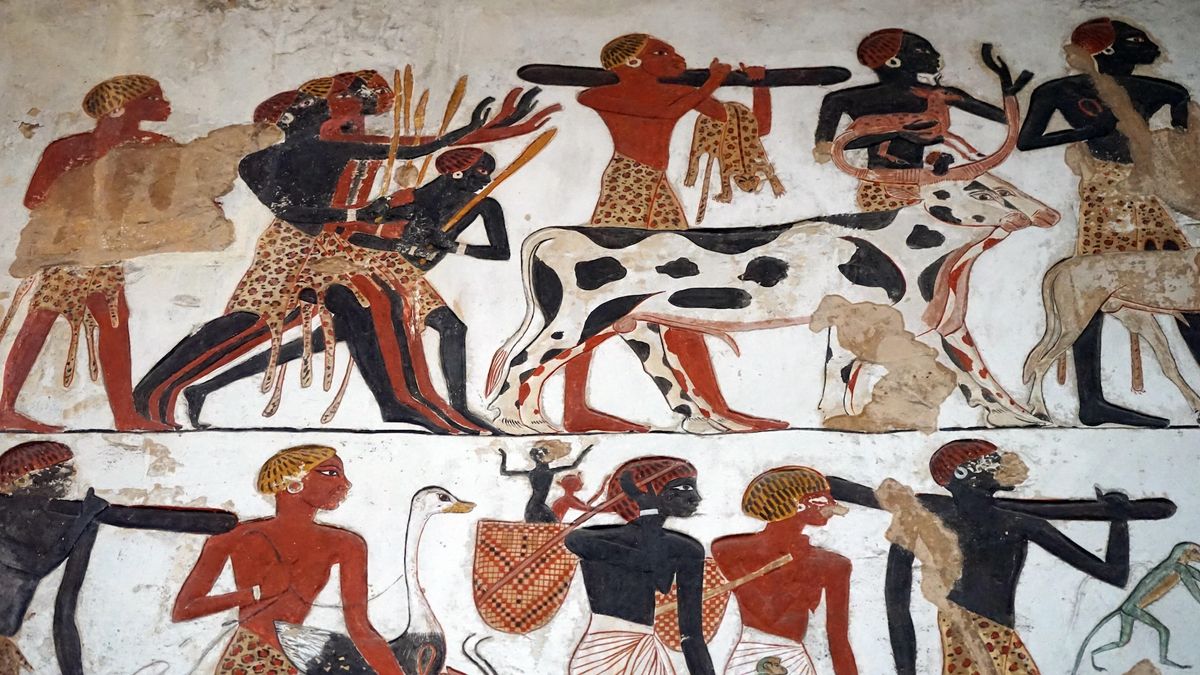
A plaster cast of a relief that depicts a military expedition launched by Ramesses II about 3,300 years ago. A Nubian woman can be seen with a head strap carrying a child in a basket. (Image credit: World History Archive via Alamy Stock Photo)

Marks on 4,000-year-old skeletons reveal that Bronze Age women in Nubia were carrying goods and young children on their heads using tumplines, a type of head strap that can hold a basket, a new study finds. The discovery reveals the oldest known use of head straps in the world.

Researchers made the finding in Sudan after analzying the remains of 30 people (14 females and 16 males) buried in a Nubian Bronze Age cemetery. One, an elite woman who was around 50 years old when she died, had the clearest marks indicative of head straps.

This is the "first clear evidence that women were using head straps — tumplines — to carry loads as early as the Bronze Age," study lead author Jared Carballo-Pérez, a researcher of bioarchaeology at the Autonomous University of Barcelona, told Live Science in an email.

Carballo-Pérez and his colleagues investigated at the archaeological site of Abu Fatima which consists of a cemetery that is located by the third cataract of the Nile River, in what was once the ancient kingdom of Kush.

After analyzing the 30 people in the Abu Fatima cemetery, the team found that women tended to have more wear on their head and neck areas than the male skeletons did, indicating that the women were bearing loads with head straps.

"Women exhibited specific degenerative changes in the cervical vertebrae and skull areas associated with prolonged use of tumplines that transfer weight from the forehead to the upper back," the team wrote in a statement.

--   Sent from my Linux system.