Search This Blog

Wednesday, March 13, 2024

University gallery explores world of ancient Egyptian and Sudanese animals - News - University of Liverpool

https://news.liverpool.ac.uk/2024/03/12/university-gallery-explores-world-of-ancient-egyptian-and-sudanese-animals/

University gallery explores world of ancient Egyptian and Sudanese animals

Ploughing and harvesting in the afterlife, from the Book of the Dead of Bakhenkhons

This spring the University of Liverpool's Victoria Gallery & Museum presents, Creatures of the Nile. The exciting exhibition explores the fascinating position animals held in ancient Egyptian and Sudanese society and culture.

On from Saturday 4 May – Saturday 5 October 2024, Creatures of the Nile features more than 250 objects, many of which have never been on public display. Highlights include one of the earliest known depictions of a domesticated dog, a sheet from the 3,500-year-old Book of the Dead and a bronze statue which entombed a mummified cat. Exhibited objects come from the collections of the University of Liverpool's Garstang Museum, with additional artefacts on loan from National Museums Liverpool and Manchester Museum.

Many species of animal called the Nile their home, long before humans settled there. As Nile-centred civilizations appeared, these creatures became central figures in societies' depictions of their world. From elaborate tomb scenes and sacred writings to amulets and pots, animals were a central motif in how people and communities communicated their values and beliefs.

In ancient Egypt and Sudan, gods were often represented in the form of an animal, taking on the full or partial appearance of creatures including lions, snakes, or baboons. These images of divine power are among the most identifiable features in Egyptian art and were represented in objects including inscribed funerary stones and protective amulets, which will be displayed in this exhibition.

The exhibition also explores mythical animals depicted in Egyptian and Sundanese art. A striking and unusual object exhibited in Creatures of the Nile depicts a hippocampus – an animal with the head of a horse, but the body of a snake.

From the spiritual to the practical, animals played a key role in everyday life with animals used in food and farming. Oxen at work in the fields of the afterlife can be seen in pages from the Book of the Dead and on inscribed funerary stones, while the exhibition also features objects made from rare materials like ivory and ostrich eggshell.

Significantly, the exhibition examines climate change in the Nile Valley. Collaborating with colleagues from the Leverhulme funded Biodiversity in Egyptian Archaeology during Societal Transitions project, the exhibition features the impact of climate change and human over-exploitation of resources. Tools used for hunting, including a stunningly preserved 4,000-year-old throw stick used for catching birds, feature alongside a timeline showing the appearance and disappearance of species in Egypt.

Nicola Euston, Head of Museums and Galleries at the University of Liverpool, said: "We're incredibly excited to bring this unique exhibition to the gallery. It showcases the University's world-leading ancient Egyptian and Sudanese collections and gives our visitors the opportunity to see many pieces for the first time. Significantly it explores an area of this ancient history that is often overlooked. While of course, stories of pharaohs and mummies have captured our imaginations for centuries, it's fantastic that we're representing the important role animals played and how their existence shaped civilisations."

Creatures of the Nile is curated by Dr Gina Criscenzo-Laycock, Curator, Garstang Museum of Archaeology, with Dr Juliet Spedding, Post-doctoral Researcher, Biodiversity in Egyptian Archaeology during Societal Transitions (BEAST) project.

--   Sent from my Linux system.

Tuesday, March 12, 2024

Engaging communities in managing the tomb of Amenhotep III at the World Heritage site in Luxor | UNESCO

https://www.unesco.org/en/articles/engaging-communities-managing-tomb-amenhotep-iii-world-heritage-site-luxor

Engaging communities in managing the tomb of Amenhotep III at the World Heritage site in Luxor

Empowering Engagement: Unveiling Amenhotep III's Legacy through Community Workshops

Within the framework of the project Conservation of the Wall Paintings of the Royal Tomb of Amenhotep III (KV22) in Luxor under the UNESCO/Japanese Funds-in-Trust, UNESCO Regional Office in Cairo supported three workshops to enhance community engagement in the management of the Tomb at the World Heritage site in Luxor. Effective community participation is vital to enhance long-term sustainable heritage management. The following workshops contributed to strengthening existing working relationships with the local community nurtured under the previous phases of the project. The vital role of women archaeologists and conservators was highlighted to celebrate International Women's Day. 

Workshop for Youth: Amenhotep III Collection in Youth Hands (Luxor Museum, 7 March 2024)

The Luxor Museum on the east bank of the River Nile displayed many movable cultural objects with significant values excavated from the temples and archaeological sites nearby, including the items relating to Amenhotep III. A workshop for Youth held at the Luxor Museum provided training for university students and young museum professionals in effective museum communication.

The workshop began with the opening remarks by the Luxor Museum, Luxor University representative and the UNESCO Regional Office in Cairo, underlining the importance of site museums for heritage preservation. This was followed by the presentation of the Egyptian conservators working on the conservation works at the Tomb KV 22. Under the guidance of the Japanese archaeological mission and the conservators at the Luxor Museum, 50 participants were then engaged in a group activity to develop a new scenario connecting the items related to the Amenhotep III at the Museum.

Each group identified the relevant items, took photos, and wrote descriptions to develop a new trail at the Museum. The outcomes of their exercise were located on the museum map and posted on the dedicated Facebook page. This activity allowed them to re-curate the Amenhotep III collection at the Museum from a youth perspective, leading to recommendations for alternative presentations.

H.E. Ambassador Oka joined the final presentation and closing session. He congratulated them on their excellent work that could contribute to the ongoing Amenhotep III project, reiterating the importance of Egyptian heritage as a foundation of the identity of young people representing the future.

Youth Workshop
Workshop for youth

Workshop for Community: Women in Archaeology and Conservation (Waseda House, 8 March 2024)

A Workshop for Community provided an opportunity for sharing information on the project's progress and the pivotal role of women professionals as a contribution to the celebration of International Women's Day (8 March) under the 2024 annual theme "Invest in Women: Accelerate Progress".

Welcoming the participants, the representative of the UNESCO Regional Office in Cairo praised the project's progress, acknowledged the project team's invaluable contribution working hand in hand with the Egyptian authorities, and reiterated UNESCO's commitment to gender equality and empowerment of women as its global priority.

The panel of national and international experts then shared their experience pursuing heritage-related professions in diverse areas ranging from archaeology, conservation science, Egyptology, art history, education, tourism, intercultural communication, journalism, photography, and cultural policy. The discussions centred around challenges they faced in terms of access to education and training, work-life balance, and social norms and how they coped with them. The KV 22 project team reported the participation of an increased number of Egyptian women specialists in the current phase. UNESCO representative mentioned the Arab Women in Science Platform, recently established in partnership with the Arab Academy of Science, Technology and Maritime Transport (AASTMT) to connect, share experiences, and access career-enhancing programmes while addressing gender stereotypes in science and advocating for gender transformative policies and open science.  

This was followed by a group activity to draw missing pieces of the mural paintings in the Tomb for "Pop-up exhibits", a new form of cultural event that could be organized in an unconventional public space to create an experience to reach out to new audiences and wider communities to get the message through.

--   Sent from my Linux system.

Sunday, March 10, 2024

Archaeologists Discover Canaanite 'Temple of the Rising Sun' Near Jerusalem - Archaeology - Haaretz.com

https://www.haaretz.com/archaeology/2024-03-10/ty-article/archaeologists-discover-canaanite-temple-of-the-rising-sun-in-central-israel/0000018e-26fe-d7d3-abce-66ffa0260000

https://img.haarets.co.il/bs/0000018e-26fe-d7d3-abce-66ff9f8e0000/57/07/138975ae4841a7901f1b628237db/55913074.JPG?precrop=1280,853,x0,y0&height=952&width=1429

Archaeologists Discover Canaanite 'Temple of the Rising Sun' Near Jerusalem

Monumental structure built 3,300 years ago would have sparkled in the morning light atop Azekah, and shows close cultural links with ancient Egypt. Click on link to read.

--   Sent from my Linux system.

Saturday, March 9, 2024

Piccadilly's Egyptian Hall | Londonist

https://londonist.com/london/features/egyptian-hall-piccadilly

Wish You Were (Still) Here: Piccadilly's Egyptian Hall

An occasional feature, in which we mourn the loss of an exceptional slice of London, wishing it was still here. This time: Piccadilly's Egyptian Hall.

An Egyptian style hall
The Egyptian Hall used to stand opposite the Burlington Arcade, and was almost impossible to ignore. Image: public domain

What was the Egyptian Hall all about?

Britain had two broad bouts of 'Egyptomania'; the second was the fallout from the discovery of Tutankhamun's tomb in 1922, which folded in rather neatly with the art deco movement of the time. The first was sparked some century-and-a-quarter earlier, thanks to Nelson's victory at the Battle of the Nile in 1798, and Napoleon's campaign in Egypt from 1798-1801. Particularly because Bonaparte had been accompanied by scientists who documented the remains of many monuments, a European fascination with ancient Egypt was sparked. Real life relics like Cleopatra's Needle found their way over to Britain, while British architects were also inspired to have a crack at recreating the Egyptian style. The first time this was the case with a full-blown building was Peter Fredrick Robinson's Egyptian Hall, commissioned by the naturalist William Bullock, and completed in 1812. Partly inspired by the Egyptian room at Thomas Hope's house in Marylebone, Memoirs of a Metro Girl tells us the Egyptian Hall also borrowed from the Temple of Dendera, with its winged mundus, scarabreus and outward projecting facade.

What was actually in the Egyptian Hall?

Napoleon's carriage
Napoleon's carriage, once on display at the Egyptian Hall, now at Chateau de Malmaison near Paris. Image: damian entwistle via creative commons

Although some ancient Egyptian objects were displayed, there was a lot more going on. The Hall was often referred to as the 'London Museum', but really it was more of a world and natural history museum rolled in with an art gallery. Until 1819 the Hall housed William Bullock's collection of over 20,000 natural history objects, including a grim menagerie called the 'Pantherion', containing a stuffed elephant, rhino, zebra and 'cameleopard' (known to you and me as a giraffe). There were also grand artworks (such as the 26-foot-long 'The Judgement of Brutus Upon His Sons') plus Napoleon-related curios, including his carriage, captured after the Battle of Waterloo. Incredibly, the coach was presented alongside its one-armed driver, who'd also been captured by the Brits, and now stood next to the coach as a living exhibit. Visitors' fascination with the captured carriage was such, it was parodied by the cartoonist Thomas Rowland.

Was it always a museum?

A flyer for a Maskelyne magic show
The Egyptian Hall became 'England's Home of Mystery'. Image: public domain

By 1844, the Egyptian Hall was humbly billing itself "the most magnificent and extensive Collection of Historical Curiosities and Works of Art ever known to have been formed by One Person" (their random use of caps, not ours). By this time, Bullock's natural history collection had long been sold off, and the Hall was filled with everything from James Ward's Allegory of Waterloo, to a family of Laplanders and their reindeers, offering sleigh rides. In fact, the Hall grew rather fond of these exotic meet-and-greets; in 1865, a group of Chinese people could be visited here, including Chang, a seven foot, eight inch-tall 19-year-old. Later still the Hall was repurposed into more of a theatre, specialising in the mystical and magical, with the likes of the 'Real Indian Basket Trick', in which exotic flower trees were said to grow instantaneously in front of spectators' eyes. The conjurers Maskelyne and Cooke (the former, who invented the world-famous levitation trick) appeared at the Egyptian Hall for over 30 years, making it 'England's Home of Mystery', and influencing the likes of French filmmaker extraordinaire Georges Méliès. It was quite an extraordinary place to visit.

What happened to it?

The Great Room of the Egyptian Hall, as redesigned by J. B. Papworth in 1819
The Great Room of the Egyptian Hall, as redesigned by J. B. Papworth in 1819. Image: public domain

The Egyptian Hall was demolished in 1905 to make way for shops and offices, standing opposite Burlington Arcade (built a few years after the Egyptian Hall). If it'd managed to hold on less than 20 years more, maybe it'd have been given a repreive, thanks to the second wave of Egyptomania. The replacement building is now called Egyptian House, though that's the only thing remotely Egyptian about it. The ground floor occupants though, currently include the French bistro Richoux, which you can read as an extremely subtle nod to Napoleon, and the fact none of this might've existed in the first place. If you want.

Can I see anything like the Egyptian Hall in real life now?

The Egyptian House
The Egyptian Hall lives on in smaller form in Cornwall. Image: Tom Parnell via creative commons

London is smattered with many Egyptian goodies, from the Petrie Museum to Cleopatra's Needle. However, if you want to see a building that's strikingly similar to the Egyptian Hall, head to Paddington.... then catch a train to Penzance in Cornwall. Here you'll find the Egyptian House, which is heavily influenced by the Piccadilly's Egyptian Hall. And the best thing about it (aside from the cracking Admiral Benbow pub nearby)? You can stay here.

Last Updated 08 March 2024

--   Sent from my Linux system.

Tuesday, March 5, 2024

Reinstallation of Room 6, Deir el-Medina - Museo Egizio

https://www.museoegizio.it/en/explore/news/reinstallation-of-room-6-deir-el-medina

https://api.museoegizio.it/wp-content/uploads/2024/03/DSC0386-NEF-HDR.jpg

Reinstallation of Room 6, Deir el-Medina


011 44 06 903
From Monday to Saturday from 9:00 a.m. to 6:30 p.m.
For quite some time, the Museo Egizio has been working on the reinstallation of Room 6, which showcases artifacts from the village of Deir el-Medina.

A comprehensive and cross-functional working group, internal to the museum, has conducted new research, both in terms of Egyptology and exhibition design, as well as regarding the interpretation and accessibility of content in the room.


Why is it so important to reorganize the room dedicated to Deir el-Medina? The site is located on the west bank of the Nile, opposite the city of Luxor, and it has been perfectly preserved because no modern city has been built over it since its abandonment. Deir el-Medina was the home of a community of artisans responsible for excavating and decorating the royal tombs of the nearby Valleys of the Kings and Queens. The context is unique because it preserves the remains of an entire village, a votive area, and a necropolis with some of the most beautiful non-royal tombs in Egypt. The site is particularly important because it has provided the most significant information about daily life in ancient Egypt. It was excavated by Ernesto Schiaparelli and the Missione Archeologica Italiana between 1905 and 1909.


On Monday, March 4, 2024, we will begin the reinstallation of the objects, which will continue until March 28.


It will be carried out in plain view, and public access to Room 7 (which houses the Tomb of Kha and Merit) as well as the passage to the "In Search of Life" room, is guaranteed.


The new arrangement will be completed and available to the public from March 29, 2024.

--   Sent from my Linux system.

Archaeologists find missing top half of Ramses II statue in Egypt

https://www.thenationalnews.com/mena/egypt/2024/03/05/archaeologists-find-missing-top-half-of-ramses-ii-statue-in-egypt/

Archaeologists find missing top half of Ramses II statue in Egypt

Uncovered head and torso a match for the lower section discovered in 1930 by a German archaeologist

The top section of a limestone statue of Ramses II was unearthed in El Ashmunein, south of the Egyptian city of Minya. Egyptian Ministry of Antiquities via Reuters
Powered by automated translation

The top half of a statue of Egyptian pharaoh Ramses II has been unearthed in southern Egypt, the Ministry of Tourism and Antiquities has revealed.

The discovery by an Egyptian-US mission completes the statue after the lower half was discovered in the same area, the Ashmunein region of Al Minya province, almost a century ago.

The top section, 3.8 metres tall, depicts Ramses II's head, shoulders and upper torso.

The pharaoh is portrayed wearing the dual crown indicating his rule over both Egypt's Upper and Lower kingdoms. A cobra, a symbol of royalty in ancient Egypt, can be seen at the front of the crown.

Preliminary scans of the limestone block have confirmed that it is part of the statue of Ramses II statue unearthed in 1930 by German archaeologist Gunther Roeder.

Once the two parts are joined, the statue is expected to stand seven metres, said Dr Bassem Gehad, head of the Egyptian team taking part in the excavation mission.

Ramses II, also known as Ramses the Great, was the third pharaoh of the 19th Dynasty of Egypt and ruled from 1,279 to 1,213 BC.

The Egyptian team, working under the authority of the Supreme Council of Antiquities, and with counterparts from the University of Colorado mission, began an excavation in Ashmunein last year to find a religious complex believed to date back to Egypt's New Kingdom era (1550-1070 BC) before collapsing during Roman rule centuries later.

"Though we have not found the complex we were initially looking for, a statue of such importance is a sign that we are digging in the right place," said Adel Okasha, an antiquities official who oversaw the dig.

He said more notable discoveries are expected.

The city of El Ashmunein, on the west bank of the Nile, was known in ancient Egypt as Khemnu and in the Greco-Roman era was the regional capital of Hermopolis Magna.

Dr Salima Ikram, a professor of Egyptology at the American University in Cairo, said the discovery was notable because "it completes the half found many, many years ago".

"Not only is it a wonderful opportunity to have a whole other massive statue of the famed king, it also adds to our general understanding and fills gaps in our data on the large corpus of Ramses II's statuary," Dr Ikram told The National.

"Through each discovery, we have been able to trace changes in the style during the course of his very long reign."

Statues of Ramses II, the longest-reigning pharaoh and one of ancient Egypt's most depicted figures, draw visitors to a number of the country's historical sites including the dual temples of Abu Simbel, in Egypt's southernmost province of Aswan.

The four giant statues of Ramses II that flank the main entrance, each 20 metres tall, gained international fame in the 1960s during an operation to move the temples to higher ground to prevent them being submerged by Lake Nasser, the reservoir of the High Aswan Dam.

Thousands of tourists visit the temples to see the Sun light up a wall engraving of Ramses II in a small chamber inside twice a year. The alignment takes place on February 22 and October 22, said to be the dates of Ramses II's birthday and his coronation day, respectively.

Another statue of the Ramses II once stood in a busy square in central Cairo near its largest train station, both named after the pharaoh, before it was moved to be the centrepiece of the main hall in the Grand Egyptian Museum, a vast complex near the Pyramids of Giza, which has been under construction since 2002 and is nearing completion.

Ramses II's mummy, along with the remains of 21 other ancient kings and queens, was transferred from the Egyptian Museum in Tahrir Square in Cairo in 2021 in a grand parade that was covered by international media and renewed interest in Egyptian heritage worldwide.

--   Sent from my Linux system.

Monday, March 4, 2024

Ancient Egyptian sarcophagus uncovered in Nile Delta en route for restoration - Ancient Egypt - Antiquities - Ahram Online

https://english.ahram.org.eg/News/518767.aspx

Ancient Egyptian sarcophagus uncovered in Nile Delta en route for restoration

Nevine El-Aref , Sunday 3 Mar 2024

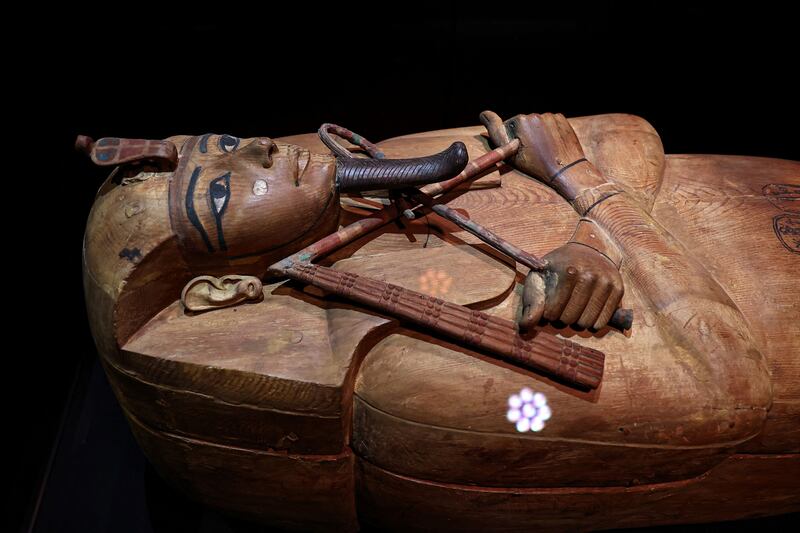
A 26-dynasty sarcophagus uncovered at a university hospital construction site in the Delta town of Banha is on its way to being restored at the Qalyoubiya archaeological site after undergoing rescue excavation, Egypt's Supreme Council of Antiquities (SCA) announced on Sunday.

ancient Egyptian
An 26-dynasty ancient Egyptian sarcophagus uncovered in a Nile Delta hospital construction site

The sarcophagus was unearthed during rescue excavations at the site designated for constructing the Benha University Hospital in Qalyoubiya Governorate.

The SCA initiated the relocation process of the quartzite sarcophagus, which dates back to the reign of King Psamtik I from the 26 Dynasty.

Mustafa Waziri, the Secretary-General of the SCA, elaborated on the meticulous scientific protocols followed in lifting and transporting it.

A specialized team from the SCA and the Grand Egyptian Museum (GEM) conducted preliminary restoration tasks at the excavation site, including mechanical cleaning and reinforcing of the sarcophagus and its lid.

Subsequently, it will be transferred to the Qalyoubiya Antiquities area for thorough maintenance and restoration procedures.

The sarcophagus weighs approximately 62 tons, inclusive of its lid. Initial studies suggest that it belonged to the overseer of the scribes during the reign of King Psamtik I of the 26th Dynasty, as evidenced by an engraved relief portraying King Psamtik I beneath the lid.

The SCA remains committed to ongoing rescue excavations until all activities at the site are concluded, ensuring the absence of any additional archaeological artefacts, Waziri said.

Short link:


--   Sent from my Linux system.
Sunday, March 3, 2024

Northern Cal. ARCE Egyptology Lecture March 17 - Imhotep: The Man, the Myth, the Monster


The American Research Center in Egypt, Northern California chapter, and the UC Berkeley Department of Middle Eastern Languages and Cultures invite you to attend a lecture by Dr. Julia Troche, Missouri State University, Springfield:


Imhotep: The Man, the Myth, the Monster
Sunday March 17, 2024, 3 PM Pacific Time
Room 140, Social Sciences Building, UC Berkeley
This in-person lecture will be recorded for later publication on YouTube.


About the Lecture:

"It comes to life!" is the tagline for the 1932 Universal film The Mummy wherein a reanimated Imhotep, as the mummy horror icon, brings terror and violence to all who encounter him. Imhotep, in fact, was a historical ancient Egyptian who is credited with engineering Egypt's first pyramid, the stepped pyramid at Saqqara for King Djoser (c. 2650 BCE). In antiquity he was venerated as a folk hero and eventually worshiped as a god. How and why did Imhotep become a horror icon? The answer is what we refer to as "Egyptomania," that is, our obsession with and consumption of ancient Egypt throughout history. This talk invites audiences to follow Imhotep and his many legacies throughout history as a way to explore Egyptomania. But it is not all fun and amusement park rides, as we consider some of the benefits and problems of Egyptomania in our everyday lives.


About the Speaker:

Dr. Julia Troche is an Egyptologist, historian, and award-winning educator. She holds a Ph.D. in Egyptology from Brown University and a B.A. in History from UCLA. Dr. Troche is currently Associate Professor at Missouri State University in Springfield, MO, and Visiting Scholar of Egyptology at Brown for her sabbatical (2023-24). She serves as a Governor for the Board of the American Research Center in Egypt (ARCE), is President and co-founder of ARCE-Missouri, and for the American Society of Overseas Research (ASOR), she is co-chair of the diversity, equity, and inclusion committee and co-chair of the Archaeology of Egypt sessions for the annual meeting. Julia's first book, Death, Power, and Apotheosis in Ancient Egypt: The Old and Middle Kingdoms was published in 2021 with Cornell University Press. She is currently working on a book about the god Ptah for Bloomsbury, a textbook (with B. Brinkman) for Routledge, and a series of articles on Egyptomania and Imhotep that she hopes to turn into a public-facing book.


About ARCE-NC:

For more information, please visit https://www.youtube.com/@NorthernCaliforniaARCE, https://facebook.com/NorthernCaliforniaARCE/, http://www.arce-nc.org,  https://twitter.com/ARCENCPostings, and https://khentiamentiu.org. To join the chapter or renew your membership, please go to https://arce.org/join-arce/ and select "Berkeley, CA" as your chapter when you sign up.

--   Sent from my Linux system.