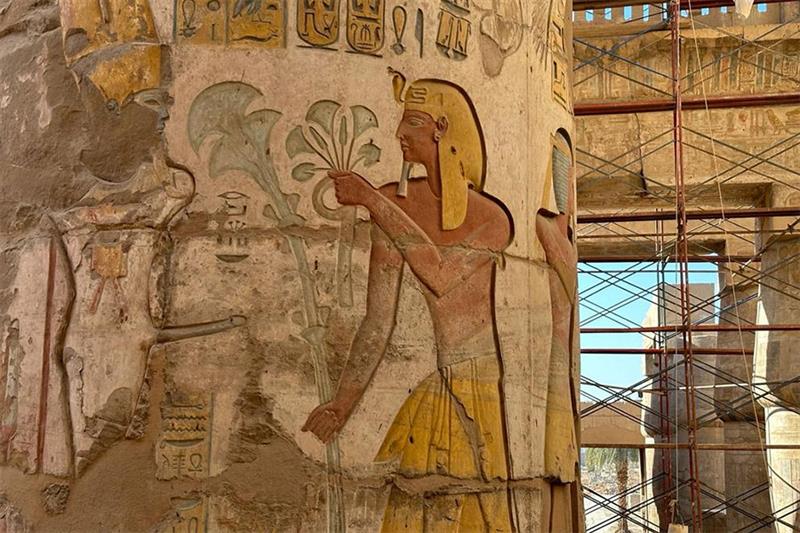
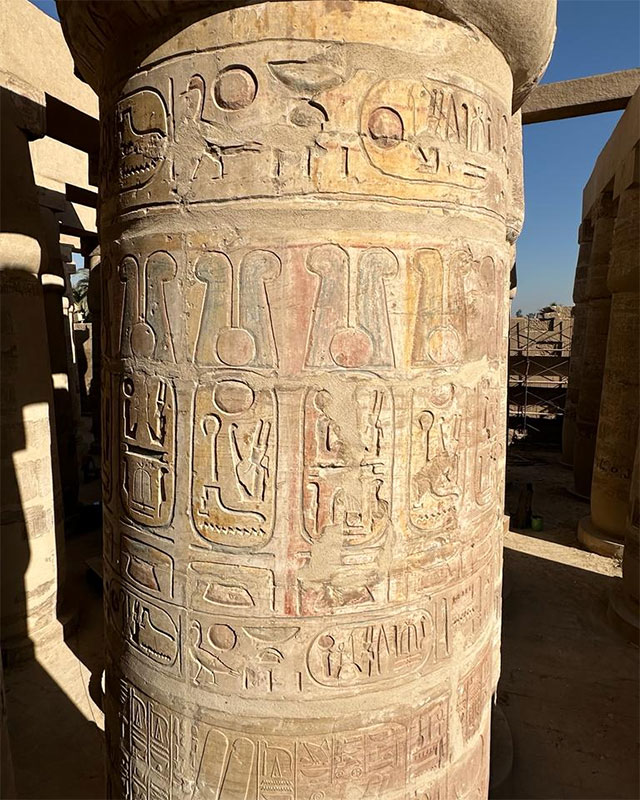
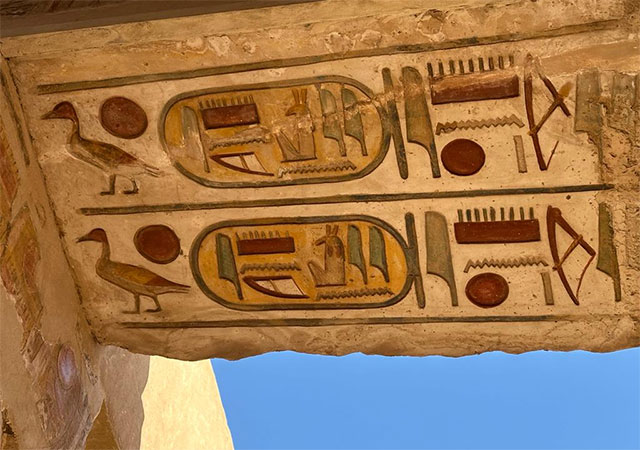
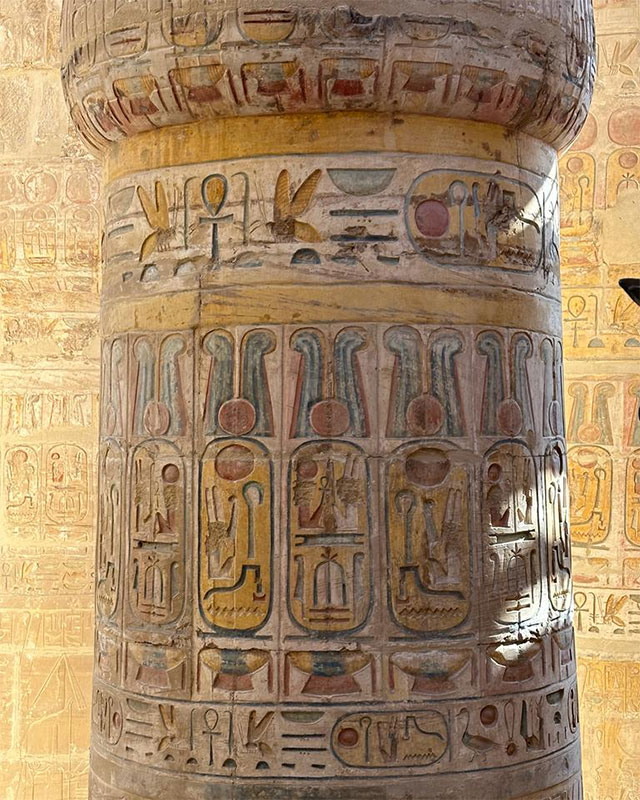
Nestled in Luxor's iconic Karnak Temple, 95 percent of the columns of the Great Hypostyle Hall have been completed, bringing back the original engravings and colours of its ancient Egyptian inscriptions.
The work was carried out by Egyptian young restorers from the Supreme Council of Antiquities (SCA) in collaboration with their colleagues among the restoration department graduates from Luxor and South Valley universities as well as Luxor Restoration Institute, Mostafa Waziry, secretary-general of the SCA, affirmed.
They were able to clean the surface of the columns, removing sand, dust, and bird deposits which accumulated for ages hiding the columns' original engravings and colours.
The restoration work adheres to international conservation standards and protocols.
"For the first time, visitors of the Karnak's Hypostyle Hall will be able to admire its original scenery," Waziry pointed out, adding that the first phase of the project started in July 2021 with the restoration of 28 columns out of the 134 columns of the hall, each of which is 20 metres in height.
The second phase started immediately after the completion of the first phase, and the hall is to be inaugurated soon.
Since Karnak was the largest and most important religious complex in ancient Egypt, its development never has ceased for over 1000 years. It is located in the south of Upper Egypt on the east bank of the city of Luxor, displaying several temples, obelisks, and shrines built throughout the Middle and New Kingdoms.
The temple of Amun-Ra is particularly famous for the vast Hypostyle Hall constructed during the reign of King Seti I. Ptolemaic rulers and Copts had altered parts of the complex for their use.
Egypt's attempts to retrieve the bust of Queen Nefertiti from the Nazis after the Second World War were thwarted by the United States, newly uncovered documents show.
The Americans dismissed the request fearing it would set a precedent that would lead to other ancient artefacts being returned and even said it would be following "Nazi principles", letters shared with The National by Egyptologist Monica Hanna reveal.
Dr Hanna is the first researcher to unearth the documents, which have sat in the US National Archive (Nara) since the end of the war, which she has used to shed new light on how Queen Nefertiti's bust was smuggled out of Egypt to Germany and how it remained there despite the Egyptians' requests to the victorious Allies.
She has unearthed correspondence by the US Army unit that dealt with the restitution of looted Nazi art, which reveal how they blocked her country's request to return the bust and served as the inspiration for the Hollywood film The Monuments Men, staring George Clooney amd Matt Damon.
Dr Hanna, associate professor and acting dean of the College of Archaeology and Cultural Heritage at the Arab Academy for Science, Technology and Maritime Transport in Egypt, told The National that "as soon as I saw the letters, I was truly amazed".
"It also showed the inherent solid cultural imperialism in the West and how they truly saw the heritage of our country," she said.
The artwork had been smuggled out of Egypt in 1912 by a German archaeologist and put on display in Berlin in 1923, but the Egyptians have been calling for it to be returned almost from the day when it first appeared in public.
An agreement with the regional government of Prussia to return the 3,300-year-old bust was vetoed by Adolf Hitler, who was said to be "in love with Nefertiti" and it remains on display in Berlin's Neues Museum. Dr Hanna believes the bust should be treated as looted Nazi art, given Hitler's role in keeping it in Germany.
At the end of the war, the bust of Queen Nefertiti was rediscovered along with a hoard of looted Nazi art in a salt mine in Wiesbaden, Germany, an episode touched on in The Monuments Men.
The letters were written in 1946 and came after Egypt's prime minister, Mahmoud Fahmy al-Nokrashy Pasha, wrote to the US State Department stating that "this masterpiece of ancient Egyptian art must return to Egypt, which it should never have left".
Initially the US appeared positive and suggested the Egyptians needed to make the request to the three other victorious allied powers, the United Kingdom, France and Soviet Union, Dr Hanna's new research paper Contesting the Lonely Queen reveals.
But while the Soviet Union appeared sympathetic, the Allied military administration told them it did not have the power to send back the bust because it came to Germany before the war.
The real life monuments men also moved to block restitution and Lamont Moore, an officer in the Monuments, Fine Arts, and Archives Section Unit, as it was formally known, set out his reasons why this should be refused in a letter to Huntington Cairns, the executive officer of the National Gallery of Art.
Moore first dismisses the request from the Egyptians as being made merely on the basis of nationalist sentiment and to satisfy their vanity.
He continues: "To return this item to Egypt now would be to follow the Nazi principle of confiscating works of art by pretence or force to enlarge their own collections.
"I feel that if the Egyptian authorities succeed in their plan, we might be faced with similar problems which might not be easily solved once the Nefertiti precedent has been established."
In another letter, Coll John H Allen, the chief of the Restitution and Reparations Branch of the Allied military administration of Germany, agreed with the stance.
He wrote that "granting this request might well establish a precedent which would require the return of thousands of art objects and other properties found in Germany".
"In addition, it might very well reopen old disputes as to property which has been in possession of other nations for many years."
The Monuments Men letters about the Queen Nefertiti bust show how Egypt was thwarted in its attempt to have it returned. Photo: National Archives
Dr Hanna explained that she first came across the documents in 2021 when she was researching the reality of the monuments men, who are "usually hailed" for their work in returning Nazi-held art.
"I had the book published on the film and so I checked the bibliography and there I found that the author had consulted the Nara archive. I wrote to them about my inquiries, and they immediately responded with two folders that I downloaded."
She said the the letters revealed Egypt's prime minister's "naivety" in believing the "US was a true Egyptian friend, how confident they were in their strong US ties and were sure that the US will definitely help since their political culture was everything that was against Nazism, colonialism and imperialism".
The statue of Queen Nefertiti, the wife of the Egyptian pharaoh Akhenaten, was taken from Egypt by Ludwig Borchardt, the German archaeologist who unearthed it.
Dr Hanna has been at the forefront of calls for the bust to be returned and is one of the organisers of a petition calling on Mostafa Madbouly, the Prime Minister of Egypt, to submit an official request to have it repatriated.
The retrieval of Nazi-held art was the inspiration for the film The Monuments Men starring George Clooney and Matt Damon. Photo: Alamy
The bust, which is 47cm tall, was discovered in 1912, but the manner in which Borchardt was able to take it to Germany is shrouded in controversy.
Dr Hanna makes the case for its treatment as Nazi looted art by drawing a parallel between the Queen Nefertiti bust and Discobolus Lancellotti, a sculpture bought by Nazi Germany from the Italian Fascist regime of Benito Mussolini at the request of Hitler but returned to Italy after the Second World War.
In her new research Dr Hanna also explores how Borchardt, who had a role in the former Antiquities Service in Egypt, was able to remove the bust of Queen Nefertiti from the country by committing what amounted to fraud.
She has also found documents in the UK's National Archive which reveal that the chief curator of the British Museum's Egyptian collection was corresponding with the British ambassador in Berlin to make sure that the Egyptian negotiations with the Prussian government failed.
This stemmed from the same fears the monuments men had about setting a precedent, in that instance regarding the Rosetta Stone and the Elgin Marbles
"This has to stop and the precedent has been delayed for almost a century because of Hitler," she said.
"A reversal of the veto of Hitler on the Prussian government agreement, which also respects the wishes of the Jewish donor of the bust to the museum, James Simon, should come today."
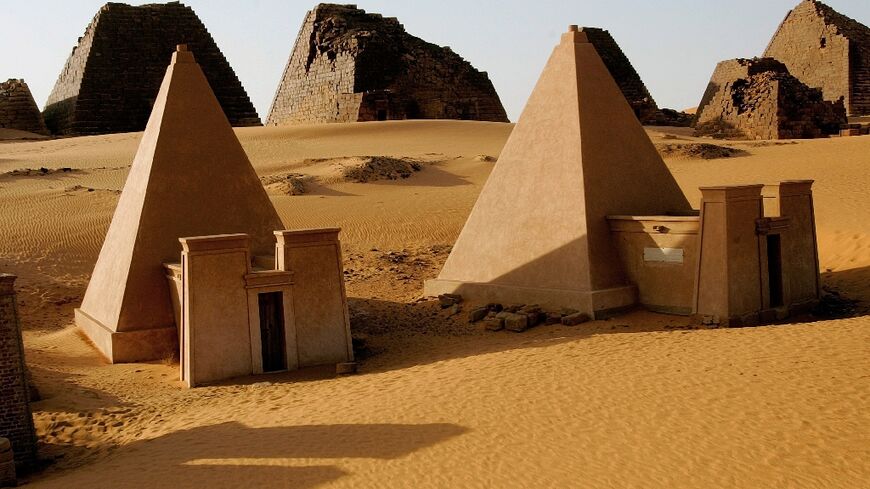
Fighting in Sudan has spread to the ancient sites of the Kingdom of Kush - ASHRAF SHAZLY
Agence France-Presse
— Gezira (Sudan) (AFP)
Sudan's devastating nine-month war between two rival generals is spreading to a UNESCO World Heritage Site, an NGO reported late Tuesday, sounding the alarm for the remains of the ancient Kingdom of Kush.
The Regional Network for Cultural Rights said it "strongly condemns the incursion by the Rapid Support Forces (RSF)", the paramilitary forces of general Mohamed Hamdan Daglo, "on the sites of Naqa and Musawwarat es-Sufra".
RSF forces have been fighting against troops loyal to Sudanese army chief Abdel Fattah al-Burhan since April last year.
The NGO said the incident, which took place on Sunday, marked the second time since December that fighting had broken out at the religious sites, located in the northern River Nile state.
State authorities also reported "an incursion by the RSF, repulsed by the air force", claiming that "calm has returned" without mentioning whether the sites suffered any damage.
The cultural rights group said it had consulted "reliable sources, images and videos posted on social networks showing fighting between the army and the RSF, which probably exposed the sites to vandalism, destruction, looting and theft".
According to UNESCO, the archaeological sites of the Island of Meroe, located about 220 kilometres (137 miles) from Khartoum, was "the heartland of the Kingdom of Kush" and is home to pyramids, temples and dwellings dating back thousands of years.
The ancient civilisations of Sudan built more pyramids than those of Egypt, but remain largely unknown.
The Island of Meroe, which lies between the Nile and Atbara rivers, is a World Heritage Site whose ancient civilisation borrowed cultural traits from Pharaonic Egypt, Greece and Rome.
More than 13,000 people have been killed since the war began in April, according to a conservative estimate by the Armed Conflict Location & Event Data Project, and the United Nations says more than seven million people have been displaced.
The American Research Center in Egypt, Northern California chapter, and the UC Berkeley Department of Middle Eastern Languages and Cultures invite you to attend a Zoom lecture by Raghda (Didi) El-Behaedi, University of Chicago:

:quality(70)/cloudfront-eu-central-1.images.arcpublishing.com/thenational/UCW3UVLW3RBJ3KASA4EXGJLZS4.jpg)
:quality(70)/cloudfront-eu-central-1.images.arcpublishing.com/thenational/UCW3UVLW3RBJ3KASA4EXGJLZS4.jpg)
:quality(70)/cloudfront-eu-central-1.images.arcpublishing.com/thenational/WBSRRUCQUZEKJADQ6TL3BYMZ7Y.jpg)
:quality(70)/cloudfront-eu-central-1.images.arcpublishing.com/thenational/K3LPGHEZJBHGDEV3D5P6JEMTAU.jpg)