Scientists used neutron tomography to see inside six sealed ancient Egyptian coffins that were used to bury animals.
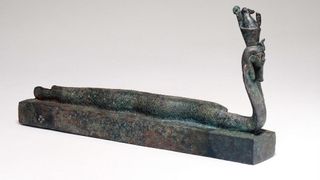
An animal coffin topped with a human-headed part-eel, part-cobra figure wearing a double crown associated with the ancient Egyptian god Atum.(Image credit: The Trustees of the British Museum)
For thousands of years, six ancient Egyptian coffins have been sealed to the outside world, their contents unknown. Now, scientists have used technology to peer inside the coffins, which are now housed at the British Museum in London, for the first time since their burial, revealing the mummified remains of several animals, including a complete lizard skull.
The coffins, which range in length from approximately 2 inches (50 millimeters) to 12 inches (300 mm) and date to between 664 B.C. and 250 B.C, were unearthed in the ancient cities of Naukratis (also spelled Naucratis) and Tell el-Yehudiyeh (or Tell el-Yehudiya) in 1885. They were constructed using copper compounds and feature figures of lizards, eels and cobras on their exteriors. (The provenance of two of the coffins is unknown.)
One of the boxes is topped with a human-headed part-eel, part-cobra creature wearing a crown that may be associated with Atum, an ancient Egyptian primordial god. The ornate imagery hints at the boxes' contents, which were revealed in a study published Thursday (April 20) in the journal Scientific Reports (opens in new tab).
Because the coffins were constructed of metal, scientists used a method called neutron tomography — a noninvasive technology that, unlike X-rays, isn't affected by metal — to look inside the coffins for the first time since their burial.
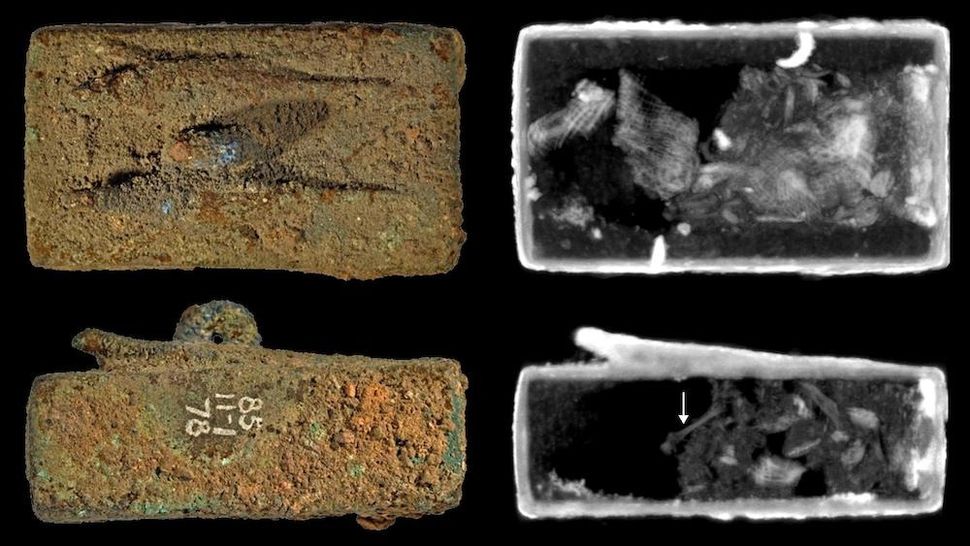
Inside one coffin, the scans revealed the complete intact skull of a lizard "similar to a group of wall lizards" whose species are found in North Africa to this day. Two other coffins contained fragments of animal bones wrapped in cloth, possibly linen, according to a statement.
"While animal burials were commonplace in ancient Egypt, it's quite rare to have coffins that are still sealed," lead author Daniel O'Flynn (opens in new tab), an X-ray imaging scientist at the British Museum, told Live Science. "Because these boxes are made out of metal, it's very difficult to look through them with X-rays, so what we were able to do with this study was to look inside a small group of coffins using neutrons. This is the first time that we've been able to confirm for these objects at the British Museum that there are actually animal remains inside of them."
An animal coffin topped with two lizard figures (top and side view). Neutron imaging shows textile wrappings and a bone (arrow). (Image credit: tk)
In addition to the bones, scientists discovered lead in three of the coffins; the metal may have been used to distribute weight during the burial process or to fix a hole in the side of one of the coffins. The exteriors of several of the boxes were also affixed with loops, which could've been used to suspend them from shrine or temple walls or to carry them during religious processions, according to the statement.
"The lead was an interesting finding," O'Flynn said. "We found quite a lot of lead in three of the boxes. We're not entirely sure of its purposes. It could've been something purely practical. But another interpretation is that it could've been included due to its status in ancient Egypt as a magical material, and we know from previous research that lead was used in the protection of mummified remains as well as in love charms and curses."
The study was inconclusive about whether the animals were sacrificed.
"It's possible that they were sacrificed, but they could also represent offerings to the gods," O'Flynn said.
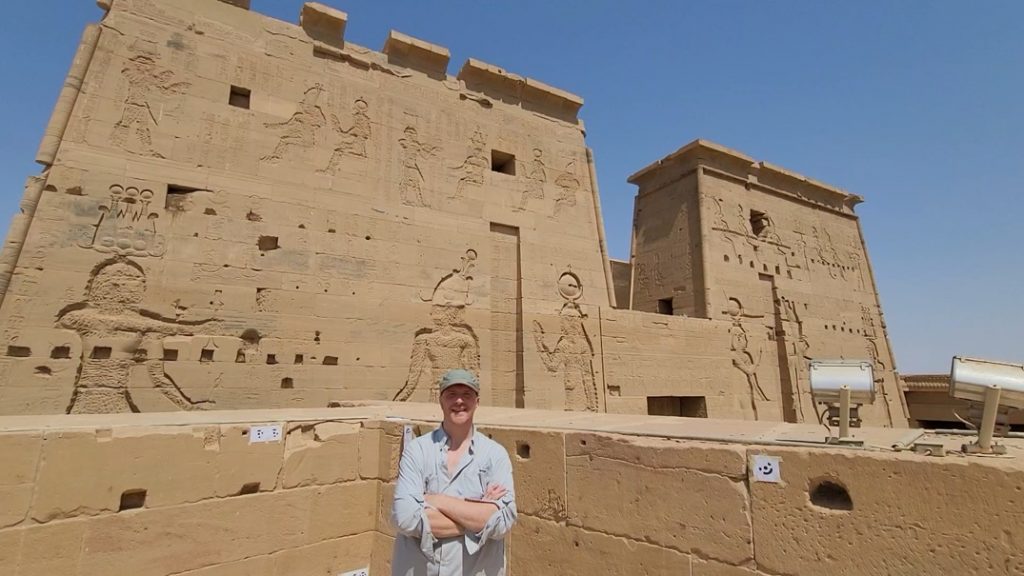
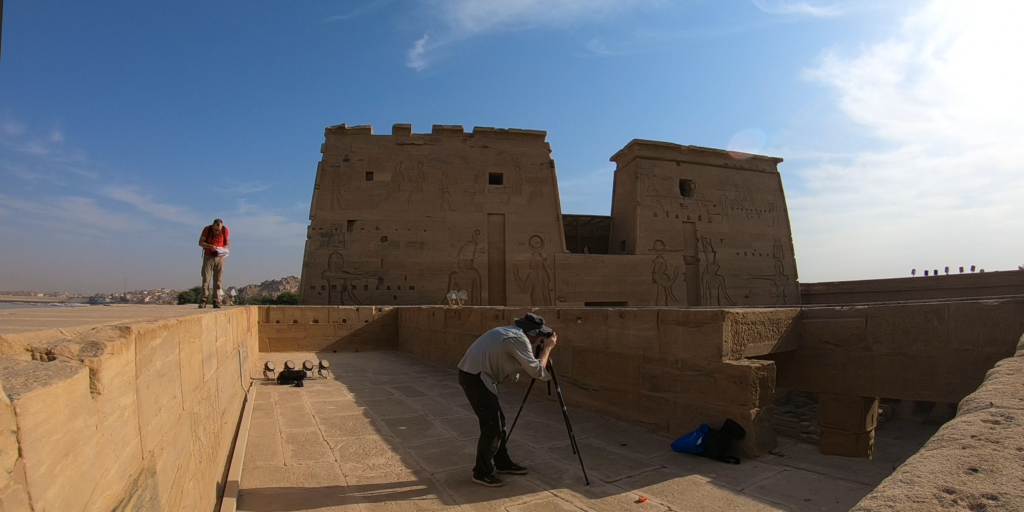
Nick Hedley onsite at the Temple of Isis. Photo: Nick Hedley/PTGP 2021-2023
If Egyptian temples are the bold declarations of the rich and powerful, the graffiti etched into their walls are the voices of the common people. At least, that's the chosen analogy of Nick Hedley, a geography professor at Simon Fraser University.
It's Hedley's expertise in spatial reality capture, however, rather than ancient Egypt, that brought him onto a project striving to record the Temple of Isis on Agilkia Island in southern Egypt. The graffiti inscriptions—written in Demotic, Arabic, Greek, Latin, Coptic, and French, along with the myriad figures of hunting scenes, feet, and gods and goddesses—tell the stories of those who have visited the site for 2,000 years.
Hedley is, in his own telling, an unconventional spatial data scientist, one concerned as much with the visual experiences his skills make possible as the practice of purely capturing data. In 2019, an exhibition he designed at the Museum of Vancouver showed how extended reality might be used to bring ancient Greece alive and connected him to the Temple of Isis project.
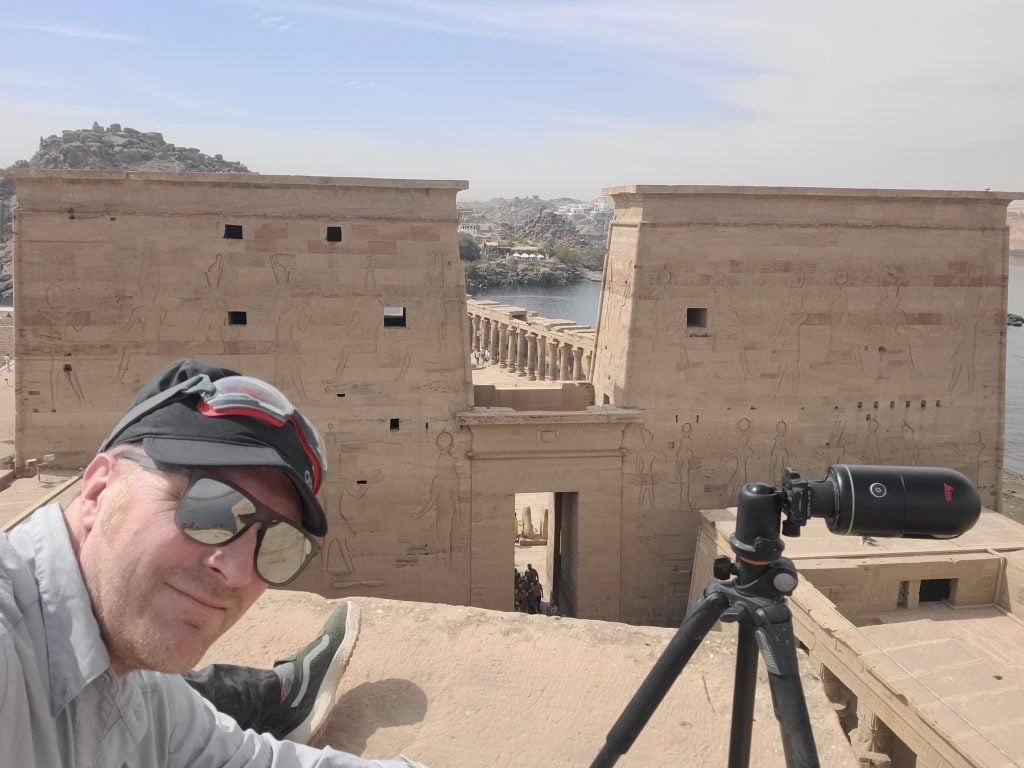
Hedley overlooking the Temple of Isis. Photo: Nick Hedley/PTGP 2021-2023.
The popularity of studying graffiti at ancient sites has swelled in recent years, but at the UNESCO site, most academic research has focused on textual graffiti, rather than the figural graffiti lining the walls, columns and roof, despite the fact they are roughly equal in number—around 1,400 items. Among them are outlines of feet (something like an ancient "I was here" marking), devotional impressions of gods, and hashes for board games.
"These inscriptions tell us something about many types of people and when you look at them up close," Hedley told Artnet News. "You can almost imagine them standing here today, quietly scratching these figures into the sandstone."
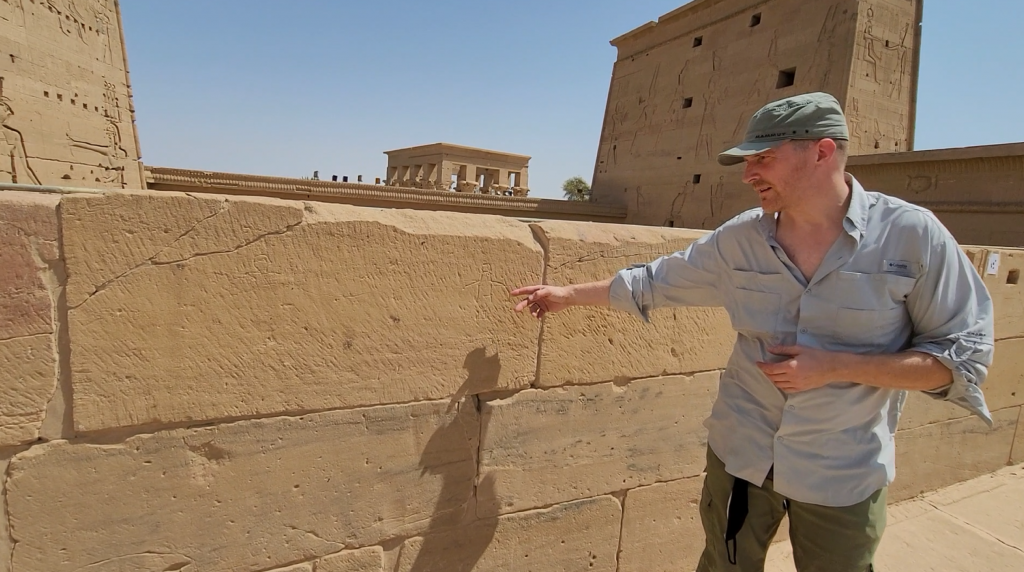
Hedley recording ancient graffiti on roof of Mammisi at Philae. Photo: Nick Hedley/PTGP 2021-2023.
Previously, similar archeological studies have relied on digitizing traced sketches to create two-dimensional plans, but Sabrina Higgins, a Simon Fraser University archeologist who has been working on the project since 2020, realized Hedley's skills in photogrammetry, raking light, and reflectance transformation imaging would produce a far more accurate model. Photogrammetry, which builds a 3D model out of photographs, can capture markings less than a millimeter deep. It's also significantly faster, achieving work that usually takes years in a matter of days.
The first stage has focused on the birth house, or Mammisis in Coptic, a small chapel focused on the nativity of a god that is connected to a large temple.
Graffiti being documented at Temple of Isis in Egypt. Photo: Nick Hedley/PTGP 2021-2023.
"My spatial reality capture work will produce the new definitive set of digital wall plans for the figural graffiti on the Mammisi," Hedley said. "In due course, I will also present the new 3D model of the Mammisi, from which point it will be used to drive multiple fundamentally new types of archaeological spatial analysis."
The project, which began in 2016, involves University of Ottawa archeologists and funding from the Swiss Institute of Archeology and the Austrian Academy of Sciences. Built in 362 B.C.E., the Temple of Isis was originally located on the island of Philae, believed to be one of burial sites of Egyptian deity Osiris. It is located on the border between Nubia and ancient Egypt and was an important pilgrimage site through the 5th century. Following repeated flooding caused by the Aswan Dam it was moved to Agilkia Island under the guide of UNESCO in the 1960s and 1970s.
It represents an intersection of history, art and, of course, fashion.
"Here at the museum, we have an internal expression that people love to see mummies and Monet," said Darnell-Jamal Lisby, assistant curator of fashion at the CMA. "So people are invested in ancient Egyptian art throughout the ages. Particularly, most people's entrance into that research is through museums.
"With that said, I really wanted a way to kind of incorporate research but also illuminate this very dense style around culture appropriation in a very digestible way."
Designed to be a thought-provoking, intimately scaled exhibition, "Egyptomania" explores the influence of ancient Egyptian art in fashion, juxtaposing contemporary creations by major fashion and accessories houses — from Chanel and Balmain to Cartier and Maison Yeya — with ancient Egyptian art from the CMA's distinguished collection.
ons by major fashion and accessories houses — from Chanel and Balmain to Cartier and Maison Yeya — with ancient Egyptian art from the CMA's distinguished collection.
"Scarab Broach," a piece of gold, platinum, blue Egyptian faience, round old-cut diamonds, emerald cabochons, smoky quartz and black enamel by Cartier London is on display in the Cleveland Museum of Art's "Egyptomania: Fashion's Conflicted Obsession." (Courtesy of Cartier)
Additionally, the exhibition tracks the history of Egyptomania in Western art through a selection of fine and decorative artworks also from the CMA collection.
Visitors will learn about the social ramifications of fashion's interpretation of ancient Egyptian art from the reclamation of ancient Egyptian history by modern Egyptians, as well as about Black empowerment.
Also, the exhibition highlights ways in which art and fashion continue to keep alive the legacy of the ancient Egyptians.
"Especially in this time we're living in now, we have a lot of different sociological dialogues going on in the public foray — particularly during the pandemic," Lisby said. "One of the things, especially in fashion, that we've seen a lot is this conversation about cultural appropriation.
"I really wanted to use this conversation of ancient Egyptian art influencing a lot of creatives and fashion created as a case study to this larger conversation about culture appropriation and understanding its nuance. I wanted to kind of use this as a low-stakes example. I didn't want to use a kind of cultural intersection that might be a little too on the side of controversial in something that we all enjoy, which is ancient Egyptian art."
After spending so much time around the creation of "Egyptomania," Lisby said he's learned much from the final product.
"The biggest surprise that I had was learning more about the ancient Egyptians themselves," Lisby said. "What I wanted to do with this exhibition was humanize it because — especially museums, academic research and also mainstream media —- we've been able to as a society kind of separate the people from the culture."
"Egypt and Nubia, Volume II: Pyramids of Geezeh," a 1848 color lithography by Louis Haghe," is on display in Egyptomania: Fashion's Conflicted Obsession" at the Cleveland Museum of Art. (Courtesy of the Cleveland Museum of Art)
Furthermore, Lisby felt a need to take on an heir-like role for ancient Egyptians who in their time "lived, loved, laughed and worshipped." He said they were no different from us.
"For them, it was about accepting their religion and culture," Lisby said. "It had nothing to do with race or ethnicity or any of these kinds of constructs that we have formulated today to create the kind of categorical divisions amongst us.
"You could be from anywhere in the world. As long as you accepted their religion and culture, you were considered ancient Egyptian. That's something quite powerful because it then kind of bursts that bubble of who can claim ancient Egypt a little bit. That was really something that I latched onto during this entire process of curating this show."
'Egyptomania: Fashion's Conflicted Obsession'
Where: The Cleveland Museum of Art, 11150 East Blvd, Cleveland.
When: 10 a.m. to 5 p.m. Tuesdays through Sundays through Jan. 1.
"Scarab Broach," a piece of gold, platinum, blue Egyptian faience, round old-cut diamonds, emerald cabochons, smoky quartz and black enamel by Cartier London is on display in the Cleveland Museum of Art's "Egyptomania: Fashion's Conflicted Obsession." (Courtesy of Cartier)
Additionally, the exhibition tracks the history of Egyptomania in Western art through a selection of fine and decorative artworks also from the CMA collection.
Visitors will learn about the social ramifications of fashion's interpretation of ancient Egyptian art from the reclamation of ancient Egyptian history by modern Egyptians, as well as about Black empowerment.
Also, the exhibition highlights ways in which art and fashion continue to keep alive the legacy of the ancient Egyptians.
"Especially in this time we're living in now, we have a lot of different sociological dialogues going on in the public foray — particularly during the pandemic," Lisby said. "One of the things, especially in fashion, that we've seen a lot is this conversation about cultural appropriation.
"I really wanted to use this conversation of ancient Egyptian art influencing a lot of creatives and fashion created as a case study to this larger conversation about culture appropriation and understanding its nuance. I wanted to kind of use this as a low-stakes example. I didn't want to use a kind of cultural intersection that might be a little too on the side of controversial in something that we all enjoy, which is ancient Egyptian art."
After spending so much time around the creation of "Egyptomania," Lisby said he's learned much from the final product.
"The biggest surprise that I had was learning more about the ancient Egyptians themselves," Lisby said. "What I wanted to do with this exhibition was humanize it because — especially museums, academic research and also mainstream media —- we've been able to as a society kind of separate the people from the culture."
"Egypt and Nubia, Volume II: Pyramids of Geezeh," a 1848 color lithography by Louis Haghe," is on display in Egyptomania: Fashion's Conflicted Obsession" at the Cleveland Museum of Art. (Courtesy of the Cleveland Museum of Art)
Furthermore, Lisby felt a need to take on an heir-like role for ancient Egyptians who in their time "lived, loved, laughed and worshipped." He said they were no different from us.
"For them, it was about accepting their religion and culture," Lisby said. "It had nothing to do with race or ethnicity or any of these kinds of constructs that we have formulated today to create the kind of categorical divisions amongst us.
"You could be from anywhere in the world. As long as you accepted their religion and culture, you were considered ancient Egyptian. That's something quite powerful because it then kind of bursts that bubble of who can claim ancient Egypt a little bit. That was really something that I latched onto during this entire process of curating this show."
'Egyptomania: Fashion's Conflicted Obsession'
Where: The Cleveland Museum of Art, 11150 East Blvd, Cleveland.
When: 10 a.m. to 5 p.m. Tuesdays through Sundays through Jan. 1.
Archaeologists have uncovered a 3,200-year-old cemetery in Saqqara, Egypt. The site served as a burial ground for the important city of Memphis and sheds light on the funerary practices of the Ancient Egyptian elite.
Lara Weiss of the Netherlands's National Antiquities Museum of Leiden and Christian Greco of the Egyptian Museum of Turin in Italy led the dig alongside researchers at Egypt's Ministry of Tourism and Antiquities. The Leiden archaeologists announced the discovery on April 11.
The lower carving shows Panahsy and his wife sitting before a priest with leopard skin around his shoulders. The holy figure sprinkles water on the couple and an inscription describes him as a scribe named Piay and an "assistant" to Panahsy.
The team was able to decipher details about the lives of the people who were buried there. The largest tomb belonged to Panahsy, who oversaw the Temple of Amun. He likely did not have children but did have a wife, who is depicted on his tomb and described as the "singer of Amun." Panahsy's large site includes a temple, three small chapels, a courtyard with columns, and underground burial chambers.
The site also has four smaller tomb chapels. One belonged to a man named Yuyu, a gold foil maker for the royal treasury. Yuyu's parents, brother, children, grandchildren, and wife are depicted in the chapel. Weiss pointed out that a "huge procession" of mourners is also engraved into the stone. Another series of carvings show a cow, the animal form of the goddess Hathor, aboard the boat of Seker, a god of the underworld who reigned over the Memphis burial site.
Another chapel describes the familial relationships of its owner but does not identify them by name, and the other two chapels have no inscriptions.
Weiss pointed out that the sculpture reliefs in the anonymous tomb were inspired by a nearby set of statues that have been in the collection of the National Antiquities Museum of Leiden since 1829. The owners of those sculptures were Merit, a high-ranking government official, and his wife Maya, who lived about 50 years before the anonymous Egyptians whose chapel was recently uncovered. Weiss said the decision to copy Maya's and Merit's tomb suggests that their burial style was perhaps ongoing.
"What fascinates me most is thus to study the daily life in this Egyptian cemetery," Weiss told Hyperallergic. Her research has centered on social dynamics in Ancient Egypt. "The choices people made in their tomb decoration, how they were inspired by others, and what all this says about the social relations of people."
Reliefs in an anonymous chapel
Excavations (and looting) at Saqqara have been ongoing for centuries. In January, Egyptian authorities announced the discovery of a 4,000-year-old mummy that may be the country's oldest. Other artifacts from the site are housed in museum collections across the world.
A carving in Yuyu's chapel shows the Hathor cow on the boat of Seker.
The trailer for Netflix's upcoming historical documentary series, Queen Cleopatra, has sparked controversy among many Egyptians who believe it promotes "false Afrocentric ideas."
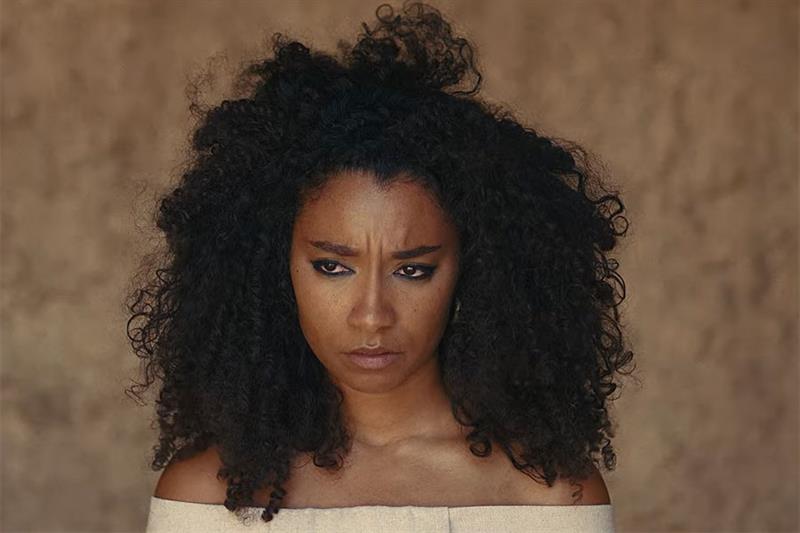
Adele James as Cleopatra in Netflix s Queen Cleopatra trailer
The trailer drew controversy after it was released online on Wednesday.
Many commentators have called on the leading streaming platform to cancel the show and some have launched an official petitions and are collecting signatures opposing.
Local news websites have quoted Egyptologists who insist that Cleopatra was Greek, including former Minister of Antiquities Zahi Hawass, who described the documentary's ideas as "falsifying facts."
The topic is still trending on social media, with angry commentators, including actors like Nabil El-Halfawy and Somaya El-Khashab, as well as other well-known influencers and celebrities.
The four-episode documentary, which is scheduled to premiere on 10 May, is produced by Jada Pinkett Smith and features black actress Adele James as Cleopatra.
Call for Applications: ARCE Northern California $1,000 Marie Buttery Memorial Student Grant
ARCE Northern California awards a $1,000 student grant each year in memory of Marie Buttery, founding president of our chapter. The application deadline is Sunday, April 30, 2023 with the grant to be awarded at our May 7 meeting at UC Berkeley.
Applicants must be graduate or undergraduate students who attend college or university in Northern California or have a hometown in Northern California. They must be pursuing a degree that incorporates Egyptian anthropology, Egyptian archaeology or art, history, museum studies or language, or Coptic or Arabic studies in any period. Proof of enrollment may be required. Previous applicants who have not yet received one of our grants are strongly urged to reapply.
The grant will be awarded by the chapter Board of Directors based on merit. Possible uses include, but are not limited to, research, travel, or preparation of an exhibition.
To apply, submit 1) a brief summary (250-500 words) describing how you will use the grant and 2) a 1-2 page CV by email (Word or PDF file) to ARCENorCal@gmail.com.
The
American Research Center in Egypt, Northern
California Chapter, and the Near Eastern Studies
Department, University of California, Berkeley,
invite you to attend a lecture byDr. Geoff Emberling, Kelsey Museum of Archaeology, University of Michigan.
New Perspectives on the African Empire of Kush: Excavation at Jebel Barkal Sunday, May 7 2023, 3 PM Pacific Daylight Time Room 20 Social Sciences Building (formerly Barrows Hall) UC Berkeley
Jebel Barkal (Image courtesy of the lecturer)
About the Lecture:
Kush was the dominant political power in the Middle Nile region of northern Sudan for over 2000 years (ca. 2000 BCE – 300 CE). Our understanding of this extensive ancient empire has long been constrained by the long legacy of focus on monumental remains (palaces, temples, pyramids) at the expense of investigation of settlements that would broaden our understanding of Kushite economy and social identities.
A joint project of the National Corporation for Antiquities and Museums of Sudan and the University of Michigan has begun work on a newly discovered area of settlement at Jebel Barkal (ancient Napata), one of the major cities of Kush (and a UNESCO World Heritage site). This talk will present the results of our first seasons of work on Meroitic levels of settlement at the site, contemporary with the Roman occupation of Egypt (1st century BCE – 1st century CE).
About the Lecturer:
Dr. Geoff Emberling is an archaeologist and museum curator who has worked extensively on ancient cultures of North Africa and the Middle East. His research has focused on identities, urbanism and empires in Mesopotamia and in Nubia. He has directed projects in northern Sudan over the past 15 years and his team is just beginning its work at Jebel Barkal, the "pure mountain" of the ancient Egyptians and capital city of ancient Kush.
Parking is available in UC lots all day on weekends, for a fee. Ticket dispensing machines accept debit or credit cards. Parking is available in lots around the Social Sciences Building, and in lots along Bancroft. A map of the campus is available online at http://www.berkeley.edu/map/
Ancient Egyptian Child Mummies Show High Rates Of Anemia
Life was tough for kids in Ancient Egypt, even before they were mummified.
Ben Taub Freelance Writer
Published
90Shares
One third of the mummies showed skull malformations linked to anemia. Image credit: Panzer et al., International Journal of Osteoarchaeology, 2023 (CC BY-NC-ND 4.0); cropped
Childhood in Ancient Egypt was something of a mixed bag, with some kids enjoying the luxury of becoming Pharaoh before turning ten while others struggled with iron deficiency and poorly oxygenated blood. According to a new analysis of child mummies, anemia was a common problem for the Egyptian youth, leading to high rates of skeletal defects and possibly sending some kids to the afterlife before their time.
Anemia is a condition that is defined by a lack of healthy red blood cells and therefore a deficiency of hemoglobin. Ultimately, this means the blood is unable to carry enough oxygen to meet the body's demand.
To determine the prevalence of the disorder among leathery antique kids, researchers examined 21 ancient Egyptian child mummies using a technique called whole-body computed tomography. This allowed them to identify skeletal abnormalities commonly associated with anemia, such as an enlargement of the cranial vault, which is the part of the skull that contains the brain.
The mummies' age at death ranged from one year to roughly 14 years. Overall, seven – or 33 percent – of the ancient volunteers displayed pathological enlargement of the cranial vault, indicating that they probably suffered from anemia.
However, most of those who had the disorder can consider themselves lucky in comparison to one of the specimens, who appears to have been born with an array of genetic abnormalities that doomed him from the moment Ra created him.
Noticing an excess of bone marrow throughout the boy's skull and facial bones, the study authors say he probably suffered from a congenital condition called thalassemia. Caused by an inability to produce hemoglobin, the disorder can now be successfully treated with blood transfusions and chelation therapy.
However, such remedies were obviously unavailable in the ancient world, leading the researchers to believe the youngster probably experienced "severe anemia and skeletal changes that result from the expansion of the bone marrow." They also note that untreated thalassemia patients may be susceptible to "growth retardation, pallor, jaundice, poor musculature, hepatosplenomegaly, masses developed from extramedullary hematopoiesis, and early death, often in childhood."
As if that weren't enough, the same individual was also found to have an unusually large tongue. According to the researchers, this may be evidence of another genetic condition called Beckwith-Wiedemann syndrome, which causes the enlargement of certain body parts.
It's therefore little surprise that the unfortunate sprog lasted no more than a year and half before descending to the underworld, with thalassemia being "the most probable cause of death."
Regarding the lucky children who suffered only from anemia, the study authors say the prevalence of the condition may have been linked to risk factors "such as decreased iron intake due to malnutrition; chronic gastrointestinal blood loss and decreased absorption, both caused by parasites; and inflammation caused by chronic infections."
Malaria is another potential contributor to anemia, and was prevalent in Ancient Egypt.
Despite this evidence, however, the researchers say it remains "unclear whether [these children] died due to anemia, due to a combination of diseases, or due to another reason and with anemia."