In 1955, Ricardo Augusto Caminos (1915-92) began surveying the rock-cut shrines at Gebel el-Silsila on behalf of the Egypt Exploration Society, a project that would last (on and off) until 1982. Originally from Buenos Aires, Argentina, Caminos pursued a career in Egyptology in the United States, Britain, and Russia. As well as his work at Silsila, Caminos is also known for his involvement in the UNESCO 'International Campaign to Save the Monuments of Nubia' during the construction of the Aswan High Dam, notably for his epigraphic copying of inscriptions at the sites of Buhen, Semna, Kumma, and Qasr Ibrim between 1960 and 1965.
While rehousing the Society's collection of Beato studio photographs of Egypt dating to the late 19th century, staff recently (2019) came across a sealed package. It was slotted between a number of photographs and had likely not been spotted by researchers when consulting the material. Writing on the pack revealed that inside were to be found two paintings: L. GREENER'S watercolours - 1. R.A.C.'s CAMP AT ABYDOS (1959) 2. R.A.C.'s CAMP AT SILSILAH (1959)
One of these paintings had been located some years previously in the personal papers of Caminos, though the subject and painter had remained unknown – until now. Fortunately, the second painting was still within the package and depicts the camp of Ricardo Caminos at Gebel el-Silsila on 9 February 1959.
The watercolour by Leslie Greener in the EES Lucy Gura Archive, depicting the camp of Ricardo Caminos at Gebel el-Silsila in 1959 (CAM.ART.03).
The Society's annual reports indicate that between January and April 1959, Caminos was employed in recording the Speos of Horemheb at Silsila. This monument is shown on the left (west bank) of the painting, while the proximity of the Nile and the east bank can be seen to the right. The Nile and a felucca frame the escarpment looking north into the distance.
The Speos of Horemheb at Gebel el-Silsila in 2012. The bank has been built up and reinforced for smaller boats to moor up, allowing access for visitors, and the trees have gone. But the large boulder at the river bank in the painting is still visiable at the lower left of the photograph.
The artist, (Herbert) Leslie Standerwick Greener (1900-74), was probably working for the University of Chicago epigraphic mission in Luxor at the time and no doubt visited Caminos during the expedition season during which he likely painted this image. Crucially, no images of Caminos' camp have survived in the EES Lucy Gura Archive and so this image is the first time we get a glimpse of how the team lived during their field season. The publication of this work was not completed when Caminos died in 1992, though the Silsila sub-archive remains a valuable resource for ongoing research and is regularly consulted by those currently working at the site as part of the Gebel el-Silsila Project.
This discovery, though small, just shows how much there is still to be found in archives and the historical importance of these paintings as well as their artistic beauty.
If you like this painting, then you can now purchase EES merchandise in our online shops at Society6 or RedBubble with this design.
AIA Site Preservation Grant to Support Project at Deir el-Ballas, Egypt
The AIA's 2019 Site Preservation Grant will fund preservation work taking place at Deir el-Ballas in Egypt. The project is being undertaken by the Ancient Egyptian Heritage and Archaeology Fund and American University in Cairo. A capital for the Theban kings at the end of the Middle Kingdom period, Deir el-Ballas also served as a military base when the Thebans waged a war against the Hyksos. The site includes the remains of two palaces, a workman's village, an administrative quarter, and a number of private houses, which range in size from small two-room huts to large villas.
Despite its archaeological and historic importance, the site is at risk from looting and more significantly from the expansion of the modern town of Deir el-Gharbi. Illicit digging by treasure hunters has undermined a number of the standing monuments and caused the collapse of a large portion of the South Palace's facade. The North Palace, located between the modern town and its associated graveyard, was being used as a trash dump. Parts of the ancient settlement were bulldozed for the construction of new housing, cemeteries, and the local pottery industry. The impact of modern development has been exacerbated by the construction of the Western Desert road which runs from Aswan to Cairo.
This AIA supported preservation project will address the damage that has been done to the site, develop a long term site protection plan in conjunction with the state antiquities service, and engage the local population in the preservation efforts. The preservation work will include stabilizing the façade of the South Palace and rebuilding the top of the wall with modern unbaked mud brick; preserving a stair platform that leads to the top of the building's eastern façade; continuing the removal of modern trash from the North Palace; filling in the North Palace's emptied casemate foundations with clean sand; and replacing fallen and eroded mud brick with new unbaked mud bricks that conform to the originals.
Project members, led by Dr. Peter Lacovara, intend to work with the antiquities service in Qena to create a plan for long term site management that includes the installation of signage in Arabic and English, a proposed wall that will clearly demarcate the area of the ancient site from the surrounding desert, and efforts to promote an understanding of the significance of the site within the local community. Planned community outreach and education efforts include working with the Education Department of the American University in Cairo to develop lesson plans that will integrate the site and its role in Egyptian history into the existing curriculum at Deir el- Gharbi's secondary school and the development of an adult education program for residents of the village. In addition, project members have commissioned the creation of a play about Queen Ahhotep and the Hyksos Expulsion centered on the site that will be performed at the restored North Palace by members of the American University in Cairo's Theater Department.
The AIA Site Preservation Program emphasizes outreach, education, and the spread of best practices in site preservation. All aspects of the program, including the awarding of grants, are made possible by generous donors and AIA members. You can make a donation to support our efforts here.
Hobby Lobby president Steve Green to give back 11,500 antiques to Iraq and Egypt governments
Benefactor Steve Green says prior resulting criticism of bible museum 'justified'
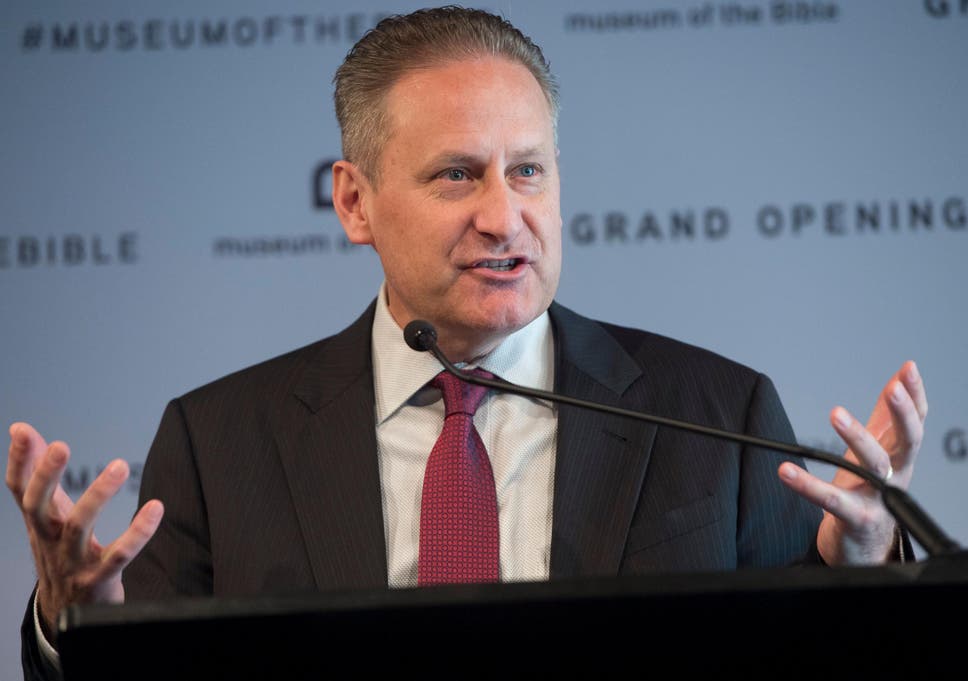
Steve Green, president of Hobby Lobby and chairman of the board of Museum of the Bible, ( AFP via Getty Images )
Hobby Lobby's president Steve Green has said he is repatriating 11,500 antiquities to the Iraqi and Egyptian governments after amassing the pieces without verifying their ownership histories.
According to a report by The Washington Post. the millionaire said he was conceding to criticism of his accumulation of artefacts, and that he was coordinating the return of around 5,000 ancient papyrus fragments and 6,500 ancient clay objects which don't have legitimate historical sourcing.
Artefacts which don't have confirmed provenance and paperwork are troubling because this means they could have been stolen.
"One area where I fell short was not appreciating the importance of the provenance of the items I purchased," Mr Green told the Post.
Mr Green said that when he started collecting biblical-era antiquities in 2009 he "knew little about the world of collecting".
The benefactor said that resulting criticism for his Museum of the Bible, of which he is a founder and chairman of the board, was "justified".
"The criticism of the museum resulting from my mistakes was justified," he said.
Before the museum even opened in 2017 it was surrounded in controversy as antiquities scholars and US Customs agents fielded curators about Mr Green's procurement of artefacts.
The controversy was sparked in July 2017 when Hobby Craft paid $3 million to settle a US government lawsuit alleging that the crafts company had smuggled 3,800 Iraqi antiquities into the country.
Last year, the benefactor and the museum and faced more scrutiny when it returned 13 ancient fragments of allegedly stolen biblical passages that were bought by his team.
The museum chairman told the Post that the rest of the ancient and pre-modern materials in his collection have now been researched to be sure they contain the necessary records, and research of the provenance of everything else is underway.
Only one of the pieces being repatriated was exhibited at Museum of The Bible, the museum said.
In terms of future acquisitions, Mr Green assured the paper that he and the museum have implemented strict procurement strict protocols to ensure any new pieces have legitimate ownership histories.
People pray in front of the shuttered gates to al-Aqsa mosque compound as all prayers are suspended to prevent the spread of coronavirus in Jerusalem, Monday, March 23, 2020. (AP Photo/Mahmoud Illean)
CAIRO (AP) — The Middle East's most populous country, Egypt, as well as Syria, a country ravaged by nine years of war, will impose nightly curfews starting this week in an effort to stop the spread of the new coronavirus, their governments announced Tuesday.
A worker disinfects the Royal Mummies Hall, in an effort to help prevent the spread of the coronavirus, at the Egyptian Museum in Tahrir Square, Cairo, Egypt, Monday, March 23, 2020. (AP Photo/Hamada Elrasam)
The International Monetary Fund meanwhile warned that a shortage of medical supplies could affect the Mideast's poorest nations.
There are over 31,000 confirmed cases of the virus across the Mideast, the vast majority in the hard-hit nation of Iran. While most recover from the virus and the COVID-19 illness that it causes, bottoming crude oil prices have put additional strain on even the region's wealthiest countries. That in turn could affect their ability to spend on needed supplies as the virus challenges medical systems worldwide.
Already, countries have reacted by either urging or ordering hundreds of millions of people to stay home. Egypt, home to over 100 million alone, and Syria, became the latest on Tuesday.
Egyptian Prime Minister Moustafa Madbouly told a news conference that the 11-hour nationwide curfew from 7 p.m. until 6 a.m. would go into effect Wednesday, during which various forms of transportation will also come to a halt.
Egypt has 402 confirmed cases and 22 fatalities, including two senior military officers.
A worker disinfects in the hall of the Queens, in an effort to help prevent the spread of the coronavirus, at the Egyptian Museum in Tahrir Square, Cairo, Egypt, Monday, March 23, 2020. (AP Photo/Hamada Elrasam)
Madbouly announced the continued closure of airports, schools and universities until April 12. He said shops and malls will close Fridays and Saturdays, Egypt's weekend. Groceries, bakeries and pharmacies would be excluded from the closure order.
He said further restrictions would be implemented "according to developments," without elaborating.
President Abdel Fattah el-Sissi tweeted that he expects Egyptians to "respond positively to these measures, in order to protect the security and safety of our beloved Egypt."
He warned that attempts to violate the announced measures would be confronted with "the utmost firmness and decisiveness."
In the Mediterranean city of Alexandria, dozens of people took to their balconies before dawn to pray for help against the virus, online videos showed. Other footage showed some three dozen people marching in a side street and chanting: "There is no God but Allah, and Muhammad is his Messenger."
Egypt's Interior Ministry, which oversees the police, said it had arrested "a number" of organizers of the Alexandria gathering.
Dome of the Rock is seen at a deserted al-Aqsa mosque compound as all prayers are suspended to prevent the spread of coronavirus in Jerusalem, Monday, March 23, 2020. In Israel daily life has largely shut down with coronavirus cases multiplying greatly over the past week, (AP Photo/Mahmoud Illean)
El-Sissi's government has banned large gatherings, closed all its museums and archaeological sites including the famed Giza Pyramids and locked down tourist cities in the south and the Red Sea. Religious authorities have closed churches and mosques.
In Syria, where the healthcare system has been decimated by nearly a decade of civil war, the government said a 12-hour curfew beginning at 6 p.m. (1600 GMT) will go into effect Wednesday. State news agency SANA did not say how long the nighttime curfew would continue, but it appeared to be open-ended.
Syria has reported only one case of the coronavirus so far, but strict measures have been taken in government-held areas including halting commercial flights, closing borders with neighboring countries and shutting down restaurants and public transportation.
Even before the curfew was announced, lines had formed outside grocery stores, banks and gas stations across the Syrian capital, Damascus, as people braced for wider closures.
The IMF, which traditionally has told governments to implement greater austerity measures, was urging Mideast governments to offer temporary tax relief and cash transfers. It warned a lack of medical supplies could hurt Iraq, Sudan and Yemen if it leads to a surge in prices.
"Given the large numbers of people employed in the service sector, there will be wide reverberations if unemployment rises and wages and remittances fall," the IMF's director for the Middle East, Jihad Azour, said in statement.
In the impoverished Gaza Strip, Hamas-run religious authorities announced all mosques will be shut down for two weeks starting Wednesday. Schools had already closed.
A worker disinfects around King Tut's famous mask in the Egyptian Museum in an effort to help prevent the spread of the coronavirus, in Tahrir Square, Cairo, Egypt, March 23, 2020. (AP Photo/Hamada Elrasam)
Donations from Qatar of food, electric appliances, clothes, furniture and fuel arrived Tuesday at temporary quarantine centers in Gaza. It's part of a $150 million boost from Qatar to fight the virus announced Sunday.
An Israeli-Egyptian blockade of Gaza, in place since the militant group took power in 2007, has slowed the arrival of the new virus to the densely populated Palestinian enclave.
After detecting two coronavirus cases earlier this week among returnees from abroad already in quarantine, Hamas imposed further precautions and closures. Gaza's Health Ministry said it has opened more than 20 quarantine facilities already housing 1,400 people.
The arrival of the pandemic in Syria, as well as the impoverished Gaza Strip, has raised concerns the virus could run rampant in some of the most vulnerable areas in the Middle East. War-torn Libya and Yemen, which have yet to report any cases, are also a source of concern.
The worst outbreak in the Mideast is unfolding in Iran, where authorities reported another 122 deaths on Tuesday, bringing the total number of fatalities to more than 1,900 amid more than 24,800 confirmed cases. The dead included the mother-in-law of the son of Supreme Leader Ayatollah Ali Khamenei, the state-run IRNA news agency said Monday.
In this Tuesday, March 10, 2020, photo, two foreign women tourists ride camels at the Giza Pyramids near Cairo, Egypt. The country's prime minister announced at a news conference on Tuesday, March 24, 2020, a two-week, 7 p.m. to 6 a.m. curfew for its over 100 million people to slow the spread of the new coronavirus. The 11-hour curfew would go into effect Wednesday across the country and last for two weeks. (AP Photo/Maya Alleruzzo)
Health Ministry spokesman Kianoush Jahanpour warned the public that infections will likely rise further, as Iran now has more ability to test and screen suspected cases. The ministry has launched a website for the public to report if they suspect they have the virus, so medical staff can come administer tests.
So far, 41 million people have used the site, Jahanpour said. Iran is home to some 80 million people.
The sultanate of Oman meanwhile announced it would halt all passenger flights beginning Sunday, although cargo flights would continue.
Saudi Arabia announced Tuesday that its virus cases jumped from 562 to 767, and included its first death.
Ramesses II, also known as Ramesses the Great, was the third pharaoh of the Nineteenth Dynasty of Egypt.
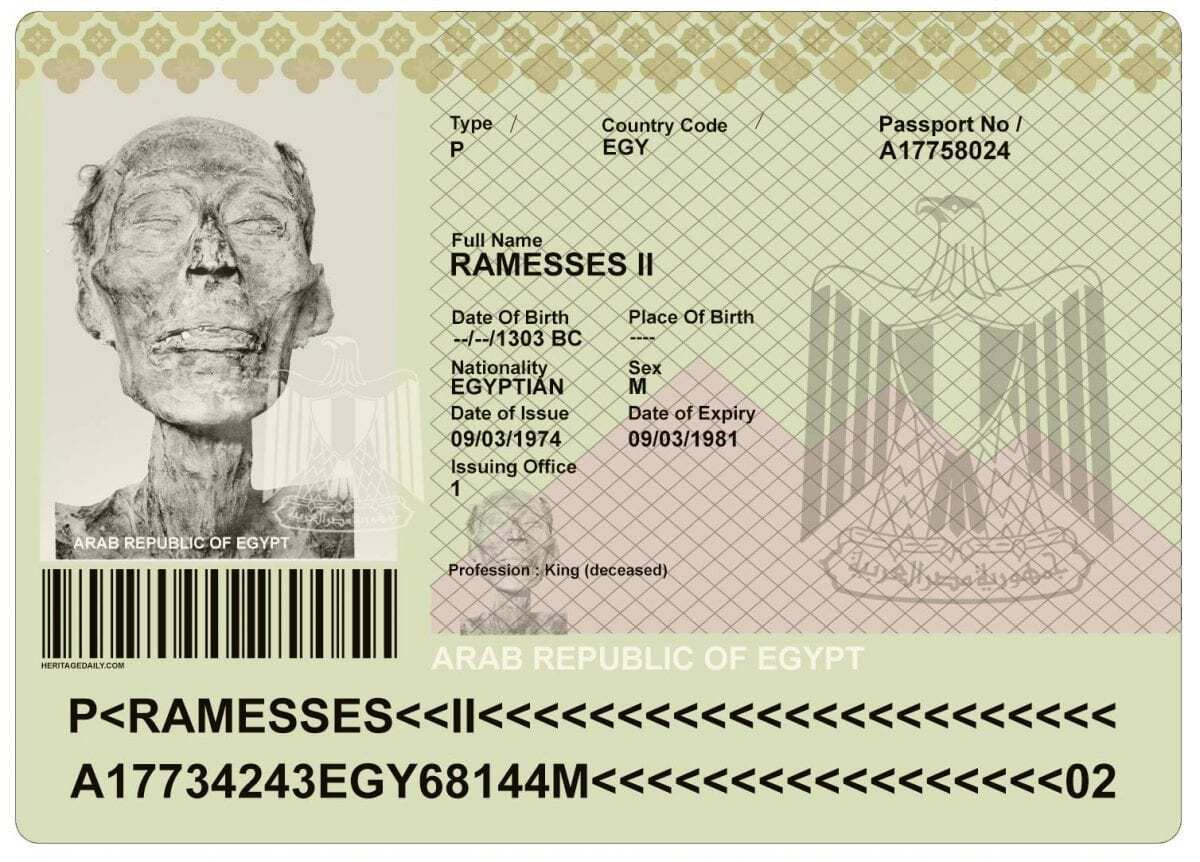
In 1976, his remains were issued an Egyptian passport (nearly 3 thousand years after his death) so that he could be transported to Paris for an irradiated treatment to prevent a fungoid growth.
Ramesses II is often regarded as the greatest, most celebrated, and most powerful pharaoh of the New Kingdom. His successors and later Egyptians called him the "Great Ancestor". On his death, he was buried in a tomb in the Valley of the Kings; his body was later moved to a royal cache where it was discovered in 1881, and is now on display in the Museum of Egyptian Antiquities.
In 1975, Maurice Bucaille, a French doctor studying his remains said that the mummy was threatened by fungus and needed urgent treatment to prevent total decay. French laws dictated that entry and transportation through the country required a valid passport. To comply with local laws, the Egyptian government issued a passport to the Pharaoh.
Image Credit – HeritageDaily – An artist's creation of the passport – Image is for representative purposes – The actual passport is not publicly available.
The New York Times reported on Sept. 27, 1976 that "The mummy was greeted by the Secretary of State for Universities, Alice Saunter‐Seite, and an army detachment. Ramses II, who ruled Egypt for 67 years, received special treatment at Le Bourget Airport."
It was then taken to the Paris Ethnological Museum for inspection by Professor Pierre-Fernand Ceccaldi, the chief forensic scientist at the Criminal Identification Laboratory of Paris.
During the examination, Cecaldi noted that the "Hair, astonishingly preserved, showed some complementary data—especially about pigmentation: Ramses II was a ginger-haired 'cymnotriche leucoderma'" (meaning he was a fair-skinned person with wavy ginger hair).
Also that "in ancient Egypt people with red hair were associated with the deity Set, the slayer of Osiris, and the name of Ramesses II's father, Seti I, means "follower of Seth" said Cecaldi. The examination also revealed evidence of previous wounds, fractures, and arthritis which would have left Ramesses with a hunched back in the later years of his life.
In 2007 it was discovered that small tufts of the Pharaoh's hair were stolen during the 1976 preservation work (published by the BBC). A Frenchman named Jean-Michel Diebolt, said he had inherited the hair from his late father, a researcher from the team who analysed the mummy. Deibolt had tried to sell the hair through an online auction for 2000 euros (£1360), but was quickly apprehended by French authorities.
I bet many of you haven't heard of Egyptology, never mind that it's possible to study it as its own subject at university – after all, how much can there really be to study about something that's all odd languages and dusty tombs?
Initiation into Egyptology involves many things, some more painful than others. There were history and civilisation lectures on Egypt and the ancient Near East, all of which were amazing and on almost any topic you can think of. We also had language classes which, I will admit, while interesting, hurt.
It also involves an introduction to the less wonderful side – the many misconceptions and misrepresentations of our discipline, which make us wish that Egyptology really was just as simple as being about funny languages and dusty tombs. And, I can promise that they do not get any less annoying as time goes on.
So, here's a run-down of some of the least wonderful things that we seem to be cursed with.
#1 Curses
One of the first things that a lot of people mention when they find out that you're an Egyptologist is the mummy's curse, specifically the one that supposedly killed Lord Carnarvon, who funded the excavation of Tutankhamun's tomb. The fact that the person who actually found the tomb, Howard Carter, didn't die for another seventeen years seems to be irrelevant.
It's unlikely that there is such a thing as mummies having curses, given how many of them we have in collections around the world and the fact that about half of all Egyptologists cram themselves onto a single plan every time a conference rolls around. If the ancient Egyptians wanted to get rid of us, they're certainly making hard work of it considering how easy we're making it for them.
#2 Hieroglyphs
One thing never to say to an Egyptologist is anything along the lines of 'it's just pictures, isn't it' – this was said to me, and was followed by a lengthy lecture on linguistics even though I was at the time studying archaeology.
Hieroglyphs are actually just one of multiple scripts used to write Egyptian, although certainly one of the longest-lived (short of the cursive version, hieratic, because the ancient Egyptians had better things to do than spend all day writing their laundry list in actual hieroglyphs). And those scripts record grammatical and phonetic information, the same as many do for other languages.
#3 Amateurs
We aren't the only discipline with hoards of amateurs around, people who haven't actually got any Egyptological training and yet think they're experts – which they're not, given the number of embarrassingly inaccurate tattoos out there. But the term 'Egyptomania' was coined for a reason. Even almost a century after the discovery of Tutankhamun's tomb, there are a lot of people out there who think that reading a couple of books is an acceptable substitute for years of training, or who feel the need to prove that aliens did indeed build the pyramids and that The Book of Exodus is word-for-word accurate.
#4 Popular culture
Staying on the subject of Egyptomania – and embarrassingly inaccurate tattoos – probably one of the most galling things about working in a field so heavily admired by the public is that the popular culture is dire to say the least. There are so many inaccurate ideas out there, from people who have no idea how Egyptian languages work, people who seem to think that civilisations three thousand years ago were so incompetent that aliens are a more likely explanation for everything (as though we're any more competent today), to whatever Gods of Egypt (2016) is supposed to be. It certainly says something when Seth (god of the desert and chaos) having a Scottish accent is one of the least cringeworthy things in a film.
#5 Sex
This part's probably not going where you think it is, but bear with me. It might shock you to know that ancient texts can be impressively filthy – and, if you think that the Greek gods were messed up, I challenge you to become acquainted with the Egyptian Gods.
The problem with all of these ancient texts isn't that they're positively pornographic in places, but that a lot of them were translated early last century or earlier and haven't been updated. That means that the juicy stuff in these texts, which I'm sure would really help in the outreach effort, was translated into Latin for the sake of decency.
#6 Organisation
Or rather, the lack thereof. I mean this in the sense of belonging. Unlike a lot of disciplines, we don't have a standard department, which means that the kinds of academics and structure of courses across universities varies hugely. For example, at Oxford we're part of Oriental Studies, but at Liverpool we're grouped with Archaeology and Classics. This disparity generates big differences in perspective.
Even within Egyptology, using different perspectives for the benefit of the discipline isn't guaranteed. Our predecessors one or two hundred years ago were often polymaths, who studied philology and archaeology in equal measure. The same can't be said of Egyptologists today, which has led the study of language and the study of material culture to be separate, competing camps, with results that are anything but conducive to the furthering of our discipline as a whole. That's probably the most frustrating, thing about being an Egyptologist.
Some of these things are certainly more annoying than problematic, but others really are a serious problem. It would be nice if we could get rid of at least the most serious ones and make Egyptology more about the wonderful things that we actually research, for both ourselves and the general public. I'm sure that Egyptology is not the only discipline plagued by misconceptions and misrepresentations – but I like to think that ours include things that are more bizarre than most.
New film explores work of a man dedicated to finding the untouched tomb of an Egyptian pharaoh
History | Life
Joanna Jasińska March 22, 2020
Tomb hunter: Prefessor Andrzej Niwiński in Egypt. Press materials
Recently TFN reported on the extraordinary and ancient stone chest uncovered in Deir El-Bahari in Egypt. A film crew was present when the discovery was made, while it was working on a documentary and biopic about the tenacious archaeologist and Egyptologist Professor Andrzej Niwiński.
TFN spoke to director Monika Krupa and the professor himself to bring to light the secrets of Thutmose II's tomb and the 30-year-long journey which will hopefully end with its discovery.
In March last year Niwiński's team uncovered a stone chest from 3,500 years ago in the rubble above the Temple of Hatshepsut in Deir El-Bahari. The extraordinary find indicates an untouched royal tomb could be nearby buried beneath the sands that have hidden it for thousands of years.
Monika Krupa: knew straight away that she wanted to make a film about the professor.Kalbar/TFN
But for Professor Niwiński, the road to the tomb started when he was just a teen. "As a child, like many others, I wanted to be an explorer. I imagined that an explorer is someone who explores some new islands, some piece of land. I read books about travellers. But then the sad truth came to me that everything had already been discovered," he recalled.
A turning point came when Niwiński received a book about the history of archaeology 'Gdy słońce było bogiem' (When the Sun was God) by Zenon Kosidowski during a summer camp.
"After reading this book, I was 13 years old, I came back home to Warsaw and told my parents, I will become an Egyptologist. Since then I have only been faithful, but faithfulness is an important value."
Niwiński has been hunting above the Temple of Hatshepsut in Deir El-Bahari.Press materials
This unwavering conviction led him not only to studying under the renowned professor Kazimierz Michałowski, often called the father of Polish archaeology, but also to countless months spent in Egypt starting in 1972. Since 1999, Niwiński has traveled to Egypt every year as part of the Polish-Egyptian Mission in Deir El-Bahari.
The professor said: "My first mission to Egypt was in Deir El-Bahari, at the Hatshepsut Temple [Poles have been working there since 1961 – TFN]. Then it turned out that above the Temple there is a mysterious shelf halfway up the cliff on with traces of human activity, so I wanted to investigate it. This is where the cliff mission came from. I already had an idea to look into it at the end of the 80s, and it took me 10 years to make it happen."
Convinced tomb is there, Niwiński dedicated his life to finding it. For 15 years he deciphered documents indicating where the tomb may be located, and then for the next 15 years he removed 3,000 tonnes of rock, layer by layer, from the slope in Deir El-Bahari.
"After reading this book, I was 13 years old, I came back home to Warsaw and told my parents, I will become an Egyptologist," says Niwiński.Kalbar/TFN
Now with the discovery of the royal deposit, all signs point to the tomb belonging to pharaoh Thutmose II.
For many years, it was believed that the mummy of Thutmose II was discovered in 1881 by a tomb-robber named Abd el-Rassul in a cache with over 50 other bodies of royals and high priests.
The mummies were badly damaged and moved there in ancient times to preserve them. As Professor Niwiński explained, a 1987 French study of the life of Thutmose II provided univocal proof, that it couldn't be his body. "The tomb of Thutmose II was never discovered and I hope we're a step away from finding it," added the Egyptologist.
He has been travelling to Egypt since 1973.Press materials
Now, feeling confident of imminent success he said: "I still have two dreams that I want to come true. One is very close to happening. What we have discovered so far indicates that we are literally on the brink of discovering the tomb of Pharaoh Thutmose II. I'm also convinced that some 40 meters from it, above the Temple of Hatshepsut, there is another intact royal tomb. I'd like to discover both."
Monika Krupa, a graduate of the Łódź Film School, was searching for a story idea for her first movie when she attended the 'Poles over the Nile' conference to hear archaeologists report on their work in Egypt and Sudan. Seeing Professor Niwiński's passion and confidence, she knew straight away she wanted to make a documentary about him.
Krupa approached the professor after the conference and he agreed to take part in her project. She told TFN: "After two years when we became friends, he admitted that he agreed only for the sake of some peace and quiet."
"I'm also convinced that some 40 meters from it, above the Temple of Hatshepsut, there is another intact royal tomb. I'd like to discover both," says Niwiński.Press materials
Professor Niwiński had a similar recollection: "Monika, whom I didn't know, approached me and said she was going to make a movie about me. I didn't believe it, I thought she was going to fail. But even if she won't make it, why would I say no?"
The young director managed to overcome the problems of funding and Egyptian bureaucracy and began filming in Egypt: "Since 2014 we have been to Egypt four times during the missions led by the professor. In 2019, when we thought that the film was finished, he invited us to accompany him one last time.
"As always, we went together with the cinematographer. We took a camera to record something for the professor, some kind of a diary perhaps when extraordinary things started to happen. The professor started digging up objects he had been waiting for for 30 years. So we had to completely redo the film."
"After two years when we became friends, he admitted that he agreed only for the sake of some peace and quiet," says Krupa.Kalbar/TFN
Still, Monika revealed that over the course of the filming she realised her hero was content to just continuing searching. "This is the driving force behind his existence. I don't know if he'll be happy when he finds that tomb. I think he's happier when he keeps looking for it," she said.
For Krupa, who also thought about being an archaeologist as a child, her debut was a project of passion. She was determined to do it even without financial support. "Everyone wants to make a movie and everyone wants to make it abroad," she said.
Equipped with an idea and a reluctant hero, she attended the Doc Lab Poland workshop to shape her story and go over her concept with experienced filmmakers. The workshops enabled her to receive funding from the Polish Film Institute and support from the Bydgoszcz Cultural Centre. In the end, with a minuscule budget of PLN 155,000 and a small crew "What if nothing?" saw the light of day.
Monika is already working on her next projects, both a documentary and a feature film.
With the opening of a new museum in Hurghada, Egypt's Red Sea resort town – already a prime destination for beach goers, scuba divers, and vacationers around the world – is now on the map as a cultural tourist attraction.
Egypt's Prime Minister announced the opening of the Hurghada Museum on Saturday, February 29, and the new complex is expected to contribute in boosting the tourism sector, allowing foreign visitors in Hurghada the chance to explore Egypt's ancient and modern history without having to make a separate trip to Cairo or Luxor.
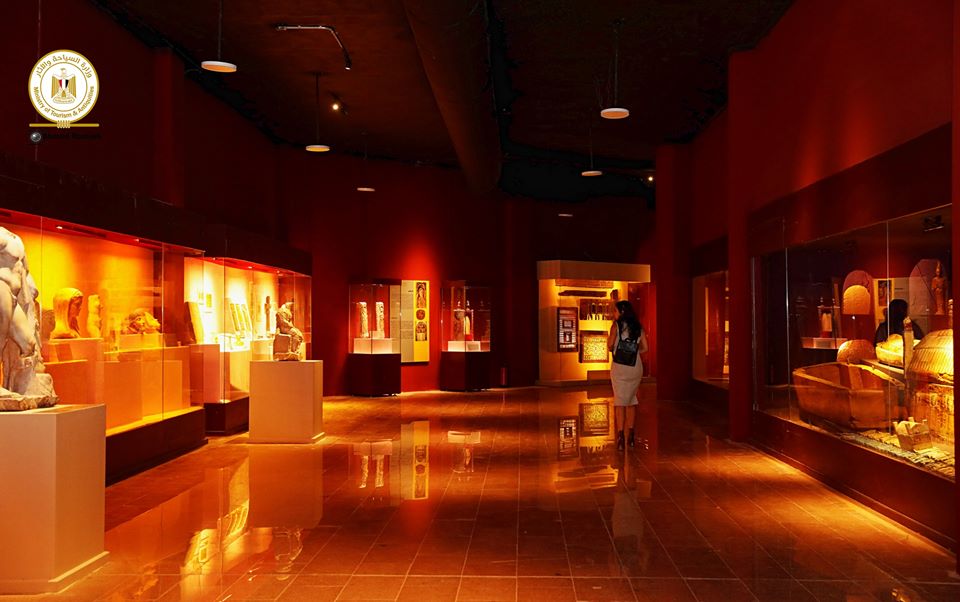
The museum was constructed on 10,000 square meters in the heart of the city, and showcases relics from different eras of Egyptian history, such as the Islamic, Coptic, and royal periods, through an extensive collection of artifacts, sculptures and portraits.
The museum houses an area fully dedicated to ancient Egypt, which includes upwards of 1,791 artifacts and intriguing details about the lives of ancient Egyptians.
"We are offering them a time capsule of history," Anani said.
The museum also boasts a first-of-its-kind exhibition hall entitled "The After Life's Showcase," which allows tourists to learn more about the ancient Egyptian pharaohs' fascinating beliefs about the after life.
In a related context, the upper part of the statue of Queen Merritt Amon, recovered from her temple in Ramesseum, has also been transferred from The Egyptian Museum in Cairo's Tahrir Square to the new museum in Hurghada.
Another exhibition room in Hurghada's museum is devoted to the monuments of the Red Sea area, which includes Al-HammamatValley, the Roman city monuments inSafaga, the Roman city inGouna, and Wady Gasus,southern Sinai, and more.
Under the title 'Beauty and Luxury', the museum will also showcase an exhibition dedicated to the beauty routines and luxurious habits of the ancient Egyptian civilization throughout its different dynasties, according to Mahmoud Mabrouk, adviser to the minister of antiquities on exhibitions.
The museum's collection features pieces related to sport, music, daily life, and more, housing as well various artifacts from the ancient Egyptian royalty and priests, such as jewelry, perfumes, and furniture. displays remarkable examples from diverse areas, including sports, music, hunting and more.
Items dating back Mohamed Ali and the royal family are also displayed at the new museum.
A shopping complex with several bazaars offering souvenirs and replicas is located nearby, in addition to a food court next to the museum.
Significantly, the Hurghada Museum also represents the first time the government and private sector have joined forces on a heritage project.
The partnering company oversaw construction of the museum, which included renovating the building and adding a security and lighting system, with total costs of LE 185 million.
The ministry of Tourism and Antiquities will be the only managing authority of the museum, while revenues will be equally divided between the two partners.
The government's decision to collaborate with private investors came as part of efforts to boost tourism and overcome the financial challenges inherent to these kinds of wide-scale projects, according to the Minister.
The Egyptian government, along with private sector investors, were motivated to launch the project due to concerns that tourists on charter flights to resorts along the Red Sea often miss the opportunity to visit Egypt's museums or historical sites.
Meanwhile, Momen Othman, Head of the museums sector at the Ministry of Tourism and Antiquities, said during a telephone interview on the Sabah al-Khir YaMasr (Good Morning Egypt) program that the same idea is behind the much-awaited Sharm el-Sheikh Museum.
Tickets to the Hurghada Museum for foreign visitors cost LE 200, reduced to LE 100 for foreign students. Tickets for Egyptians cost LE 80 and will be reduced by half for Egyptian students as well.
The path of the journey of The Holy Family to Egypt (Photo: Egyptian Tourism Authority)
The Tourism Fund's board has agreed to transfer EGP 41 million to the Ministry of Local Development to complete the development of the stops located on the Holy Family's path in Egypt.
This amount is a part of a larger budget of EGP 60 million allocated to the project by the fund.
Nader Al-Shaaer, secretary general of the Tourism Fund, explained that the development project will include three areas on the path of the Holy Family: Old Cairo, the Maadi church and Wadi Natrun.
The Tourism Development Authority has put in place development requires because of the importance of this project to the tourism sector, which will increase the number of tourists to religious tourist destinations.
The development work aims to create or upgrade tourist facilities and services along the path.
The Supreme Council of Antiquities has completed the restoration of all the archaeological sites located on the Holy Family path.
The traditional path includes 25 points, starting from Arafat in North Sinai passing through Al-Farama in Mirth Por Said, to Sakha town in Kafr El-Sheikh, Tel Basta in Sharqiya, Samanoud in Gharbiya, to Wadi El-Natroun where the Paramos and St. Macarius monasteries are located.
It then moves to Bab Zuweila in Cairo, to Old Cairo where the Abu Serga Church and Maadi church are located, then to Minya in Upper Egypt to Gabal Am-Teir church, then to Assiut, to the Maharaq Monastery, then to Dronka cave.
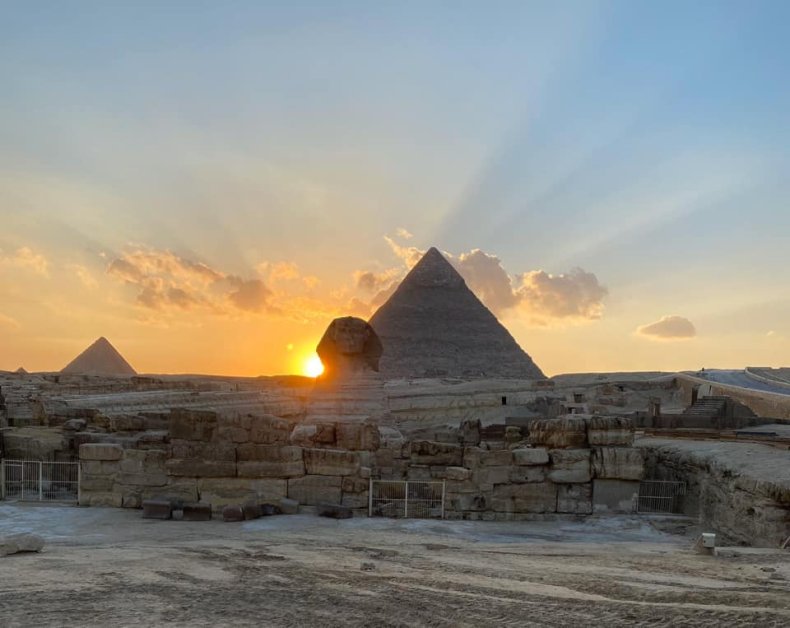
An image showing the sun setting over the right shoulder of the Sphinx statue on spring equinox has been released by Egypt's Ministry of Antiquities. The image shows the carving with the Giza pyramids of Khafra directly behind, and Khufu—also known as the Great Pyramid of Giza—to the left.
Zahi Hawass, the former Minister of Antiquities, said the image shows that there is an astronomical and religious element to the carving. This is contrary to what some archaeologists believe—that the positioning of the sphinx was accidental, with no link to astronomical events.
Hawass said the alignment between the sun and the sphinx happens twice a year during the spring and autumn equinoxes. Both events mark the point at which day and night are equal in length.
The sun setting between the pyramid of Khufu and Khafra suggests an astronomical link, Hawass says. The Ancient Egyptians worshiped the sun, with the God of Ra being one of the most important in the civilization's religion. The Sphinx of Giza, which was built around 4,500 years ago, is believed to have been built for, and to represent, the pharaoh Khafre, who was the son of Khufu.
Photo showing the sun setting on the right shoulder of the Sphinx of Giza. Some researchers believe the positioning of the pyramids relates to astronomy. Ministry of Antiquities
The link between astronomy and the construction of the pyramids has been the subject of research for decades. The Great Pyramid of Giza is known to be almost perfectly aligned to the points of north, south, east and west. A number of ideas have been put forward for this feat, including the use of constellations and the sun.
Glen Dash, an engineer who studied Egypt's pyramids, looked at the alignment of the Great Pyramid of Khufu, the Pyramid of Khafre and the Red Pyramid and found all three were well aligned. He also found all three had the same small error, being rotated ever so slightly counterclockwise from the cardinal points. He suggests the ancient Egyptians used a straight rod and the shadow it cast to track the movement of the sun on the equinox. On the equinox, the top of the shadow would run in a straight line from east to west, Dash said.
"The Egyptians, unfortunately, left us few clues," he concluded. "No engineering documents or architectural plans have been found that give technical explanations demonstrating how the ancient Egyptians aligned any of their temples or pyramids. No Egyptian compasses have ever been discovered, nor has any other type of sophisticated survey equipment."
Dash said that using the method they describe, the results produced match the alignments of these three pyramids. "It is hard to imagine a method that could be simpler either conceptually or in practice," he said.
Egypt Disinfects Landmark Museum as Virus Fears Grow
Monday, 23 March, 2020 - 19:00
A worker disinfects a gallery at the Egyptian Museum in Cairo's Tahrir Square amid the coronavirus COVID-19 pandemic. (AFP)
Asharq Al-Awsat
Cleaning crews descended upon the landmark Egyptian Museum in Cairo on Monday, dousing it with disinfectants as fears mount over the spread of the novel coronavirus.
Sporting white coats, gloves and face masks, the men sprayed sanitizers across the vast museum halls, home to thousands of precious relics spanning Egypt's prehistoric era through the Roman period.
The museum also holds the priceless objects of the 18th dynasty Egyptian boy king Tutankhamun including his gold mask, a chariot and throne.
Nestled in Cairo's iconic Tahrir Square, the museum has long been a major tourist draw.
"The museum has been ordered shut from today (Monday) until March 31 and we started the cleaning operations on exposed surfaces," said Sabah Sediq, the museum's director, according to AFP.
The artifacts were kept behind locked glass vitrines as staff proceeded with the disinfection procedures.
"We will be using special materials designed to clean and protect the artifacts in restoration labs," Sediq said.
Similar cleaning operations are to be carried out at archaeological sites and museums across Egypt to guard against the COVID-19 pandemic.
On Saturday, the antiquities ministry said disinfection and sterilization measures had already been taken at prominent ancient sites including the Kom al-Shoqafa catacombs and the Roman victory column of "Pompey's Pillar" in the coastal city of Alexandria.
The operations have also swept hotels, sea and airports, metro stations and other sites across Egypt.
Egypt's health ministry has so far registered 14 deaths out of 327 confirmed cases of the COVID-19 disease.
Authorities have imposed tough measures to limit social interaction in the country of 100 million inhabitants, closing schools and universities and ordering cafes, restaurants, sporting clubs and malls to close by 7:00 pm.
Air traffic was halted from last Thursday until the end of March.
Egypt's religious authorities have shuttered all mosques and churches and banned communal prayer gatherings for at least two weeks.
ARCE's Northern California Chapter is pleased to present the following lectures by renowned Egyptologists. All lectures take place on the University of California Berkeley campus. Note that because of the COVID-19 pandemic, the March, April and May lectures have had to be canceled.
Canceled:The Life & Deeds of Luigi Vassalli: Painter, Patriot & Egyptologist March 29, 2020 -3:00 PM -Room 20 Barrows Hall Dr. Francesco Tiradritti, Italian Archaeological Mission to Luxor
Canceled: Requiem for a Sanctuary: The El Hibeh Temple April 19, 2020 -3:00 PM -Room 20 Barrows Hall Dr. Carol Redmount, UC Berkeley Canceled:The Land of Gold and Nomads: The History and Archaeology of the Atabi Desert in Sudan May 3, 2020 -3:00 PM -Room 20 Barrows Hall Dr. Julien Cooper, Yale University June and July, no lectures
Dirty Pictures for a Dangerous Goddess
August 9, 2020 -3:00 PM -Room 20 Barrows Hall
Dr. Ann Macy Roth, New York University Ramesside Jaffa and the Decline of Egyptian Control in Canaan
September 13, 2020 -3:00 PM -Room 20 Barrows Hall
Dr. Aaron Burke, UCLA Topic: Tattooing in Ancient Egypt
October 11, 2020 -3:00 PM -Room 20 Barrows Hall
Dr. Anne Austin, University of Missouri-St. Louis
Princeton-Institute of Fine Arts, NYU, North Abydos Expedition: Current Work