The Swedish-Egyptian mission led by Dr. Maria Nilsson and John Ward from Lund University, has discovered a New Kingdom sandstone workshop and several sculptures during excavations carried out at Gebel el-Silsila archaeological site in Aswan.
Dr. Mostafa Waziri, Secretary General of the Supreme Councul of Antiquities pointed out that the mission has found inside the workshop within the debris, a large criosphinx which is a ram-headed sphinx measuring approximately 5 m long, 3.5 m high, and 1.5 m wide, and was carved in a style comparable with the criosphinxes to the south of Khonsu Temple at Karnak. Archaeological context suggests a date from Amenhotep III of the 18th Dynasty.
Abdel Moneim Saeed, Director General of Aswan and Nubia Antiquities said that hundreds of hieroglyphic fragments that belong to a destroyed Naos of Amenhotep III (Naos E), together with new sculpture fragments of the associated falcon were unearthed. In addition, parts of an obelisk, including its pyramidion, were retrieved.
Nilsson said that during excavations, the team discovered a smaller practice piece of another ram-headed sphinx, perhaps carved by an apprentice. Both sculptures are preserved in a rough-cut and prepared for transportation, but were likely abandoned at Gebel el-Silsila as the larger sculpture fractured. Since then, later Roman quarry activity buried the sphinxes in spoil.
Nearby the practice piece, she continued, embedded in the walls of a contemporary workshop, was also uncovered a rough-cut uraeus (coiled cobra), made to crown the head of the larger ram-headed sphinx, and a blank round-top stela.
The archaeological unit at the Luxor International Airport have seized 18 artifacts were in possession of a non-Egyptian passenger departing to Jordan, said Hamdy Hamam, head of the Central Department of Ports and Antiquities units in Egyptian ports.
The seized artifacts included silver and bronze coins as well as arrowheads.
All objects are dated back to the Greco-Roman era, Yossria Hassan, director of the archaeological unit at Luxor International Airport and head of the archaeological committee, stated.
Hamam said "The security authorities found these pieces in the traveller's suitcases, and took legal action against him, and confiscated them in favor of the Ministry of Antiquities in accordance to the antiquities protection law."
Rami Malek became the first Egyptian to pick up a Best Actor Oscar on Sunday night in Los Angeles, when he collected the statue for his role in the Freddie Mercury biopic Bohemian Rhapsody.
The star used his acceptance speech to highlight his experiences as the child of immigrants to the US: "We made a film about an immigrant who lived his life unapologetically himself," he said, of Queen frontman Freddie Mercury. "I am the son of immigrants from Egypt. I am a first-generation American, and my story is being written right now. I cannot be more grateful to each and every one of you."
Malek was born in Los Angeles to Coptic Egyptian immigrant parents, and has spoken in the past of the difficulties he had fitting in during his childhood, including the fact that none of his peers could pronounce his name.
"It took me until high school, where I found the confidence to tell everybody, no, my name is Rami. It's a very upsetting thing to think about, that I didn't have the confidence to correct anyone at that point," Malek told National Public Radio earlier this year.
The actor grew up speaking colloquial Egytian Arabic at home until the age of four, he told The New Yorker last year.
Malek studied at Notre Dame High School in Sherman Oaks, California, where he shared a musical theatre class with Kirsten Dunst. He has an identical twin brother named Sami, a teacher, who is younger by four minutes and an older sister, Yasmine, a doctor.
His parents emphasised to their children the importance of preserving their Egyptian roots, and his father would wake his son in the middle of the night to talk to his Arabic-speaking extended family in their Egyptian hometown of Samalut.
Ramik has remained true to his parents wishes throughout his growing success, and previously told the audience at the 2016 Critics Choice Awards: "It's not just good to be different – it's better to be different."
The actor made his big screen debut in 2006's Night at the Museum and its 2009 and 2014 sequels Battle of the Smithsonian and Secret of the Tomb playing, appropriately enough or stereotypically enough, depending on your viewpoint, Pharaoh Ahkmenrah.
He also had supporting roles in movies including 2012's teen vampire romance The Twilight Saga: Breaking Dawn and Spike Lee's 2013 Oldboy remake.
It was his Emmy Award-winning, and twice Golden Globe-nominated role as socially awkward computer hacker Eliot in the TV hit Mr Robot that really brought him into the spotlight, however. Malek won his Emmy in 2016, and in doing so became the first non-white actor to take home the Emmy for Best Lead Actor in a Television Drama Series in over 18 years.
Malek used his moment in the spotlight on Sunday night to pay tribute to his parents.
"My mom is in here somewhere — I love you lady," he said. "My family, thank you for all of this. My dad didn't get to see me do any of this, but I think he's looking down on me right now so this is a monumental moment."
Egypt and the Oscars: A history
Malek's win is the latest, and perhaps greatest, in a succession of Egyptian brushes with the Oscars, which have to date proved to be near misses, that began when Youssef Chahine's Cairo Station was unsuccessfully nominated for the Best Foreign Language Film award in 1959.
More recently Jehane Noujaim's The Square was an unsuccessful nomination for the Best Documentary prize at 2014's ceremony, while Omar Sharif famously missed out on a Best Supporting Actor award for his role in David Lean's 1962 classic Lawrence of Arabia.
Malek picked up the award on the night by offering thanks to Queen and his mother, who clearly pays a big part in Malek's life - the actor previously took her as his "date" to the Golden Globes. He has also previously taken his cousin to the Emmy Awards.
Malek also notably omitted to mention Bohemian Rhapsody's director Bryan Singer in his Oscars acceptance speech. Singer is the latest Hollywood name to be mired in allegations of abuse and sexual misconduct, and Dexter Fletcher completed shooting the film's final scenes following Singer's removal from the set.
Malek's success in the coveted Oscar category is a fitting high point in his rags-to-riches story. The unassuming son of an insurance salesman father and an accountant mother who moved to Los Angeles in 1978 once made falafel sandwiches and shwarma in a Hollywood restaurant to help support himself while starting out as a young actor. He can now take his seat at the top table with Hollywood's A-listers and be assured that his days serving falafel are behind him.
WOULD you take your child to see a dead body? Well, if you visited a museum over half-term where Egyptian mummies are on display, you'll have done just that.
But is it ethical to include mummified bodies in museum exhibitions? A recent documentary raising the issue of how artefacts should be displayed has sparked debate as to whether or not the bodies of long deceased people, preserved by mummification, should be on public display.
Television presenter Konnie Huq believes it is "disrespectful". It is, she says, a cultural issue and only acceptable if consent has been given. In places such as Indonesia, where bodies are exhumed after a few years and paraded to celebrate the deceased and their lives, such exhibitionism of the dead is a cultural ritual. Ancient mummies, however, presumably didn't have a say on whether they were okay with being dug up and laid out on display in air conditioned museums for all and sundry to gawp at.
Is it an issue of respect? We know from ancient Egyptian texts that they believed the souls of the dead were guided to the afterlife by gods. Is this process disturbed when their bodies are exhumed, thousands of years later? Even if we don't share their beliefs, shouldn't we respect them?
Part of me thinks we should - but it's also important to learn about, and from, history. And we wouldn't know much about past civilisations without the tools and utensils they used, the places they lived and died in, and the bodies that were left behind.
To a party of schoolchildren, seeing human remains preserved over centuries brings history alive, and helps them to learn. Looking at a plastic dummy just isn't as exciting. I remember as a child seeing a real Egyptian mummy in a museum. It fascinated me, I've never forgotten it. I thought about the person behind the bandages - what their life was like, what they ate and wore, how they died, and were buried - and it made ancient history seem more real.
A friend who has been to the pyramids in Egypt said she came "alarmingly close" to mummified bodies, albeit under the watchful eyes of armed guards, and it made her children more engaged with the history and culture they saw out there.
Much of history was macabre, that's often what makes it interesting. Children love the unpleasant bits of the past - it's what former teacher Terry Deary tapped into so brilliantly in his Horrible Histories books about the Vile Victorians, Slimy Stuarts and Terrible Tudors.
I wish my school history lessons had been more colourful. My exam curriculum was all about the Industrial Revolution and, much as I enjoyed it, I'd liked to have learned about other periods too. The furthest I got on a history trip was the Industrial Museum to look at silent weaving looms. My nephew is on a school trip to Poland this week, and is going to Auschwitz as part of history lessons on the Holocaust. It could be argued that the death camp is a 'museum of the dead' but it's important to visit it to understand what took place there. When I went to Auschwitz, years after school, I was particularly moved by piles of suitcases and spectacles belonging to those who arrived there.
The human face of the past is what makes it more accessible - and keeps it alive for a future when we, too, will be history.
John Gaudet, a professional ecologist has worked with the U.S. government and carried out research under grants from the National Geographic Society. As an ecologist and primary environmental advisor he is now a writer and consultant. His work has appeared in the Washington Post and he remains active in African, agricultural, and conservation/environmental agencies.
On the December 12, 2018 episode of Jeopardy, Alex Trebek gave Faris Alikhan, a speechwriter from Atlanta, Georgia, a clue. "Subtitled 'The Plant that Changed the World' in John Gaudet's study, this species was first widely used in Ancient Egypt.What is the answer?'"
Faris registered a blank even though he had $16,000 riding on it, and so the host moved on to the second contestant, Elana Schor, a journalist from Washington, D.C., who also passed. Mary Kate Moriarty, a dentist from Dumfries, Virginia, volunteered an answer, "The what is wheat."
This was not a bad response, considering how important wheat was and still is in Egypt, but, it is wrong in several ways, the least being that wheat is a collective name for several species. Alex specifically asked for only one.
The word they were looking for was "papyrus." Once I got over the incredible surprise of seeing my name on my TV screen, I looked at the three contestants and couldn't help but be surprised that none of them knew the answer. This confirmed my suspicion that much like the contestants on Jeopardy, many historians might still be confused about papyrus and ecological history.
A recent review of my latest book (The Pharaoh's Treasure: the origin of paper and the rise of western civilization, Pegasus, NY,) brought this point home to me when the reviewer reminded me that I'm an ecologist and history was by no means my expertise. I realized that at least in this case, I had missed my chance to get across my message. The story told in my book was supposed to be an account of what happened during the early days when papyrus paper was the most common medium used throughout the world. The making of this kind of paper, and the books and documents that came from it, represented to me one of the most astonishing and exciting stories in the history of the world.
Ancient Egyptians used papyrusto build millions of reed boats, huts, houses, mats, and fences,and make millions of miles of rope and millions of sheets and rolls of paper. Much of the rope and paper was exported to earn foreign exchange (hence the name of the book, The Pharaoh's Treasure). It also provided millions of tons of locally dried stems used as fuel for the bath-fire stokers in Roman times in towns like Alexandria.
Despite the importance of papyrus, as far as I could see its history hadnever been told in its entirety until I wrote the book. The reviewer wasn't concerned about that, and my excuses that the book was written as narrative non-fiction and was designed for a general reading public didn't cut it. According to him there was no substitute for history plain, simple and accurate to a fault.
I still wondered if there wasn't something in the book worth his while. Then I thought of one item that should have impressed him, a quote from the 1911 edition of the Encyclopedia Britannica. It was an item written by "E. M. T.", the abbreviation used by Sir Edward Maunde Thompson, the first director of the British Museumandan historian of the first degree.
He wrote, "it seems hardly credible that the Cyperus papyrus could have sufficed for the many uses to which it is said to have been applied and we may conclude that several plants of the genus Cyperus were comprehended . . ."
As an ecologist and particularly one specializing in the ecology of tropical African swamps I immediately knew that Sir Edward was very far off base. E.M.T. was writing after papyrus had disappeared from Egypt (after 1000 A.D.) and well before modern ecological studies of the 20th and 21st centuries. These modern studies show that both ancient and modern papyrus plants have an enormous rate of production. We now know that in the ancient world no other species was needed,because papyrus was more than capable of providing for the needs of the people.
Understanding ecology can help historians explain ancient history and human behavior. For example, ecological factors drove people's choice of early writing materials. The Sumerians lived in the ancient floodplains of the Tigris and Euphrates on the eastern arm of the Fertile Crescent. Their environmentwas dominated by reeds, a situationvery similar to the wetland environment of ancient Egypt on the opposite western arm of the same Crescent. But the Sumerians used clay tablets to write on while the Egyptians used paper. Why? Because the dominant reed growing in the wetlands of Mesopotamia was a grass reed, bardi, that was useless as a source of paper.
In the modern world we could convert this reed into paper by the pulping process, but in ancient times this was a nonstarter. At maturity, the grass reed of the Sumerians was too stiff to be worked into a great number of handicrafts or to be made into paper or rope. So the people of Egypt were lucky in that they had a natural resource, the papyrus sedge, a flexible reed of infinite possibilities, while the Mesopotamians had to make do with a clumsy substitutefor paper.
Both wetland resources eventually disappeared: papyrus vanished from the Delta before the Crusades while the grass reed marshes were recentlydrained by Saddam Hussein. Though neither region suffers today from a shortage of paper (they import what is needed) the loss of wetlands that acted as natural filters has resulted in a serious decrease in water quality in both places.
Ecology is also important in explaining the history of climate change. In my book, I discuss changes in the aquatic fauna and flora in ancient times that reflect what is happening in today's global climate change. During the Holocene wet phase in Northern Africa, a period sometimes referred to as the "Aqualithic," wetlands, papyrus swamps and large lakes flourished. It was after this that papyrus paper appeared. Eventually, the wet phrase ended and wasfollowed by the drying that resulted in the present north African desert. The whole process reflects the changes affecting the large modern day papyrus swamps that are threatened along the Nile river basin in South Sudan.
Egypt was the only one among the many early hydraulic civilizations blessed by the papyrus plant. This is another fact that seems to have escaped modern historians, and there is precious little in the general or scientific literature to indicate how or why this plant, almost from the beginning of recorded history, was revered and treasured by common folk and the pharaohs. The Pharaoh's Treasure provides some answers and indicates some recorded and projected changes in ecology that can help historians improve and sharpen their conclusions in this area. It can also help substantiate historical changes that might otherwise go unnoticed.
Every season the work at the Industrial Site has produced a wonderful example of a tool. In 2015, almost immediately after opening the first square, we found a perfect flint awl. In 2016 and 2017, we were intrigued by what appeared to be discarded copper alloy drill bits. This year we have a spectacular micro-chisel.
All of us are familiar with chisels. Very practical tools, they can be fashioned with different types of edges that allow a craftsman to accomplish the splitting or cutting of stone, wood, and metal. If the task requires splitting stone or wood, a big chisel is positioned and then hit with a hammer, or in the case of ancient Egypt, probably a wood mallet. When chisels are needed for finer work, the tool is pushed into the material by hand in order to remove what isn't wanted. The size of the chisel and the style of the edge changes depending on what the work is; smaller chisels are needed for detailed work in wood and other soft materials.
Carpenters at work. Facsimile from the Tomb of Rekhmire, Thebes. Rogers Fund, 1935 (35.101.1)
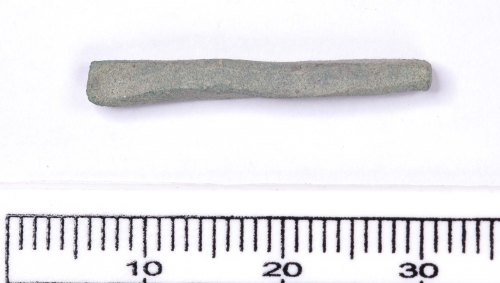
This tiny copper alloy chisel, only 2.5 cm long, is perfectly formed and remarkably preserved. The slightly reduced and rounded proximal end may have been designed as such to be hafted in a small wood handle that would have made it easier to manipulate the tool. The distal end was fashioned into a sharp beveled edge that is somewhat splayed, allowing a craftsman to cut the material cleanly, or to trim or neaten tiny grooves or spaces in the object under manufacture.
View of the chisel (JEMIS.2019.69)Second view of the chisel (JEMWS.2019.69)
We have not posted on the blog in awhile, but that doesn't mean that we haven't been up to our eyeballs in work! In fact, the Artifact Lab has been closed to the public since the week after Thanksgiving but it re-opens tomorrow as part of a larger exhibit, AncientEgypt: From Discovery to Display. This new exhibit will highlight some of our Museum's excavations in Egypt around the turn of the last century (in Memphis) and in the present day (in Abydos). It also will include artifacts that were previously on display in our Lower Egyptian gallery, which we closed last July to begin conservation work on the monumental pieces previously displayed in that space. This work is in preparation for the future opening of our Ancient Egypt and Nubia galleries and is part of our larger Building Transformationproject.
Photos showing the deinstallation of pieces in the Lower Egyptian gallery, summer 2018
Another feature of Ancient Egypt: From Discovery to Display is a visible storage area, adjacent to the Artifact Lab, which will show coffins, mummies, and other funerary materials on "display" on storage shelves. Some of this material was treated recently in the Artifact Lab while other pieces are awaiting treatment in the upcoming months. Display cases in this space contain some pretty stellar pieces including 2 painted wooden boat models from the First Intermediate Period and the faience broad collar that was recently re-strung.
View of the visible storage space, with the Artifact Lab in the background
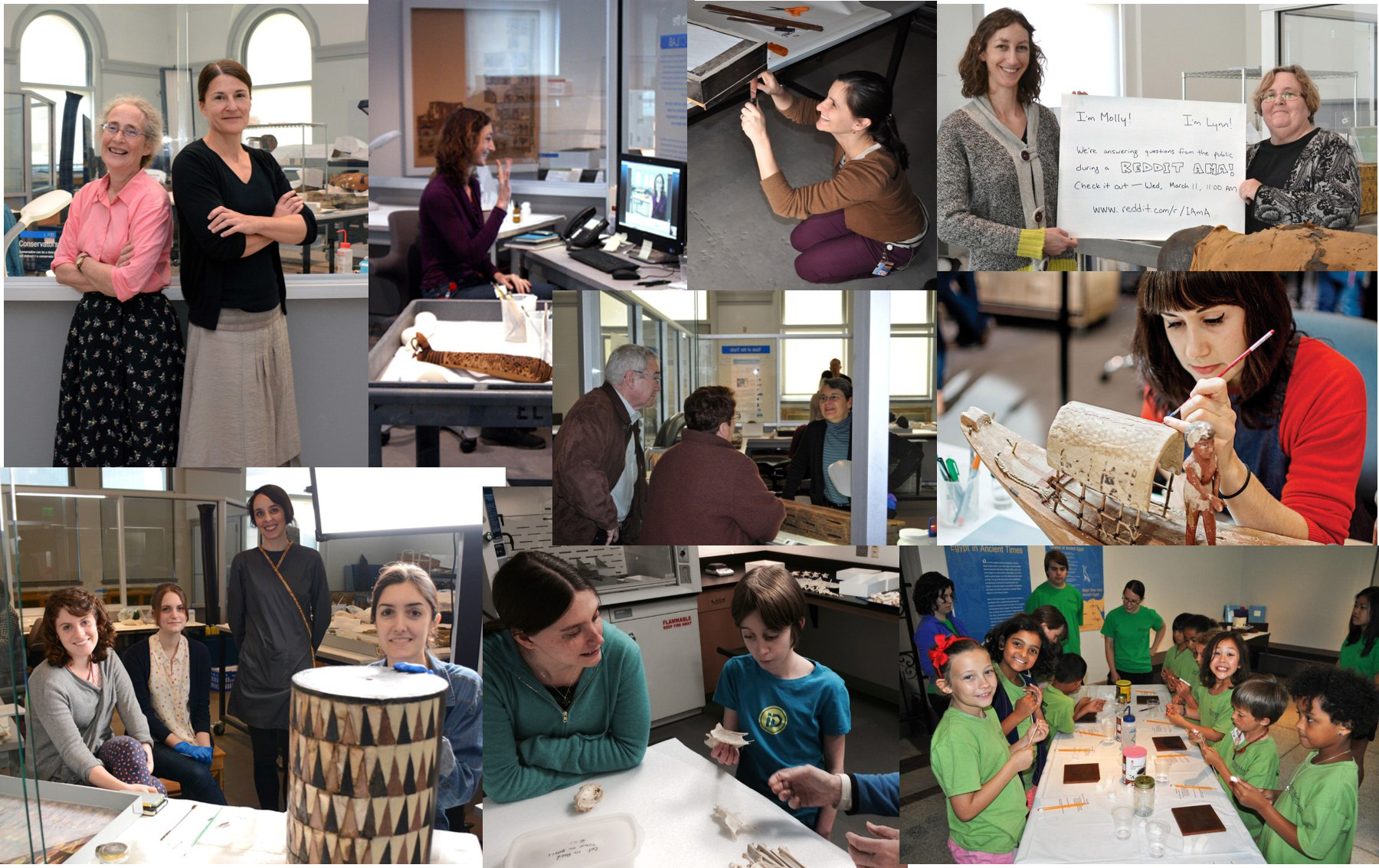
Before we re-open and our focus turns completely to working on material for the new Ancient Egypt and Nubia galleries, we thought we'd reflect on what we have done in the Artifact Lab over the last 6+ years that we have been open. Here are some numbers:
6+ years (77 months) in the Artifact Lab:
Spoken to approximately 30,000 museum visitors during our twice daily open window sessions (that is more than 2000 hours, or 83 days of talking!)
The outreach has been carried out by 15 conservators, five curriculum interns, 21 pre-program interns, four high school interns, and five Penn-affiliated non-conservator colleagues
Treated approximately 700* artifacts and 13 human mummies from the following Sections in the Museum: Egyptian, American, Asian, Near Eastern, Mediterranean, African, Babylonian, Physical Anthropology. *Note – many of these required 100+ hours of treatment
Thanks to this blog, reunited family members whose great grandparents donated our mummy Wilfreda to the Museum
Hosted and created programming for approximately 400 Penn Museum summer campers
Spoken with the media on more than twenty separate occasions, appeared in newspapers across the country in stories like this one about CT scanning a child mummy, and recorded content for the news and for educational programs – most recently for NBC News Learn
Gave formal presentations about our work in the Artifact Lab at five professional conferences and eight other professional events/venues. They were all great but the 2015 Death Salon was definitely a highlight.
AND we had fun doing all of it!
Stay tuned for updates on some of our recent work, including treatments for objects that are in Ancient Egypt: From Discovery to Display and for the upcoming Mexico & Central America Gallery!
CAIRO – 23 February 2019: Several African diplomats watched Friday the sun alignment on the statute of Pharaoh Ramses II at Egypt's Abu Simbel temple, as many spectators gathered to attend the phenomenon.
Among visitors who attended the event were 22 African ambassadors and diplomats, along with their relatives, watched the sun alignment. President Abdel Fatah al-Sisi assumed this month the chairmanship of the African Union for one year term, during which he seeks to boost relations between Cairo and countries of the continent.
Egypt is also preparing to host the African Cup of Nations football tournament this summer.
The 201-minute sun alignment phenomenon happens twice per year on the anniversaries of Paranoiac king's birthday and coronation on October 22 and February 22 respectively.
The sun illuminates four statues of King Ramses II seated at the top of the temple, symbolize the facade of the temple, which resembles an edifice.
Among the visitors of the archaeological site were Ministers of Antiquities, Tourism, Investments, Culture and Communication Khaled Anani, Rania Mashat, Sahr Nasr, Inas Abdel-Dayem, Amr Talaat respectively, said a statement by the Ministry of Antiquities.
The ministry announced that a total of 6,500 tourists watched the sun alignment at the face of Ramses II status at Abu Simbel temple
Nevine El-Aref enjoys a fascinating adventure up the rocky mountain of Serabit Al-Khadim in South Sinai to the ancient Egyptian Temple of Hathor
El-Enany during the hiking trip
Al-Ahram Weekly
The ancient Egyptian Hathor Temple, known as "the Lady of Turquoise Temple", and the surrounding ancient mines are the only sightseeing at Serabit Al-Khadim in South Sinai. However, the stunning natural environment and the traditions and hospitality of the local Bedouin make this mountain very special.
Armoured with a bottle of water and an Indiana Jones-style hat, I started my hiking trip towards the Temple of Hathor that stands on a massive rocky mountain at a height of 850 metres above sea level in South Sinai.
Although the ruins are not as impressive as others in Egypt, and the road is like going on a trekking expedition, it is worth the muscle-ache afterwards because of the spectacular natural scenery, the silence at the top of the mountain, and the unforgettable and fascinating exploration experience.
The trip begins with the visitor centre giving an overview of the area and information about the temple and its structure. To facilitate the climb, the Ministry of Antiquities has established a less strenuous route with a path and a series of steps up the western side of the mountain. It is an easier route, but also a longer one than the previous steeper one that some in our party used on their journey back along the mountain paths.
A stelae at Hathor Temple
Guided by local Bedouin, it took about an hour and a half to reach the temple. Anoir, an 11-year-old Bedouin boy, was my guide along the mountain trek. Minister of Antiquities Khaled El-Enany and secretary-general of the Supreme Council of Antiquities (SCA) Mustafa Waziri were also on the hiking trip to inspect the temple and the restoration work being carried out there.
"El-Enany is the first minister and Waziri the first SCA secretary-general to climb the mountain to visit the temple," said Abu Rabie, one of the Bedouin guides.
Along the road, we passed several inscriptions carved on the mountain in the shape of prehistoric engravings. Among the most beautiful was a rock inscribed with pictures of the boats used to transport turquoise from the ancient mines to destinations in Egypt for the fabrication of amulets, jewellery, and the blue pigment beloved of the ancient Egyptians.
There were also many shafts where the turquoise was mined, and in some of them hieroglyphic tablets of ancient Egyptian kings have been found. The rock colours and formations were reminiscent of Petra in Jordan. The view was stunning, and not a soul was stirring along the road except our group.
We had three stops to rest and recharge our lungs and stretch our muscles while local children started singing Bedouin songs for our entertainment.
The ruined temple was further along, with engraved columns with hieroglyphic texts along with bas-reliefs, stelae and blocks depicting the face of Hathor scattered all around. Although the temple and the environment around it are awe-inspiring, I could not help asking myself why the ancient Egyptians had built this temple on top of a mountain.
Regretfully I did not get a clear answer, but Waziri said that according to a legend Sinai was thought to be the place where Hathor, the goddess of the sun, music, the arts, and the sky, placed the seeds of her beauty to grow among the high mountains and narrow valleys of the region.
The Fourth-Dynasty Pharaoh Senefru was the first to send expeditions to Sinai where turquoise was found. By 3,500 BCE, the great turquoise mines of Serabit Al-Khadim had been discovered.
The Hathor Temple was originally built during the reign of the 12th-Dynasty Pharaoh Amenemhat I. During the New Kingdom, the temple was enlarged and extended during the reigns of queen Hatshepsut and the Pharaohs Tuthmosis III and Amenhotep III.
The original design of the temple
This was a revival period for mining operations after a decline during the Second Intermediate Period. Hathor was then called the "Lady of Turquoise", and she became the patron goddess of miners.
The temple was rediscovered in the early 1900s by British Egyptologist Sir Flinders Petrie, but later parts of it and many of its engravings were destroyed during attempts to reopen the mines.
A number of scenes in the temple portray the role of Hathor in the transformation of the Pharaoh upon ascending the throne into the deified ruler of Egypt. Shrines dedicated to the god of the eastern desert Sopdu are also among the temple's ruins.
On our way back down the mountain, we had two choices: either to return the same way we had come, or to descend on the other side via a rocky path. We selected the latter as it was shorter, even if it involved some scrambling.
After 45 minutes among unstable rocks, steep slopes, and very high steps, we succeeded in reaching the area where a four-by-four car was waiting. Then we started another adventure crossing the steep sand dunes, forcing our driver to undertake a sometimes rough and ready drive.
"It was more of a trekking adventure than an ancient Egyptian sightseeing tour," El-Enany told Al-Ahram Weekly. He described the trip to the temple as a stunning adventure and called on all mountain lovers to come to Serabit Al-Khadim to enjoy an unforgettable climb in the mountains and admire the temple of the "Lady of Turquoise", the only ancient temple in the area.
Upon reaching the visitor centre, local Bedouin welcomed us with hot cups of tea.
This Nile Scribes series enables our readers to learn more about Egyptologists from around the world. From questions about their life and their career, we also explore their research interests and perspectives on the field of Egyptology. We want to use this series to help strengthen the public's awareness of the Egyptological community, and to illustrate the varied careers and on-going research projects within our discipline. This week we interviewed Dr. Katherine Blouin.
Who is Dr. Katherine Blouin?
Dr. Katherine Blouin received her Ph.D. in Roman History at the Université Laval in Quebec, Canada and is a specialist on Roman Egypt with a focus on its socio-economic and environmental history. Today, Dr. Blouin serves as Associate Professor in Roman History at the University of Toronto. Among her many research interests are the Nile Delta, its environment and people, and more recently she has focussed her research on the impact of imperialism, colonialism, and Orientalism on the modern fields of Classics, Papyrology, and Egyptology.
Dr. Katherine Blouin in Medieval Cairo (photo: Katherine Blouin)
Nile Scribes: Where are you from and where were you educated?
Katherine Blouin: I was born in Québec city into a middle class family with working class roots. I've wanted to be a historian specialising on ancient Egypt for as long as I can remember. Since there were no Egyptology programs in Québec, I decided to do a B.A. in Ancient Studies at the Université Laval. This is where I discovered Hellenistic to Late Antique Egypt, and decided that it was the period I wanted to focus my research on. So after my B.A., I did an M.A. in Roman History at the Université Laval, with a complementary year in Egyptology at the Université Paris IV Sorbonne. I then went on to do a Ph.D. in Roman History at both the Université Laval and the Université de Nice Sophia Antipolis, and a Postdoctoral degree in Papyrology at the École Pratique des Hautes Études. I was the first person in my entire, extended family to get a university degree. My parents didn't have the means to pay for my undergraduate and graduate studies. Since student fees were much lower in Québec and in France than in English-speaking North America, I felt like graduate studies were a possibility for me despite the fact that I was not from a bourgeois or affluent background. I managed by working part-time, taking on a small student loan, and, at the graduate level, getting grants and scholarships. Yet despite all the hard work I put into my studies, I consider myself lucky: Given the ongoing governmental cuts to education in Ontario and in many other places (the UK for instance), university education is now becoming more and more out of reach to many young adults.
NB: What got you interested in ancient Egypt? Is there a specific site visit or monument that inspired you, or perhaps a book or a film?
KB: I think almost all children go through an Egypt phase. I just never grew out of mine! I've always loved books and I remember that my interest for ancient Egypt developed as a bookish one when I was in primary school. At about the same time, I saw my first mummy and sarcophagus during a visit at the Musée de l'Amérique francophone in Québec city. It's the mummy of Nen-Oun-ef son of Perpaout from the Theban area. I still remember how that mummy freaked me out. For some reason, I was afraid it would come back to haunt me, and I couldn't sleep well for a few nights after that. Yet this experience did not put an end to my growing obsession with ancient Egypt. I used to read and watch anything that had to do with the country and the region more broadly. I wrote my class papers on related topics, painted Egypt-themed canvases, and listened to Egyptian music. I went through many phases: Papyrus (the comic book series), Christian Jacq, Naguib Mahfouz, Lawrence Durrell, and Constantin Cavafy. I also had an embarrassingly long crush on Ralph Fiennes after The English Patient came out. I am now fully aware of how Orientalist, romanticised, and, thus, historically problematic most of these cultural products are, but I also acknowledge that they did, and still do, act as entry points for most of us who end up pursuing studies and careers in Egyptology, Classics, and Archaeology. I only wish that the offer be more nuanced and less stereotypically-constructed. That's why I'm increasingly interested in public-facing scholarship and in the diversification and decolonisation of the field.
Remains of a house and a redbrick structure at the site of Tell Timai (photo: Katherine Blouin)
NS: Where have you worked/excavated in Egypt? Which parts of Egypt do you study (certain cities or regions, etc.)? Can you share an interesting, memorable, or funny excavation story?
KB: I'm not an archaeologist, but a historian and a papyrologist. That being said, I've been going to Egypt every year for almost 2 decades now for pleasure, research, and to improve my Egyptian Arabic. I have the utmost respect for Egypt, its people, land, history, and culture. Despite all the changes the country experienced between Antiquity and now, I feel that my historical work benefits greatly from my firsthand experiences there. I usually work at the IFAO in Cairo and I've travelled around quite a bit to visit ancient sites and modern cities, but I've also spent some time at Tebtunis to work on ostraca, organised two fieldtrips for graduate students in Classics (I intend to apply for funding in order to make this initiative a more regular one), and directed one mission on the site of Tell Timai back in 2013. Tell Timai is the site of ancient Thmuis. This urban mound is located close to Mansurah in the northeastern Delta. It's actually an extension of Mendes, and it was the Roman metropolis (capital) of the Mendesian Nome, which my second book is dedicated to. My work on the papyri and other evidence from the region explained my interest in the site, whose archaeological potential is quite extraordinary. Even though the Fates had us excavate a monumental, Late Antique structure made of redbricks that looked very promising at first, but turned out to have been dug before (most probably in the late 19th c.), we nevertheless were able to generate some interesting data regarding the occupation of this peripheral part of the tell. Sadly though, due to a series of unforeseen circumstances and despite having received enough funding for three more seasons, I had to cancel the mission after its first year. It was all for the best in the end for it allowed me more time to work on my other projects.
NS: What are your primary research interests? What are your areas of expertise?
KB: I'm first and foremost a socio-economic and environmental historian. My research interests include the Nile Delta, multiculturalism, cultural identities, as well as environments, peoples, and periods that are commonly considered to be 'marginal'. I'm also interested by the ways in which imperialism, colonialism, and Orientalism have impacted (and are still impacting) the fields of Classics, Papyrology, and Egyptology. Lastly, I have done some papyrological work, notably the cataloguing, restoring, and digitising of the Greek papyrus collection in the Bibliothèque Nationale de France. I'm currently completing the edition of Greek documents on papyri and leather from that collection, and have also edited Greek ostraca for the Franco-Italian mission at Tebtunis.
NB: Your work touches upon the important intersections of Rome and Egypt, ancient and modern (both within the evidence as well as modern interpretations). How can scholars today navigate the ancient waters more effectively, especially given our increasing diversity in the field? How can diversity be represented more effectively within modern scholarship?
KB: First, as Dan-el Padilla Peralta has brilliantly argued recently, diversity is good because it allows diverse perspectives into the conversation. The more diverse – and I use this term in an intersectional way that includes gender, race, socio-economic background, country of origin, and area of expertise – academia is, and the more inter-disciplinary, diachronic, and collaborative our approaches are, the more encompassing our understanding of ancient history will be. If most Antiquity-related fields keep teaching, supervising, promoting, and producing the same type of scholarship produced by the same types of peoples, who were trained in the same way in the same handful of "prestigious" universities, we are self-limiting our understanding of the past because we are only telling a very limited number of stories. Paul Veyne once defined history as a tale made of true events. I say the more seats we allow at the ancient history table, the more tales we'll finally get to hear.
Second, I don't believe in grand, revolutionary gestures. I find it more realistic and meaningful in the long run to see those of us who are in a position to do so implementing small but serious and steady initiatives towards diversity – and also decolonisation – at all steps of the way: high school curricula and classroom pedagogy, undergraduate and graduate teaching and recruitment, scholarship, journals, conferences, public scholarship.
Visit of Dr. Blouin and several UofT graduate students in Classics to the IFAO library in 2017 (Photo: Katherine Blouin)
NS: What would you say is the largest impact colonialism has made on the field of Egyptology and our understanding of ancient Egypt?
KB: The whole field – like Classics – is a colonial construct: Its development as a scientific discipline took place in the context of the French, then British occupation of Egypt and, more generally, of the cultural and political competition between European (and later American) imperial powers. This is also the context in which most museum collections and archives were acquired and the "official" languages of Egyptology and Classics (German, French, Italian, and English) established. As a result, Antiquity-related fields remain to this day largely Eurocentric. Thus is it perfectly excusable still for non Arab-speaking scholars to ignore scholarship in Arabic (and the same goes for modern Greek and Turkish). The categorisation of Egyptology within the wider field of "Oriental Studies" also stems from the colonial and reductive dualism European/Western/Graeco-Roman vs Oriental/Eastern/Egyptian/Arabic. This phenomenon leads to this day to absurd chronological and linguistic compartmentalisation in universities, archives, and museums. For instance, scholars working on Greek papyri from Ptolemaic and Roman Egypt are considered "Classicists" and, for that reason, not necessarily expected to read Egyptian scripts nor Arabic, whereas colleagues studying excavating or studying texts from Egyptian temples of Ptolemaic and Roman date are considered Egyptologists. Things are slowly changing, but lots remain to be done in order to foster a more integrated approach to the history of ancient Egypt in the longue durée.
Another, persisting issue is the difficulty many Egyptian students and scholars still face when it comes to accessing scholarship and conducting research abroad. While many events do take place in Egypt, be they organised by Egyptian colleagues and/or foreign institutions with an anchor in the country, most major conferences on the history of ancient Egypt tend to take place in Europe or North America. As Haythem Guesmi recently argued on the blog Africa is not a Country regarding African Studies, this phenomenon contributes to excluding our Egyptian colleagues further because these conferences are super expensive and, also, often hosted in countries whose visa policies are increasingly discriminatory against citizens from the Global South, including, Egyptians. That's one of the reasons why Usama Ali Gad, Rachel Mairs, and myself have decided to launch a yearly, Egypt-held workshop entitled Orientalism, the Classics, and Egypt. The 2019 edition will take place in Alexandria's Bibliotheca Alexandrinaon March 11. I also see it as an excellent news that the next International Congress of Egyptologistswill take place in Cairo.
NS: You also share pedagogical musings on your blog. What is the best advice you can give to scholars and teachers of history?
KB: My first advice would be to try to involve as wide a variety of "voices" as possible in the conversation, both in terms of ancient (types of) evidence and modern historiography. If you tend to fetishise literary sources, consider how including artefacts, papyri, inscriptions or geo-archaeological data could contribute to your teaching. If your syllabus contains mostly or exclusively readings from older white men working in the Anglo-Saxon world, why not make an effort to include content from scholars of historically marginalised groups, of a more junior status, or from outside the Anglo-Saxon academic world? I find that blogs, online journals (like Eidolon), and podcasts are very helpful in that regard.
NS: Is there a site or monument in Egypt that you've never had the chance to visit that you're dying to see?
KB: There are two areas I really want to visit but haven't been to yet. The first one is the Menzaleh Lake, which I've worked on and have sadly never been able to visit so far because of logistical/security reasons. The second one is the oases of Dakhla and Kharga (the above-ground Christian cemetery of al-Bagawat in the Kharga Oasis is a marvel I promise myself to see alive one day). I have friends who excavate there and the pictures they've shared trigger huge FOMO in me!
Looking around the agricultural landscape at Tell Timai (photo: Katherine Blouin)
NS: What are you currently reading? What about it has caught your interest?
KB: At the moment, I'm reading two books written by two female, Egyptian scholars. The first one is Hala Halim's Cosmopolitan Alexandria: An Archive, which provides an in-depth, post-colonial analysis of Constantin Cavafy's poetry, E.M. Forster's writings on Alexandria, and Lawrence Durrell's Quartet. This is a powerful, monumental work of scholarship that demonstrates how embedded in colonial and Orientalist tropes most narratives about Alexandrian (and Egyptian) history and culture remain to this day. For this reason, I recommend it to anyone working on Alexandrian and Egyptian history, no matter the period (same goes for Timothy Mitchell's and Malcolm Reid's books). I'm also reading A Daughter of Isis: The Early Life of Nawal El Saadawi, In Her Own Words. el-Sadaawi is one of the Egypt's most prominent figures of feminism and literature and I still hadn't read her, so I thought that to do so now would be a great way to kick start my literary year. Luckily for me, I was right!
The Nile Scribesare grateful for Dr. Blouin's participation in our interview series. If you have any questions for Dr. Blouin, you may contact her on Twitter or leave a comment on the blog.
The object of the week to be display at the entrance hall at the Egyptian Museum in Cairo is actually two objects.
The first one is a gilded mask dated to the 25th Dynasty which was in possession of an Egyptian citizen lives in France. He gifted the mask to Egypt to be displayed at the Egyptian Museum. It is on public display for the first time.
The mask received the needed restoration by the restoration team at the museum before going on display.
dav
The second piece is the funerary stela of Nit-Ptah.
The stela was discovered in Assasif, West Bank of the Nile in Luxor by the Metropolitan museum mission in 1915. The stela is dated to the Middle Kingdom.
The stela depicts four members of the same family: two males alternating with two females to create a pleasing chromatic contrast as a result of the different colors of their skins. Men were painted in ochre and women in light cream wash.
The head of the family, Nit-Ptah, is shown on the right, wearing a wide necklace, and a white kilt and holding a cane and a staff in his hands. The woman next to him is probably his wife Seni, who wears a patterned dress with colored beads that leaves one breast uncovered. She is adorned with a narrow necklace, bracelets and anklets. She sniffs at on open lotus flower and is holding a bud in her right hand.
The two figures at the end are identified in the inscriptions as Seni's children. The son is in the same attitude as his father and the daughter is wearing a green dress.
The inscriptions over the figures are decorated in black and invoke the god Ptah-Sokaris to provide offerings for the Ka of each member of the family.
The limestone stela measures 23 cm in height and 30 cm in width.