On World Heritage Day, Dr. Khaled El-Enany revealed Amenhotep III temple at the garden of Luxor Museum which was discovered by the European mission directed by Dr. Hourig Sourouzian at the site of Amenhotep III Temple at Kom El-Hittan. (Scroll down for video)
Above (Minister of Antiquities inspecting the newly discovered statue at the magazine of Kom El-Hitan site)
Above (Amenhotep III statue at Kom El-Hitan where it was discovered, March 2017)
The colossus depicts King Amenhotep III seated on the throne with hands resting flat on the thighs. The King is represented westing the nemes headgear and the pleated Royal shendyt (kilt), held at the waist with a belt decorated with zigzag lines and closed by an oval shaped clasp. A broad collar adorns the king's chest. The throne jambs and the back pillar of the statue are inscribed with the names of the King.
The colossus is considered as a masterpiece of ancient Egyptian sculptures carved in black granite, extremely well worked and perfectly polished. It is 248cm high, 61cm wide and 110cm deep.
It is almost intact but the head of the uraeus is missing, and the beard is broken along with the chin. However, one of the young restorers succeeded in finding the missing fragment of the chin, which was subsequently fixed at its place.
Scientific examination of the inscription on the statue's back qualifies the King as one with numerous jubilees.
I am a huge movie fan with a PhD in archaeology in hand!
New archaeological discoveries are always exciting. The thrill of seeing things that nobody else has seen in thousands of years, and finding out a little bit more about how people lived in the ancient world is unlike anything else. The excitement of discovery has inspired filmmakers to include archaeological themes since the early days of motion pictures.
The most storied of archaeology films are the ones that deal with an old archaeological myth: the Curse of the #Mummy. Whenever a new tomb is discovered in Egypt and there are still mummies inside, there's always a fleeting moment when I imagine a scene straight out of the movies: Archaeologists uncover something they are not prepared to deal with!
Thankfully, real archaeological surprises are more along the lines of tens of thousands of pieces of broken pottery you weren't expecting, rather than apocalypse-inducing mummies!
I promise you, nothing good will come out of that thing! [Credit: Universal]
A Recent Mummy Discovery
The latest archaeological news out of Egypt is that an undisturbed tomb has been opened by archaeologists. The location of the tomb has apparently been known for some time, but for some reason it had never been opened. It's located at Dra Abu El-Naga, near the Valley of the Kings, a valley on the west bank of the Nile River where the tombs of many of the pharaohs of Ancient Egypt are located, including the famous Tomb of Tutankhamun.
The tomb belongs to a man named Userhat, who lived about 3500 years ago. He was a member of the Egyptian nobility shortly before the time of Tutankhamun. Inside his tomb, eight mummies were found, as well as hundreds of ushabti figurines, which were believed to come to life as servants for the deceased in the afterlife.
Happily, no archaeologists were harmed by a curse as of this writing.
History Of The Curse Of The Mummy
It is difficult to pinpoint the origins of the Western concept of the mummy curse, but general superstitions related to bad luck and the dead go way back into medieval times, and probably extended to mummies once European travelers started bringing them back from Egypt. It wasn't until Jean Francois Champollion deciphered the hieroglyphic writing system in the 1800s that actual curses were found to exist in some tombs. While very rare, some Egyptian tombs do have texts in them that include a curse. One, as quoted by notable archaeologist and television personality Zahi Hawass, reads:
Cursed be those who disturb the rest of a Pharaoh. They that shall break the seal of this tomb shall meet death by a disease that no doctor can diagnose.
Howard Carter and an assistant working on the mummy of Tutankhamun [Credit: The New York Times via Wikimedia Commons]
The most famous case used as an example of a mummy's curse is that of Tutankhamun. The story goes that a cobra (the symbol of Egyptian royalty) got into the house of Howard Carter (the archaeologist in charge of the excavation), eating his pet canary. After this, the financier of the expedition, Lord Carnarvon, died four months after the opening of the tomb due to an infected mosquito bite.
In the years following the opening of the tomb, a number of expedition team members met untimely deaths, including: murder, suicide, poisoning and unexplained illnesses. However, Carter himself lived for another decade, dying of natural causes at age 64. The last participant in the excavation died in 1961, the tomb having been opened in 1922.
In that movie, an intact tomb is found with a mummy that has not been mummified according to the usual Egyptian manner. When an assistant reads a passage aloud from the Scroll of Thoth, the mummy Imhotep is resurrected and goes to search for the modern reincarnation of his ancient lover so he can kill her, mummify her and resurrect her as his eternal bride.
While this version of The Mummy doesn't contain as much of a reliance on the idea of the Curse of the Mummy, the 1999 version starring Brendan Fraser does. In this version, Imhotep has superhuman powers that he uses to get to his ancient lover's modern incarnation.
It looks like the newly imagined female mummy, Ahmanet, will have incredible powers similar to those Imhotep used against Brendan Fraser. We won't know the extent of these until the film is released on June 9, but the trailer gives us some clues about the affects her curse will have.
While the discovery of Userhat's tomb is not likely to gain the same amount of attention that Tutankhamun's did almost 100 years ago, it surely is timely considering the upcoming release of The Mummy. Since this movie will be launching the #UniversalMonstersCinematicUniverse, I'm sure Universal will take any and all interest in Egyptian archaeology it can find.
Needless to say, these cinematic imaginations of the consequences of archaeology are nothing short of pure fantasy for entertainment. Nevertheless, we can still sit back and enjoy them, as long as we realize the disconnect between reality and fantasy.
Of all of ancient Egypt's kings and queens, none has captured the world's imagination like Cleopatra. At one time the most powerful woman in the world, Cleopatra was the last active pharaoh of ancient Egypt, ruling after Alexander the Great's death. While her dramatic story has been famously rendered in art for millennia (her love affairs with Julius Caesar and Mark Antony, her suicide by snake bite), today barely any traces of her existence survive. For centuries, archaeologists have been unsuccessfully searching for Cleopatra's tomb, but the final resting place of Egypt's last queen was believed to have vanished from history. Now, that may change thanks to Kathleen Martinez, a criminal lawyer from the Dominican Republic turned unorthodox archaeologist.
Kathleen Martinez's back story could give Indiana Jones a run for his money. Despite having no field experience, she left a 20-year law career behind in order to undertake an Egyptian expedition for Cleopatra's tomb. "From a very young age, I recall wanting to be an archaeologist, but my parents discouraged me from pursuing my interests seeing as how there was no archaeological precedent in the Dominican Republic," Martinez told PBS.
Martinez's theory led her on a drama-filled quest to Egypt that could have been ripped from the plot of a Hollywood movie.
Though she was dissuaded from pursuing her childhood dream, Martinez developed a lifelong fascination with Cleopatra. As she held down a day job – running a law practice – she began researching Cleopatra in her free time. "I [approached] Cleopatra's life as a case," she said, explaining how she leveraged her criminal law training to analyze all the ancient texts she could get her hands on. Eventually, after obtaining a Master's in archaeology, Martinez came up with a radical new theory about where Cleopatra was laid to rest.
While many scholars believe that Cleopatra was buried in the ancient city of Alexandria (which sank into the Mediterranean sea more than one thousand years ago), Martinez theorizes that she may have been buried beneath a temple, as part of a deliberate strategy to prevent her body from falling into the hands of the Romans. Martinez's theory is based on an important fact that she believes other historians have ignored: Cleopatra considered herself the living form of the goddess Isis, and her lover Mark Antony, the god Osiris. Her suicide by snake bite, Martinez believes, could have been the beginning of a religious rite – and an indication that Cleopatra wanted to die and be buried as a goddess in a temple.
Internal view towards South of the Osiris Temple in Taposiris Magna.
Martinez's theory has since led her on a drama-filled quest to Egypt, one that could have been ripped from the plot of a Hollywood movie. As soon as she touched down in Cairo, her search was fraught with obstacles – starting with her hours-long detention by immigration authorities who were skeptical of her provenance. "The Dominican Republic didn't have an embassy in Egypt, and a place with no embassy in Egypt didn't exist," Martinez explained at a presentation of her work in October. "Therefore, the Dominican Republic didn't exist to them."
Martinez hoped to prove that Latin American archaeologists can make their mark on Egyptology.
Hours later, when she was finally released, she faced an even bigger challenge: how would she get permission from the Egyptian government to visit the temples she wanted to investigate, many of which were not open to the public? As luck would have it, the Spanish interpreter she'd hired happened to know the secretary for Zahi Hawass, the then-Minister of State for Antiquities Affairs. This is how, less than a day later, Martinez was given an appointment with him, and granted a two-month approval to visit the temples. Using maps of Isis and Osiris temples she had developed in the DR, Martinez visited each site, hoping it would unearth a clue. Finally, with time dwindling, she found one at the Taposiris Magna Temple, about 50 kilometers west of Alexandria. There was just one problem: she, a rookie archaeologist with no backing, team, or funding, would need to secure an extended excavation license. These licenses are highly competitive; with thousands of applications submitted, roughly 150 are granted – usually to established research universities.
Dr.Kathleen Martinez at one of the chambers discovered in the temple Taposiris Magna.
Having come so far, Martinez worried she might have hit a wall. "I sat against the remains of a column and I cried," she recounted to the University of Pennsylvania's Knowledge at Wharton. "Why? I am a citizen of the Dominican Republic. I am not a famous archeologist. I don't have a big school like Harvard behind me. I thought, 'I have come this far but no one will listen, no one will give me permission.' Then I stopped crying and thought, 'I have to fight until they tell me yes, if it takes the rest of my life.'" Martinez was determined to push ahead, not just for her own dream, but because she wanted to prove that Latin American archaeologists can make their mark on Egyptology too.
A bronze coin portraying Cleopatra discovered by Dr Kathleen Martinez and her team at Taposiris Magna.
Returning to the Dominican Republic, Martinez gained the support of the minister of Foreign Affairs, who appointed her the nation's first Minister of Culture to Egypt. With the backing of a Santo Domingo university, she returned to Egypt to make her case to Hawass, and within a few weeks was granted a two month excavation license. In fact, Martinez had persuaded Hawass of the merits of her theory, and he has since become one of her biggest allies. With his support, Martinez soon made a major discovery – finding six burial chambers in the Taposiris Magna Temple. These types of chambers had never before been found in temples, and their discovery has changed what was known about the architecture of temples and tombs. At the site, workers also found over 600 artifacts, including 40 coins bearing the image of Cleopatra and Mark Antony, an alabaster bust of Cleopatra, and other items that give credence to Martinez's "crazy" theory.
Dr. Kathleen Martinez with Dr. Zahi Hawass (April 2010)
Today, Martinez's search continues, but she has already made history. "If we discover the tomb of Mark Antony and Cleopatra, it would be the most important discovery of the 21st century," Hawass told reporters. And even if they don't, Martinez believes her efforts will still have been worthwhile. "In the beginning, people laughed at us and made fun," she says. "Now, they respect the work we do. It's been worth it."
This post, profiling unconventional genius, was developed in partnership with National Geographic. National Geographic's new TV series 'Genius' follows the brilliant scientist Albert Einstein through the ups and downs of his life, from failing to get his doctorate to developing the general theory of relativity.
Global event series Genius premieres Tuesday, April 25th at 9/8c, on National Geographic. Learn more at http://natgeotv.com/genius.
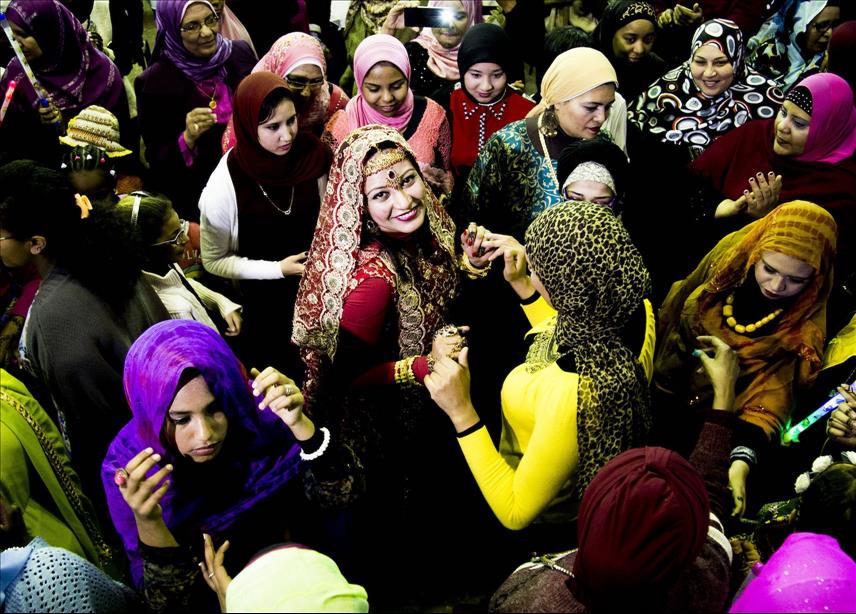
(MENAFN - Daily News Egypt) For ages, henna night has been as equally important as the wedding day. The Middle Eastern 'bachelorette' party is considered the second most important life event for any girl and her female friends. The time and effort spent for preparing the henna night starts sometimes with the wedding preparations.
Henna night is usually the last night the bride spends at her parent's home. In that night, her female friends gather for dancing and singing all night long, while the 'hanana' (the lady who draws henna) beautifies them with henna drawings on their bodies. Usually, females apply henna on their hands and legs, as it's believed to enrich their beauty.
Shapes are usually flowery, connected circles that go from the finger tips to past the wrists.
For some women, henna night is their real wedding, as they get to dance freely and wear different revealing costumes without any men around. They believe that it is more important than the mixed wedding.
Celebrating the marriage with henna night goes back the pharaonic era. Back then, henna and jewellery were the main accessories women wore. According to myth, henna night is believed to go back to the time of the Egyptian gods Isis and Osiris.
It is said that the evil god Set killed Osiris out of jealousy and chopped his body into pieces, each being put in a different corner of Egypt. However, Isis never gave up on collecting the pieces of her late husband's body, and every time she collected a part, her hands were coloured with his blood until they turned red.
Since then, red hands are believed to be a symbol of a wife's loyalty to her husband, and that's why traditions are to colour the palm of the hands with henna.
Henna is also believed to be a fertility symbol in Egypt, so drawing several henna shapes around the bride's body is a wish from her family and friends to start a new life blessed with many children.
Nowadays, henna celebrations have taken different modern forms. Brides get to wear different costumes, including some from Egyptian folklore, others from different cultures, like Hindi and Moroccan outfits, and even fairytales, like Snow White.
The celebration is also required to be accompanied with dinner for the guests. The cost of henna night nowadays ranges between EGP 1,000 and 5,000.
Egypt Eyes Faith and Luxury in 2-Year Tourism Recovery Plan
by
Deena Kamel
New markets being targeted in India, Eastern Europe: Minister
Number of visitors from Germany, Middle East is on the rise
Egypt plans to promote religious, medical and luxury trips, and develop new markets in India and Eastern Europe, as it pushes to revive its vital tourism industry to pre-2011 revolution levels within two years.
In addition to more diverse tourism offerings, the home of the pyramids will ease travel for residents of the Gulf Arab nations through an e-visa program as part of a broader plan to boost visitors and encourage longer stays and more spending, Tourism Minister Mohamed Rashed said in an interview in Dubai.
The effort marks the latest attempt by Egyptian authorities to kick-start a sector that had been a primary source of foreign currency, and the broader economy, which has struggled since the 2011 uprising that ousted President Hosni Mubarak. The political turmoil and militant violence that followed his overthrow have burdened government efforts to attract foreign money.
"The final target is to get to the 2010 numbers," Rashed said, referring to the more than 14 million visitors the country hosted in 2010, its peak year for tourism arrivals. "We should be able to get as close as possible to the target in the next 18 to 24 months."
Small Upturn
Egypt has already seen a slight reversal of the downward trend it's endured for years, from tourism levels still as low as 5.4 million in 2016, according to government figures. But to cement the gains and stage a sustained recovery, officials plan on further promoting programs far removed from the traditional surf and sun offerings found along the Red Sea resorts, or the antiquities for which Egypt is famed.
Those options include "Holy Family" tours to eight destinations, Rashed said. To get a slice of the medical tourism industry, the country would be capitalizing on the lower cost of some cosmetic procedures in Egypt, relative to the expense in Europe and the U.S.
The road to recovery has been difficult. The 2015 downing of a Russian passenger jet shortly after its takeoff from the Red Sea resort of Sharm El-Sheikh killed all 224 on board and prompted a ban on flights to Egypt from Russia that has yet to be lifted.
Palm Sunday church bombings earlier this month left at least 45 dead and dozens wounded in two cities, while another attack on a police checkpoint near the storied St. Catherine's Monastery in south Sinai brought the militant threat closer to the main tourism hubs. The three attacks were all claimed by the Islamic State's local affiliate.
Egypt is working on revamping its image to change the perceptions of potential visitors that it is an unsafe destination. Rashed stressed that terrorism is a global threat, and not just targeting one particular country.
"What happened in Egypt is no different than what's happening anywhere in the world," Rashed said. "When you talk about an incident right in front of Westminster in London or an incident in Champs-Elysees or other incidents in last three to four years, it proves that Egypt has taken the right measures to stop these people from advancing."
The North African country is already seeing a "very optimistic" first quarter and is "well-positioned" to see the return of tourists by diversifying source markets and developing Cairo, Luxor and Aswan as luxury destinations, he said. Germany is the top growing market, followed by the Middle East, especially Saudi Arabia, he said. There's also been growth in tourists from China, Japan, the U.S. and Ukraine, he added.
Egypt administrative prosecution referred 12 former employees of the Antiquities Ministry to trial in a disciplinary court for allegedly allowing individuals from a German expedition to steal samples from the Egyptian Great Pyramid Khufu.
An official press statement said that the employees let the German group steal samples from the red ink used in writing King Khufu's name in a small room on top of the king's burial chamber inside the Great Pyramid, known as King Khufu's cartouche, using a sharp machine that caused noticable scratches and damages.
The statment pointed out that the employees comitted several crimes in the period from July 14 to November 9, 2013; the crimes included allowing the German group to steal fargments from the walls and the ceiling of the main burial chamber of King Khufu's tomb using a sharp machine that also caused some scratches and abrasions to both ceiling and walls.
Moreover the Germans were allowed to enter the five chambers above the main burial one and take photos inside it without permission.
One of the crimes was that five people were let to visit the Great Pyramid without following the permission they had from the General Secretariat of the Supreme Council of Antiquities that said only three Germans can enter the place. Plus, the authorization papers did not include the names of another two Egyptians, the director of the tour organizing company and the chief inspector of scientific affairs antiquities who accompanied the German group into the great pyramid.
"The defendants did not perform the work entrusted to them accurately and safely, did not preserve the property and funds of the place they work at, did not observe the maintenance and violated all the financial and legal rules," the statment said.
The story was revealed in November 2013 when a documentary entitled "The Cheops Project" was uploaded on YouTube showing two German researchers Dominique Goerlitz and Stefan Erdmann from the University of Dresden during a secret tiring tour inside Khufu's Pyramid to reveal the secrets of the Pyramid's construction.
During the documentry the researches showed how it was hard to reach Khufu's cartouche;The researchers analyized a sample of the cartouche in a German laboratory after stealing it and claimed that Khufu had not build the Great Pyramid and the ink used in the cartouche is not old and it's much younger than the age of the pyramid itself by centuries, which confirms that the pyramid does not return to Khufu and who built it in reality were the ancient Jews because they lived in Egypt during the period of the Great Pyramid construction.
When the documentry came to light, the Egyptian Ministry of Antiquities realized the issue and took strict legal actions against the researchers who were put under Egypt airport's watchlist by the interpol; the tourist company that helped them and the University as well were both faced with legal accusations.
Moreover, the Egyptian Government has suspended any scientific cooperation with Dresden University and the German laboratory that analyzed the stolen fragments.
Rania Medhat (bottom L) and other practitioners of the martial art tahteeb pose for a photo in Cairo, in a photo uploaded on April 1, 2017. (photo by Facebook/Modern Tahtib)
Ancient Egyptian martial art enters modern world, opens to women
Both fate and her fondness for tahteeb, a stick-fighting type of martial arts, played a role in the life of Rania Medhat, the first Egyptian woman ever certified as an instructor in this art, which dates back to the days of the pharaohs.
Summary⎙ Print As the first Egyptian woman certified to teach and compete in the discipline of tahteeb, Rania Medhat is training others in the ancient Egyptian sport.
"I am the first woman [in Egypt] ever to play and teach tahteeb," Medhat, 24, proudly told Al-Monitor. Medhat is a physical education teacher at a girls-only school in Nekheila village, in the Upper Egypt governorate of Assuit.
She has long adored tahteeb. "I have been fond of this art since my childhood. I've always watched the competitors' performances in the Egyptian cinema because in Upper Egypt, women are not allowed to attend among the spectators," she said.
The history of tahteeb dates back to the Old Kingdom of Egypt, also known as the Age of the Pyramids, which ran from roughly 2700 to 2150 B.C.
Engravings of the sport have been found at the Necropolis of Abusir. The martial art was one of three taught to soldiers during their training, along with wrestling and archery.
Tahteeb evolved into a stylized stick-dancing game, practiced since the New Kingdom (roughly 1550-1077 B.C.). Depictions of tahteeb performances at festivals have been found engraved in walls of Luxor and Saqqara. Today, Upper Egyptian men perform tahteeb as a folkloric art on religious and festive occasions such as weddings.
On Nov. 30, the art of tahteeb was added to the UNESCO Intangible Cultural Heritage List by the Intergovernmental Committee for the Safeguarding of the Intangible Cultural Heritage at a meeting in the Ethiopian capital of Addis Ababa.
Medhat's journey started at the beginning of this year, when she was selected by the Association of Upper Egypt for Education and Development, a nongovernmental organization based in Cairo, to take part in a modern tahteeb training course in Cairo. The course was taught by Adel Boulad, the founder of modern tahteeb.
Medhat completed the 30-day training program in February and became Egypt's first certified female player and instructor of tahteeb. Her team is currently being developed in Nekheila.
"I didn't find any difficulty in learning tahteeb itself. All it needs is concentration and flexibility, which I already have as a physical education teacher," she said. She added that her family encouraged her pursuit, especially once they learned she would be practicing in Cairo training centers and not in front of men in the village.
"In the Upper Egyptian governorates, with their conservative communities, it is difficult for me as a woman to perform tahteeb, a male-dominated sport. So I attended the courses in the capital. The first-ever modern art tournament for tahteeb will be held this July in Cairo as well," she said.
Asked about modern tahteeb and the differences between it and the traditional practice, Medhat said Boulad made no fundamental changes to the historic art. He just developed it as a modern sport.
Medhat described the atmosphere of practicing tahteeb: Spectators form a circle and surround two competitors, who each hold a rattan stick. Music is essential, and the scene includes drummers and players of mizmar, a wind instrument.
In modern tahteeb, players wear loose clothing: T-shirts, pants and athletic shoes. The traditional tahteeb garment, a galabiya, isn't considered suitable for women.
After performing an opening ritual, competitors take turns making one-minute "assaults." The objective is to touch — not strike — the other's head without being touched. She explained that victory is won with any touch on the head or three touches on the rest of the body. Players must stay within the circle.
Medhat said that when her friends see her successfully practicing tahteeb, they too become eager to learn it. "Many children also attend my performances and ask me to teach them," she said, pointing out that any child with a strong body can perform tahteeb.
She urges all Egyptians to learn the historic art and hopes tahteeb will be included as a sport in Egypt's physical education curricula like other marital arts.
"Apart from being our ancestors' heritage, tahteeb helps in developing one's physical skills" like flexibility, reaction speed and strength, she said. "It can be used as a new method in fighting a harasser, even without the stick," she said. "This art is really helping to strengthen the Egyptian identity and enhance the self-confidence of its practitioners."
Too often, it might appear as if Egypt's dunes no longer deliver Giza-grade delights. While it would be extremely difficult to top the famous pyramids, incredible discoveries are still being made. New ruins reveal vast, rich tombs and even when the plague came to Thebes. Even modern places such as Cairo's museum and slums deliver unexpected historic gems.
Ancient Egypt experienced invasions from several overlords, and Napoleon Bonaparte eventually joined that club. In 1798, he sailed with an armada of over 100 warships and surprised the famous city of Alexandria in the early hours of the morning.
Determined to rule the land of the pharaohs, he fought off the British successfully until the lure of power got the best of him. The English nabbed Egypt while Napoleon was attempting a coup in France.
In 2014, Russian divers found traces of his army near Pharos Island, which is located near Alexandria. The island once held the highest building of the time—a lighthouse that reached 117 meters (384 ft) into the sky.
While exploring the waters of Pharos Island, the team found 18th-century guns, pistols, and even cannons belonging to Bonaparte's men. The cache is believed to have belonged to the crew aboard the French vessel Le Patriot, which lost in a skirmish with the British at the port of Alexandria.
While Egypt is not the most surprising place to find a new pyramid, one pointy wonder appeared unexpectedly. The structure was no longer recognizable since all that remained were some of its lower ruins.
Located inside the Dahshur necropolis south of Cairo, the remains consisted of rooms, alabaster paving blocks, and a stone corridor. The building was misidentified as an early tomb building attempt. A reexamination in 2017 revealed the truth.
It wasn't merely an elaborate or experimental grave but a pyramid built around 3,700 years ago. The closest pyramid to this newcomer is the well-known Bent Pyramid. The latter was raised around 2600 BC on the orders of King Snefru.
It's unknown whose body was supposed to be interred within the newly discovered Dahshur pyramid. Its age places it in the 13th dynasty and was most likely meant to be the eternal resting place of a highly born individual. The necropolis that surrounds it was also constructed on the west bank of the Nile, an area reserved for the tombs of royalty.
A magnificent moment came for Egyptian archaeologists when they unearthed another tomb on the Nile's west bank. This one was also within the boundaries of a necropolis. The Dra Abu-el Naga site in Luxor yielded a wealth of artifacts as well as caskets.
When the tomb was opened in 2017, it was discovered to belong to a nobleman who died 3,000 years ago. Named Userhat, he worked as a judge during his lifetime in the New Kingdom era (1500–1000 BC).
The tomb complex consisted of an open courtyard connected to a pair of halls. In one, there were four coffins. When the researchers investigated the second hall, they found six more sarcophagi.
Yet another room was uncovered, and inside was an army of over 1,000 small statues. The diminutive figurines represented the kings from several different dynasties, and more are expected to be found before excavations are completed. In the same room, there was also a wooden mask and the handle of a sarcophagus lid.
A necropolis (burial ground) is common in Egypt. However, when a new one was located in 2016, it tweaked the area's history and presented a mystery. Gebel el Silsila was thought to be a quarry camp. The shrine and 42 tombs show that it was a flourishing community with families, religion, and commerce.
This led archaeologists to look for the ruins of homes, but there was no sign of them. There was the necropolis, quarry, statues, and stelae but no village or city. The tombs were discovered when archaeologists tried to reverse flood damage. They were aware of the rock-cut hollows but didn't find out their exact nature until the Nile silt was being removed.
The double-chambered shrine was the first to be found. Inside one room was a carved solar disc with wings, a powerful protection symbol. The tombs had been looted, and human bones were in disarray.
The burial site appeared to have been for elites. The statues depicted important families from 1543–1189 BC. A scarab amulet displaying Pharaoh Thutmose III's name also supports the notion that Silsila was far more important than just a quarry.
In 2015, this treasure received the honor of being named "one of the 10 most important archaeological discoveries in Egypt." At first glance, the rock art appears dull and faded. But its worth flows from the fact that it predates the pharaohs.
Almost nothing is known about the Neolithic Nile culture that later became the unique ancient Egyptian society. Egyptologists working at Qubbet el-Hawa, a necropolis near Aswan, found images dating to the fourth millennium BC. They survived the eons because they were carved and not painted.
The style was interesting. Instead of lines, tiny dots formed the outlines of a dancer and an archer stalking an ostrich. They cannot be seen unless the dots are connected. The dancer, shown with arms raised in perhaps encouragement or a blessing for the hunt, wears what looks like a bird mask.
This could be a much sought-after link between the two cultures. Several years ago, similar clay masks and paintings of female dancers with bird masks were found in Hierakonpolis. They also date to the fourth millennium BC.
Nine metal beads from northern Egypt, the oldest iron artifacts in the world, are from space. A burial ground in Gerzeh produced the tiny items from two different tombs. Grave goods helped to securely date the rare metal to 3200 BC.
Made of meteorite iron, the beads were created by hammering the metal into thin sheets before rolling them into the final form. The tubelike jewelry was highly prized.
Four were strung on a necklace with other valuable minerals such as gold, carnelian, agate, and lapis lazuli. Another three were found on the waist of the same corpse. The remaining two were at the hands of a person buried in another richly furnished grave.
The cemetery was excavated in 1911 and contains the remains of predynastic people who died sometime during the fourth millennium BC. Although the brittle and rough meteoric iron was harder than copper (which was more commonly used at the time), this ancient community already possessed the smelting skills to finely hammer sheets as thin as 1 millimeter (0.04 in) and roll them without causing any fractures.
Flinders Petrie uncovered a site in 1902. But for some reason, the world-famous Egyptologist decided not to waste his time on the modest tombs. Had he done so, Petrie would have added another sterling discovery to his career.
In 2014, archaeologists took their spades, headed over to this area of Abydos, and found an unknown king. But this wasn't just any old pharaoh. The looted body of King Senebkay dates back 3,600 years ago.
The significance is that scholars theorized about a dynasty that existed during that era but had no physical proof for their theories until now. Even more remarkable, it rewrites the long-held belief that Egypt only had two kingdoms before its unification.
In the central territory between the northern and southern kingdoms, another one existed and it was controlled by Senebkay's dynasty around 1600 BC. What role this lost state played is unknown, but it will be interesting to find out with whom it was allied or whether it acted like a buffer between the other two.
Archaeologists remain hopeful that the remaining tombs will turn up more royalty and missing history.
A grisly find occurred during the 1997–2012 excavations of Luxor. A team working at the funerary complex of Harwa and Akhimenru, once used by the ancient people of Thebes, discovered a human disposal site.
Three kilns at the complex produced massive amounts of lime, a disinfectant in olden times. There were bodies covered with lime and the remains of a bonfire with skeletons. The fire was fed the victims of a plague so horrific that the writer Saint Cyprian thought the end of the world was near.
Pottery dates the complex to the third century AD when a plague swept through the Roman Empire and decimated populations everywhere, Egypt included. Cyprian was a bishop of Carthage and described the harrowing sickness that occurred between AD 250–271. Symptoms included persistent vomiting, diarrhea, weakness, mouth sores, and rotting extremities.
The monument was meant to receive two grand stewards, Harwa and Akhimenru, but was used as an emergency funeral parlor instead. Examination of the victims shows that people died at such a rapid pace that none received burial rites. A strain of measles or smallpox is likely behind what history later called the "Plague of Cyprian."
A unique relic was forgotten for years in the storage section of the Egyptian museum in Cairo. The leather book's modern origins are hazy. The French Institute for Oriental Archaeology purchased it after World War I. The seller was an antiquities dealer, but nobody knows who it was.
Just before the start of World War II, the book was donated to the museum where it lay forgotten until 2015. When it was rediscovered, the roll of leather was in pieces. After careful reconstruction, it turned out to be a 4,000-year-old manuscript brimming with religious spells and color images of sacred and supernatural creatures.
Writing and images adorn both sides of the 2.5-meter-long (8 ft) artifact, and it even predates the infamous Book of the Dead, which is also a collection of rituals. Created between 2300–2000 BC, the Cairo scroll is the oldest leather manuscript from ancient Egypt. Among the new religious texts, the reader is also taught the specifics of how to gain access to a restricted sacred site guarded by powerful magical beings.
In 2017, two statues were found in a Cairo slum. One was the upper half of a life-size man, and the other was a breathtaking colossus measuring 8 meters (26 ft).
Although the smaller man was identified as Pharaoh Seti II, the jury is still out on the identity of the giant. The yet-to-be-named royal was submerged in groundwater and was unfortunately not in one piece. The head was lifted from the mud with a forklift but was incomplete as far as facial features went, obscuring any features that might have helped with a name.
One candidate is Pharaoh Ramses II (r. 1279–1213 BC). The other limestone statue is the upper part of his grandson, and nearby ruins belonged to a temple built by Ramses II.
As one of Egypt's most revered leaders, one can imagine a massive statue being made in Ramses's honor. Carved from quartzite, it was found in the slum of Matariya where roads are unpaved and buildings are incomplete.
Ironically, this is where the ancient Egyptians believed that the Sun god created the Earth. The pair of statues requires renovations and further study, but they are already being praised as one of Egypt's most important discoveries.