Search This Blog

Wednesday, April 9, 2025

Controversy over Pyramid claims - Heritage - Al-Ahram Weekly - Ahram Online

https://english.ahram.org.eg/NewsContent/50/1207/544236/AlAhram-Weekly/Heritage/Controversy-over-Pyramid-claims.aspx

Controversy over Pyramid claims

Nevine El-Aref , Tuesday 8 Apr 2025

Claims that a vast underground city has been discovered beneath the Giza Pyramids have sparked controversy and rejection among Egyptologists, reports Nevine El-Aref

Controversy over Pyramid claims
Giza Plateau; a 3D image showing the shafts leading into two giant chambers beneath Khafre Pyramid; a visual representation of the structures and underground water system the researchers claim to have identified; and a 3D model created to display the newly discovered structures inside the central part of the Pyramid of Khafre

The Giza Plateau, home to the iconic Pyramids and the Great Sphinx, has long symbolised ancient ingenuity and human achievement. However, beyond its warm sands and weathered stone structures, a new controversy is beginning to unfold.

Late last month, two scientists, Filippo Biondi of the University of Strathclyde in Scotland and Corrado Malanga of the University of Pisa in Italy, claimed that using Synthetic Aperture Radar (SAR) technology they had identified what they described as a vast underground city stretching 2 km beneath the Giza Pyramids.

According to their findings, the subterranean complex includes eight distinct vertical, cylinder-shaped structures spanning over 610 m beneath the Pyramid of Khafre.

They also reported the presence of various unidentified structures detected at a depth of approximately 1,220 m, among them a structure containing a sarcophagus initially believed to be the tomb of a Pharaoh. These newly identified formations are said to be connected by underground pathways that lead beneath the surface and are believed to reveal hidden chambers and wells beneath the 4,500-year-old Pyramid complex.

The scientists claimed that electromagnetic signals were converted into phononic data, which revealed what they interpreted as extensive infrastructure reaching thousands of metres below ground. The eight large vertical features, speculated to be wells or shafts, are believed to stretch over 1,980 m across and extend to depths of 610 m.

The team also referenced the so-called "Halls of Amenti", a mythical feature in Egyptian lore, suggesting it could include the legendary Hall of Records, a secret chamber believed by some to lie beneath the Great Sphinx or elsewhere within the Giza Pyramid complex and containing ancient knowledge about Egypt's earliest civilisation.

The findings, made public through a reinterpretation of a scientific paper published in 2022 in the journal Remote Sensing and a video published on YouTube presenting the claim, had garnered thousands of viewers at the time of reporting, reflecting widespread public interest and speculation.

Social media platforms lit up with reactions to the alleged discovery, as users on X (formerly Twitter), Instagram, and TikTok shared archived posts expressing fascination and excitement. Many referred to the purported find as "a vast underground city".

Egyptologist and former minister of antiquities Zahi Hawass firmly rejected the claims, however, stating that the use of radar technology inside the Pyramid of Khafre was "completely false" and amounted to "fake news".

He emphasised that both researchers have never come to Egypt to do research, and the techniques cited in their report are neither scientifically approved nor validated by the archaeological community and radar experts. The findings were not peer-reviewed nor made publicly available in scientific journals, he said.

"No radar devices have been used inside the Pyramid," Hawass confirmed, adding that there is "no scientific evidence" to support the existence of the underground structures described. He explained that the ancient Egyptians had carved the base of the Pyramid directly from the natural bedrock to a height of approximately eight metres and that no columns or vertical shafts lie beneath it.

He wondered about the purposes behind the claims, suggesting that the researchers wanted to argue that the Pyramids were not constructed as royal tombs, but rather as components of a sophisticated ancient power-generating system and that they were built by aliens not the ancient Egyptians.

Hawass said that all the 120 pyramids stretching from Giza to Dahshour were built by the ancient Egyptians as royal tombs and national projects.

He said that the Wadi Al-Jarf papyri, considered the oldest papyri in the world, is strong evidence that the ancient Egyptians were the Pyramid builders. The papyri contain the diary of Merer, the overseer of workers at Wadi Al-Jarf, 24 km south of Zaafarana and 119 km south of Suez, during the reign of King Khufu, showing how they constructed the Great Pyramid on the Giza Plateau.

It tells how the workers transported stones from the Tora Quarry to the Plateau to build the Pyramids. "These claims are nothing more than an attempt to diminish the achievements of ancient Egyptian civilisation," Hawass stated.

CLAIMS: Mohamed Ismail Khaled, secretary-general of the Supreme Council of Antiquities (SCA), pointed out that the research was authored by two researchers, one of them with a background in electrical engineering and the second a specialist in industrial chemistry.

Their study was published in Remote Sensing, a journal issued by a Swiss-based publishing house headquartered in Basel. Neither author holds formal qualifications in Egyptology, archaeology, or even remote sensing, the core discipline of the journal in which their work appeared.

Khaled said that Remote Sensing is published by MDPI, a well-known open-access publisher. Under this model, researchers pay publication fees in exchange for making their work freely available to the public.

"While the journal claims to uphold a peer-review process, a closer look at the submission timeline raises questions," Khaled said, adding that the paper was submitted on 30 August 2022, underwent review by 28 September, and was accepted for publication on 12 October. This turnaround time of approximately six weeks is unusually short for comprehensive peer review, particularly for a paper exceeding 30 pages in length.

"Scholars across disciplines generally recognise that rigorous peer review often requires several months to ensure methodological and scientific soundness," Khaled said.  

An identical version of the paper can be found on the academic platform ResearchGate listed with a submission date of 7 October 2020. This earlier version lacks any indication that it underwent peer review, yet it mirrors the final published manuscript in both structure and content.

This raises the possibility that the research was published largely unchanged, without substantial input from reviewers or the revisions typically required in academic publishing.

"The use of satellite technology to detect deep subterranean structures, particularly beneath solid stone formations such as the Pyramid of Khafre, presents significant scientific and technical challenges," Khaled said.

He added that the claim that SAR was used to identify corridors and columns at extreme depths under the Pyramid is not only highly speculative but may be technically implausible.

"SAR technology, while effective in certain geospatial applications, does not possess the capability to penetrate dense stone to the degree required for such claims. Although it is theoretically possible to interpret minute ground movements caused by natural seismic activity using the Doppler effect, the practical application of such a technique in this context remains highly questionable," he said.

The study also opens with a number of controversial assertions, including the claim that the Great Pyramid was constructed entirely from granite blocks weighing approximately 2.5 tons each fitted with millimetric precision over a span of just 15 to 30 years. This assumption is fundamentally flawed, as the bulk of the Great Pyramid was constructed from limestone, with granite reserved primarily for interior chambers.

Even assuming the scientific methodology is theoretically sound, it must undergo thorough calibration and peer review to be considered valid. The input data used in the modelling software must also be rigorously verified, and both the data and processing methods must be made publicly available to allow independent validation.

Publishing only the visualised computer outputs, without disclosing the raw data or computational methodology, undermines the credibility of the findings. In other words, even scientifically robust techniques can produce misleading results if the data input is inaccurate or manipulated to fit a desired narrative, Khaled said.

CREDIBILITY: Egyptologists have raised concerns over the credibility of the findings for three reasons.

First, the original study was published in 2022 and received little attention at the time, an expected outcome given its lack of scientific rigour and limited relevance. The recent surge in interest appears to stem from viral social media posts in March this year, accompanied by mention of a press conference. However, no reputable academic or scientific institution has claimed involvement or responsibility for such a presentation.

Second, there is a significant inconsistency in citing a research paper focused on the Great Pyramid of Khufu within a video that claims discoveries related to the Pyramid of Khafre. If the same technique was used for both sites, despite the method not having been peer-reviewed or scientifically validated, questions arise regarding how the data was collected and why no separate peer-reviewed study was published specifically addressing Khafre's Pyramid.

Resorting to social media videos, rather than scholarly publication, further undermines the credibility of the claim.

Third, the claim involves the existence of eight cylindrical columns beneath the Pyramid of Khafre, each allegedly 648 m in height. This raises serious questions: how could such a high degree of precision be obtained using satellite imagery to examine what lies beneath the Earth's surface? Surrounding these columns are said to be spiral corridors, suggesting that the Pyramid resembles an oil-production platform resting on eight pillars, each extending 648 m deep, while the actual height of the Pyramid of Khafre above ground is only 136 m.

Furthermore, it is claimed that at the base of these columns are two massive chambers, each measuring 80 x 80 m, and that a network of corridors stretching two km connects the Giza Pyramids underground. How were such highly specific underground features measured with satellite technology? If the claims are accurate, which recognised scientific institution conducted this study? And why were these findings not published in a peer-reviewed scientific journal, but instead disseminated through videos on social media platforms?

According to Yasser Al-Shayeb, professor of Rock Engineering and its Applications in Archaeology and Heritage at Cairo University and deputy director of the Centre for Archaeological Engineering, dismissed the study as "neither accurate nor scientific".

"The geology of the Giza Plateau is well known, thoroughly documented, and understood," he said, adding that it consists of stratified limestone, which may include small voids or natural fissures, but the idea of massive columns or chambers hundreds of metres underground is scientifically implausible.

Furthermore, it is inconceivable that the ancient Egyptians could have excavated and engineered structures of such scale at such profound depths using the tools and techniques available at the time.

"There is no doubt the ancient Egyptians were master builders," Al-Shayeb acknowledged. "We have examples of underground chambers in Saqqara and the Valley of the Kings, particularly during the third and fourth dynasties. However, those structures were typically carved at much shallower depths and even those required incredible effort and planning."

He pointed out that beneath the Great Pyramid of Khufu the only known subterranean chamber lies just 30 m below ground, a far cry from the 600 claimed in the controversial paper.

"It's a small space, and there are no inscriptions or records to suggest the existence of vast rooms or pillars. The engineering tools and manpower of the time would not have allowed for the excavation of such extensive and deep systems beneath solid rock," he said.

While new technologies have significantly expanded our ability to explore ancient sites, Al-Shayeb cautioned that they have their limitations.

"We use techniques like thermal imaging, tomography, and geophysical surveys to study these monuments," he explained. "But they don't allow for high-resolution imaging at such depths. Even seismic or electrical surveys, as used in the oil industry, cannot detect specific underground objects with the accuracy being claimed."

He also stressed the importance of transparency and scientific rigour in publishing such findings.

"If these claims were legitimate, they should have been published in a credible, peer-reviewed archaeological journal, not disseminated via social media or speculative videos. Moreover, raw data, methodologies, and imaging should be shared with the wider scientific community for validation."

He expressed concerns that such speculative claims dilute the real achievements of Egyptian civilisation and distract from ongoing scholarly efforts.

"The Pyramids are not just monuments; they are a symbol of national pride and global heritage. It's our duty to protect the truth about them, Al-Shayeb concluded.

* A version of this article appears in print in the 10 April, 2025 edition of Al-Ahram Weekly

--   Sent from my Linux system.

Tuesday, April 8, 2025

4,000-year-old burial of elite woman with ostrich fan reveals world's oldest known evidence of head straps | Live Science

https://www.livescience.com/archaeology/4-000-year-old-burial-of-elite-woman-with-ostrich-fan-reveals-worlds-oldest-known-evidence-of-head-straps

4,000-year-old burial of elite woman with ostrich fan reveals world's oldest known evidence of head straps

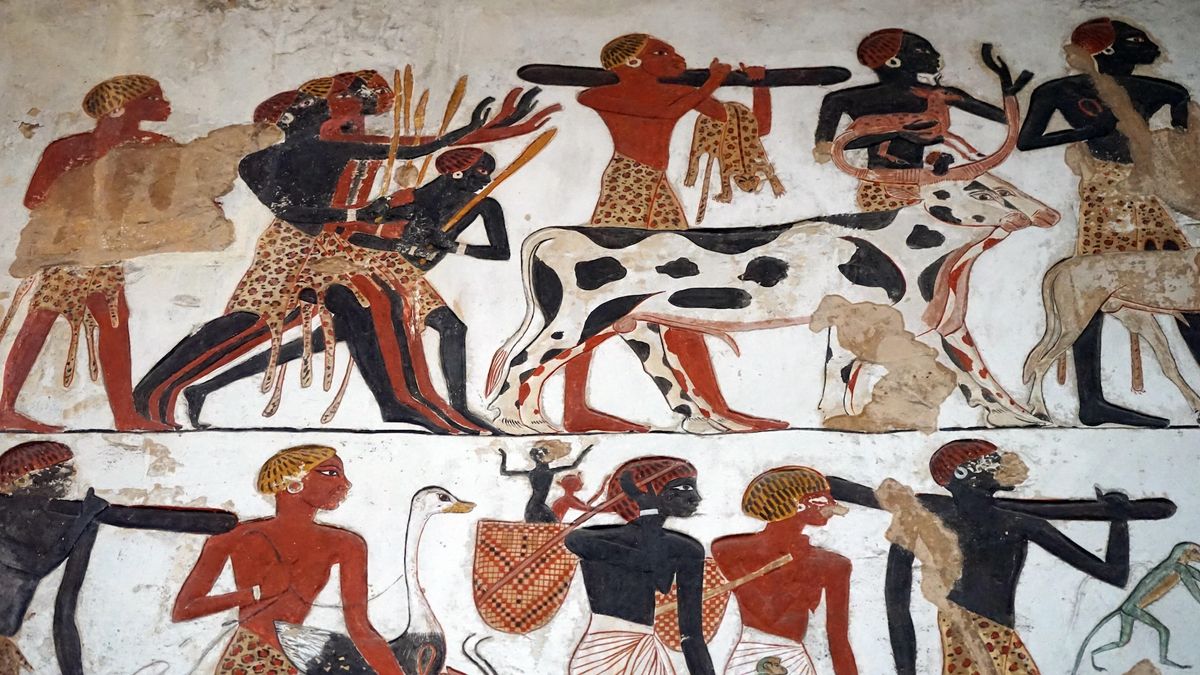
A plaster cast of a relief that depicts a military expedition launched by Ramesses II about 3,300 years ago. A Nubian woman can be seen with a head strap carrying a child in a basket. (Image credit: World History Archive via Alamy Stock Photo)

Marks on 4,000-year-old skeletons reveal that Bronze Age women in Nubia were carrying goods and young children on their heads using tumplines, a type of head strap that can hold a basket, a new study finds. The discovery reveals the oldest known use of head straps in the world.

Researchers made the finding in Sudan after analzying the remains of 30 people (14 females and 16 males) buried in a Nubian Bronze Age cemetery. One, an elite woman who was around 50 years old when she died, had the clearest marks indicative of head straps.

This is the "first clear evidence that women were using head straps — tumplines — to carry loads as early as the Bronze Age," study lead author Jared Carballo-Pérez, a researcher of bioarchaeology at the Autonomous University of Barcelona, told Live Science in an email.

Carballo-Pérez and his colleagues investigated at the archaeological site of Abu Fatima which consists of a cemetery that is located by the third cataract of the Nile River, in what was once the ancient kingdom of Kush.

After analyzing the 30 people in the Abu Fatima cemetery, the team found that women tended to have more wear on their head and neck areas than the male skeletons did, indicating that the women were bearing loads with head straps.

"Women exhibited specific degenerative changes in the cervical vertebrae and skull areas associated with prolonged use of tumplines that transfer weight from the forehead to the upper back," the team wrote in a statement.

--   Sent from my Linux system.

Saturday, April 5, 2025

“House of Life” Discovered at the Ramesseum in Luxor, Filled with Drawings and School Games

https://www.labrujulaverde.com/en/2025/04/house-of-life-discovered-at-the-ramesseum-in-luxor-filled-with-drawings-and-school-games/

"House of Life" Discovered at the Ramesseum in Luxor, Filled with Drawings and School Games

Ramesseum Luxor School
Discovered in the Ramesseum of Luxor the House of Life, a school inside the temple. Credit: Ministry of Tourism and Antiquities of Egypt

An Egyptian-French archaeological mission has made a series of highly significant discoveries at the Ramesseum temple (commissioned by Ramses II), located on the western bank of Luxor, Egypt. The discoveries, the result of cooperation between the Conservation and Documentation Sector of the Supreme Council of Antiquities, the French National Center for Research, and the Sorbonne University, have brought to light new elements that allow for a deeper understanding of the history and function of this iconic temple.

Among the main findings are a series of tombs from the Third Intermediate Period, storerooms for olive oil, honey, and fats, as well as wine cellars. Additionally, textile and stone workshops have been identified, along with kitchens and bakeries. These elements point to a much more complex economic and administrative activity than previously documented.

One of the most remarkable discoveries has been that of the so-called House of Life, an educational institution attached to the temple. This find is exceptional not only for providing the architectural layout of this teaching center, but also for yielding a collection of archaeological objects related to educational activity, such as remains of drawings and school games. This is the first physical evidence of the existence of a school within the Ramesseum, also known as the Temple of Millions of Years.

Ramesseum Luxor School
Objects discovered in the Ramesseum. Credit: Ministry of Tourism and Antiquities of Egypt

In the eastern sector of the temple, structures were found that, according to archaeologists, would have functioned as administrative offices. Meanwhile, studies carried out on the buildings and storerooms in the northern part indicate that olive oil, honey, and fats were stored there. A large number of wine jar labels were also found, confirming the use of the area as a wine cellar.

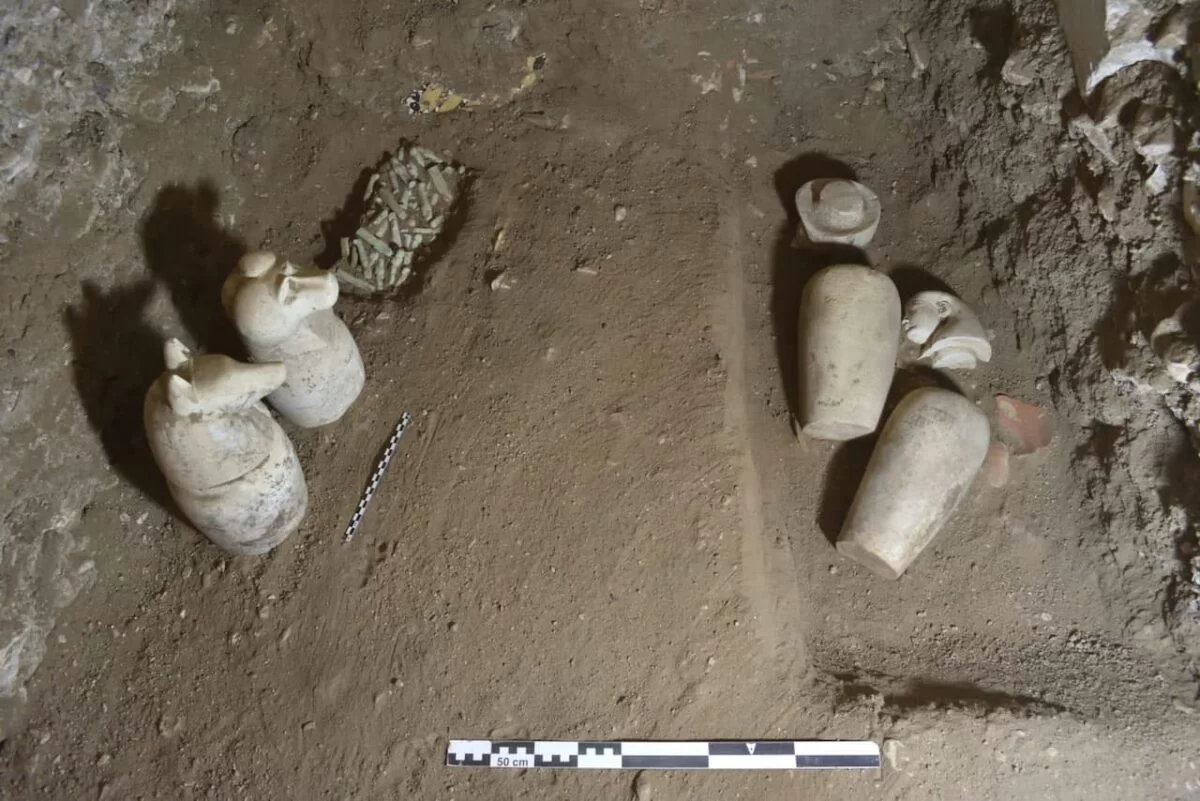
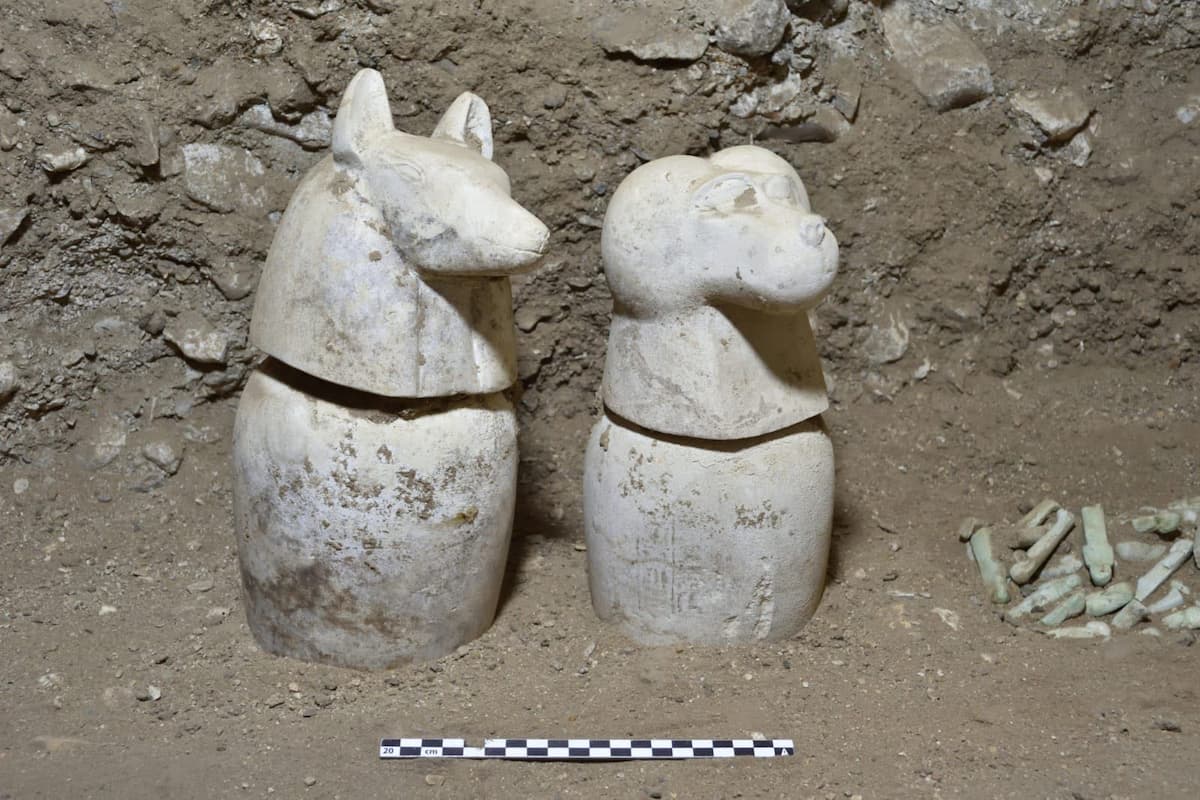
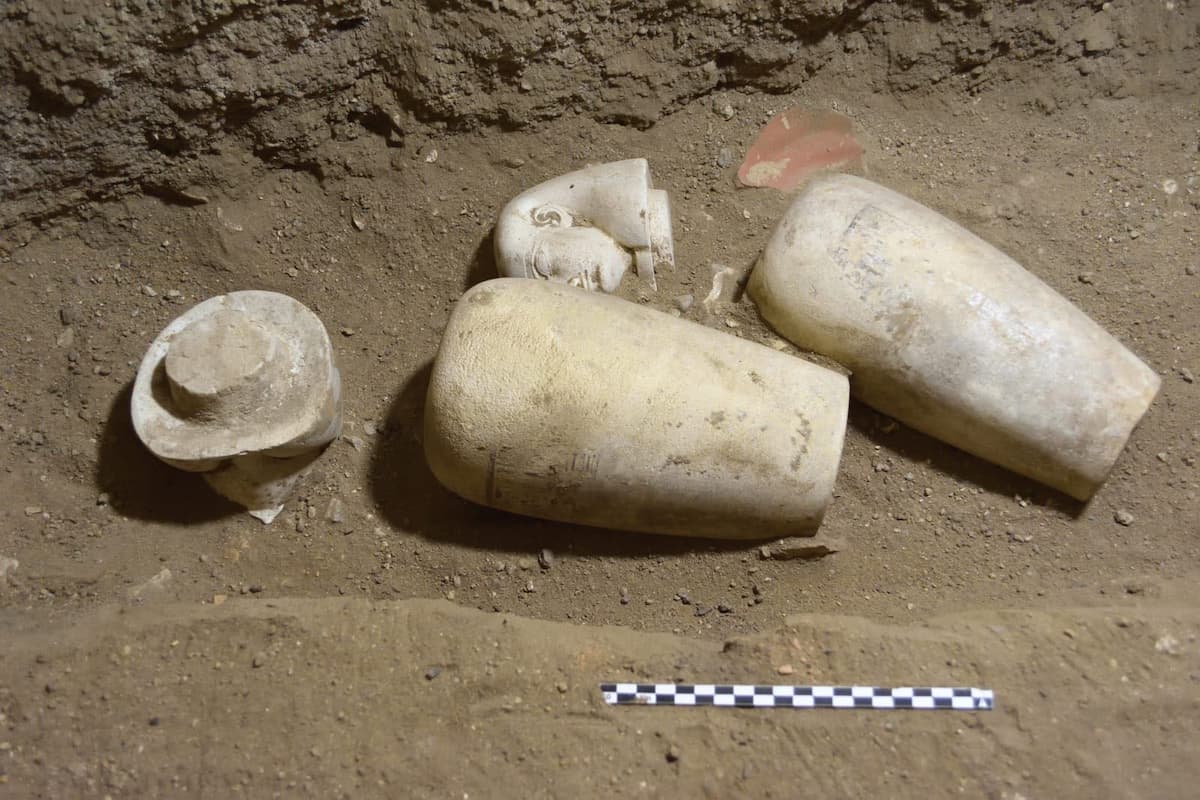
In the northeastern area of the temple, numerous tombs from the Third Intermediate Period were discovered. These contain funerary chambers, burial shafts with canopic jars, well-preserved funerary objects, nested sarcophagi, and a total of 401 ushabti figurines carved in ceramic. Human bones were also found scattered in the area.

The Minister of Tourism and Antiquities, Sharif Fathi, praised the mission's efforts to reveal new aspects of the religious and social role of the Ramesseum in ancient Egypt. For his part, the secretary general of the Supreme Council of Antiquities, Mohamed Ismail, emphasized the importance of these discoveries, as they provide key information about the temple's complex history, founded during the New Kingdom, under the reign of the Ramesside pharaohs.

Ramesseum Luxor School
Objects discovered in the Ramesseum. Credit: Ministry of Tourism and Antiquities of Egypt

Ismail explained that the temple not only served as a place of worship, where rituals in honor of the pharaoh were carried out even during his lifetime, but also fulfilled administrative and economic functions. The new evidence points to the existence of a complete hierarchy of civil officials who managed the redistribution of stored or manufactured goods, which benefited the local community, including the artisans of Deir el-Medina under the control of royal authority.

The studies also confirm that the site was already occupied before Ramses II built the temple, and that it was later reused as a large priestly necropolis after being looted. In later periods, during the Ptolemaic and Roman periods, it was used by stonecutters.

The head of the mission on the Egyptian side, Hisham El-Leithy, announced the re-exploration of the tomb of "Sehetep-ib-Re," located in the northwestern sector of the temple. This tomb, originally discovered in 1896 by British archaeologist Quibell, dates from the Middle Kingdom and preserves funerary depictions of the owner on its walls.

Ramesseum Luxor School
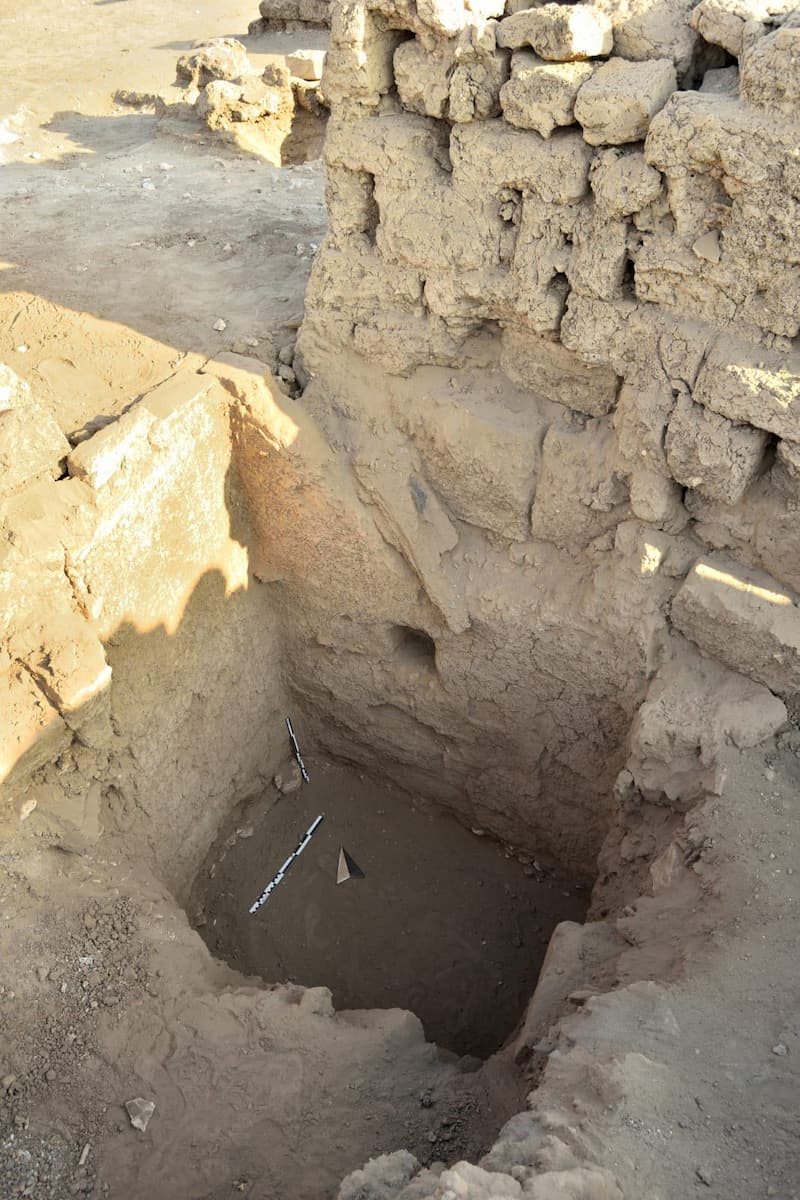
Excavations in the place of the discovery. Credit: Ministry of Tourism and Antiquities of Egypt

The team has also completed the full restoration of the southern sector of the temple, from the hypostyle hall to the sanctuary, including the first courtyard. In this area, the pieces of the colossus of Tuya, mother of Ramses II, were reassembled and placed in their original location. Similarly, parts of the colossus of Ramses II himself were reconstructed and restored.

On the French side of the mission, archaeologist Christian Leblanc detailed that restoration work was also carried out on the royal palace adjacent to the temple's first courtyard. Thanks to this work, the original layout of the building was recovered, which included a reception hall and a throne room. The king used this space to hold audiences during his stay at the temple.

In the area of the second monumental gate, part of the granite lintel was discovered, depicting a deified Ramses II before the god Amun-Ra, as well as remains of the decorative frieze that originally rested on a cornice with monkey figures.

The mission also cleared the northern and southern processional paths, where several findings from the Third Intermediate Period appeared. It was identified that this part of the temple was flanked by statues of Anubis reclining over small chapels. Many of these sculptures have been recovered and restored.


--   Sent from my Linux system.

Friday, April 4, 2025

Toddler Discovers 3,800-Year-Old Egyptian Amulet While Hiking With Her Family in Israel

https://www.smithsonianmag.com/smart-news/toddler-discovers-3800-year-old-egyptian-amulet-while-hiking-with-her-family-in-israel-180986359/

Toddler Discovers 3,800-Year-Old Egyptian Amulet While Hiking With Her Family in Israel

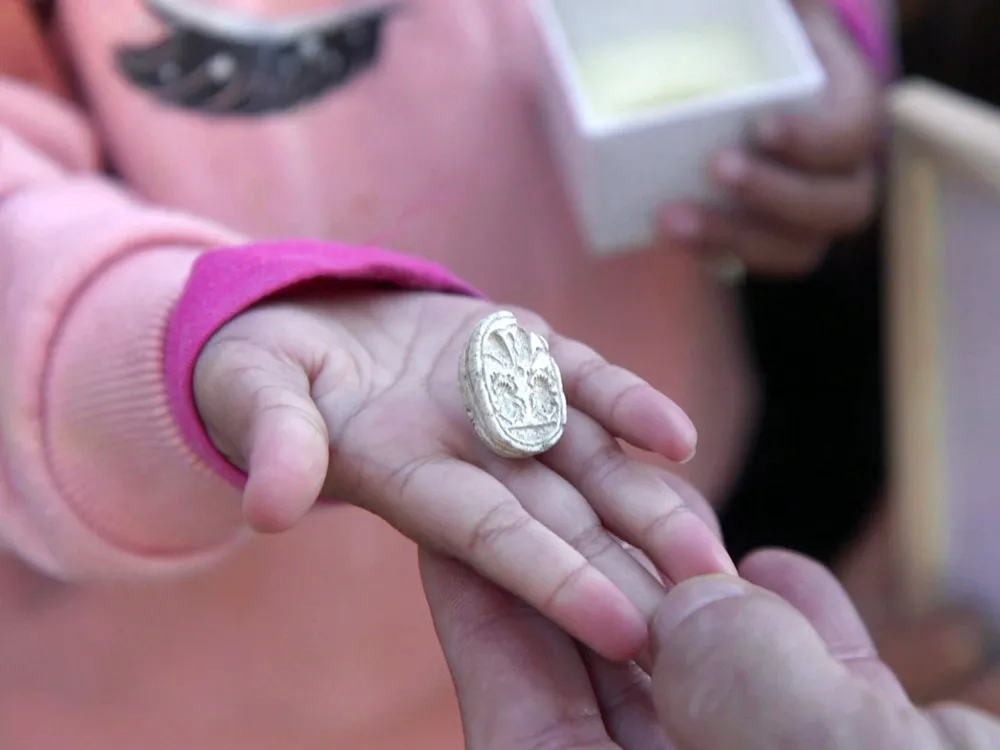
Little girl's hand holding a small decorative stone
The family handed the scarab over to the Israel Antiquities Authority, which plans to display it in an upcoming exhibition. Emil Aladjem / Israel Antiquities Authority

Ziv Nitzan was on a hike with her family when a rock on the ground caught her eye. But when the 3-year-old girl picked up the small stone and cleaned it off, she realized it was no ordinary rock.

Instead, the toddler had chanced upon a 3,800-year-old treasure, the Israel Antiquities Authority (IAA) announced this week.

Archaeologists say Nitzan picked up an ancient Canaanite scarab that dates to the Middle Bronze Age. When her siblings realized what she'd found, they asked their parents to take a look. The family then handed the scarab over to the government.

"There are thousands of stones over there and it was upside down, but somehow out of all those stones, she picked this one," the girl's mother, Sivan Nitzan, tells the Washington Post's Vivian Ho.

Scarabs are small, decorated objects that originated in ancient Egypt. They're typically shaped like dung beetles, which ancient Egyptians considered a sacred symbol of new life, per the IAA.

These beetles create dung balls or dung pats, then lay their eggs inside or nearby. When the eggs hatch, the larvae feed on the dung.

Ancient Egyptians also revered dung beetles because the rolling of the dung balls reminded them of the sun god rolling the sun across the sky, according to the Israel Museum. Because they mistakenly believed the beetles could spontaneously reproduce, they also connected the bugs with the primary god of creation.

In the Egyptian language, the beetle's name stems from the verb for "to be created" or "to come into being," per the IAA.

During the Middle Bronze Age, scarabs were used as seals and amulets, as Daphna Ben-Tor, curator of Egyptian archaeology at the Israel Museum, says in the IAA statement.

"They were found in graves, in public buildings and in private homes," Ben-Tor adds. "Sometimes, they bear symbols and messages that reflect religious beliefs or status."

Nitzan discovered the scarab during a family outing at the Tel Azekah archaeological site near the city of Beit Shemesh. Over the past 15 years, archaeologists have unearthed evidence of "many changing cultures over the course of history" at Tel Azekah, per the IAA. The Bible also references the area around Tel Azekah as the site of the famed battle between David and Goliath.

Recent archaeological findings suggest Tel Azekah was home to "one of the most important cities in the Judean Lowlands" during the Middle Bronze and Late Bronze ages, says Oded Lipschits, an archaeologist at Tel Aviv University who is leading the excavation work at the site, in the statement.

A 3.5-Year-Old Girl Discovers an Ancient Seal Dating Back 3,800 Years During a Family Hike - IAA PR

Located high above sea level, Tel Azekah was once the "control point of a strategic junction of roads" that traveled in all directions, according to the website of the archaeological expedition at the site. "For millennia, Azekah flourished and grew, as its community benefited from Azekah's rich natural and strategic location."

The scarab is just one of the many Egyptian and Canaanite artifacts discovered at Tel Azekah, which attests to the "close ties and cultural influences between Canaan and Egypt during that period," Lipschits adds.

The IAA thanked Nitzan for her discovery by presenting her with a certificate of appreciation for good citizenship. The agency also plans to highlight the scarab during an upcoming exhibition at the Jay and Jeanie Schottenstein National Campus for the Archaeology of Israel.

It will be placed alongside other Egyptian and Canaanite artifacts, many of which have never been displayed before. The exhibition will include seals of the pharaohs, Egyptian statues, ritual vessels and other examples of Egypt's cultural influence on Israel.

"If she put it in her pocket and kept it, we wouldn't know about it," Yoli Schwartz, a spokesperson for the IAA, tells the New York Times' Jonathan Wolfe. "We're very happy to show it to the public."


--   Sent from my Linux system.

Wednesday, April 2, 2025

ARCE2025 Session Schedule is Now Live!

ARCE We knew you were waiting for this: 2025 ARCE Annual Meeting paper schedule


arce 2025 annual meeting

This year's ARCE In-Person Annual Meeting Session Schedule and Meeting Schedule are now live*.

We are looking forward to a rich schedule of sessions across interests and disciplines. The meeting will feature over 100 presentations under various themes such as archaeological sciences, Greco-Roman Egypt, art history, Nubia, philology, religion, and more! 

Additionally, this year's special events include the Teaching Workshop: Translating the Book of the Dead in the 21st Century, led by Rita Lucarelli, and the Dessert Reception at the Legion of Honor Museum (Ticketed Offsite Event).

Visit www.arce.org/annual-meeting to register and learn more. 

For assistance, please email AMHelp@arce.org 

*Schedule is subject to change

View Schedule

Tuesday, April 1, 2025

New images reveal extent of looting at Sudan’s national museum as rooms stripped of treasures | Sudan | The Guardian

https://www.theguardian.com/world/2025/mar/31/sudan-war-national-museum-khartoum-rsf-paramilitaries-looting-ancient-treasures-kush-nubia-pharoahs

New images reveal extent of looting at Sudan's national museum as rooms stripped of treasures

Only a few statues remain, with thousands of priceless artefacts from Nubian and Kushite kingdoms missing

Supported by
theguardian.org
About this content
Mon 31 Mar 2025 06.00 EDT Last modified on Mon 31 Mar 2025 06.03 EDT

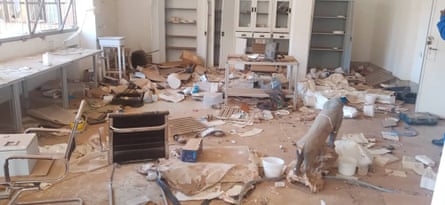
Videos of Sudan's national museum showing empty rooms, piles of rubble and broken artefacts posted on social media after the Sudanese army recaptured the area from the paramilitary Rapid Support Forces (RSF) in recent days show the extent of looting of the country's antiquities.

Fears of looting in the museum were first raised in June 2023 and a year later satellite images emerged of trucks loaded with artefacts leaving the building, according to museum officials. But last week, as the RSF were driven out of Khartoum after two years of war, the full extent of the theft became apparent.

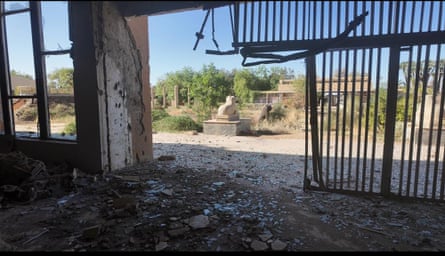
The destruction at the Sudan National Museum wreaked by RSF fighters, who were driven out of Khartoum last week. Photograph: Courtesy of Sudanese National Corporation for Antiquities

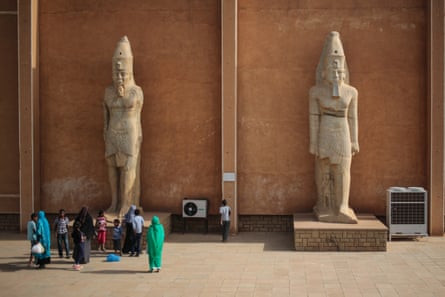
A video shared by the Sudan Tribune newspaper showed the museum stripped bare, with only a few large statues remaining, including the seven-tonne statue of King Taharqa, a pharaoh who ruled Egypt and Kush (present-day Sudan) from 690 to 664BC. Others showed ransacked rooms and smashed display cabinets.

The museum held an estimated 100,000 artefacts from thousands of years of the country's history, including the Nubian kingdom, the Kushite empire and through to the Christian and Islamic eras. It held mummies dating from 2500BC, making them among the oldest and archaeologically most important in the world.

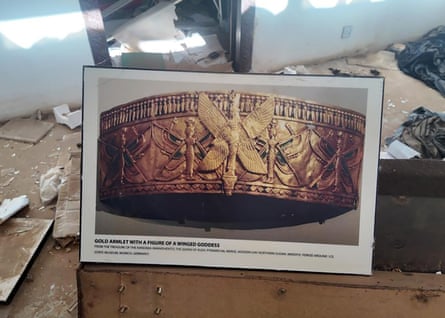
A 1st-century gold armlet from the treasure of Amanishakheto, a queen of Kush. Photograph: Courtesy of Sudanese National Corporation for Antiquities

Elnzeer Tirab Abaker Haroun, a curator at the Ethnographic Museum in Khartoum, said a specialist team visited the site after the RSF were expelled to assess the damage, which they will be documenting in a report.

"The tragedy was immense," he said. "Most of the museum's rare artefacts, as well as its precious gold and precious stones, have been lost."

The theft includes not only items on public display but those held inside a fortified room, including gold, which it is feared have been smuggled out of the country for sale abroad.

Unesco, the UN's cultural agency, has previously called on art dealers not to trade, import or export artefacts smuggled out of Sudan.

The scale of the damage to the museum and Sudan's heritage has been felt deeply by Sudanese.

"Seeing the Sudan National Museum being looted and destroyed by RSF was one of the most painful crimes … I felt ashamed and angry," said Hala al-Karib, a prominent Sudanese women's rights activist.

As a student, Karib and her friends would walk through the building admiring the artefacts from ancient kingdoms and jokingly posing as if they were themselves the queens depicted.

Visitors to the national museum in 2015. One statue is of King Natakamani, who ruled Kush with his mother, Amanitore, in the 1st century AD. Photograph: Mosa'ab Elshamy/AP

She first started visiting the museum with her father and, when she became a parent herself, took her own daughter there almost weekly.

"It was very personal; we are proud people and continually inspired by our ancient civilisation – it is the heritage we pass on to our children and grandchildren."

Many view it as a tragedy emblematic of the loss the country has suffered since the war started in 2023 during a power struggle between the army commander, Abdel Fattah al-Burhan, and the RSF's leader, Mohamed Hamdan Dagolo

Shahenda Suliman, a Sudanese trade unionist, said: "Whilst the human tragedy of this war outweighs everything for me, there's a symbolism there in seeing emptiness where these grand objects once stood that sort of captures the scale of destruction, loss and emptying of the country that we've seen since the war started.

"There are artefacts that have survived every plague, invasion and occupation for millennia, and predate the birth of Christ, that didn't survive this war."

Among the treasures at the museum were mummies dating from 2500BC, among the world's oldest and most important. Photograph: Courtesy of Sudanese National Corporation for Antiquities

Dallia Mohamed Abdelmoniem, a former journalist displaced from Khartoum by the war, said the loss of the museum's heritage was especially significant as an appreciation of Sudan's ancient history has become more widespread only recently.

She highlighted how the term Kandaka – a title for queens from the ancient kingdom of Kush – was used to describe female activists who participated in the 2018 protest movement that ousted the dictator Omar al-Bashir.

"I don't know how we'll be able to replace these priceless historical artefacts – and if there's a will to do so," said Abdelmoniem.

"The majority of Sudanese have been adversely affected on so many levels by this war, the restoration and return of items of historical, cultural and ancient significance I fear may not be viewed as a priority."

Why you can rely on the Guardian not to bow to Trump – or anyone

I hope you appreciated this article. Before you move on, I wanted to ask whether you could support the Guardian's journalism as we face the unprecedented challenges of covering the second Trump administration.

As Trump himself observed: "The first term, everybody was fighting me. In this term, everybody wants to be my friend." 

He's not entirely wrong. All around us, media organizations have begun to capitulate. First, two news outlets pulled election endorsements at the behest of their billionaire owners. Next, prominent reporters bent the knee at Mar-a-Lago. And then a major network – ABC News – rolled over in response to Trump's legal challenges and agreed to a $16m million settlement in his favor.

The Guardian is clear: we have no interest in being Donald Trump's – or any politician's – friend. Our allegiance as independent journalists is not to those in power but to the public. Whatever happens in the coming months and years, you can rely on the Guardian never to bow down to power, nor back down from truth.

How are we able to stand firm in the face of intimidation and threats? As journalists say: follow the money. The Guardian has neither a self-interested billionaire owner nor profit-seeking corporate henchmen pressuring us to appease the rich and powerful. We are funded by our readers and owned by the Scott Trust – whose only financial obligation is to preserve our journalistic mission in perpetuity.

What's more, we make our fearless, fiercely independent journalism free to all, with no paywall – so that everyone in the US can have access to responsible, fact-based news.

With the new administration boasting about its desire to punish journalists, and Trump and his allies already pursuing lawsuits against newspapers whose stories they don't like, it has never been more urgent, or more perilous, to pursue fair, accurate reporting. Can you support the Guardian today? 

We value whatever you can spare, but a recurring contribution makes the most impact, enabling greater investment in our most crucial, fearless journalism. As our thanks to you, we can offer you some great benefits – including seeing far fewer fundraising messages like this. We've made it very quick to set up, so we hope you'll consider it. Thank you.

Betsy Reed

Editor, Guardian US

Betsy Reed, Editor Headshot for Guardian US Epic
--   Sent from my Linux system.