Analysis of the paintings in the tomb of Thutmose III. Credit: CEA Université de Liège
An international team of researchers has uncovered significant findings in the tomb of Thutmose III in the Valley of the Kings, Egypt. The study, which began in 2018, represents an unprecedented effort to analyze the ancient wall paintings with modern technology, leading to revelations about the techniques and materials used by ancient Egyptian artists. The results have wide-reaching implications for our understanding of Egyptian art and its cultural connections.
The project is a joint venture between the European Center for Archaeometry (CEA) at the University of Liège, the Laboratory of Molecular and Structural Archaeology (LAMS) at the University of Paris-Sorbonne, and the Center for Studies and Documentation of Ancient Egypt (CEDAE) under the Supreme Council of Antiquities (SCA). By utilizing a portable laboratory, the team was able to conduct non-invasive physical-chemical analysis in situ, avoiding damage to the fragile wall paintings.
The researchers employed a rigorous and systematic approach, contrasting with previous methods that were often limited to isolated analyses. This comprehensive study aimed to understand not only the pigments and binders used but also the broader cultural context and artistic techniques. David Strivay, a researcher at the University of Liège, explained, With these analyses, we hope to understand the choice and application of the pigments and binders used in these mural paintings, but also to establish comparisons with previous analyses and those we will conduct in the future.
Multispectral imaging and chemical analysis of the Eye of Udjat from the Sarcophagus of Thutmes III (from top to bottom and from left to right): high resolution daylight photography, ultraviolet photography, infrared luminescence, chemical imaging. Credit: CEA Université de Liège
The project's first major breakthrough came with the analysis of the tomb of Thutmose III, where researchers found an unusual combination of high-quality pigments and innovative color blends. This finding challenged existing notions about ancient Egyptian art and suggested cultural exchanges with the Minoan civilization. Catherine Defeyt, a FED-tWIN researcher at the CEA, stated, The analyses carried out during the 2024 campaign revealed an unprecedented mix of colors and high-quality pigments. This observation calls into question established knowledge about Egyptian art. Philippe Martinez, an Egyptologist at the University of Paris-Sorbonne and project leader, added, The techniques used could be the result of intense cultural exchanges with the Minoan world.
The detailed study of the pigments and artistic techniques also provided insights into the symbolic significance of the colors. For example, the black lines of the oujdat eye, often used for magical and medical protection, were composed of galena, a black mineral powder also employed in ancient Egyptian makeup. This finding, along with others, indicates a complex interplay between artistic, magical, and medicinal practices in ancient Egypt.
Despite logistical difficulties due to the tomb's location and ventilation issues, the portable laboratory played a crucial role in the project's success. The team even created a 3D model of the tomb, offering a new perspective on its architectural design. Philippe Martinez emphasized the importance of this research in enhancing our understanding of ancient Egyptian culture, stating that these discoveries could guide future restoration efforts by the Supreme Council of Antiquities.
Given these fascinating revelations, a new research campaign is planned for late 2024 or early 2025, promising to uncover even more secrets hidden within the tombs of ancient Egypt.
If you couldn't join us at the ARCE Annual Meeting in Pittsburgh, we hope you will join us for the ARCE Virtual Annual Meeting. The virtual meeting will be held on May 17-19, 2024, via Zoom. You'll have the opportunity to view live presentations from leading scholars on topics related to Egyptian history, recent fieldwork, technological advances, and much more. Register today for just $125.
If you registered for the in-person meeting, then virtual meeting access is included.
If you couldn't join us at the ARCE Annual Meeting in Pittsburgh, we hope you will join us for the ARCE Virtual Annual Meeting. The virtual meeting will be held on May 17-19, 2024, via Zoom. You'll have the opportunity to view live presentations from leading scholars on topics related to Egyptian history, recent fieldwork, technological advances, and much more. Register today for just $125.
Virtual registrants will have access to our live virtual tour of Journey Through Time: Exploring the Coptic Museum's Rich Legacy with Mary Missak on May 18th at 12 PM EST.
View the *Virtual Schedule and more information will be sent to speakers and registrants soon.
For assistance and inquiries, please email AMHelp@arce.org. Fee waivers are available for student members and early career scholars in financial need.
Ancient Egyptian Pyramids, Sphinx Close to Public for Tech Billionaire's Lavish Wedding
May 3, 2024 4:20pm
The Great Sphinx of Giza. Photo F. Schneider/picture-alliance/dp
Ancient Egyptian pyramids and the Great Sphinx in Giza were briefly shuttered to the public this week for a tech billionaire's wedding.
That billionaire, Ankur Jain, and fitness trainer Erika Hammond reportedly paid to have those sites closed down for their wedding, a weeklong celebration that is estimated to have cost upward of $3 million. The event, which has since gone viral on TikTok, offered guests a private tour of the pyramids and the sphinx without interruption, as well as a close look at a statue of Ramses II.
The couple also hosted a party at the Grand Egyptian Museum, which is thought to be the largest constructed museum in the world devoted to a single civilization. That institution, which cost $1 billion to build, is still not open to the public, though it is expected to begin welcoming visitors later this year.
Jain and Hammond wed at sunset between two of the pyramids before celebrating with a star-studded reception with performances by Robin Thicke, Lance Bass, and Lindsey Stirling.
Accounts of the wedding events have generated hearty debate across multiple social media platforms, with many claiming that the event was needlessly extravagant.
Jain is the founder and CEO of Bilt Rewards loyalty program. Hammond is a former WWE champion and fitness mogul.
The event was supported by the country itself. Egypt Independentreported that Egypt's minister of Tourism and Antiquities, Zahi Hawass, was among those who attended the wedding. Per that publication, Jain and Hammond paid $200,000 to host a party near a sculpture of Ramses II.
See 1,000 Perfect Replicas of Objects Unearthed From King Tut's Tomb
A traveling exhibition on view in Washington, D.C. blends education and entertainment, letting visitors get up close and personal with the ancient Egyptian pharaoh's treasures
The exhibition features recreations of the tomb's antechamber, burial chamber and treasury. Exhibition Hub
In 1924, two years after British archaeologist Howard Carter discovered Tutankhamun's tomb, an exhibition in London promised to immerse visitors in a "complete replica" of the ancient Egyptian pharaoh's final resting place.
Working off of published photographs and drawings of the tomb, artist William Aumonier spent eight months painstakingly recreating such artifacts as an ornate throne, a wooden bed and a statue of the boy king, who reigned in the 14th century B.C.E. Though the display wasn't an exact mirror of the site in Egypt's Valley of the Kings, its reproductions exhibited an impressive level of attention to detail and commitment to accuracy—thanks in part to Egyptologist Arthur Weigall, who'd witnessed Carter's excavation firsthand.
But at least one person disapproved of the venture: Carter himself. The archaeologist sued the event's organizers for copyright infringement—and lost. Ultimately, more than 25 million people attended the exhibition, which counted the replica tomb among its greatest hits.
A century later, a separate exhibition in Washington, D.C. is recreating Tutankhamun's tomb on an even grander (and less exploitative) scale. Featuring more than 1,000 reproductions crafted by Egyptian artisans, "Tutankhamun: His Tomb and His Treasures" offers a sense of the sheer extravagance of the king's funerary trappings. The show also makes a clear argument for the value of replicas as educational tools, particularly when the originals are largely inaccessible to the public. The Grand Egyptian Museum in Cairo owns all 5,000 artifacts found in the tomb, but its opening (and planned display of the vast assortment of treasures) has long been delayed.
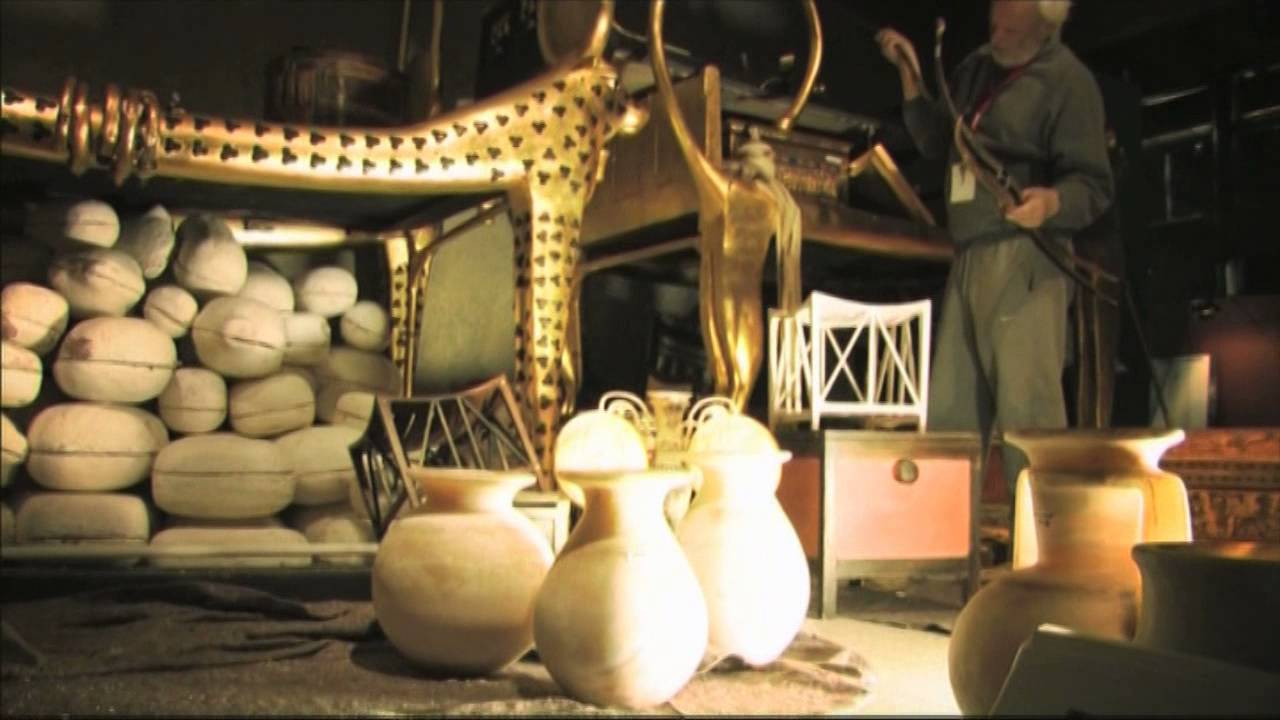
Melinda Hartwig, an Egyptologist at Emory University and a special adviser to the exhibition, says the show allows visitors to "follow in Carter's footsteps" by drawing directly on the archaeologist's excavation notes and photographs. Early on, the exhibition transports visitors into recreations of the pharaoh's burial chamber, antechamber and treasury, all presented as they appeared when Carter first saw them. Later sections focus on the artifacts themselves, grouping replicas of Tutankhamun's shabtis (funerary figurines), nested coffins, canopic jars and more.
A replica of one of Tut's coffins Exhibition Hub
According to Hartwig, Egyptian craftspeople, lapidaries and sculptors spent around four years recreating the artifacts found in the pharaoh's tomb, from his wooden chariot to his iconic golden mask. First, they cast the objects in plaster, and then they covered the models in resin. Finally, they used alloys and glass appliques to add color and depth.
Unlike Aumonier, these artisans had access to extensive primary source material, as well as 3D scans of the original artifacts. Still, it's impossible to know whether Carter, who died in 1939, would have been any more impressed by the contemporary replicas than he was by the ones created 100 years ago.
Semmel Concerts, a German live event promoter and producer, debuted "Tutankhamun: His Tomb and His Treasures" in Zurich in 2008. Created in conjunction with Egyptologists, the immersive experience spent the next decade-plus traveling across Europe, attracting more than seven million visitors.
1 / 4
More than seven million people visited the exhibition while it was touring Europe. Exhibition Hub
Reviewing a Czech staging of the exhibition in January 2009, Egyptologist Jaromír Málek praised the artisans' attention to detail as "astounding," writing that "there are few things with which one would seriously like to quarrel."
The scholar added, however, that "it must be admitted that replicas, no matter how good, do not allow one to experience the frisson of being face to face with the original items removed from Tutankhamun's tomb. Some of the original objects, such as furniture, would have been used by the king in his lifetime, and the idea that Tutankhamun's bottom once rested on the chair in front of us is mind-boggling."
Semmel Concerts and its various local partners have never claimed to be the real thing. As the San Diego Natural History Museumnoted in 2014, when it hosted an iteration of the show, the reproductions are not intended to replace the real artifacts, but rather to complement them "by allowing visitors to experience the tomb and the indescribable treasures of … Tutankhamun just as they were when he died." Unlike the fragile originals, replicas "enable us to recreate archaeological sites that have long since been dispersed, to bring together objects that are now in different locations and in some instances no longer available for public display."
In Tutankhamun's case, the original artifacts are all owned by the same entity: the Grand Egyptian Museum, which has been under construction since 2005. But the Cairo cultural institution's opening has repeatedly been pushed back, from 2018 to 2020, 2021 and so on. An official opening date has yet to be announced, though the museum does offer limited guided tours of certain spaces, including the Grand Staircase, which features 60 artifacts from the collections.
Even if the Grand Egyptian Museum were open, its treasures wouldn't be traveling internationally, as they did to greatfanfare between the 1960s and the 2000s. At more than 3,300 years old, the objects from Tutankhamun's tomb are incredibly fragile, making it difficult—and very expensive—to transport them safely. Additionally, Málek wrote in 2009, "The Egyptians point out that these are antiquities of their own past, and … it is only appropriate that they remain on display in Cairo where they can be seen by ordinary Egyptian visitors, such as schoolchildren."
In lieu of a visit to Cairo or Tutankhamun's mostly empty tomb in the Valley of the Kings, replicas are among the easiest ways to experience the grandeur of ancient Egypt. As Hartwig explains, "Tutankhamun: His Tomb and His Treasures" blends entertainment and education; the exhibition's wall panels are changed with each iteration of the show, reflecting updated understandings of the pharaoh's life and legacy. For instance, recent research suggests he was a warrior king, rather than a sickly, infirm ruler.
Replicas of statues found in Tut's tomb Exhibition Hub
Initially a skeptic regarding the traveling show, Málek admitted, "somewhat reluctantly," that he had "become a convert," adding, "This exhibition can do things which no other, perhaps with the exception of future virtual reality shows, is able to."
Hartwig, for her part, says she loves the exhibition "because you experience the objects. They're not behind glass. They're not separated from context." And, in perhaps the greatest departure from the standard museum experience, you can even reach out and touch the replicas, tracing the hieroglyphs that spell out Tutankhamun's name on the back of his throne or running your hands across the smooth surface of his death mask.
US authorities return antiquities linked with notorious smuggling ring to Egypt
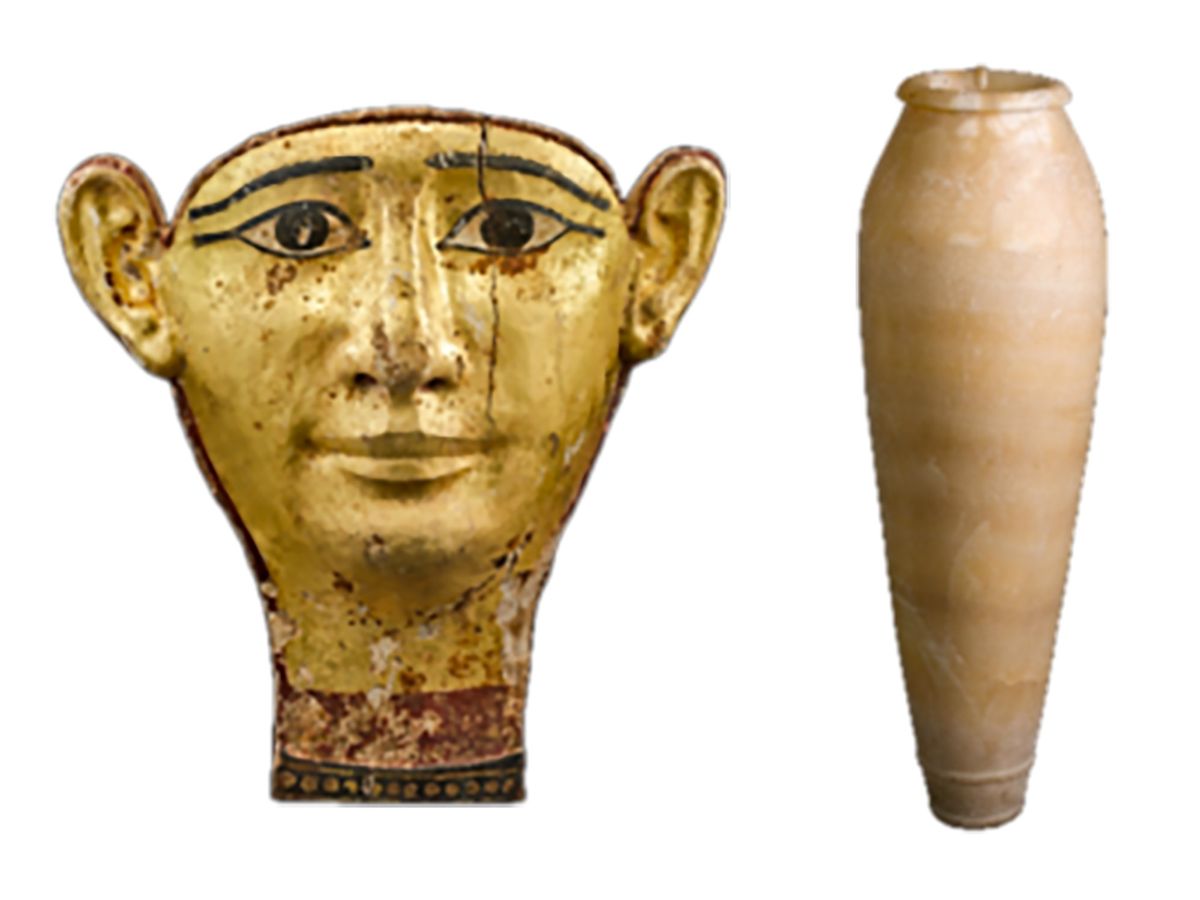
The Egyptian items repatriated by the Manhattan District Attorney's office this week, collectively valued at $1.4m, include a wood coffin face and a royal alabaster vase
Among the artefacts restituted to Egypt: a face from a gilded wood coffin dating to around 332BCE-275BCE (left) and an alabaster royal vase from around 3100BCE-2670BCE (right) Courtesy the Manhattan District Attorney's Office
The office of Manhattan District Attorney Alvin L. Bragg announced on Thursday (2 May) that ten antiquities collectively valued at $1.4 million had been restituted to Egyptian officials.
Eight of the objects were recovered as part of the Manhattan DA's investigation into the Dib-Simonian trafficking network, a nine-person team that allegedly included former Musée du Louvre director Jean-Luc Martinez and facilitated the sale and purchase of looted cultural artefacts to institutions including the Metropolitan Museum of Art and Louvre Abu Dhabi. Assistant District Attorney Matthew Bogdanos, chief of the Antiquities Trafficking Unit, supervised the investigation. The head of the ring, Serop Simonian, an art dealer in his 80s, was arrested last year in Germany and transferred to France.
Since 2022, the Manhattan DA's office has returned 27 items to the government of Egypt, valued at more than $6.5m in total.
"Egypt has an incredibly rich cultural history that we will not allow to be diminished by selfish looters and traffickers. I am proud that my Office has successfully returned more than 25 antiquities to Egypt in just over two years, and we look forward to continued work with our partners at HSI to protect cultural heritage all around the globe," District Attorney Bragg said in a statement.
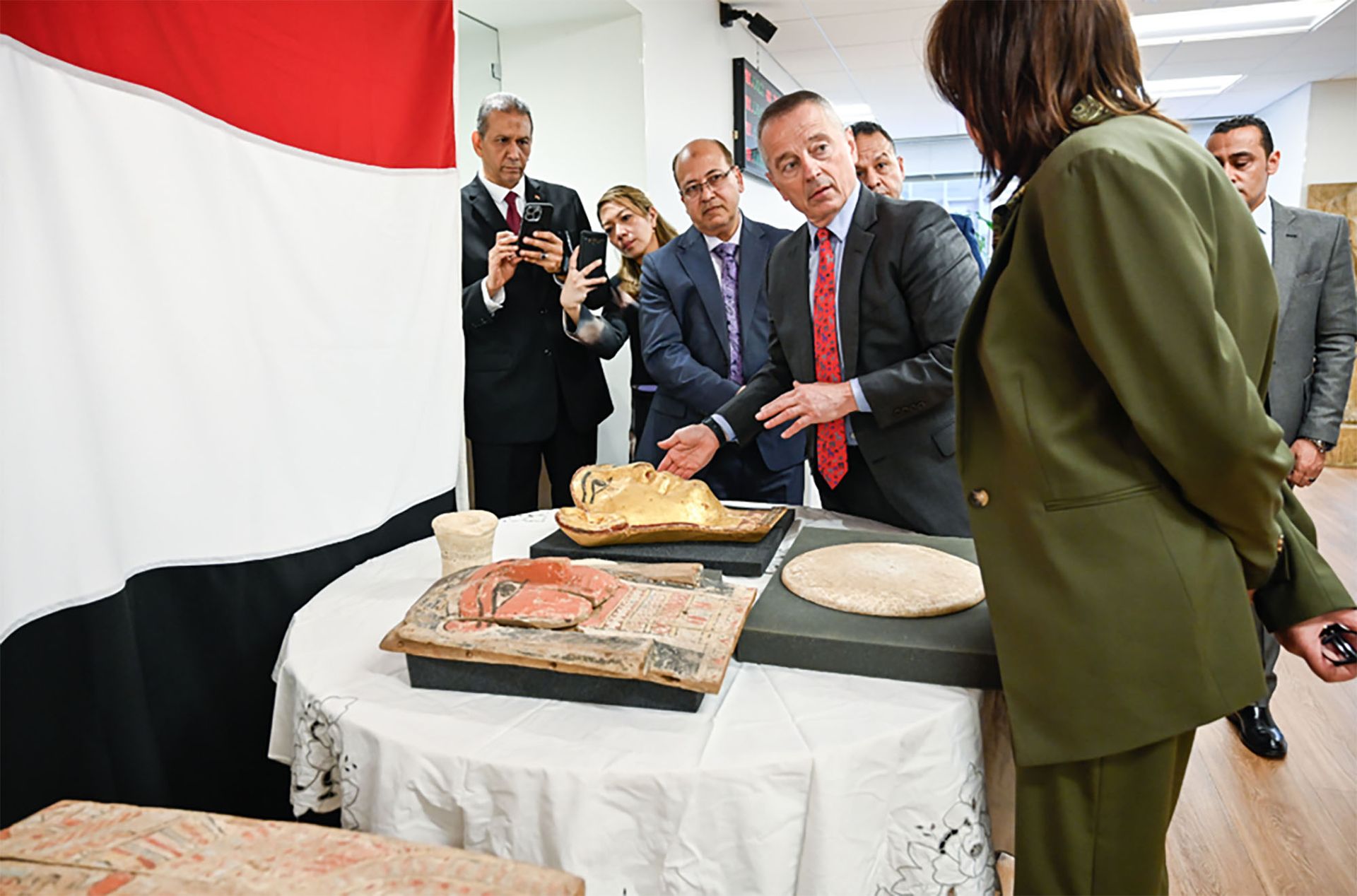
Howaida Essam, Egypt's consul general in New York, examines artefacts recovered by the Manhattan District Attorney's Office Courtesy the Manhattan District Attorney's Office
The recovered pieces include a gilded wooden coffin face dating from around 332BC-275BC that was looted from the Nag el-Hissaya necropolis, a site near the famed Temple of Horus that served as a burial ground for priests and other religious officials. The face was severed from a larger coffin headdress before coming into Simonian's possession in 2001; a member of the trafficking network consigned it for auction at Christie's but it failed to sell; it subsequently changed hands several times in private sales over the next two decades. Bragg's office seized the object from Manhattan's Merrin Gallery in 2023.
Another notable item in the group is an alabaster royal vase from between 3100BC and 2670BC, which was excavated by the British Egyptologist Cecil M. Firth from the Step Pyramid of Djoser in Saqqara between 1924 and 1935. The vase was stolen from a warehouse in Egypt and smuggled out of the country, resurfacing in the holdings of the disgraced British dealer and notorious trafficker Robin Symes, who sold it to private collectors. It was also seized from Merrin Gallery in 2023.
The objects were handed over in a ceremony with the Consul General of Egypt in New York, Howaida Essam.


/https://tf-cmsv2-smithsonianmag-media.s3.amazonaws.com/accounts/headshot/mellon.png)
:focal(700x527:701x528)/https://tf-cmsv2-smithsonianmag-media.s3.amazonaws.com/filer_public/65/3e/653e4413-148f-4f25-9286-9755ea43f286/efwefwe.jpg)
/https://tf-cmsv2-smithsonianmag-media.s3.amazonaws.com/filer_public/f5/26/f526e2b0-2dbc-4146-a1fb-d5d20748586b/tutankhamun_tomb_photographs_2_009.jpeg)
/https://tf-cmsv2-smithsonianmag-media.s3.amazonaws.com/filer_public/81/d1/81d1a5fb-53bd-473d-b052-6e5cfe5161d9/495425-expo_tut_8-af29f8-original-1690571404.jpeg)
/https://tf-cmsv2-smithsonianmag-media.s3.amazonaws.com/filer_public/fd/ed/fded99fb-95a3-4255-a873-eff274d5d8ff/495423-expo_tut_11-4e6f43-original-1690571398.jpeg)
/https://tf-cmsv2-smithsonianmag-media.s3.amazonaws.com/filer_public/56/d6/56d6e56d-7fe3-46b8-8b85-ebb947a8284b/495419-expo_tut_6-21190d-original-1690571364.jpeg)
/https://tf-cmsv2-smithsonianmag-media.s3.amazonaws.com/accounts/headshot/mellon.png)