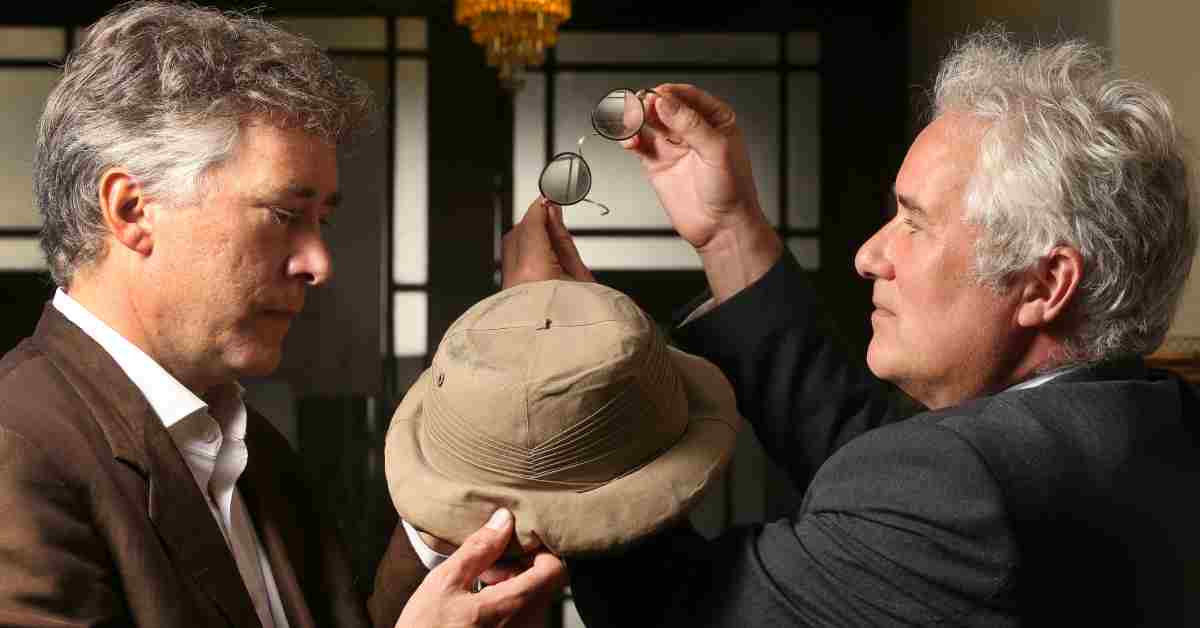
Robert (left) and Ben Ogden with their great great grandfather's hat and spectacles.
One of Harrogate's most famous shops is to host an Egyptology exhibition that highlights its links to Tutankhamun.
Ogden of Harrogate's Egyptomania exhibition, which opens on Thursday, celebrates 130 years of the family jewellers and the 100th anniversary of the discovery of Tutankhamun's tomb.
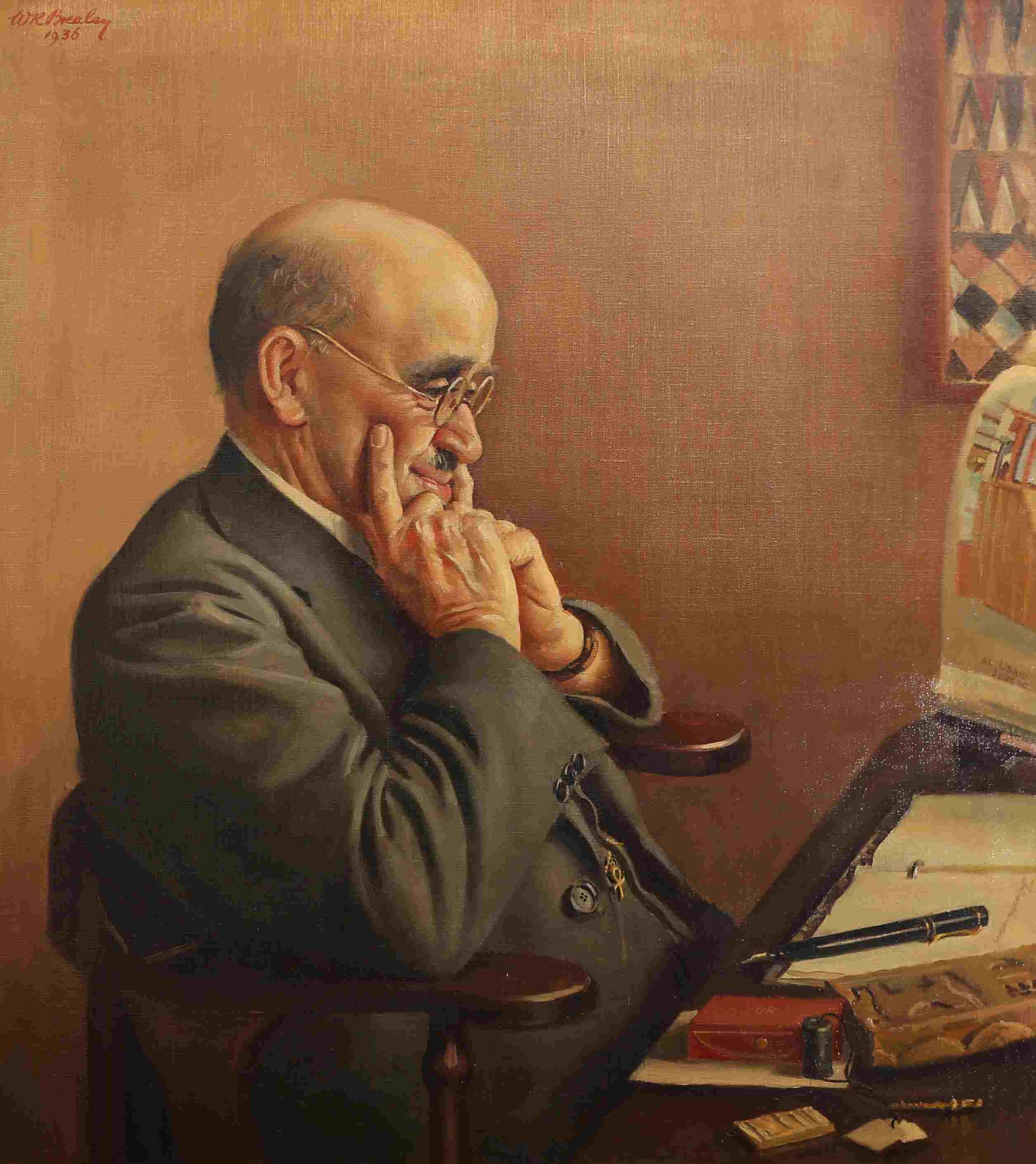
James R Ogden, who founded the business in 1893, travelled widely to obtain jewels and the exhibition features his artefacts and letters.
When Howard Carter discovered Tutankhamun's tomb, he invited Ogden to the Valley of the Kings to value and weigh the gold, including Tutankhamun's coffin.
The Harrogate jeweller was one of the first people in over 3,000 years to enter the tomb.
JR Ogden, who founded the family jewellers.
Ogden of Harrogate, which is based on James Street, is now run by JR Ogden's great, great grandsons Robert and Ben Ogden.
Robert Ogden said:
"The history of our business is our cornerstone and we have recently been cataloguing our archive, where we have a vast collection of JR Ogden's memorabilia, including a remarkable collection of 10,000 lantern slides of his travels to Tutankhamun's tomb, and artefacts from his expeditions to Ur, Babylon, Palestine, Syria, and Assyria.
"There are also hundreds of letters that are fascinating glimpses of the key characters of that time, and their explorations."
JR Ogden knew Howard Carter, Lord Carnarvon, Max Mallowan (Agatha Christie's second husband) and worked particularly closely with the archaeologists Leonard and Katharine Woolley.
Some of these artefacts and letters will be on display for the first time.
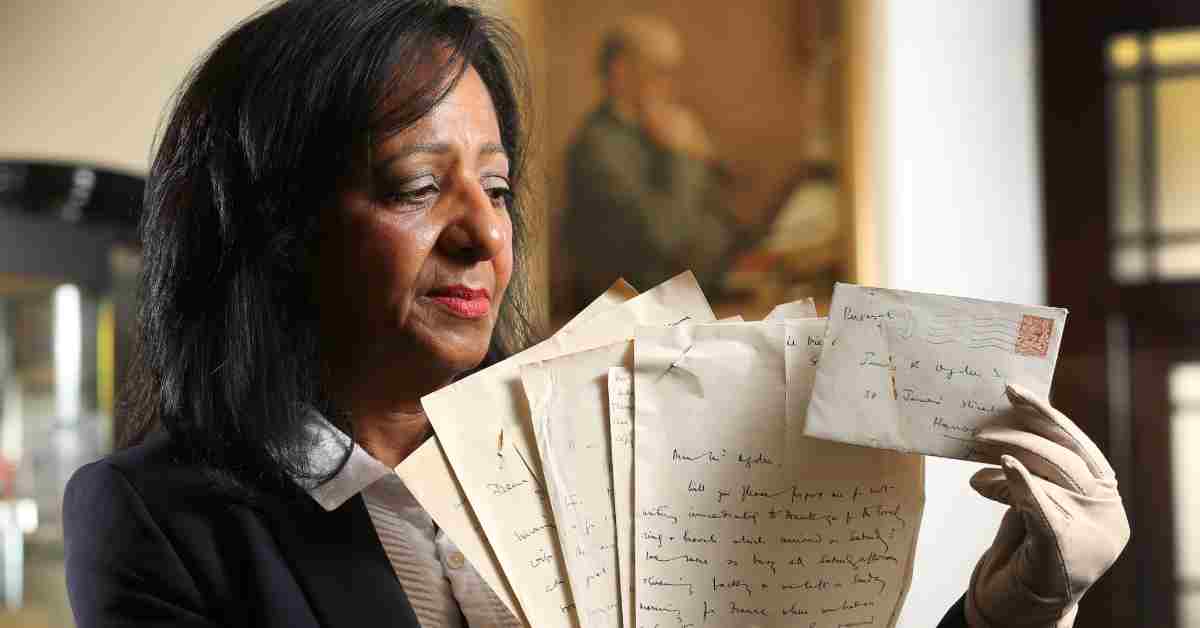
The exhibition also includes previously unseen letters of Katharine Woolley, a pioneering female archaeologist, that are of particular interest, as on her death she asked that all her personal documents be destroyed.
Yvonne Nightingale, general manager at Ogden of Harrogate, with some letters from the exhibition. Pic: Lorne Campbell. Guzelian
Ogden made many replicas of the artefacts found at Tutankhamun and Ur and donated them to the British Museum.
The exhibition provides an insight into the social and political context in which archaeology was practiced at that time. JR Ogden collected hundreds of newspaper clippings about archaeological digs, some of which will also be on display.
Egyptology runs at Ogden of Harrogate on James Street, Harrogate, from September 7 to 21.
One ancient graffiti artist carved this creature at the Philae temple complex—most likely a horse. Alamy
Beginning with its construction in the fourth century B.C. and continuing for more than 800 years, the Temple of Isis on the small island of Philae, set where the Nile flowed out of Nubia, was visited by a stream of pilgrims. Coming from all parts of the Egyptian empire, and even as far away as Cyprus and Rome, they passed between 60-foot towers to attend elaborate seasonal ceremonies that celebrated Isis' miraculous resurrection of her husband, the god Osiris, and the birth of their son, Horus. They beseeched Isis, the queen of the Egyptian pantheon, for aid and thanked her for interceding in their affairs.
Before heading home, many also etched their marks—a carving of their footprints on sacred ground, a picture of the deity, a name, a date or perhaps a short prayer—into the temple's massive sandstone blocks. Some testified to the difficulty of their journey: "Isis, you are the Mistress of the Road," wrote a third-century A.D. Nubian envoy named Sasan, beside a crude self-portrait. "Our hearts are entrusted to you upon the way." Others were likely carved on pilgrims' behalf by the priests who worked at the temple: "His name endures forever: Nesmety, the banker of Isis. … As for the one who will erase these writings, his name will be erased forever."
An ancient pilgrim visited Philae and etched this boat on the wall of one of the temples. Alamy
When European explorers began visiting Philae in the 19th century, more than a millennium after the cult of Isis slipped into history, they labeled these informal inscriptions "graffiti," from the Italian for "scratches." To these visitors, the phenomenon was a curiosity, at best—and at worst, vandalism. (Contemporary graffiti, like the messages recently carved by tourists on the wall of Rome's Colosseum, is still considered vandalism.) For generations, most archaeologists were principally interested in the temple's epic architecture and the official ornamentation on its walls, which include intricate reliefs of gods and goddesses carved by skilled artisans.
Jitse Dijkstra and Roxanne Bélanger Sarrazin record graffiti on the roof of a temple in the courtyard of the Temple of Isis. Courtesy Sabrina Higgins, PhD
But over the last two decades, the etchings of the worshipers at Philae and other sites across the ancient world have gradually become the focus of serious inquiry, part of a broader turn away from the monarchs and monuments that long dominated our study of the past—and limited our historical perception.
"People are looking more at women, the enslaved, people who have been left out of the historical record—and graffiti are really one of the best ways to get at these voices," says Jacqueline DiBiasie-Sammons, a classicist at the University of Mississippi, whose research centers on graffiti in the doomed Roman cities of Herculaneum and Pompeii.
The tools of ancient graffiti artists were simple—a knife, a chisel, perhaps a stick of charcoal. But these researchers have the advantage of breakthrough technology that is helping them recover, preserve and publicize these etchings, from sophisticated image capture to massive online databases and even artificial intelligence.
The Ancient Graffiti Project has digitized thousands of Roman graffiti since its founding at Washington and Lee University in Virginia in 2014. In Italy, researchers are documenting graffiti in medieval churches using a technique called photogrammetry. Last year, an international team of researchers debuted "Ithaca," a deep neural network—a form of artificial intelligence—designed to read damaged or incomplete Greek inscriptions. And, in one of the most ambitious projects to date, a Canadian team has been working since 2016 to create a 3D model of the Temple of Isis that will allow researchers to explore, in intimate detail, the devotions of people like Sasan and Nesmety, who lived and died millennia ago.
The Philae Temple complex is, technically, no longer on Philae. In the late 1970s, it was carefully disassembled and moved, block by block, to Agilkia, a higher island a quarter-mile downriver, after Philae was flooded by the construction of the Aswan High Dam. Still, Isis' rebuilt temple retains its power to inspire awe, looming over the Nile as visitors approach in flat-bottomed river boats, much as pilgrims might have done in the age of the pharaohs.
"That ferry ride never ceases to amaze me," says Sabrina Higgins, an archaeologist at Simon Fraser University in British Columbia and a co-leader of the Canadian research team. "To go to Philae feels as if you are stepping back in time."
It's easy to imagine the festivals and rituals that once took place here, Higgins says—the flotillas bearing effigies of the gods, the solemn re-enactments of Osiris' funeral rites. That's especially true early in the morning, before all the tourists arrive, when the island is the sole domain of hundreds of feral cats, who are fed by workers there, in a throwback to the age when Egyptians considered felines to be divine. It's also the time of day when, thanks to the angle of the sun, the graffiti is easiest to capture in photographs.
Much of Philae's graffiti consists of prayers and names in Demotic script, a form of Egyptian writing that succeeded hieroglyphics, used primarily by priests and officials in an era when few people could read and write. Higgins and her colleagues, though, are concentrating on figural graffiti, which range from humans and animals (often representing a god) to game boards likely carved by Isis' priests for diversion during their off hours. A falcon in flight honors Isis' son Horus, the great god commonly depicted with the head of a bird of prey. A crude line drawing of a horse is set so high on a wall that the artist must have been sitting on the roof with his legs dangling over the edge.
This article is a selection from the September/October 2023 issue of Smithsonian magazine
"The figures are at least as interesting" as textual graffiti, says Jitse Dijkstra, a classicist at the University of Ottawa, who has been studying Philae's graffiti for more than 20 years and was among the first scholars to examine it seriously. Dijkstra began the current survey in 2016 with his Ottawa colleague Roxanne Bélanger Sarrazin. Higgins joined the project in 2020 and later recruited Nicholas Hedley, a geographer at Simon Fraser who has previously worked with oceanographers to map the seafloor and with NASA to model the surface of Mars. Hedley contributed his expertise in digital visualization, plus a dazzling array of high-tech gadgetry, which the team believes will one day be central to future graffiti projects.
Hedley began his survey with photogrammetry, a technique originally developed for architectural surveying in the 19th century that has become increasingly powerful since the advent of digital photography. Digital photogrammetry uses a mosaic of hundreds of overlapping images, each captured from a slightly different angle, to construct a high-definition, three-dimensional representation of each surface—not only walls but also rooftops, stairwells and the sides of columns. But photogrammetry requires unbroken light, which can be rare in the Philae complex, so on a subsequent trip, Hedley brought a brand-new piece of technology: a small, powerful laser scanner, about the size of a soda can. Even in the temple's darkest recesses, the device could capture images of graffiti that may have been unseen by human eyes for centuries.
Nicholas Hedley records etchings using a Leica Laser Scanner—a technology that Bélanger Sarrazin says was a "game changer" for the project. Courtesy Sabrina Higgins, PhD
"That was a game changer," Bélanger Sarrazin says of the new, portable laser scanner. "In 2016, we were still using tracing paper on the walls. Later, we changed to doing drawings from photographs, but sometimes on the photographs we don't see all the details, the depths, the texture of the wall and the graffiti in its context."
Context can reveal a lot about where pilgrims were allowed to go, which areas were limited to priests and how worshipers chose to express their devotion. On a Zoom call from his office at Simon Fraser, Hedley walks me through a 3D model-in-progress and notes a particular concentration of graffiti just outside the most hallowed part of the temple, where people apparently chipped off pieces of sandstone as souvenirs. The human-made gouges and the graffiti in this spot, Hedley says, suggest that many worshipers were prevented from entering and instead crowded outside. "There would've been thresholds of access," Hedley says. "This was the holiest of holies."
Much like Philae's ancient pilgrims, today's tourists do not have full access to the Temple of Isis—nor can everyone travel to this fairly remote part of southern Egypt. But the Canadian team is working to create a detailed digital model of the entire temple that they plan eventually to make widely accessible.
"Nobody has thought to use this kind of technology for capturing graffiti before," Higgins says.
"As a conservator and someone who has studied ancient graffiti, I think this is a wonderful form of preservation," says Suzanne Davis, head of conservation at the University of Michigan's Kelsey Museum of Archaeology and the president of the American Institute for Conservation, who has been following the project from afar. "But it also has the huge benefit of making the graffiti available to students and scholars all over the world."
"Ancient graffiti do show us how much things have changed in 2,000 years, but they also show us how much is just part of the human condition," DiBiasie-Sammons says.
After all, at any given time in history, everyday people are living their ordinary lives. Few of us will build monuments, live in palaces or have our names and deeds recorded in official histories. Still, the urge to leave a mark seems universal, whether it's a declaration to a deity, to posterity, or simply to oneself: "I was here."
Amy Crawford is a Michigan-based freelance journalist writing about cities, science, the environment, art and education. A longtime Smithsonian contributor, her work also appears in CityLab and the Boston Globe.
Resending to correct the date for the November lecture. My apologies for the extra email.
American Research Center in Egypt (ARCE)
Northern California Chapter
Upcoming 2023 Lectures
The following are among the lectures to be presented in the coming months by ARCE's Northern California Chapter and by the UC Berkeley Department of Middle Eastern Languages and Cultures. Unless otherwise indicated, lectures will be at 3 pm Sunday, in person, at venues to be determined.
Preparing for Eternity: Funerary Models & Wall Scenes from the Old and Middle Kingdoms September 10, 2023 Dr. Georgia Barker, Macquarie University/CSU San Bernardino Room 20 Social Sciences Building, UC Berkeley.
The Upper Egyptian Temple of Edfu: Its Architecture as an Image of the World 1:30 PM Zoom Lecture October 15, 2023 Dr. Dieter Kurth, Prof-Dr. Emeritus, Hamburg University Zoom lecture co-sponsored by ARCE/Orange County. To register, please click on this link and follow the directions.
Topic: TBD November 5, 2023 (tentative) Jason Silvestri, UC Berkeley
Topic: TBD December 10, 2023 Dr. Jennifer Babcock, SUNY
---------------------------------
Parking is available in UC lots all day on weekends, for a fee. Ticket dispensing machines accept debit or credit cards. Parking is available in lots around the Social Sciences Building, and in lots along Bancroft. A map of the campus is available online at http://www.berkeley.edu/map/
The following are among the lectures to be presented in the coming months by ARCE's Northern California Chapter and by the UC Berkeley Department of Middle Eastern Languages and Cultures. Unless otherwise indicated, lectures will be at 3 pm Sunday, in person, at venues to be determined.
Preparing for Eternity: Funerary Models & Wall Scenes from the Old and Middle Kingdoms September 10, 2023 Dr. Georgia Barker, Macquarie University/CSU San Bernardino Room 20 Social Sciences Building, UC Berkeley.
The Upper Egyptian Temple of Edfu: Its Architecture as an Image of the World 1:30 PM Zoom Lecture October 15, 2023 Dr. Dieter Kurth, Prof-Dr. Emeritus, Hamburg University Zoom lecture co-sponsored by ARCE/Orange County. To register, please click on this link and follow the directions.
Topic: TBD November 12, 2023 Jason Silvestri, UC Berkeley
Topic: TBD December 10, 2023 Dr. Jennifer Babcock, SUNY
---------------------------------
Parking is available in UC lots all day on weekends, for a fee. Ticket dispensing machines accept debit or credit cards. Parking is available in lots around the Social Sciences Building, and in lots along Bancroft. A map of the campus is available online at http://www.berkeley.edu/map/
Will Egypt back off from the demolition of Cairo's historic Islamic cemeteries?
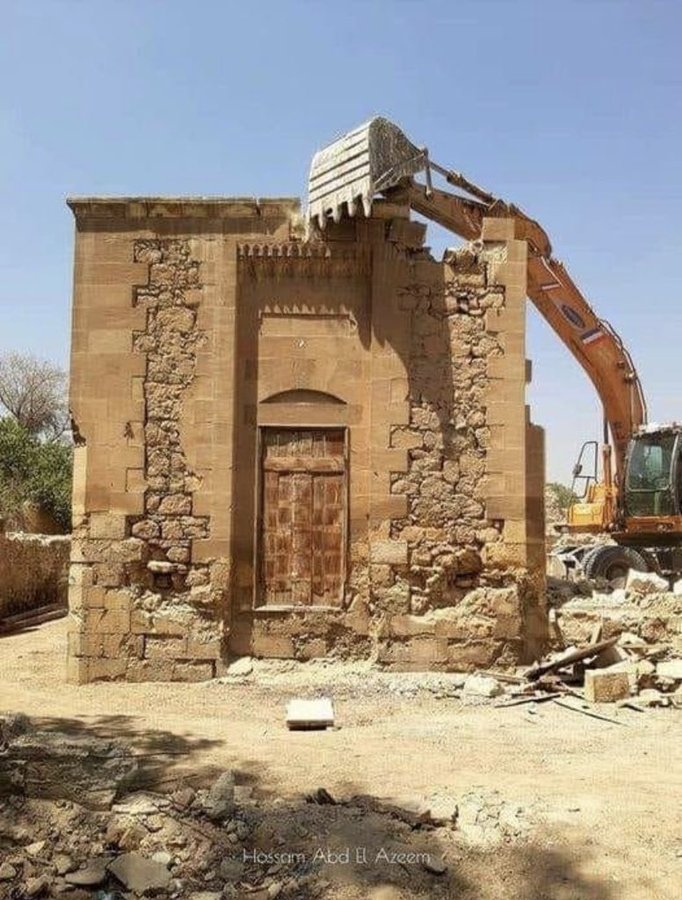
Egypt's government has been demolishing ancient tombs for three years as part of a controversial project that tore apart a renowned cemetery in Cairo, even as researchers and activists fight to stop the destruction.
CAIRO — For the past 10 years, Egyptian researcher Mostafa el-Sadek has been visiting the Islamic cemetery complex City of the Dead in Cairo, always discovering something new about Egyptian heritage from tombs that date back to the arrival of Islam in the seventh century and up to the early 20th century.
But everything has changed since 2020. That's when the Egyptian government began demolishing hundreds of these historic graves to widen highways to the new administrative capital 50 kilometers east of Cairo.
Sadek's visits have also changed. He joined volunteers fighting to save the historic area. They work in parallel with the diggers and bulldozers to rescue artifacts amid the rubble of tombs in the Imam al-Shafi'i and Sayyida Nafisa complexes.
"We feel incapable and frustrated. The government that should protect this heritage destroyed it with its bulldozers," Sadek told Al-Monitor.
First wave in 2020
The City of the Dead, which was first built with the inception of the Islamic capital in 642, covers six areas in the historic northern and southern Cairo, according to the Urban Regeneration Project for Historic Cairo report in 2010-2012.
In July 2020, the first wave of demolition targeted al-Qarafa al-Kobra in historic northern Cairo to link the area with the new administrative capital. Many tombs were demolished that housed famous figures from the 20th century, such as the first president of Cairo University, Ahmed Lutfi El-Sayed; writers Ihsan Abdel Quddous and Mohamed El-Tabii; engineer Abbud Pasha; and Princess Nazli Hanim Halim, Sadek said.
The government said in a statement that these tombs were not registered as Islamic or Coptic monuments and were modern graves.
Sadek, who is also an obstetrician at Cairo University, argued, "Yes, it is not registered. But some of these tombs are full of history, architecture and art."
A few months later, the government embarked on the second wave, which involved al-Qarafa al-Sughra (also called the Qarafa of Imam al-Shafi'i). The plan was to raze 2,760 tombs as part of the Salah Salem Road, to link the mosques and mausoleums that belong to the family of Prophet Muhammad in Islamic Cairo.
On Aug. 8, Egyptian President Abdel Fattah al-Sisi inaugurated Sayyida Nafisa Mosque as part of the renovation of the Ahl al-Bayt shrines. Speaking at the inauguration, Sisi spoke of "the state's plan to revamp Historic Cairo."
But Sisi's plan has stirred public outcry and criticism from heritage researchers, archaeologists and architects. Distinguished architect Tarek el-Murri filed a lawsuit to stop the demolition of cemeteries, with the court set to decide the case on Sept. 21.
"The removal and demolition operations are a disdain to a part of Egypt's history and represent a danger to a significant area back to the seventh century A.D.," Murri told Al-Monitor.
In contrast, Sisi ordered that a committee be formed to "assess the situation and consider available alternatives" for the relocation of the Sayyida Nafissa and Imam Shafi'i cemeteries, even as the government implements its development plan in the two areas. He also directed that a cemetery be established to bury remnants of the great figures of Egypt. The cemetery would also include a museum for artifacts found in the current cemeteries.
"We had felt optimistic after the president's order, especially since the committee recommended to stop the demolition and [that there was] no need to build new roads in that heritage area," Sadek said.
Twitter Post Translated from Arabic by Google, with slight editing:
The Association of Egyptian Architects called for the cemeteries of historic Cairo to be saved from demolition, according to a statement it published last Monday, signed by members of professional syndicates and scientific societies. The statement pointed out that the cemeteries are registered within Historic Cairo, which in turn is included in the World Heritage List, which is protected by international conventions.
·
10.4K
Views
Prominent tombs destroyed
A week after Sisi inaugurated the Sayyida Nafisa Mosque on Aug. 18, as part of the second wave bulldozers were at the Qarafa of Imam al-Shafi'i to demolish the aforementioned 2,760 tombs, including those of prominent Egyptians in the fields of culture, politics, religion and art, as well as members of the royal family.
"I had never been shocked like this time. The demolition was more violent and indiscriminate," Sadek said. "Even workers on bulldozers in the site felt sorry about that." He said workers helped rescue the artifacts from the tomb of Prince Ibrahim-Hilmy, son of Ismail, the Khedive of Egypt (1860-1927).
"The situation is so catastrophic," said Hossam Abdel-Azeem, founder of Egypt's Shawahid Misr initiative, which is tasked with preserving Egypt's lostheritage. Since December 2021, the initiative has rescued 25 artifacts and antiquities from the tombs, including tombstones dating from the Abbasid caliphate in the ninth century.
"All these landmarks are not registered under antiquities laws," Abdel-Azeem told Al-Monitor. But "the funeral monuments are a major factor in Egypt's history from ancient Egyptians to Islamic ages and modern history."
On Aug. 29, the Cairo governorate rejected reports that the tombs of poet Ahmed Shawqi and of Imam Warsh had been destroyed.
However, Sadek said that he did find debris close to poet Shawqi's tomb, and six graves of his family were destroyed.
Parliament member Maha Abdel Nasser sent several questions to Prime Minister Mustafa Madbouly on the development plans in 2020, but she hasn't received any answers. She told Al-Monitor that five members pulled out of the Sisi's presidential committee of experts over the government's determination to demolish the graves.
"It is not clear what's behind the project and the government's determination to demolish the graves," she said. Murri said that the government's plan will replace these cemeteries with skyscrapers and green areas by 2030.
In a rare objection, Ayman Wanas, a government official who headed the Committee for the Survey of Buildings and Facilities of Distinguished Architectural Style, resigned on Thursday to protest the destruction of Cairo's historic tombs.
Wanas posted his handwritten resignation on Facebook: "The ongoing demolition of the heritage cemeteries is not only a loss of the historical cemetery buildings but a loss of a historical urban fabric of unique value in the world and an important part of the world heritage." Yet Wanas retracted his resignation the next day, saying, "My resignation has been used to criticize the government ... and I am sure that the development plan will be corrected."
World heritage site
Historic Cairo has been considered a world heritage site by UNESCO since 1979. "We sent letters to the organization, but it hasn't replied yet," Sadek said.
In 2021, UNESCO said that "no information on this project was sent beforehand to the World Heritage Center for evaluation. ... The World Heritage Center sent a letter in July 2020 to the Egyptian authorities requesting confirmation of this information and the provision of any relevant information, but neither of these has yet been provided," UNESCO said.
The organization added, "While these demolished tombs and mausolea may not have been protected/registered monuments, they are nevertheless important parts of the historic urban fabric, and the roads could channel yet more traffic into the property."
"Even UNESCO can't halt this mess," Murri said. Murri and Sadek still have a glimmer of hope that popular support might push the government to back off through talks, petitions, exhibitions and social media.
Work begins on bridge between Giza pyramids and Grand Egyptian Museum
The 2km walkway will connect the ancient landmarks with the new institution
Construction is under way on the bridge between the Grand Egyptian Museum and the Giza pyramid complex. All photos: Reuters (unless otherwise mentioned)
Construction is under way for a walkway connecting the Giza pyramid complex with the Grand Egyptian Museum.
The bridge – 2km long and 500 metres wide – will allow visitors to move easily between the newly built institution and the ancient landmarks.
The construction is part of a massive urban redevelopment surrounding the vast museum, which is expected to open gradually to the public between October and February. An opening date for the bridge is yet to be announced.
The museum spans 50 hectares and will be home to the world's largest archaeological collection. It will have a comprehensive set of artefacts of ancient Egyptian antiquities, with pieces dating back thousands of years.
Limited areas of the Gem are already open to visitors. Photo: Grand Egyptian Museum
It has been two decades since the multimillion-dollar project was announced, with the opening date originally set for 2013.
The museum will also have a dedicated children's section, galleries and exhibition spaces, a library, an education centre and a state-of-the-art conservation centre.
The outdoors will be dominated by a trio of gardens, named Sculpture, Palm and Terrace.
The Pyramid Complex of King Djedkare and its Surrounding
Era: 5th and 6th Dynasty
Project Director: Dr. Mohamed Megahed
Location: Saqqara
Affiliation: Czech Institute of Egyptology, Faculty of Arts, Charles University
Project Sponsor: Antiquities Endowment Fund
Project dates: 2021 - 2022
Written by: Dr. Mohamed Megahed
The era of the pyramid builders still hides many secrets that have not yet been resolved. Most of the sites of the ancient Egyptian pyramids, concentrated in the Memphite region, have been excavated since the beginning of the 20th century – first unprofessionally and later scientifically. Nevertheless, further studies are still needed to clarify many vague aspects.
One of mysterious periods was the reign of King Djedkare Isesi at the end of the 5th Dynasty of the Old Kingdom. Djedkare came to the throne after a short reign of King Menkauhor, and one of his most important and yet unexplained decisions was to construct his pyramid complex at a completely new area. He selected the site of south Saqqara, which had no earlier pyramids or infrastructure for building the king's funerary complex. It seems possible that Djedkare decided to choose this site for his pyramid because of its location: it is situated less than 3 kilometers to the immediate west of the temple of Ptah in Memphis (Mit Rahina), the capital city of ancient Egypt at that time.
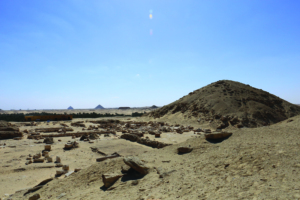
Fig. 1. General view of the pyramid and the funerary temple of Djedkare. Photo: H. Vymazalová
Supported twice by ARCE's Antiquities Endowment Fund, the Djedkare Project (DJP) mission of the Charles University working at this south Saqqara site was able to find new evidence of Djedkare's family and officials. In 2018, the mission discovered a large burial ground above the south part of the funerary temple of Djedkare's queen, and inscriptions with her name, Setibhor, were found here revealing that she was the king's wife.
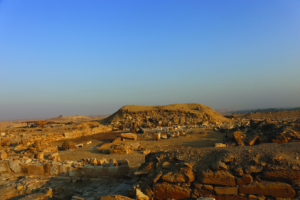
Fig 2. General view of the south side of the pyramid and the funerary temple of Queen Setibhor. Photo: H. Vymazalová
In 2021 the DJP team entered the burial chamber in Setibhor's pyramid for the first time to conduct excavation and documentation followed by conservation and proper protection of her monument. The work of the DJP mission proved Setibhor's pyramid to be a key queenly monument, which set a trend followed by later Old Kingdom queens.
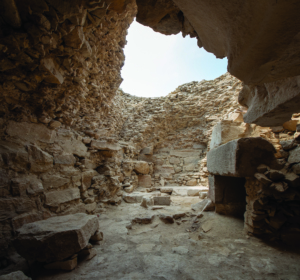
The monument of Queen Setibhor was briefly explored by Ahmed Fakhry in 1952, who showed that her pyramid was the largest of all Old Kingdom queens, and the temple on the east side contained some royal features. Fakhry also started to explore the inner rooms of the queen's pyramid but he only reached the entrance of the burial chamber and then stopped the work. The DJP mission in 2021 focused on clearing the entrance to the burial chamber again and continued to uncover the substructure of the pyramid and document its layout. It soon became apparent that the inner rooms of Setibhor's pyramid suffered bad damage by ancient stone robbers; the side walls, floor, and ceiling of the rooms, once made of fine white limestone blocks, are almost completely missing today.
Fig. 3. The substructure of Setibhor after reaching the floor level. Photo: P. Košárek
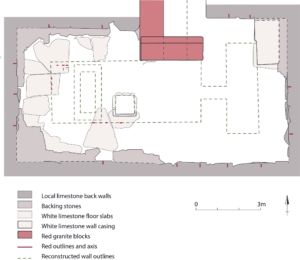
Despite the absence of the original walls, however, the DJP team found indications in the form of red lines drawn by the builders on the core masonry and on the few remaining parts of the floor. With the help of these lines, the DJP team reconstructed the original layout of the interior of the pyramid. It was divided into two spaces: the western side was occupied by the large burial chamber of the queen, while the eastern side contained a smaller room known as the serdab.
The queen's burial chamber had an entrance at the eastern end of its northern wall, and it was 7.12m long, 2.80m wide, and the height of the walls reached 3.10m. Although the sarcophagus is missing today, its position is indicated by unsmoothed areas on the few preserved floor slabs. A partly preserved canopic pit was situated by the southeast corner of the sarcophagus. The east wall of the burial chamber, today completely missing, used to give access to the east room that represented the serdab. The same layout of inner rooms can be found in pyramid of Sixth Dynasty queens.
Fig. 4. Plan of the substructure of Setibhor. Drawing: H. Vymazalová
The DJP team cleaned and documented the current state of the inner rooms of Setibhor's pyramid using traditional archaeological methods as well as 3D scanning. The following consolidation and reconstruction works focused on the entire substructure of the pyramid. Starting from the descending corridor and continuing until the burial chamber and the serdab, the preserved masonry was consolidated, and the missing side walls were rebuilt to support a strong modern ceiling protecting the inner rooms.
Fig. 5. 3D model of the north-south section of the pyramid of Setibhor. Photo: V. Brůna
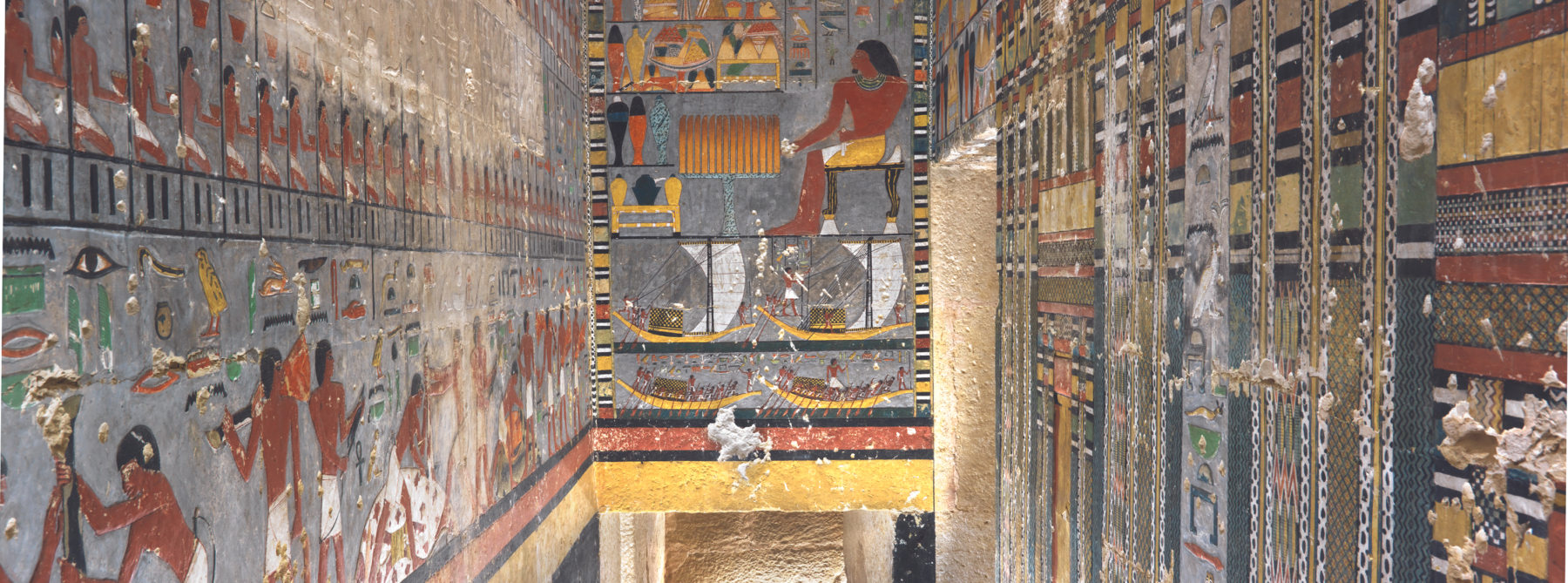
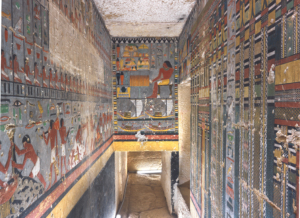
Another important part of the Antiquities Endowment Fund project was the continuation of the work in the tomb Khuwy. The DJP team completed the reconstruction of the eastern façade of the mastaba and installed a modern door to protect the chapel and offering chamber with remains of its decoration.
Fig. 6. General view of the antechamber of the substructure of Khuwy. Photo: S. Vannini
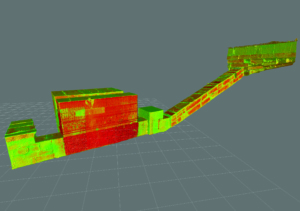
The area south of the tomb of Khuwy was also explored, and the mastaba's south wall was fully cleaned. Less than a meter from this wall, another tomb was found, which was constructed for the king's oldest son, Isesiankh. Even though it was badly devastated in the antiquity, its architecture still reflects the importance of its owner. The superstructure of the tomb was entered by a monumental portico, situated in the north part of the eastern façade, and leading to several rooms. One of the most significant architectural features of the tomb was a large pillared hall that once included 10 pillars made of white limestone. The tomb also contained six storerooms distributed in the superstructure of the tomb.
Fig. 7. 3D model of the tomb of Khuwy. Photo: V. Brůna
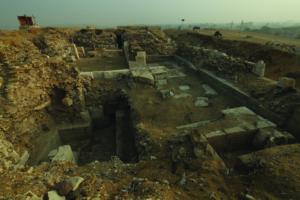
Like in the tomb of Khuwy, the substructure of Isesiankh's tomb was reached through a descending corridor, which starts in the north-east corner of the pillared hall. The corridor lead to a vestibule and a large burial chamber with a huge white limestone sarcophagus placed in a western recess. A large storeroom was situated to the south of the burial chamber, with its walls and ceiling blocks still preserved. No decoration was found in Isesiankh's burial chamber.
Fig. 8. View from the south of the tomb of Isesiankh MSE3. Photo: P. Košárek
The two tombs of Khuwy and Isesiankh prove the importance of Djedkare's royal cemetery and its exploration. They provided us with a large amount of new information concerning the transformation of funerary beliefs during Djedkare's reign and the transitional period between the Fifth and Sixth Dynasties
Connect with ARCE
US Office 909 North Washington St Suite 320 Alexandria VA 22314 United States tel: 703-721-3479 email: info@arce.org

/https://tf-cmsv2-smithsonianmag-media.s3.amazonaws.com/accounts/headshot/amy.png)
:focal(1050x750:1051x751)/https://tf-cmsv2-smithsonianmag-media.s3.amazonaws.com/filer_public/91/79/9179efe3-7c63-4a37-a55c-1796b0f55dee/horse.jpg)
/https://tf-cmsv2-smithsonianmag-media.s3.amazonaws.com/filer_public/97/0b/970be809-1048-4281-9c14-9e16eab90468/spain_map.jpg)
/https://tf-cmsv2-smithsonianmag-media.s3.amazonaws.com/filer_public/d4/c9/d4c92243-d835-4e7f-84b0-a742ca859ca2/sepoct2023_c18_prologue.jpg)
/https://tf-cmsv2-smithsonianmag-media.s3.amazonaws.com/filer_public/4a/1f/4a1f8dab-4ad7-40fc-bae7-0ba9ea1b1764/sepoct2023_c16_prologue.jpg)
/https://tf-cmsv2-smithsonianmag-media.s3.amazonaws.com/accounts/headshot/amy.png)


:quality(70)/cloudfront-eu-central-1.images.arcpublishing.com/thenational/ESGBFK6SK5FP5FE42CQOHYMYWE.JPG)
:quality(70)/cloudfront-eu-central-1.images.arcpublishing.com/thenational/LVKITU5KYJE2TKFIOZCPJ4SACE.JPG)
:quality(70)/cloudfront-eu-central-1.images.arcpublishing.com/thenational/FOVUI7CK45HSZJWK4X5CUIZL64.JPG)
:quality(70)/cloudfront-eu-central-1.images.arcpublishing.com/thenational/Q62TOABJXZGYTFXBGRWXG2OBPI.JPG)
:quality(70)/cloudfront-eu-central-1.images.arcpublishing.com/thenational/OTVMBB6X4VGJ5OABXLPT5LH6JM.JPG)
:quality(70)/cloudfront-eu-central-1.images.arcpublishing.com/thenational/SUZDEMTMC5E73FWNTASD4XJYOE.JPG)
:quality(70)/cloudfront-eu-central-1.images.arcpublishing.com/thenational/A4O4P5ZR5NCADJYKJVIUUUFYVI.JPG)
:quality(70)/cloudfront-eu-central-1.images.arcpublishing.com/thenational/ESGBFK6SK5FP5FE42CQOHYMYWE.JPG)
:quality(70)/cloudfront-eu-central-1.images.arcpublishing.com/thenational/H7UWOWIZQNACLLUZTGQCJTPA6A.jpg)
:quality(70)/cloudfront-eu-central-1.images.arcpublishing.com/thenational/H7UWOWIZQNACLLUZTGQCJTPA6A.jpg)