Search This Blog

Tuesday, January 3, 2023

Ancient Egyptian 'Green Coffin' returned to Cairo by US - BBC News

https://www.bbc.com/news/world-middle-east-64147545

Ancient Egyptian 'Green Coffin' returned to Cairo by US

  • Published
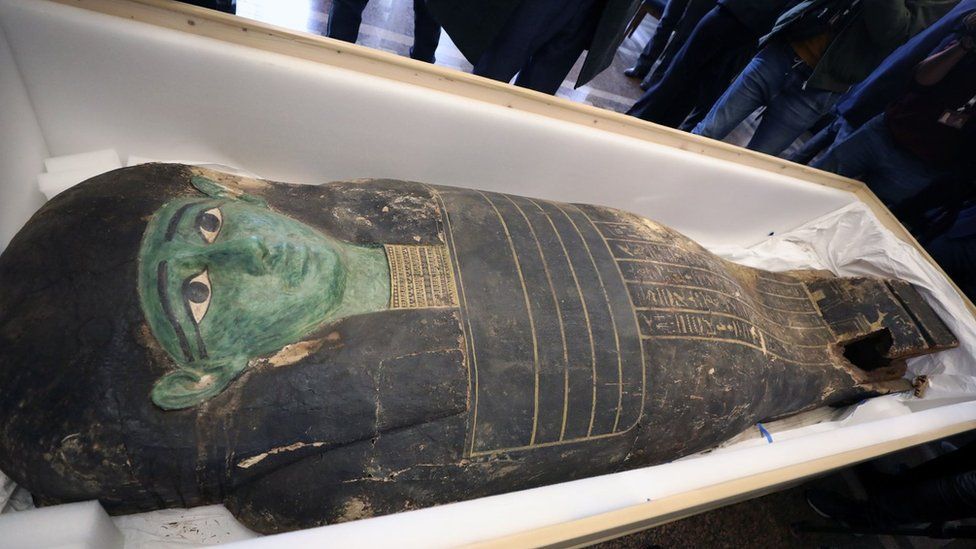
The looted "Green                  Coffin" on display in Cairo following its return by                  the US (2 January 2023)Image source, EPA
Image caption,
The 2.9m (9.5ft) long "Green Coffin" belonged to an ancient Egyptian priest called Ankhenmaat

A looted ancient Egyptian sarcophagus that was on display at a US museum has been returned to Egypt.

The 2.9m (9.5ft) long "Green Coffin" dates back to the Late Dynastic Period, which spanned 664BC to 332BC, and belonged to a priest called Ankhenmaat.

A collector loaned it to the Houston Museum of Natural Science in 2013.

The sarcophagus was repatriated after an investigation that lasted several years and was formally handed over by US diplomats at a ceremony in Cairo on Monday. The event was attended by Egypt's Foreign Minister Sameh Shoukry and Tourism and Antiquities Minister Ahmed Issa.
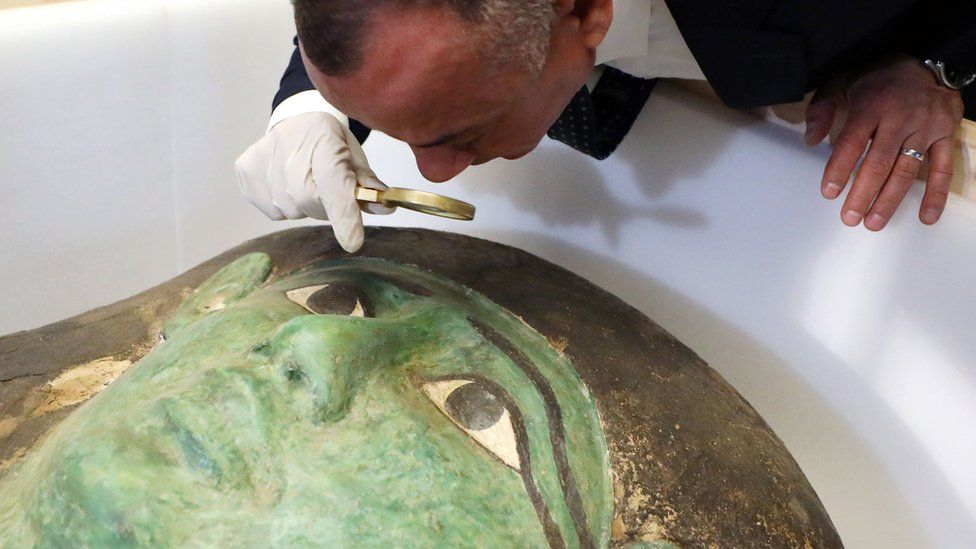
Secretary-General of the                    Egyptian Supreme Council of Antiquities Mostafa Waziri                    takes a close look at the ancient Egyptian Green                    Coffin, after it was returned by the US (2 January                    2023)
Image source,
EPA
Image caption,
Mostafa Waziri, the top official at the Supreme Council of Antiquities, inspected the sarcophagus

"Today's ceremony is emblematic of the long history of co-operation between the United States and Egypt on antiquities protection and cultural heritage preservation," said US chargé d'affaires in Egypt, Daniel Rubinstein.

Mr Issa said the return of the sarcophagus showed Egypt's strenuous efforts to recover smuggled artefacts.

In September, Manhattan District Attorney Alvin Bragg said the Green Coffin, which was valued at over $1m (£830,000), was illegally trafficked out of Egypt by a multinational network of antiquities smugglers.

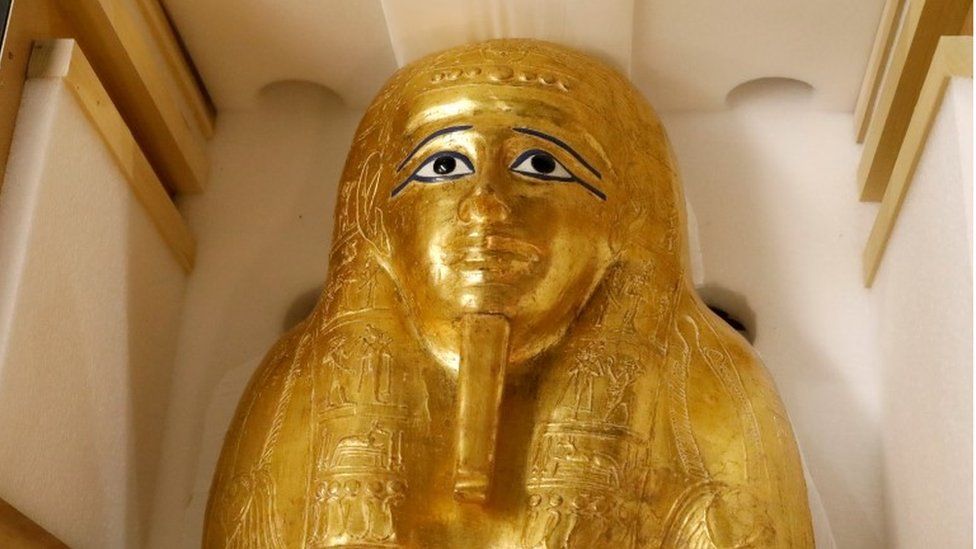
The network was also responsible for trafficking the "Gold Coffin", which was which was returned to Egypt in 2019, the Stele of Pa-di-Sena, which is also from the Late Dynastic Period and was handed over in 2020, and five pieces seized from New York's Metropolitan Museum of Art last year.

The US is not the only country to have returned antiquities to Egypt recently.

In 2021, Israel handed over 95 relics which had been smuggled into the country or found for sale in Jerusalem.

Last month, a university in the Republic of Ireland said it was planning to repatriate a sarcophagus, mummified human remains and canopic jars.

--   Sent from my Linux system.

Monday, January 2, 2023

Ancient Art Council Feb. 4 Lecture: The ancient Egyptian imagery of the Beyond in the Ramesside Period

 https://www.ancientartcouncil.org/program/The-ancient-Egyptian-imagery-of-the-Beyond-in-the-Ramesside-Period

ancient-art-council-v2_logo.jpg

 
February 4, 2023 at 2:00 PM - 3:30 PM (PST)

The ancient Egyptian imagery of the Beyond in the Ramesside Period

In person (Koret Auditorium, de Young Museum, 50 Hagiwara Tea Garden Drive, Golden Gate Park, San Francisco, CA 94118) and livestream (link to come)

Presented by Dr. Rita Lucarelli Associate Professor of Egyptology, Department of Middle Eastern Languages and Cultures, University of California, Berkeley

Admission: Lecture is free and open to the public. It is also a hybrid event. IN PERSON: Seating is limited and unassigned. The Koret Auditorium will open its doors at 1:30 pm. LIVE STREAM: online (link to come).

At the time of Ramses the Great, magical practices for the protection of the dead and their empowerment in the Duat (the Egyptian Otherworld) were central in the ancient Egyptian society. Royal, elite, and non-elite tomb walls, coffins and other funerary artefacts were decorated with images and texts describing the daily journey of the sun god Ra, the rebirth of Osiris, the god of the dead, as well as the transfiguration of the deceased in an akh (effective spirit). By analyzing those sources as well as some of the works of art included in the Fine Arts Museums of San Francisco's Ramses the Great and the Gold of the Pharaohs exhibition at the de Young Museum, this lecture will present an overview on the ancient Egyptian funerary religion and literature of the Ramesside period through the imagery of the Beyond originated from the creativity of theologians, priests, and scribes of the time.

Northern Cal. Egyptology Zoom Lecture Jan. 15: A Wholistic Approach to Studying Yellow Coffins from Thebes

The American Research Center in Egypt, Northern California Chapter, and the Near Eastern Studies Department, University of California, Berkeley, invite you to attend a lecture by Dr. Stefania Mainieri, Museo Egizio di Torino and UCLA:


Ancient Egyptian Yellow Coffins from Thebes: A Holistic Approach to Studying Complex Objects

Sunday, January 15, 2023, 3 PM Pacific Time

Zoom Lecture. A registration link will be automatically sent to ARCE-NC members. Non-members may request a registration link by sending email with your name and email address to arcencZoom@gmail.com. Non-members, please send any registration requests no later than noon Friday, January 13. Registrations are limited to 100, so the sooner you register, the better.

Glenn Meyer
ARCE-NC ePublicity Director


About the Lecture:

The yellow coffins are a specific class of artefact that appeared in Thebes at the end of the New Kingdom and were used for more than a millennium peaking during the 21st Dynasty (1069-945 BCE ca.). Called yellow for the colour of the background, they are anthropoid in shape, with rich textual and iconographical apparatus and with a detailed rendering of the human face and hands. Even though this complex class of materials has been (and is still) intensively studied, a specific and peculiar element of them has never been considered before: the geometry and the volume of the objects which render the human forms. A new project is focusing on these aspects through the help of new technologies – photogrammetry and 3D models - which allow us to switch off digitally the paint and observe in a better way the geometrical elements. The way to render the anthropoid forms (i.e. mouth, ears, forearms, or hands) could indicate, in fact, specific productions corroborating also a posited common origin of the material as well as hints at the possibility of identifying craftspeople operating in workshops. The used approach in the project combines digital technologies and traditional approaches of analyses with the aim to study in a holistic way this complex class of materials.

About the Speaker:

Dr. Stefania Mainieri completed her PhD research at the University of Naples "L'Orientale" (UniOr) on the Egyptian Collection of the Archaeological Museum of Naples (MANN). She was also one of the curators of the new permanent exhibition of the Egyptian Collection at the MANN, which opened in 2016.

Specializing  in museography, Egyptian funerary archaeology and New Technologies, she is presently a Researcher at the Museo Egizio di Torino and Visiting Associate Researcher at the University of California, Los Angeles for a research project on yellow coffins named Faces Revealed  (H2020-MSCA-GF 2019: 895130).


About ARCE-NC:

For more information, please visit https://facebook.com/NorthernCaliforniaARCE/, http://www.arce-nc.org/lectures.htm https://twitter.com/ARCENCPostings, or https://khentiamentiu.org. To join the chapter or renew your membership, please go to https://www.arce.org/general-membership and select "Berkeley, CA" as your chapter when you sign up.

Northern California ARCE Upcoming Lectures


American Research Center in Egypt (ARCE)

Northern California Chapter

Upcoming Lectures


The following are among the lectures to be presented by ARCE's Northern California Chapter in the coming months. Other lectures are in process. Unless otherwise indicated, lectures are at 3 p.m.
PST, in-person, Room 126 of the Social Sciences Building (formerly Barrows Hall) at UC Berkeley

Ancient Egyptian Yellow Coffins from Thebes: A Holistic Approach to Studying Complex Objects
January 15, 2023
Dr. Stefania Mainieri, Museo Egizio di Torino, UCLA
This 3 pm PST lecture is a Zoom lecture, NOT in-person. 

Ramses II and the Hittite Empire: War & Peace in the Late Bronze Age
February 12, 2023
Dr. Peter Brand, University of Memphis

Mummy Portraits in the J. Paul Getty Museum OR Hellenistic Sealings from Ptolemaic Edfu
March 12, 2023
Dr. Branko van Oppen, Tampa Museum of Art

New Perspectives on the African Empire of Kush: Excavations at Gebel Barkal
May 7, 2023
Dr. Geoff Emberling, Kelsey Museum, Univ. of Michigan


Parking is available in UC lots all day on weekends, for a fee. Ticket dispensing machines accept debit or credit cards. Parking is available in lots around the Social Sciences Building, and in lots along Bancroft. A map of the campus is available online at http://www.berkeley.edu/map/

For more information, please visit https://facebook.com/NorthernCaliforniaARCE/, https://arce-nc.org/lectures.htm, https://twitter.com/ARCENCPostings, or https://khentiamentiu.org. To join the chapter or renew your membership, please go to https://www.arce.org/general-membership and select "Berkeley, CA" as your chapter when you sign u
p.


West Coast Tut Tour - Feb 5 Aidan Dodson Lecture | San Francisco | American Research Center In Egypt


West Coast Tut Tour | San Francisco | American Research Center In Egypt


https://www.arce.org/west-coast-tut-tour

Sunday, February 5, 2023

Time: 2:00 PM PT

de Young Museum 

50 Hagiwara Tea Garden Dr. San Francisco, CA 94118

The American Research Center in Egypt (ARCE), the Northern California ARCE Chapter, and the Ancient Art Council of the Fine Arts Museums of San Francisco are pleased to present an afternoon with Dr. Aidan Dodson in celebration of the 100th Anniversary of the discovery of the tomb of King Tutankhamun.

Tutankhamun: from Zero to Hero

This lecture will trace how Tutankhamun came to be written out of history soon after his death, and then how the earliest Egyptologists began to piece together evidence for his existence, and some of their theories as to his identity and place in events. We then trace the events that led up to the discovery of his tomb in 1922, catapulting the king from obscurity to universal fame. 

Aidan Dodson Bio: 

Dr. Dodson is an honorary full Professor of Egyptology at the University of Bristol, UK, where he has taught since 1996. A graduate of Liverpool (BA) and Cambridge (MPhil, PhD), he was Simpson Professor of Egyptology at the American University in Cairo for the spring of 2013, and Chair of Trustees of Egypt Exploration Society, the UK equivalent of ARCE, from 2011 to 2016. He has been a member of ARCE for some 30 years and is currently part of the Missouri Chapter. Professor Dodson is the author more than 25 books and 400 articles and reviews, the most recent book being Tutankhamun, King of Egypt: his life and afterlife, published by AUC Press in December 2022.

About ARCE.ORG:
© 2022 American Research Center in Egypt

About ARCE-NC (ARCE's Northern California chapter):

For more information, please visit https://facebook.com/NorthernCaliforniaARCE/, https://twitter.com/ARCENCPostings, https://khentiamentiu.org, or https://arce-nc.org. To join the chapter or renew your membership, please go to https://www.arce.org/general-membership and select "Berkeley, CA" as your chapter when you sign up.

About the Ancient Art Council:
The Ancient Art Council is dedicated to supporting Antiquities at the Fine Arts Museums of San Francisco.
For all those who share an interest in ancient art and the preservation and promotion of antiquities and culture of the ancient Mediterranean and Near East, the Ancient Art Council offers lectures by noted archaeologists, curators, and historians; exclusive tours of the permanent collection and special exhibitions; travel to other collections; receptions and opportunities to meet fellow enthusiasts of antiquities and the ancient world.
Maps & Directions
Contact Us
ancientart@famsf.org

Sunday, January 1, 2023

Spanish Egyptologists unearth 60 mummies at Luxor site - La Prensa Latina Media

https://www.laprensalatina.com/spanish-egyptologists-unearth-60-mummies-at-luxor-site/

Spanish Egyptologists unearth 60 mummies at Luxor site

By Shady Roshdy

Luxor, Egypt, Dec 29 (EFE).- A group of Egyptologists from Spain have discovered two tombs that housed almost 60 mummies at site in the ancient Egyptian city of Luxor.

"The most important thing this year is the discovery of two tombs, almost six meters deep," made up of "two chambers each and housing around 60 mummies and remains of mummies," Francisco J. Martin, the president of the Vizier Amenhotep Huy Project, told Efe.

MartĂ­n, who leads a team of 22 Spanish Egyptologists and eight Egyptian experts, said the tombs were dated after Vizier Amenhotep-Huy's tomb (18th dynasty).

The site is a rich example of the architectural style and "evidence that the vizier's tomb at some point became a necropolis," the expert added.

The two secondary tombs are connected via two burial chambers and are characterized by a lack of epigraphs that were found in Vizier Amenhotep Huy's tomb, which is a chapel that contains 30 columns with epigraphs, according to MartĂ­n.

"They began to build other tombs from different dynasties within the vizier's tomb, since the place was sacred," MartĂ­n continued from the mission's headquarters in the southern city of Luxor. "It is a very rich site and we are discovering many things."

Amenhotep Huy was vizier to pharaoh Amenhotep III during the last third of his reign.

He was originally from northern Egypt and was considered the "opposition leader" amid new religious trends promoted by Akhenaten, the Pharaoh's son and heir.

"He is a very important person," MartĂ­n added.

Teresa Bedman, co-director of the project, told Efe that, so far, all mummies buried in the area "were senior officials of the clergy of Amun of Thebes."

Because the bodies were mummified, experts can be sure they belonged to "higher social classes," according to Bedman.

Once the vizier died and was martyred, his burial site became a prestigious one where many others wanted to be buried: "a necropolis inside the vizier's tomb," Bedman added.

The Spanish mission has launched an exhibition of the contents of the vizier's necropolis with the Luxor museum which will continue into 2023.EFE

--   Sent from my Linux system.