The
American Research Center in Egypt, Northern
California Chapter, and the Near Eastern Studies
Department, University of California, Berkeley,
invite you to attend a lecture by Dr. Aleksandra Ksiezak, University of Toronto, CSU San Bernardino: The
American Research Center in Egypt, Northern
California Chapter, and the Near Eastern Studies
Department, University of California, Berkeley,
invite you to attend a lecture by Dr. Aleksandra Ksiezak, University of Toronto, CSU San Bernardino: A Gateway into the Desert: History, Exploration, and Cyclical Rediscovery of Wadi Tumilat Sunday, December 11, 2022, 3 PM Pacific Standard Time Room 126 Social Sciences Building (formerly Barrows Hall) UC Berkeley No Zoom meeting is scheduled for this lecture.  A drawing by Dominique Adolphe Grenet de Joigny shows a view of the ancient canal. (Image courtesy of Dr. Aleksandra Ksiezak) About the Lecture: Once a distributary of the Nile, Wadi Tumilat is a dry river valley in the Eastern Nile Delta. In antiquity, the wadi was a major communication artery for trade between Egypt and her neighbours to the east, and its importance was recognized by many great strategic minds of their day. Across Wadi Tumilat are numerous archaeological sites, dating from the 3rd millennium BCE to the Late Roman Period. Accompanying them was a navigable canal—an impressive waterway that not only provided the arid valley with water but allowed transportation of goods and people in and out of Egypt. While the ancient canal and its surrounding ruins were a source of fascination for ancient geographers, and historians, and were recorded in their writings, it took centuries for these antiquities to re-emerge in the letters, reports, and memoirs of early European travellers to Egypt. This lecture aims to summarize the history of the discovery of Wadi Tumilat and our understanding of its place in Egyptian archaeology.  About the Speaker: Dr. Aleksandra Ksiezak is a field archaeologist, Egyptologist, and ceramicist specializing in macro-and microscopic analyses of Egyptian and Nubian pottery. She obtained her Ph.D. in Egyptology at the University of Toronto (Department of Near and Middle Eastern Civilizations) where she focused on the analysis of the ceramic material from the Second Intermediate Period Hyksos settlement at Tell el-Maskhuta excavated by the Wadi Tumilat Project (WTP) during the late 1970s/early 80s. She is currently involved in research on the identification and study of the Middle Bronze Age trade routes involving Wadi Tumilat through the identification of imported objects and their local imitations identified at Tell el-Maskhuta and the neighbouring sites. Both her past and present research deal with the broader question of migration and mobility in Egypt, the Sinai Peninsula, and the Levant during the Bronze Age. She currently holds the position of W. Benson Harer Egyptology Scholar in Residence at California State University, San Bernardino.
Parking is available in UC lots all day on weekends, for a fee. Ticket dispensing machines accept debit or credit cards. Parking is available in lots around the Social Sciences Building, and in lots along Bancroft. A map of the campus is available online at http://www.berkeley.edu/map/ About ARCE-NC:
For more information, please visit https://facebook.com/NorthernCaliforniaARCE/, https://arce-nc.org/, https://twitter.com/ARCENCPostings, or https://khentiamentiu.org. To join the chapter or renew your membership, please go to https://www.arce.org/general-membership and select "Berkeley, CA" as your chapter when you sign up. |

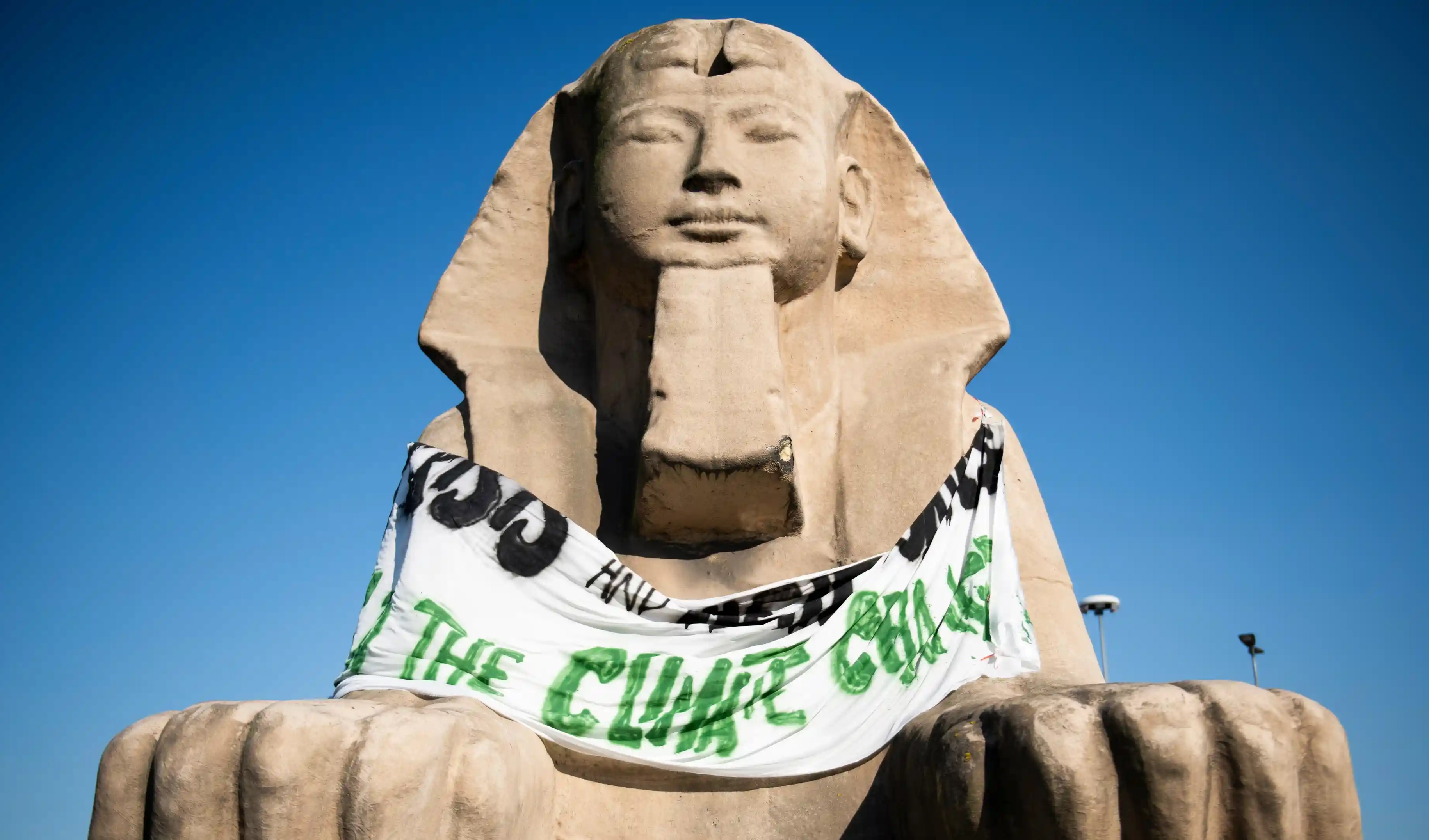
The 27th United Nations Climate Change Conference, COP27, begins on November 6 in Sharm El-Sheikh, Egypt. Never before has a COP summit been held in a country so inextricably linked to ancient monuments, from the pyramids to the Sphinx and Tutankhamun's tomb, all of which face escalating risks from harsher weather, hotter temperatures, and rising seas.
Egypt's Former Minister of State for Antiquities Affairs, Zahi Hawass, said that practically all open-air archaeological monuments in Egypt are in grave danger.
"In my opinion, all of these antiquities will be gone in 100 years due to climate change," he warned.
Delegates at COP27 will debate whether museums should abandon their historic posture of "climate neutrality" in favor of climate action. Is the argument, however, still necessary?
Read next: Drought reveals ruins of 3,400-year-old lost city in Iraq
The American Alliance of Museums commissioned research in 2021 that revealed museums to be the second most trusted source behind friends and family, and far ahead of scientists, NGOs, the media, the government, and businesses. Should this trust bank be used for the common good?
Robert Janes is a researcher at Leicester's School of Museum Studies and was the editor-in-chief of the Museum Management and Curatorship journal from 2003 to 2014. He writes for the online journal The Beam, "Why is the global museum community not confronting climate change with its collective will and intelligence? One explanation is that climate change is a taboo subject—not to be talked about with family, friends, and colleagues."
This taboo must be demolished. "Radical changes are needed across society to ensure global heating remains below 1.5°C," said Rodney Harrison, the professor of heritage studies at University College London.
Read next: Egypt hopes geopolitics won't hinder UN Climate Change Conference
"Museums could play a leading role in these transformations, but they can only do so if they make significant changes to the way they operate and communicate."
"The frustrating thing is—this is all already agreed," says Henry McGhie, founder of climate consultancy Curating Tomorrow. "The governments of all the countries that are party to the UN Framework Convention on Climate Change [UNFCCC] and Paris Agreement already recognize this. They have adopted a new program, but this doesn't seem to have bled down to the workings of many museums. We have a golden opportunity to act on climate change as a sector, but we're not making use of it."
In addition to the COP summits, the UN hosted Mondiacult (the Unesco World Conference on Cultural Policies and Sustainable Development) in Mexico City this September. It was held 40 years after the inaugural Mondiacult conference and was solely focused on UNESCO's cultural policy and how it connects to globally approved sustainable development and climate change policies.