Archaeological museums all over Egypt celebrated Labour Day and the advent of Eid El-Fitr by organising special exhibitions in their foyers featuring collections of various artefacts depicting Egyptian celebrations across history.
These artefacts, which will be exhibited throughout the month of May, were selected based on the votes antiquities lovers worldwide on the official Facebook page of each museum.
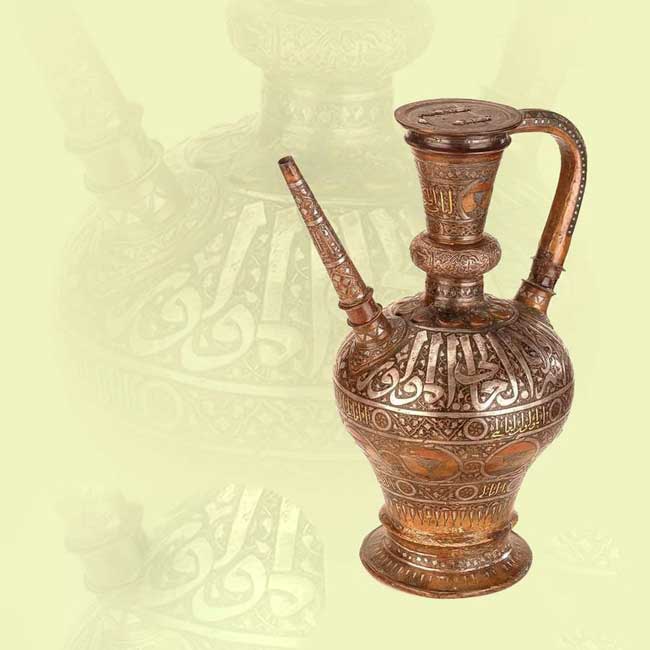
The Museum of Islamic Art put on display a copper jar embellished with silver and gold, while the Jewellery Museum in Alexandria has an office set from king Farouk's collection carved in lapis lazuli, showing a feather with a gold end, a stamp carved with the signature of the king, and a letter opener with a knife made of silver.
Furthermore, the Police Museum at the citadel is exhibiting a turtle shaped shield from the Islamic era and the Hall Three Museum of the Cairo International Airport is displaying a 3D model of a Middle Kingdom tomb at El-Assassif necropolis in Luxor depicting seven people brewing beers, baking bread, and cooking meat.
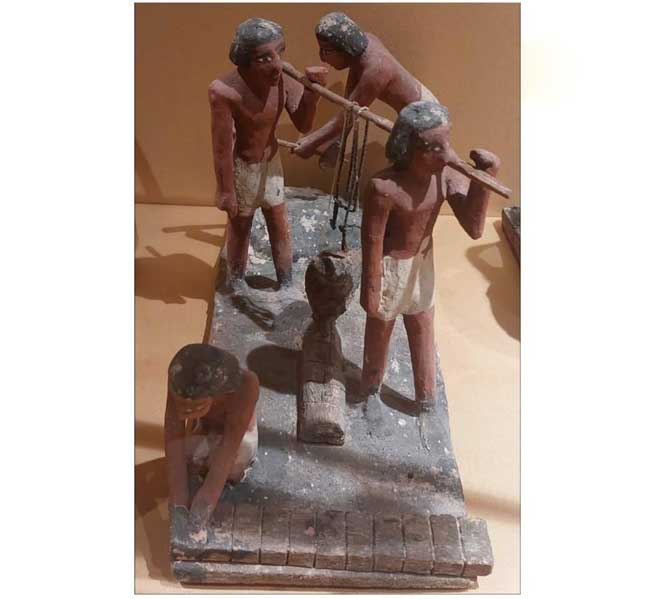
Additionally, the Suez and Ismailia National Museums have a collection of limestone Roman medical tools and a wooden model of a wheat gallery from the Middle Kingdom showing three people storing wheat in a silo and a scribe documenting the quantity of wheat stored.
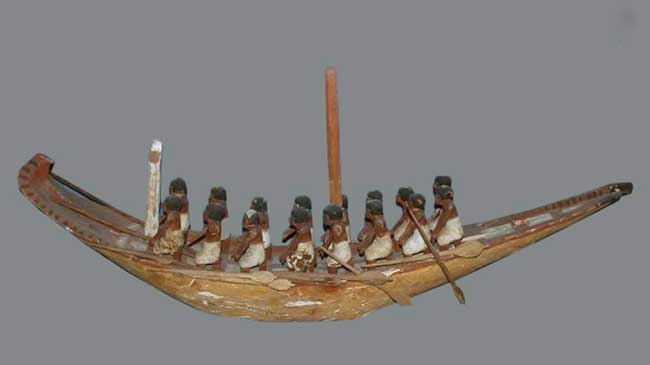
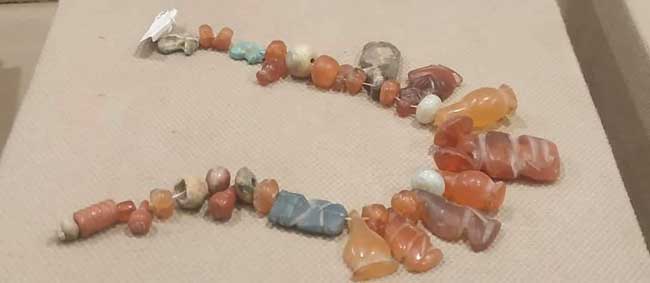
The National Museum of Alexandria is exhibiting a pencil case embellished with silver and gold; the Tel Basta Museum is showing an agate bracelet with amulets; the KomOshim Museum in Fayoum has a wooden model of a boat with its full staff; and the Luxor Museum is displaying a collection of construction instruments.
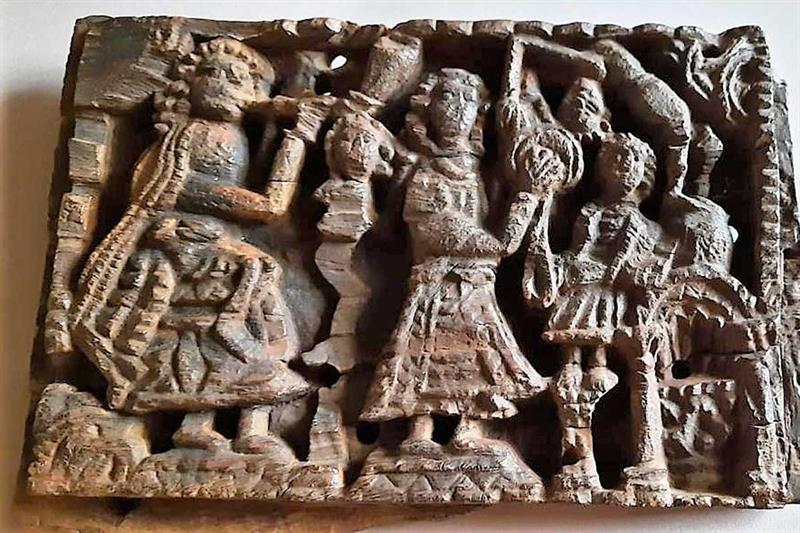
Also, the Coptic Museum in Old Cairo is exhibiting a wooden engraving showing a group of women playing music along with a group of children performing acrobats as part of a feast.
The Farouk Corner Museum in Maadi is exhibiting a photo of king Farouk's wedding with queen Nariman; and the Royal Carriage Museum in Bulaq is displaying the alay carriage that was used during official ceremonies to transport VIPs.
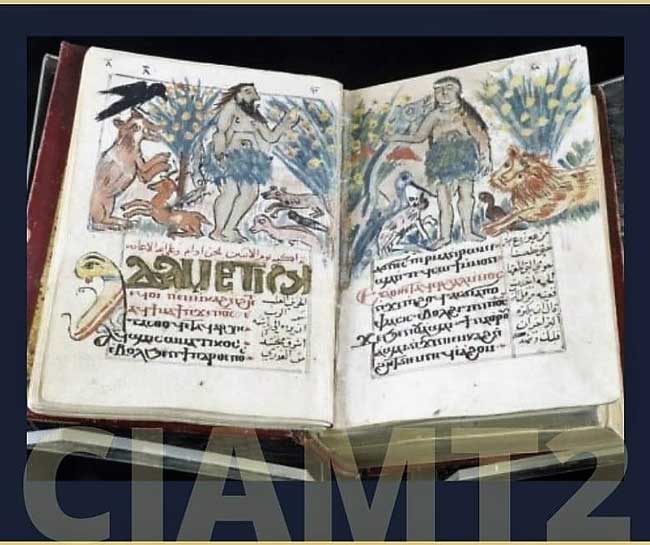
Furthermore, the Gayer Anderson Museum is showing a drum and a tambourine made of wood and ivory, while Hall Two Museum of Cairo International Airport Museum is exhibiting a Coptic Orthodox Christian manuscript for praises.
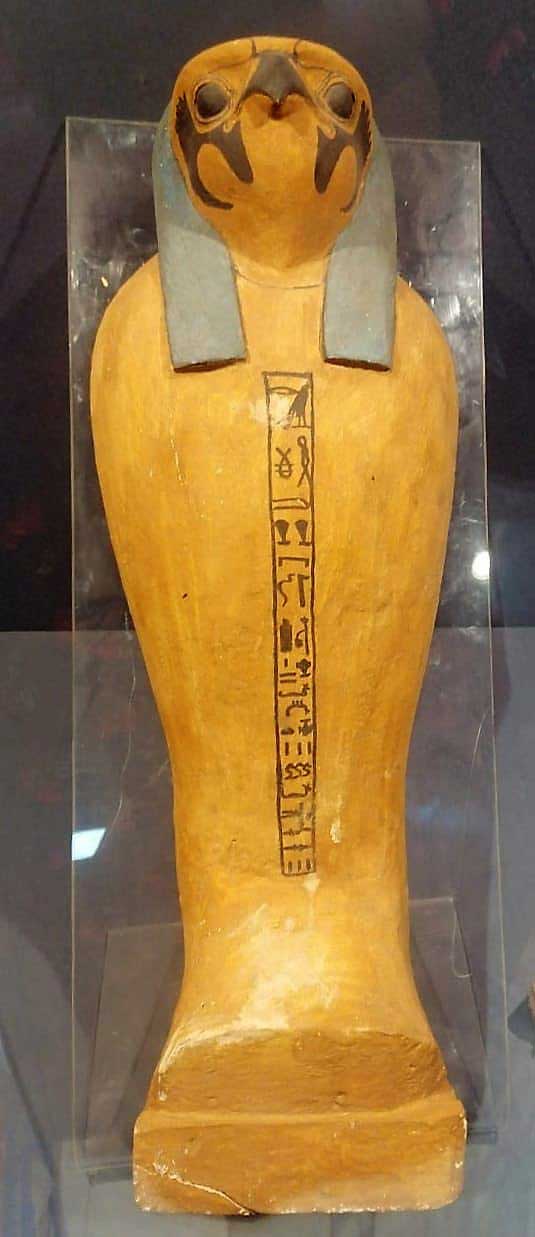
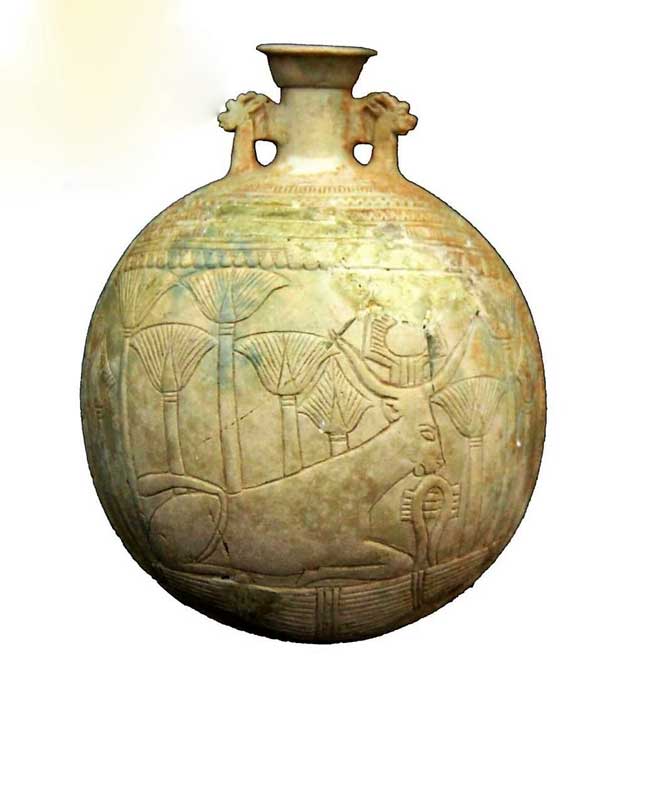
Meanwhile, the Tanta and New Valley Museums has symbolic wheat mummies from the Greaco-Roman era in the shape of Osiris and a faience pot decorated with foliage motive and the goddess Hathor on display.
ARCE's Northern California Chapter is pleased to present the following lecture schedule of renowned Egyptologists. All lectures are at 3 p.m. Pacific time. The venue or venues for the fall lectures, virtual or not, are in process. June and July, Summer Break Consumed by Raging Fire: Cremation Burial in Ptolemaic Alexandria August 21, 2022 Dr. Thomas Landvatter, Reed College
New Perspectives on the African Empire of Kush: Excavations at Jebel Barkal in North Sudan September 11, 2022 Dr. Geoff Emberling, University of Michigan
Topic TBD October 9, 2022 Dr. Arielle Kozloff, Cleveland Museum of Art
Iron in the Sky: Words and Conceptions of Iron and Meteorites in Ancient Egypt November 13, 2022 Dr. Victoria Almansa-Villatoro, Brown University
A remarkable discovery by Polish archaeologists in Egypt
News: I wrote the most recent developments about A remarkable discovery by Polish archaeologists in Egypt here, and all the details you are curious about are in our news.News: The current developments about A remarkable discovery by Polish archaeologists in Egypt are below.
A remarkable discovery by Polish archaeologists in Egypt
Polish archaeologists in Saqqara, next to the oldest pyramid in the world, discovered the tomb of an official responsible for secret documents in the royal chancellery during the reign of one of the first pharaohs of the VI dynasty. It comes from before 4.3 thousand. years.
Photo illustrative /Shutterstock
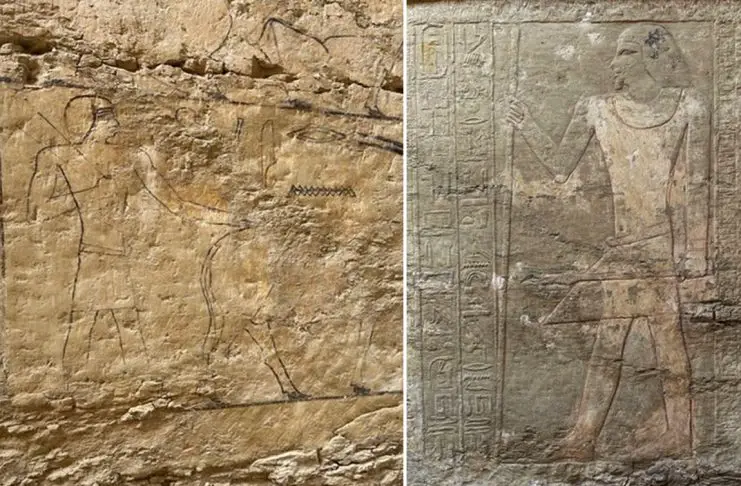
So far, researchers have reached the chapel, that is, the above-ground part of the tomb with reliefs. Egyptologists managed to read from the hieroglyphs carved on its facade that the tomb belongs to a man named Mehcheczi.
For now, only the facade of the chapel has been unveiled, the interior is waiting for the next excavation campaign. Probably thanks to a good job, Mehczeczi could hire an efficient team of craftsmen, because his chapel is decorated with reliefs of exceptional beauty – emphasized in an interview with PAP, the head of research of the Polish-Egyptian archaeological mission in Saqqara, Prof. Kamil O. Kuraszkiewicz from the Faculty of Oriental Studies at the University of Warsaw. The work was carried out as part of the mission of the Center of Mediterranean Archeology of the University of Warsaw.
The tomb is located on the eastern shore of the so-called Dry Moat. It was a gigantic ditch made on a rectangular plan (approx. 750 by 600 m). It surrounded the complex of the oldest pyramid in Egypt (the Step Pyramid), built 4.7 thousand meters. years ago for Djoser – including the great wall and adjoining chapels.
Today, the "Dry Moat" is almost entirely covered with rubble and sand blown in from the desert. Today it is completely invisible from the earth's surface, but its outline can be seen in some aerial and satellite photographs.
Successive seasons of excavations bring researchers more and more new information about this place. It turned out that the "Dry Moat" was also used several hundred years after the reign of Djoser. One of the evidence for this is the latest discovery from October last year. in the form of an entrance to Mehczecziego's tomb. The inscriptions on the façade of the newly discovered chapel show that, inter alia, was admitted to the secrets of the Pharaoh's archive. How should this title be interpreted? It can be assumed that this title is not so much about the category of documents as about access to the stage of their creation. Perhaps he had a right to know what documents were produced at the royal chancellery before they were published. But this is only a guess, because we have little information for the times we are talking about – emphasized prof. Kuraszkiewicz.
Mehczeczi was also the inspector of the royal estate and the priest of the tomb of king Teti. This means that he lived most likely during the reign of his heir, Pharaoh Userkare.
Although the study of the interior of the chapel and the tomb, which is probably carved under it, has not yet begun, archaeologists have obtained a lot of information from reading the facade of the tomb. There are inscriptions and reliefs depicting the owner of the tomb.
As added by prof. Kuraszkiewicz, unfortunately the colors have not survived. But the relief itself reveals an exceptionally skilled hand – elegant lines, subtle modeling – of an artist at least as good as the best of the authors of the reliefs in Merefnebef's tomb – added.
Everything indicates that Mehcheczi lived in the time of Merefnebef, who was a vizier at the court of Pharaoh Userkare. He was the supreme Egyptian dignitary, whose function is comparable to that of today's prime minister. Merefnebef's tomb is nearby. It was discovered in 1997 by a team led by prof. Karol Myśliwiec. The tomb of Merefnebef is one of the few in Saqqara with such an exquisitely preserved polychrome.
Prof. Kuraszkiewicz described that the decoration was not finished in the entrance to the newly discovered Mehczecziego chapel. Only sketches in black ink on lime plaster are visible. It was on their basis that subsequent craftsmen were to later make a bas-relief. They show images of sacrificial animals: cows, oryxes and ibexes.
The scientist noted that the rock in which the decorations were made is very brittle and heavily eroded, so the entire substrate, including the painted plaster, required immediate intervention by conservators. This task was led by Zbigniew Godziejewski, head of the conservation team, who died this year from the National Museum in Warsaw.
For now, we have located the chapel. There is almost certainly a burial shaft in which the owner was buried, but we will find out after exploring the chapel, as well as whether it was robbed – emphasized prof. Kuraszkiewicz.
Near this tomb there are rooms from the 3rd dynasty (i.e. the times of Djoser) and other tombs from the 6th dynasty, therefore contemporary to the one belonging to Mehczeci.
The new find is therefore not a complete surprise for us. The quality of the reliefs and the name of the owner were certainly a surprise, the scientist noted.
Prof. Kuraszkiewicz has been conducting research in the area of "Sucha Moat" for many years. Scholars suggested that it constituted the boundary between the sphere of the sacred, that is, the royal tomb, and the profane, that is, everything outside of it. According to others, it was a quarry, where the material for the construction of the pyramid was mined, and otherwise it did not perform any important function. A few years ago, Kuraszkiewicz introduced a new concept. According to him, it could act as a three-dimensional model of the road to the underworld of the deceased pharaoh.
Do not hesitate to comment and ask us your opinion about A remarkable discovery by Polish archaeologists in Egypt
Archaeologists discover tomb of Ancient Egyptian royal clerk at Saqqara
Archaeologists from the Polish-Egyptian archaeological mission in Saqqara, Egypt, have discovered a tomb belonging to a royal clerk during the reign of Pharaoh Userkare.
Userkare (also Woserkare, meaning "Powerful is the soul of Ra") was the second pharaoh of the Sixth Dynasty during the late 24th to early 23rd century BC. It is believed that Userkare rose to power by orchestrating a harem plot with palace bodyguards to murder Pharaoh Teti.
Archaeologists uncovered what they believe is the burial shaft of the tomb whilst excavating a chapel, discovering reliefs that describe Mehcheczi, a royal clerk who was in charge of managing the royal estates.
The reliefs suggest that Mehczeczi was admitted to the secrets of the pharaoh's archive, assumed to indicate that he had access to documents created at the royal chancellery before they were published. The chapel wasn't finished by the time Mehczeczi died, with sketches of sacrificial animals: cows, oryxes and ibexes in black ink on lime plaster being visible.
The tomb and chapel is located on the eastern edge of a large rectangular dry moat that surrounds the Step Pyramid burial complex dedicated to Pharaoh Djoser. The moat remained in use for several hundred years after the pharaoh's reign, but today is almost entirely covered with rubble and sand blown in from the desert.
Kamil O. Kuraszkiewicz from the Faculty of Oriental Studies at the University of Warsaw said: "We have only unveiled the façade of the chapel with the interior waiting for the next excavation season. Mehczeczi was clearly able to hire an efficient team of craftsmen, his chapel is decorated with reliefs of exceptional beauty that reveals an exceptionally skilled hand – elegant lines and subtle modelling comparable with the reliefs of Merefnebef's tomb (a vizier at the court of Pharaoh Userkare)".
Excavations have concluded for this season, with the research team planning to explore what remains beneath the chapel and determine whether the tomb has been robbed in the near future.
Kom El Shoqafa Catacombs – The Theatre of the Dead
The catacombs of Kom El Shoqafa, meaning the "Mound of Shards" or "Potshards" is a subterranean necropolis beneath the streets of modern-day Alexandria in Egypt.
Alexandria is located in the eastern part of the Mediterranean Basin in Northern Egypt and was founded in the vicinity of an Egyptian settlement named Rhacotis (that became the Egyptian quarter of the city) by Alexander the Great in 331 BC after he captured the Egyptian Satrapy from the Persians.
The city was famous for the Pharos Lighthouse of Alexandria (one of the Seven Wonders of the Ancient World) and the Great Library. Alexandria was the intellectual and cultural centre of the ancient Mediterranean for much of the Hellenistic age and throughout the Roman period.
Kom El Shoqafa is likely named for the quantities of terracotta jars, plates and objects deposited in the vicinity by people visiting the tombs during antiquity. Visitors would often bring food and wine, purposely breaking the containers and discarding them outside the catacomb's entrance.
Image Credit : Carole Raddato – CC BY-SA 2.0
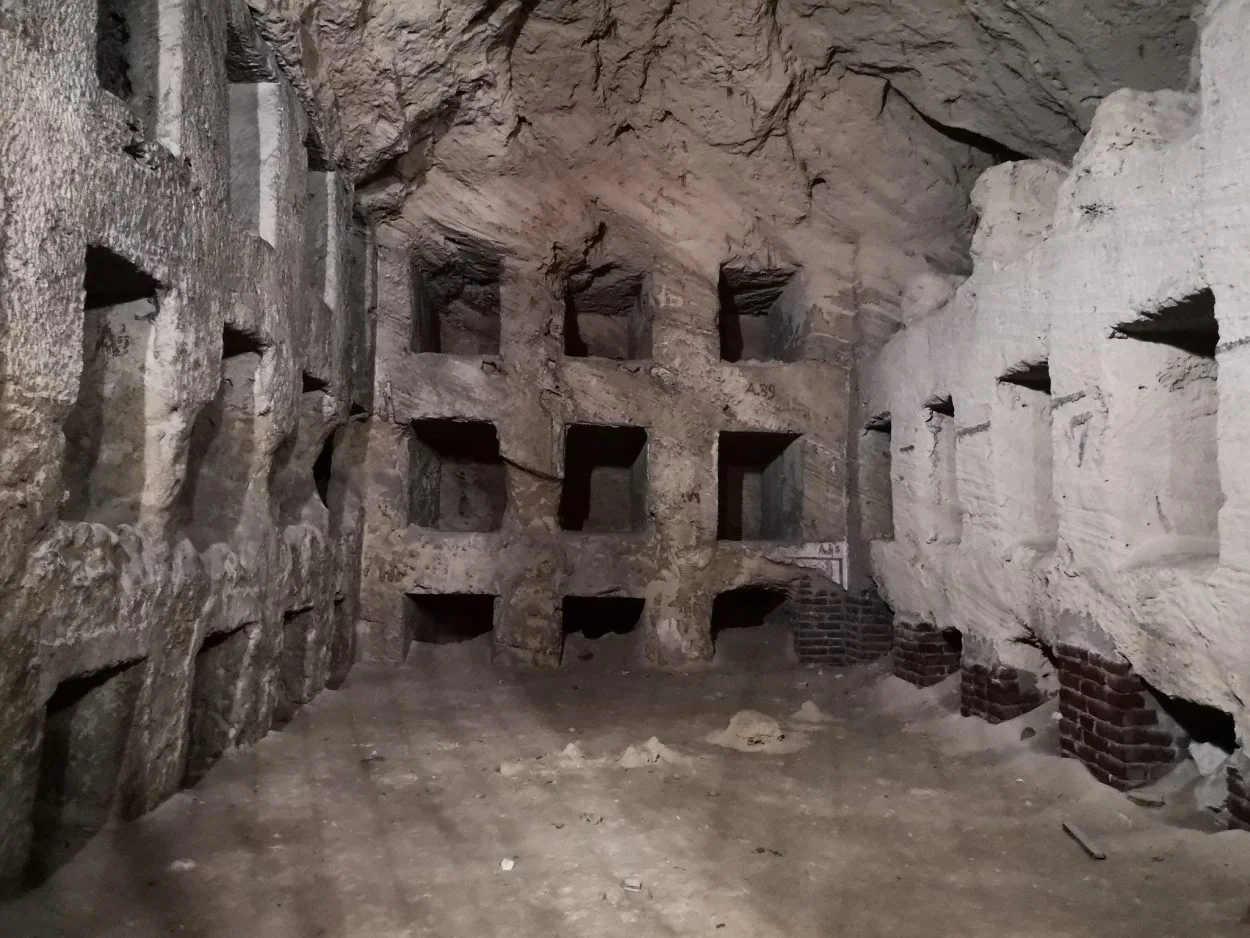
Kom El Shoqafa was first built during the 2nd century AD during the age of the Antonine emperors a short distance from the ancient acropolis, serving as a place of burial associated with the Pharaonic funerary cult. Over time, the necropolis developed into a labyrinth of tunnels and chambers over multiple floors, accessed via a spiral staircase and divided into the Hypogeum 1 and Hypogeum 2.
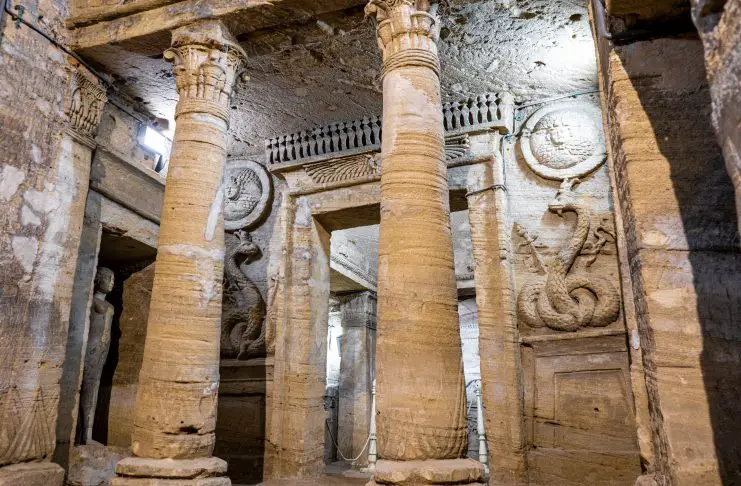
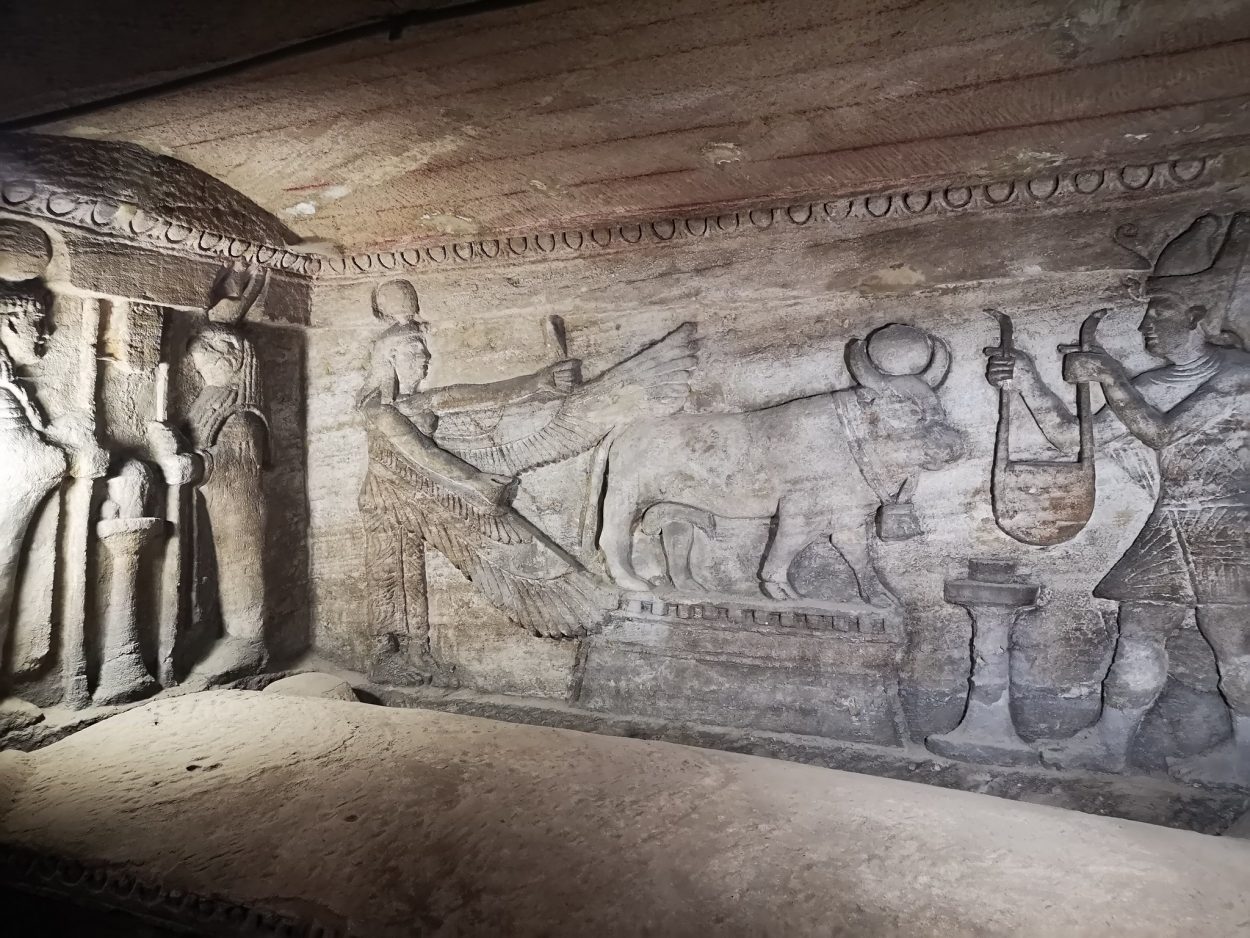
The catacombs are a rare fusion of Hellenistic, Egyptian and early Imperial Roman architecture featuring dozens of chambers adorned with sculpted pillars, statues, and other syncretic Romano-Egyptian religious symbols, burial niches, sarcophagi, as well as a large Roman-style banquet room where memorial meals were conducted by relatives of the deceased.
Image Credit : Carole Raddato – CC BY-SA 2.0
The dead would have been lowered by a vertical shaft in the staircase using ropes that leads off to a rotunda with a central well. The rotunda connects to the triclinium, the Hall of Caracalla in which the bones of horses and humans were found, and the principal tomb chamber which has a temple-like façade consisting of two columns topped by papyrus, lotus, acanthus leaves and an architrave with a relief of a central winged sun-disk flanked by Horus falcons.
Kom El Shoqafa was used by the inhabitants of Alexandria for over three centuries, where additional chambers were carved into the bedrock creating a hive network that could accommodate around 300 corpses.
'Inconceivable': Centuries of Jewish Life Rescued From Cairo Garbage Dumps
A Passover miracle: Special project, carried out with the support of Egyptian authorities, seeks to preserve synagogues, cemeteries and priceless documents left behind after Jews were expelled
The volunteers trying to revive Egypt's Jewish heritage often encounter difficult scenes – synagogue courtyards that have become garbage dumps, Jewish cemeteries that have been destroyed and ancient manuscripts that have been discarded and neglected. "We have come to places that were closed for 70 years, during which they became – it's hard to say this – a garbage dump, with awful destruction and neglect," says Prof. Yoram Meital of Ben-Gurion University's Middle East Studies Department.
Over the last five years, Meital, a 63-year-old specialist on Egypt, has been taking part in a project aimed at conserving synagogues, cemeteries and other Jewish sites in Egypt. The project is being carried out by the tiny Jewish community that remains in Egypt, with American funding and the cooperation of Egyptian authorities. A consultant on the history of the Jewish community, Meital is documenting existing conditions through photography and texts, and creating a detailed database of remaining Jewish sites in Egypt.
"I document the height of synagogue pillars, the state of curtains covering the ark (parochet), the writing on memorial plaques in synagogues and the names of people on name plates affixed to synagogue chairs," he says. No less important is the collection and preservation of Jewish manuscripts, some of them rare and valuable, that he have found in the course of his documentation.
The neighborhood dump
Last month, the focus of the project was an old Jewish cemetery in Cairo. "Some 250 garbage trucks were used to clear the area. The place had become the neighborhood dump," says Meital.
While the site was being cleared, Meital received a WhatsApp message while he was in Israel that made him sit up. "They sent me a photo of an opening to a genizah (repository) inside a burial chamber," he says excitedly.
A Jewish grave in Cairo, before and after renovations
But before he had a chance of examining the material found there, officials from the Egyptian Supreme Council of Antiquities arrived and took away 165 sacks of documents. "We can't say what's there and how valuable it might be," he says.
In the same breath he notes that nearby were found 120 years ago, parts of the famous Cairo Genizah, a collection of Jewish manuscripts spanning from the ninth to the 19th centuries.
He notes that one of the guiding principles of the Jewish heritage project is to keep what is found in Egypt. "We oppose in principle the idea of taking Judaic artifacts out of Egypt, supporting the preservation of what remains of the Jewish past in the places where it was created," he adds.
A Jewish communist who converted to Islam
The driving spirit behind the project is Magda Haroun, 70, the head of the small Jewish community in Egypt, together with Samy Ibrahim, the son of Albert Arie, a Jewish communist who converted to Islam but was once one of the community's pillars. At its peak in the 1940s, the community numbered 80,000 people, most of them living in Cairo and Alexandria, with a few residing in smaller towns and villages. The number of Jews living in Egypt today can be counted on one hand.
"We ask ourselves what will happen when there are no Jews left here. What will be done with all the treasures they left behind? With the synagogues, the cemeteries, one of which is more than 1,000 years old, and with the Cairo Genizah?" asks Meital.
The most important finding came from the Karaite synagogue in Cairo, a manuscript of the Bible written 1,000 years ago on vellum.Credit: יורם מיטל
One idea they are promoting is using synagogues as cultural centers for local Egyptian communities, "on condition that they don't change anything having to do with artifacts and architecture," he says. The first test of cooperation with local community members was successful.
Prof. Yoram Meital of Ben-Gurion University's Middle East Studies DepartmentCredit: אסתר לסמן
"We published an invitation to visit the synagogue in Cairo on Facebook after it had been closed for 70 years. We were worried that no one would come, since a synagogue is associated with Jews, who are identified with Israel, etc., but we tried," says Meital. No fewer than 5,000 people expressed their interest, although the authorities permitted only 20 to visit. "But, through sharing on social media, photos and information reached tens of thousands of people," says Meital with satisfaction. "All of a sudden, there was talk about a building people had walked past for decades without knowing what was inside."
Egyptian government covers all costs
There are 16 synagogue buildings in Egypt, 13 of them in Cairo. Half of them are in "reasonably good condition," according to Meital. In one of them there is a government office which the community is trying to oust. Another is out of bounds. In the city of El-Mahalla El-Kubra, in the center of the Nile Delta, Meital and his partners found the remains of a synagogue. When they got there, they were surprised to discover that the locals knew about the site, despite the fact that no Jews remained in the city. They put up a gate to close it off and prevent it from continuing to be used as "a garbage dump and a den of drugs," as Meital calls it.
The pinnacle of the conservation drive occurred in 2020 with the completion of the refurbishing of the Eliyahu Hanavi synagogue in Alexandria, which was originally built in the 19th century. The Egyptian government covered all the costs of refurbishing the structure.
Manuscripts found at the old Jewish cemetery in Cairo. The place became the neighborhood dump.Credit: Yoram Meital
This week, during Hol Hamoed, the intermediate days of Passover, the Egyptian Ministry of Tourism and Antiquities announced that it has begun to restore the Ben Ezra Synagogue in Cairo, which was built about 1,200 years ago and is one of the oldest synagogues in the world. This synagogue is the site of the famous Cairo Geniza, which, to this day, serves as the main source for writing the history of Eastern Jewish communities. "In the past year the condition of the building has deteriorated. This is an important and encouraging step, which testifies to the commitment of the authorities to preserving the heritage," said Meital.
The Sha'ar Hashamayim synagogue in Cairo, built in 1905, has been hosting Passover seders since 2017 (although not this year), to which Egyptians with an interest in Jewish heritage are invited. "Simple Egyptians sit by the table and read from the Haggadah," says Meital. "They wonder about the story and ask questions." He says that apart from a few oddballs, most visitors show a genuine interest in Egypt's Jews, something that's becoming trendy.
Meital traces the renewed Egyptian interest in its Jewish heritage to the 2011 Arab Spring. "We are in the midst of a new and unprecedented process, which I can see as a historian, in which the Jewish past is undergoing a revision," says Meital. "The Arab Spring generated a political and social change, opening a historical Pandora's box, that made Egyptians examine their identity anew." Consideration of Egypt's attitude towards its minorities became part of the process of self-examination.
Under the regime of Abdel Fattah al-Sissi, in power since 2013, the small Jewish community got approval to undertake new projects meant to conserve the local Jewish heritage. This process, described by Meital as unprecedented in its scope, still encounters difficulties posed by some authorities, but he hopes to continue despite this. "Continuing this welcome process of conserving Jewish heritage as part of Egypt's heritage depends on the wide support of Egypt's government and society," he says.
The entrance to the Library of the Jewish Heritage next to the Ben Ezra Synagogue in Cairo.Credit: Ovedc
As expected, opponents of the regime do not welcome the Jewish revival. "The Muslim Brothers, persecuted by the regime, oppose our projects. The whole issue is evoking an internal debate in Egyptian society," says Meital.
"Inconceivable"
Meital puts particular emphasis on conserving documents he locates in existing structures. So far, he says, his team has collected around 1,000 books that were "strewn all over the place." Some of them are rare editions dating from the 16th or 17th centuries. "Among these large collections, we found some rare editions as well as a body of Karaite manuscripts," he recounts.
The most important finding came from the Karaite synagogue in Cairo, a manuscript of the Bible written 1,000 years ago on vellum "preserved in excellent condition," he says. "It's inconceivable. This book was located in a place where anyone could have picked it up .... You can't imagine its monetary value." The 616-page book, dated to 1028, had been previously documented by researchers but later disappeared.
Inside the Ben Ezra Synagogue in Cairo.Credit: Ovedc
Another recent discovery was found in the cellar of a Cairo synagogue. "A small metal container was full of papers. When I examined them I saw that this was a registry of the entire Ashkenazi community in Egypt, including names, birthdates, emigration, professions and many other delights from the community's past, such as letters of complaint," says Meital. "It was all stowed away at the synagogue, including a story about a Jewish doctor from Vienna who escaped Austria after the Anschluss, arriving at Alexandria, then moving to Cairo. When he asked to be accepted by the Jewish community, he said that he'd left Vienna with the approval of an SS officer," says Meital.
He also found documentation of a Yiddish theater that operated in Cairo, putting on plays by Shalom Aleichem, as well as invitations to a Purim spiel. "We are able for the first time to significantly document Ashkenazi community life in Egypt," he says excitedly.
If the project's organizers' vision comes true, a central library will be set up in Cairo whose holdings will include manuscripts that are now in the process of preservation. They are currently being held in a safe location, Meital says, declining to give any details.