|
Northern California Chapter Upcoming Lectures |

-- Sent from my Linux system.
|
Northern California Chapter Upcoming Lectures |
-- Sent from my Linux system.
 The American Research Center in Egypt, Northern California Chapter, and the Near Eastern Studies Department, University of California, Berkeley, invite you to attend a virtual lecture by Dr. Julien Cooper, United International College, Zhuhai, China: The Land of Gold and Nomads: The History and Archaeology of the Atbai Desert of Sudan Zoom Lecture. A registration link will be automatically sent to ARCE-NC members. Non-members may request a registration link by sending email with your name and email address to arcencZoom@gmail.com. Attendance is limited, so non-members, please send any registration requests no later than February 5. About the Lecture:  A cemetery of 'ring-graves' found at Gebel Di'irabab in the Eastern Desert of the Sudan (Photo courtesy of Julien Cooper). The vast and rocky deserts of the Eastern Desert of Sudan, known as the 'Atbai', is the heartland of ancient nomadic groups known as the Medjay, Blemmyes, and Beja. The desert was also the source of much of the gold for Egypt and Nubia, making it of vital importance to the Egyptian and Kushite states. Despite this importance, very little archaeological exploration has been undertaken in this desert - little is known of the nature of foreign incursions in this area nor the archaeology of the indigenous inhabitants. As part of a program aiming to uncover the local archaeology this region, a new fieldwork survey began in 2018 largely designed to record archaeological sites under threat from modern activities. This presentation will showcase the history of this desert and the discoveries of the Atbai Survey. About the Speaker:  Dr. Julien Cooper
Julien Cooper is a Research Fellow at United International College, Xiangzhou District, Zhuhai, China. He received his Ph.D. in Ancient History from Macquarie University, Australia in 2016. He was then a Postdoctoral Research Associate at Oxford University and a Postdoctoral Research Associate & Lecturer in Egyptology at Yale University. He has conducted research in the areas of Egyptology and Egyptian Language (Old, Middle, and Late Egyptian, hieratic); Egyptian Epigraphy; Ancient Sudan & Nubia and relations with Egypt; Archaeology of Sudan; Red Sea Studies; Nomads and ancient nomadism; Blemmyes and nomads of Northeast Africa; Afroasiatic Languages; and Language Contact. About ARCE-NC:
For more information, please visit https://facebook.com/NorthernCaliforniaARCE/, https://arce-nc.org/, https://twitter.com/ARCENCPostings, or https://khentiamentiu.org. To join the chapter or renew your membership, please go to https://www.arce.org/become-arce-member and select "Berkeley, CA" as your chapter when you sign up. |
-- Sent from my Linux system.

The ancient world of Egypt, Greece and Rome with mummies, hieroglyph-filled papyrus and ancient statues is once again available to the public as the Gallery of Ancient Art at Warsaw's National Museum opened its doors after a break of 10 years.
Work on the new permanent exhibition was completed in December last year, but culture-starved visitors had to wait until today to see the ancient treasures, one day after the government relaxed the pandemic-related closure of museums and art galleries.
 A pyramidion which capped small, black pyramids built on top of funnery chapels in Western Thebes.
"Such an event in the history of Polish museology happens once every few decades," said the director of the National Museum in Warsaw, Łukasz Gaweł.
The items on display come from the museum's antiquity collection, which numbers over 18,000 items, making it the leading collection on the ancient world in this part of Europe.
The long closure of the previous gallery dedicated to them was closed in 2011 due to the poor condition of the rooms.

 Other highlights include a portrait of an Egyptian boy painted on a wooden panel by a Roman artist in the second half of the second century.
Work on the new exhibition was supposed to be completed in 2013, but the project turned out to be so complicated and expensive that the opening date soon fell through.
The new gallery was designed by Warsaw architect Mirosław Nizio and cost around PLN 16.2 million.
 The items on display come from the museum's antiquity collection, which numbers over 18,000 items, making it the leading collection on the ancient world in this part of Europe.
Those who braved the early February snow today were in for a treat. Around 1,800 exhibits spread out over 700 sqm of state-of-the-art exhibition space form a virtual time machine transporting visitors back to ancient cultures.
The nine rooms show the monuments of ancient civilisations arranged by place of origin – Egypt, the Middle East, Greece and Rome.
Tricks of light and colour in each room transport visitors in time and space to Egyptian temples and tombs, ancient Babylon, a Greek theatre and inside a Roman atrium house.
 Around 1,800 exhibits spread out over 700 sqm of state-of-the-art exhibition space form a virtual time machine transporting visitors back to ancient cultures.
In the rooms associated with the symbolism of light, light stone and light plaster have been used.
In the space dedicated to Egypt, sandstone was used. White marble was used where the exhibition tells the story of Greece.
 A small tablet from the time of Caesar Augustus shows the scene from the Odyssey when Odysseus visits Circe. It is extremely rare and comes from a group known as the Tabulae Iliacae, only 22 of which are to have survived.
Grey limestone appears in the section dedicated to ancient Rome. One of the rooms is entirely covered with hieroglyphs.
From bright colours that evoke the desert sand and Egyptian sun, visitors move into dark halls resembling the interiors of ancient tombs and Roman catacombs.
The gallery attempts to answer the question of what kind of people the ancients were and were they us.
 Exhibition curator Monika Muszyńska told TFN: "The closer we get to everyday life, the more like us they were. Through the objects in our exhibition we can see how they lived, had fun, paid taxes, their family relations."
One of the most interesting exhibits is an ancient Egyptian mummy, preserved in the gypsum-stiffened linen wrapping in which the deceased was entombed in the eighth or ninth century BC.
Other highlights include a portrait of an Egyptian boy painted on a wooden panel, a rare Greek vase depicting the poet Sappho and a 10-metre-long papyrus scroll of the Egyptian Book of the Dead from the 15th century BC.
 The nine rooms show the monuments of ancient civilisations arranged by place of origin – Egypt, the Middle East, Greece and Rome.
Yet another highlight, this time from the room designed like a Roman atrium house, is one of the museum's most mysterious objects.
A small tablet from the time of Caesar Augustus shows the scene from the Odyssey when Odysseus visits Circe. It is extremely rare and comes from a group known as the Tabulae Iliacae, only 22 of which are to have survived.
Muszyńska said: "It is like an ancient coffee-table book, probably owned by someone wealthy who wanted to show his wealth and prestige."
Work on the new permanent exhibition was completed in December last year, but culture-starved visitors had to wait until today to see the ancient treasures, one day after the government relaxed the pandemic-related closure of museums and art galleries.
The small relief was discovered in the museum's basement in the 1950s, but it is a complete mystery how it got there.
"Nobody knows how it got here. Perhaps it was part of the collection of one of the magnate families, which the museum inherited," Muszyńska said.
Most of the objects in the exhibition belong to the National Museum in Warsaw. Some of the objects come from collections that became part of the museum's holdings after 1945, including the Radziwiłł collection from Nieborów, the Potocki family from Jabłonna and the Czartoryski family from Gołuchów.
 The identity of the Egyptian mummy remains a mystery.
Other items come from pre-war German collections, including those from Silesia, Königsberg and Braniewo, which were put together in the late nineteenth and early twentieth centuries.
The exhibition also includes works from the Louvre Museum's collection, some of which have been held at the Museum since 1960.
The exhibition is open Tuesday to Sunday 10.00–18.00 with pandemic restrictions on number of visitors and social distancing requirements.
-- Sent from my Linux system.

It's a good day when archaeologists can return an individual, long deceased, to their place and time in history. Two weeks ago, the Egyptian Ministry of Tourism and Antiquities announced more discoveries at Saqqara, the same site that made the news for lion mummies in 2019 and a mummy cache a few months ago. Among these new discoveries at Saqqara was an Old Kingdom queen whose name had been forgotten for millennia.
Teti was the first king of the Sixth Dynasty and ruler of Egypt during the 24th century BC. As was common for Egyptian kings, Teti had several wives, perhaps as many as four. Until last month, only two of their names had been definitively identified, Khuit II and Iput I, although a third wife, a woman named Khenet, has also been proposed. Khuit II and Iput I were buried in pyramids of their own, roughly a hundred meters away from Teti's pyramid complex at Saqqara.
Khuit II may have been Teti's chief wife, as construction on her tomb was begun first. Teti also married Iput I, the daughter of his predecessor, King Unas. Iput I was the mother of future king Pepi I, meaning that she held the three titles: "daughter of the king," "wife of the king," and "mother of the king." According to Manetho, Teti's reign came to an unfortunate end when he was killed by his own bodyguards. He was succeeded by the brief reign of Userkare, whose parentage remains unsure, but who may have been his son.

If you've toured Saqqara, it's very likely that you visited Teti's pyramid after seeing the mastaba tombs of Kagemni and Mereruka. Both officials served during Teti's reign as vizier (Mereruka succeeded Kagemni in the role) and their eternal resting places are located beside their king's. Although the mound of rubble atop Teti's pyramid isn't much to look at now due to stone-quarrying over the years, his is one of the few pyramids at Saqqara you can still enter.
Teti's pyramid was only the second pyramid to contain the Pyramid Texts, following the precedent set by his predecessor, Unas, who was buried nearby. However, the Pyramid Texts inside Teti's pyramid were never painted, as they were in Unas' pyramid, perhaps due to Teti's early death.

In 2010, excavations led by Dr. Zahi Hawass uncovered a third satellite pyramid beside Teti's pyramid. Satellite pyramids, or 'subsidiary' pyramids, are smaller pyramids clustered around a larger pyramid complex (usually that of a king's) that were built for the burials of royal family members. For many years, Hawass theorized that the new satellite pyramid might have belonged to Teti's mother, Queen Sesheshet, but without a name inside the pyramid it was impossible to know for certain for whom it had been built.

A decade later, new excavations at Saqqara have revealed the funerary temple associated with the satellite pyramid, this time containing the name of the owner on a temple wall and a fallen obelisk: Queen Neit (being reported as Narat, Naert, or Naerit). Hawass seems glad to finally confirm who the pyramid and temple were built for, and proud to return this Old Kingdom queen to her place in history. At this point, little else is known about this Sixth Dynasty queen but future excavations may reveal more about her family and her role.
The area around Neit's funerary temple also yielded fifty wooden sarcophagi discovered in as many burial shafts along with a number of other luxury funerary items. These sarcophagi are from much later in Egyptian history, buried there roughly 800 years later, during the New Kingdom (1539-1077 BC). These finds illustrate the longevity of Saqqara's importance as a cemetery, despite shifting capitols, royal families, and cult centers.

Taylor Bryanne Woodcock is an Egyptology Ph.D. candidate at the University of Toronto, where she also teaches Middle Egyptian. She currently works in Egypt at the South Asasif and in Sudan at Gebel Barkal.

Mustafa al-Saghir, director-general of Karnak Temple Complex Antiquities, told Xinhua in a recent interview that "although the joint Egyptian-Chinese mission has been working for two seasons only, it has achieved very significant results at the temple."
The mission is doing excavations through which the architectural elements of the temple are being revealed, he said.
"There are also restoration works in many parts of the temple… the mission is also conducting special studies such as the study of pottery and inscriptions found in the temple and its buildings," the official added.
Al-Saghir pointed out that the spread of the COVID-19 pandemic impacted the mission's work, revealing that the Chinese team could not come to Egypt to complete its works for this season.
"We are working at the site to avoid any negative effects… the Egyptian crew is currently completing some minor works to keep the work at the temple ongoing," he added.
The Egyptian official said there are many archaeological missions operating in Egypt, adding that it is always a good thing to have missions that can help save and unearth Egyptian antiquities and heritage.
He stressed that the members of the Chinese mission have great knowledge in the field of archeology, noting that China also has a great and ancient civilization.
"The Egyptian members of the mission were chosen carefully… they have great experiences in Egyptian archeology," al-Saghir said.
"Cooperation is great between the two sides, and this is the main reason that led the mission to achieve great results during only two seasons," he added.
Al-Saghir said a Chinese study and research center for Egyptian antiquities will be established in Egypt, which will focus on studying the ancient Egyptian archaeology and civilization, as well as sponsoring the activities of the Chinese archaeological missions that will work in Egypt in the future.
"Research centers help maintain the work of missions and raise the level of scientific research," al-Saghir said, expressing hope that more Chinese missions would come to work in Egypt.
"China has up-to-date technologies that are used in excavations and restoration… this is very helpful for us in Egypt," he said.
The first Egyptian-Chinese archeological mission in Egypt is the outcome of a protocol of cooperation signed between the Egyptian Ministry of Antiquities and the Chinese Academy of Social Sciences. They formed a joint Egyptian-Chinese archaeological mission to do the excavation works in the relics of Montu Temple that was untouched and closed for visitors for decades.
The first season of the joint mission started in late November 2018 and continued for about four months.
In a recent interview, the head of the Chinese archaeological mission Jia Xiaobing told Xinhua that further excavation and documentation work has been fulfilled in the second season of the Egyptian-Chinese archeological mission at the Montu Temple.
Meanwhile, al-Saghir said Egyptian archaeological teams at the Karnak Temple Complex took advantage of last year's months-long coronavirus-related closure to restore the 29 statues of rams in the first courtyard of the Karnak Temple.
"The statues were in a very poor condition of reservation due to the factors of weather," al-Saghir said, adding that the project is the largest restoration project carried out by Egypt's Ministry of Tourism and Antiquities at the complex in recent years.
"We are very proud that this project was carried out by Egyptian hands despite the challenges we faced due to the spread of the pandemic as well as the limited capabilities," he added.
The official said that many projects have been implemented and a number of discoveries have been made in Luxor last year, which greatly helped creat job opportunities.
Al-Saghir said implementing such projects helped seasonal workers in the city earn money to sustain their families after they lost their jobs due to the coronavirus-related measures imposed by the government.
"This mainly benefited those who work in the tourism sector which was suspended for months," al-Saghir said.
Egypt, one of the world's oldest civilizations, has been working hard to preserve its archaeological heritage and discover the secrets of its ancient artifacts.
Over the past few years, the country has witnessed several big archaeological discoveries including pharaonic tombs, statues, coffins, mummies, burial sites, and funerary gardens. Enditem
-- Sent from my Linux system.
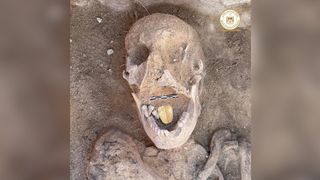
Archaeologists have found a 2,000-year-old mummy with a gold tongue at an ancient Egyptian site called Taposiris Magna.
Embalmers perhaps placed the golden tongue on the mummy to ensure that the deceased would be able to speak in the afterlife, the Egyptian antiquities ministry said in a statement released Jan 29.
For instance, if the golden-tongued mummy encountered Osiris, the god of the underworld, in the afterlife, they would have needed to be able to speak to the god, the statement said. It isn't clear if the mummy had a speech impediment when they were alive. It's also not clear why the tongue was made out of gold specifically.
Related: The 25 most mysterious archaeological finds on Earth
The archaeologists, led by Kathleen Martinez, from the Dominican Republic, discovered the mummy in one of 16 burials at Taposiris Magna, which has temples dedicated to Osiris and Isis, a goddess who was both the wife and sister of Osiris. Previously, archaeologists found a hoard of coins decorated with the face of Cleopatra VII, suggesting the temples were in use during the queen's reign.
The 15 other burials also date back around 2,000 years and contain remarkable treasure. In one, a female mummy is wearing a death mask that covers much of her body and depicts her with a headdress while smiling.
Two of the mummies were found with the remains of scrolls, which scholars are currently analyzing and deciphering. The plastered layers, or cartonnage, encasing one of these mummies has golden decorations of Osiris, the statement said.
The researchers also found several statues that depict the people who were buried at the site; the statues are so well preserved, you can still make out the individual's hairstyles and headdresses, the statement said. The statues give the people a formal look, with no smiles on their faces.
Though the archaeologists aren't sure exactly when the individuals died, they can tell that the people lived at a time when Egypt was ruled either by the Ptolemies (304 B.C. to 30 B.C.), who were the descendants of one of Alexander the Great's generals, or by the Roman Empire, which took over the country after the death of Cleopatra VII in 30 B.C.
A team made of archaeologists from Egypt and the University of Santo Domingo in the Dominican Republic are conducting these excavations at Taposiris Magna. It is led by Kathleen Martinez, an archaeologist from the Dominican Republic. Excavation of the site and analysis of the remains is ongoing.
Originally published on Live Science.
-- Sent from my Linux system.