As promised, a short report on new architecture in the West Settlement: we do have more "walls" (still generally only one brick high, but clearly outlining built structures laid out along a NE-SW grid) in the West Settlement. These line up with walls uncovered in earlier seasons, and also connect with ones excavated by Barry Kemp in the 1970s. The wadi has washed out anything that might have remained to the east (What Lies Beneath), but the settlement does continue to the west and perhaps also to the north, and promises to yield more information in future seasons.
N140 line: looking southwest over squares excavated in 2019
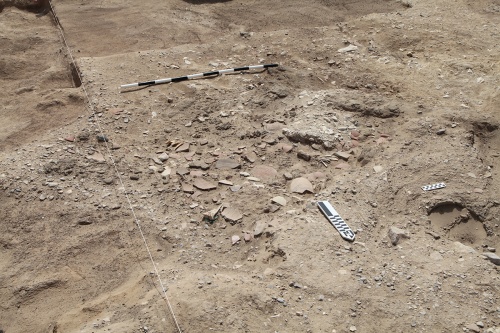
But today's blog is about our "midden." We have uncovered a large (about 2 and a half meters in diameter) deposit that spans the border between two of our squares, an area we are calling Feature 201. On the surface, this looked like the usual sort of sherd scatter, but as we began to clean and clear, we discovered that it continued for a several levels, and was thick with large and small sherds and lots of faunal remains. These include bones of various sizes, bits of hide, and even several parts of hooves.
N140/E115: looking south over Feature 201
A preliminary look at the pottery (with which we have filled 26 of our yellow bags so far) suggests a higher percentage of the elite "Palace" ware than we've found in most of the rest of the site, although we will need to analyze it properly before coming to any conclusions.
JEMWS.2019.B40: Keratin of the hoof of a ruminant (identification courtesy of Salima Ikram)
This is larger than other such deposits we have found in previous seasons. It is also not clear how it relates to our architecture – other deposits have tended to be along walls or in corners, or even used as leveling fill under walls (Broken Dishes); this looks like it might go over a wall, although we will need to do more excavation here to find out for sure.
This is an intriguing deposit, and one that is sure to yield interesting and useful information once it has been completely cleared and the material recovered has been studied by our experts.
The seal protecting the fifth shrine of the burial chamber of the young pharaoh Tutankhamun. (Photo: Harry Burton/Wikimedia Commons)
More than 3,000 years ago, deep below the surface of the Valley of the Kings, someone sealed one of a series of nested shrines protecting the final resting place of the young pharoah Tutankhamun with an intricate combination of knots and clay. There it remained, fully intact for more than 32 centuries, until until Feb. 16, 1923, when famed archaeologist Howard Carter breached the seal and explored the riches of the inner burial shrines for the first time.
It was arguably one of the greatest archaeological discoveries of the 20th century, but beyond all the gold and historical riches, it's worth asking: How in the world did rope from ancient Egypt manage to survive until 1923?
Like other organic materials found within tombs in the Valley of the Kings, including items such as honey, bread and beer residue, the rope binding the fifth shrine door to Tut's final rest place benefited from the extremely arid environment of the desert region and the low-oxygen level of the sealed tomb.
"Tombs are sealed to the outside," explains the site Rare Historical Photos. "Bacteria can break things down as long as they have oxygen, but then they effectively suffocate. It's not uncommon to find rope, wooden carvings, cloth, organic dyes, etc. in Egyptian pyramids and tombs that wouldn't have survived elsewhere in the world."
An example of papyrus fiber cordage dating back to ancient Egypt. (Photo: Daderot/Wikimedia)
While we can't say for sure what the rope was made from, we know that a vast majority of rope-making in ancient Egypt was sourced from the stem of the papyrus plant. Susceptible to decay in humid regions, papyrus exhibits exceptional longevity in arid conditions thanks to its composition of highly rot-resistant cellulose. In 2004, an archaeology team from Boston University uncovered over two dozen coils of thick papyrus sailing ropes hidden in the back of a cave in Egypt.
"It was a scene frozen in time," archaeologist Kathryn Bard told Hakai Magazine. "They hadn't been disturbed for close to 4,000 years."
As for the knot that tied the two copper handles together on Tut's fifth shrine door, one Reddit commentator seems to have deciphered how it worked:
It looks like they started with something like a cow hitch on the left handle, with equal free ends, then the rope wraps around both handles (left and right) several times and then was finished with the spiral wrap and half hitches near the ends. Even though it would be easy to undo the half hitches and the spiral wrap, one would not be able to undo the rope between the handles without breaking the seal.
Sadly, out of the thousands of items catalogued and removed from the tomb, it's unknown if these remarkable seals survived after being breached. As one Egyptologist commented, only one-tenth of the items found within the tomb have ever been properly studied.
"The famous death mask has never even been properly studied," they added. "So if you ever hear that someone studies ancient Egypt, please don't ask them if there's anything left to do."
CAIRO - 27 February 2019: Drainage workers found a Pharaonic stone with inscriptions during excavations in Masjid al-Sada al-Shahawiya area in Kafr El-Sheikh. Major General Issam Rasas, head of the Metobas Center and City, was informed of the discovery and decided to stop the excavation in that area immediately. Head of the local unit of the village Mohammed Qutb Abu Zlat and Head of Brambal police station Mohammed Zaher headed to the site to examine the stone after receiving information from the excavation site's engineer that he suspects the finding is an ancient stone.
The head of the city of Metobas stated that the ancient stone was reserved to be presented to a committee of the Antiquities Authority.
CAIRO – 1 March 2019: The acclaimed Egyptian archaeologist Zahi Hawass said on Friday during giving a lecture at the Royal Library in Copenhagen that a national Egyptian project to study the royal mummies will kick off next month.
Hawass announced that the project is tailor made to search for the mummies of Queen Nefertiti and Ankhesenamun, the wife of Tutankhamun, using DNA analysis and Computed Tomography (CT) scans.
Hawass explained important facts during the lecture such as how Tutankhamun died, the discoveries of pyramid builders tombs and other important archelogical discoveries.
During his lecture on the ancient Egyptian civilization Hawass invited the Danish people to visit Egypt, assuring that it is safe.
Hawass declared to the multiple Danish newspapers that interviewed him that he is leading an Egyptian global team to restore stolen artifacts.
The lecture was attended by Queen of Denmark Margrethe II and Egyptian Ambassador in Copenhagen Ayman Alkaffas.
Hawass previously stressed the difficulty of retrieving Egyptian monuments from various museums all over the world since they were transferred under the 50 percent law or the Antiquities Protection Act.
The Antiquities Protection Act permitted foreign missions to take their share of the excavations.
Hawass pointed out that there is currently an international outcry that calls for retrieving artifacts. French President Emmanuel Macron said France occupied some African countries and looted their artifacts and it is a must to return the looted items to their original countries.
Meanwhile, Greece is fighting to return its artifacts from London and China is demanding Japan and other countries to return its looted artifacts.
The veteran archaeologist announced that Egypt must demand its right to retrieve its looted artifacts, pointing out that he is currently forming a national team consisting of public figures to demand Egypt's right to retrieving its artifacts.
Hawas stated that Egypt must demand the retrieval of the five most significant pieces found in the world's museums, namely the Rosetta Stone which was seized by the French and the head of Nefertiti that Hawas asserted he collected evidence proving it was stolen.
Hawas claimed that he demanded the head of Berlin Museum to retrieve the stolen artifact; however, the revolution of Jan. 25, 2011 postponed the retrieving process.
Hawas further stated that the third most significant piece is the Planetarium located in the Louvre Museum, which was stolen by a French thief.
Moreover, Hawas claimed that the two additional artifacts were legally transferred outside Egypt, but Egypt must demand their retrieval. The two pieces are the statue of the architect of the Great Pyramid that is located in Germany and the statue of Khafre pyramid manager that is located in the USA.
Hawas further stated that the world perceived Egypt in the past as a country that does not provide museums for its priceless artifacts and cannot protect its ancient heritage.
However, the veteran archaeologist affirmed that Egypt currently holds numerous museums, including the Grand Egyptian Museum that is considered the biggest museum in the world.
THE ROLE OF SEILA AND THE SEILA PYRAMID IN THE OLD KINGDOM
Special Guest Lecture by Kerry Muhlestein on Monday, March 4, at 6:00 p.m.
While we typically think of the Fayoum as not playing a significant role until the Middle Kingdom, mounting evidence suggests that it was rising in importance by the beginning of the Fourth Dynasty. Statues of Officials found at Seila, the topography of the area, and the Seila Pyramid all help us better understand the Fayoum during this era. Excavations at the Seila Pyramid show us that it is connected with the Nile Valley in surprising ways, and that this portion of the Fayoum was playing an economic and religious role, including being part of religious and royal innovations Snefru was enacting. Evidence of his pyramid cultic program and his titulary will be examined in this lecture.
SPACIALIZING THE HISTORIC TOPOGRAPHY OF ALEXANDRIA FOR SUSTAINABLE DEVELOPMENT
Lecture by Mohamed Soliman on Wednesday, March 13, at 6:00 p.m.
Many historic maps have been produced of Alexandria, including Mahmoud Pasha el-Falaki's very accurate map that was produced in 1859. El-Falaki's map shows ancient natural and human landmarks that continue to exist, allowing for any topographic changes to be traced. However, Alexandria is an incredibly multilayered city, so further exploration is required.
The application of GPR in archaeological assessment is a known procedure. Three areas were in Alexandria were examined for this study using the GPR technique: Sultan Husain Street, Khartom Square and Nabi Danial Street. The GPR device utilized was the unique Russian system LOZA model, LOZA-V. The data was significant and has indicated the possibility of further archaeological remains. In this context, spatializing the historic topography of Alexandria via remote sensing and building a GIS database will support the national sustainable development strategy of 2030, specifically in the areas of urban development, road, traffic and transportation infrastructure, and the tourism industry.
RAMESSIDE QUEENS' TOMBS, THE BOOK OF THE DEAD, AND THE DEIR EL-MEDINA ICONOGRAPHIC TRADITION: A WORK IN PROGRESS
Lecture by Heather Lee McCarthy on Wednesday, March 20, at 6:00 p.m.
At the beginning of the 19th Dynasty, Ramesside royal women's tombs, located in the Valley of the Queens, were dramatically enhanced in several ways, including the creation of new, innovative decorative programs tailored to the gender, status, and roles of the royal female tomb owners. The development of these programs also involved the creation of new Book of the Dead vignettes and new arrangements of pre-existing vignettes. The Deir el-Medina artisans, who cut and decorated the royal tombs in western Thebes, were at the center of this creative activity, and they also developed a rich iconographic tradition of their own, which they applied to the decoration of their tombs and funerary papyri.
The twofold purpose of this research project is to examine the crucial role played by early 19th Dynasty Ramesside royal women's tombs in the development of Book of the Dead vignettes subsequently incorporated into the Deir el-Medina iconographic tradition and to systematically investigate the paths of transmission from queens' tombs to artisans' tombs. In order to achieve the research aims, the speaker is studying and photographing relevant scenes from twenty-one decorated Deir el-Medina private tombs, focusing on those that employed the same Book of the Dead spells used in the tombs of Ramesside royal women in the Valley of the Queens. In this lecture, an overview of the project will be presented as well as data gathered during the ongoing field research in Western Thebes.
LECTURE SEASON CLOSING EVENT
ENABLING ROOTED HISTORY: THE ESTABLISHMENT OF AN ONLINE INTERACTIVE ATLAS OF HISTORICAL CAIRO
Lecture by Yasser M. Ayad on Wednesday, March 27, at 6:00 p.m.
A wealth of documentation on Islamic monuments that date back to the early 7th century exists in multiple forms. Nevertheless, very few of those would have the information (historical account, stories, legends, descriptions, and reasons for construction), place identification, and illustrations/digital representations concurrently available. The broader aims of this project are to contribute to the digital preservation of the cultural as well as the architectural heritage of Medieval Cairo through the development of an online interactive atlas that is based on geospatial technologies. It is aimed to provide researchers as well as casual users with the ability to share information as well as to browse historical encounters of designated locations and monuments of interest. This presentation demonstrates an effort in this direction. It opens a discussion with regards to aspects of spatial and non-spatial data collection, inclusion and development techniques, data evaluation and quality assurance, data storage options, dissemination methods and their effectiveness, as well as procedures for possible future data updates and system maintenance and handling.



 DEVELOPMENT


