Search This Blog

Tuesday, July 3, 2018

Two 4,500-Year-Old Homes Found Near Giza Pyramids


https://www.livescience.com/62976-ancient-homes-giza-pyramids.html

Two 4,500-Year-Old Homes Found Near Giza Pyramids


Two 4,500-Year-Old Homes Found Near Giza Pyramids
Credit: Copyright 2016 by Ancient Egypt Research Associates

Archaeologists have discovered two ancient homes near the Giza pyramids in Egypt. The structures may have housed officials responsible for overseeing the production of food for a paramilitary force more than 4,500 years ago. 

The residences were found in an ancient port at Giza that flourished at a time when the Pyramid of Menkaure was being constructed at Giza. (Menkaure was a pharaoh who reigned from around 2490 B.C. to 2472 B.C.)

One of the structures may have housed an official who oversaw the containment and slaughtering of animals for food, while a priest who was part of an institution called the "wadaat" may have lived in the other home, archaeologists said. [See Photos of the Excavation Site and Giza Residences]

Seals found near the suspected priest's residence mention the wadaat, an ancient Egyptian institution whose priests could be high-ranking officials in government, said Mark Lehner, the director of Ancient Egypt Research Associates, the organization that led excavations at the two homes. This residence is attached to a structure that may have been used for malting, suggesting that its occupant oversaw brewing and baking operations at the time, Lehner said.  

The two residences are located near a series of structures called galleries, which may have housed a paramilitary force at Giza, Lehner said. These galleries may have held more than 1,000 people. Any food produced near the two residences was likely meant mainly for people living in the galleries, although some of the food could have reached people working at the Menkaure pyramid, Lehner said.

Just the food necessary to feed those living in the galleries would have been immense. The amount of emmer wheat required may have been 877.54 kilograms (1,934 lbs.) per day, calculated Claire Malleson, an archaeobotanist with Ancient Egypt Research Associates, in a paper published in the book "Exploring the Materiality of Food Stuffs" (Routledge, 2017).

People would have had to bake this emmer wheat and turn it into bread. Those living in the galleries and laboring on the Menkaure pyramid would also have required a massive amount of meat

The two residences are located in what Lehner believes was "basically the national port of its time," with goods and materials coming in from all over Egypt and the eastern Mediterranean. Archaeologists previously found other residences in this port, including a 21-room house used by scribes who worked in the port.

A port was likely also in operation at Giza when the Great Pyramid was being constructed in the name of the Pharaoh Khufu (reign circa 2551–2528 B.C.). A logbook written by an inspector named Merer, who lived during the 27th year of Khufu's reign, appears to contain references to such a port. This logbook is in the process of being deciphered. 

Excavations will resume in this area in 2019.

Originally published on Live Science.

--   Sent from my Linux system.

A cache of pottery vessels discovered - Egypt Today


https://www.egypttoday.com/Article/4/53278/A-cache-of-pottery-vessels-discovered
A cache of pottery vessels discovered - The Ministry of        Antiquities official facebook page A cache of pottery vessels discovered - The Ministry of Antiquities official facebook page

A cache of pottery vessels discovered

Tue, Jul. 3, 2018

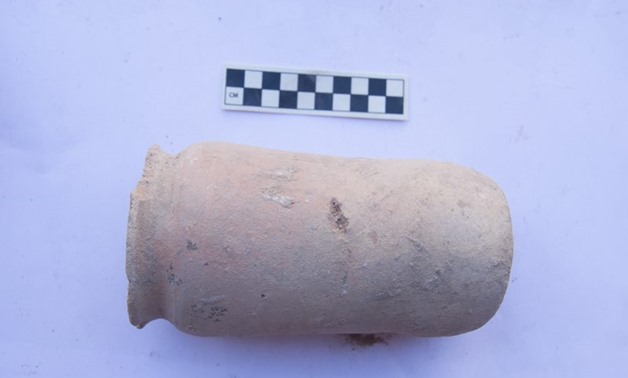
CAIRO – 3 July 2018: The Ministry of Antiquities found a cache containing hundreds of pottery vessels, dating back to the beginning of the Greco-Roman era, the Coptic era and the Islamic era.

pottery 1


Head of the Supreme Council of Antiquities, Mostafa el-Waziri, said that the discovered potteries were examined carefully in order to be documented and preserved in the storehouses.

pottery 3


Head of the Egyptian Antiquities Sector, Ayman Ashmawy, said that it seems that during the Second World War between 1939 and 1945, the famous British archaeologist, Alan Rowe, along with Graeco-Roman Museum officials hid a number of pieces in the garden of the Greco-Roman Museum to protect them from being looted or damaged.


The discovered items include vessels which contain ashes of dead people; these vessels were used to bury the ashes during the Hellenistic period in the Greek era.
The items also include a large collection of liquid vessels of various shapes and sizes, as well as crockery and colored pots, a large number of dishes which date back to the Greek, Roman and Byzantine periods and large quantities of glazed pottery decorated with geometric and vegetal drawings dating back to the Islamic era.

Such an archaeological discovery is very important because it unveils archaeological collections which have not been studied before, making it a reference for future archaeological studies.

It is worth mentioning that Egyptian archaeologists uncovered a statuette of Osiris while performing restoration works on the eastern side of the King Djoser Step Pyramid in Saqqara on Sunday.

Waziri, the head of the Supreme Council of Antiquities, announced that the statue was found in a small incision between the huge blocks of the pyramid's eastern façade.
Waziri added that the statuette is for Osiris, the god of resurrection and eternity, and depicts Osiris wearing the double crown, and holding a feather in one hand and a scepter in the other.

The statuette's height is 63 cm and its width is about 15 cm. Head of the Saqqara archaeological site, Sabri Farag, said that a priest of Saqqara probably concealed the statue in this area. The statuette is currently under restoration.

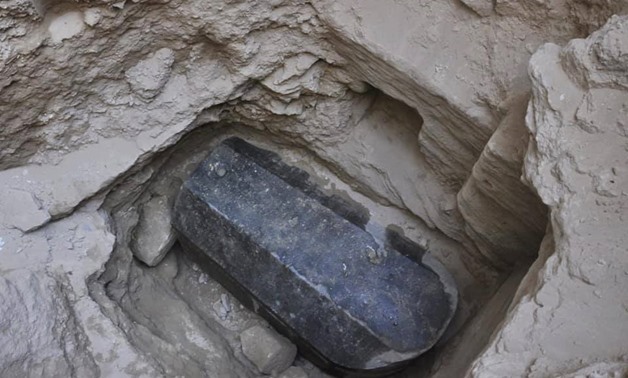
A 30-ton archeological sarcophagus was also found below a building in Alexandria governorate, Egypt, by the security forces on Sunday.

Inspection of the sarcophagus revealed that it is made of black granite; the security forces coordinated with the Engineering Department of the Armed Forces, as well as the Tourism police to extract the sarcophagus.

Ashmawy, head of the Ancient Egyptian Antiquities Sector, said that the tomb was found at a depth of five meters beneath the surface of the land. It is noted that there is a layer of mortar between the lid and the body of the sarcophagus, indicating that it had not been opened since it was closed.


pottery 4


--   Sent from my Linux system.

Finding Canopic Jars | South Asasif Conservation Project Blog


https://southasasif.wordpress.com/2018/07/03/finding-canopic-jars/

Finding Canopic Jars

We congratulate the team of the South Asasif Conservation Project on finding the canopic jars of the Lady of the House Amenirdis in the tomb of Karabasken (TT 391).

Fig. 0

The name of Amenirdis on the Duamutef canopic jar.

The discovery was recently announced by Dr. Mostafa Waziri. General Secretary of the Supreme Council of Antiquities.

It was an unforgettable day for (from left to right) Ali Hassan Ibrahim, Abdelrazk Mohamed Ali, Hussein Ahmed Hussein, Marion Brew, Katerina Ball and John Billman.

Fig. 1

The set of canopic jars was found on the 7th of May, 2018 in an intrusive burial compartment in the pillared hall of the tomb of Karabasken by the archaeologists Marion Brew, Katerina Ball, Hassan Mohamed Ali and Reis Mohamed Ali.  The room, accessed via a staircase carved between the 4th and 5th pillars of the southern side of the hall, was discovered in 2016.

Fig. 2

The shaft in the south-east corner of the room and burial chambers were cleared in April-May 2018. The 3m deep shaft leads to two burial chambers oriented to the east and west of the shaft. Both chambers were roughly carved and undecorated.

Fig. 3

The canopic jars were found in the eastern chamber in a nearly cubic cutting in the floor and photographed by Katherine Blakeney.

The happy moment of discovery was shared by Mohamed Shebib, inspector Hussein Ahmed Hussein, Abdelrazk Mohamed Ali, Katherine Blakeney and Reis Mohamed Ali.

Fig. 6

The jars and lids, made of Egyptian alabaster, needed emergency conservation performed by a team of MoA conservators including Ali Hassan Ibrahim, Mohamed Shebib, Ali Taib Mohamed, Taib Said Mohamed, and Mohamed El Azeb Hakem. Mohamed Shebib is performing injections.

Fig. 7

Canopic jars after conservation:

Fig. 8

The Jars were measured and registered by John Billman.

Many of the mission members gave their hears to Duamutef with his mischievous smile and elongated eyes.

Fig. 9

His erect jackal ears, connected by an area of negative space are elegantly indicated by two parallel incised lines. The jar was found in two pieces. The smoothness of the edges suggests this was the original construction and the pieces were joined in antiquity.

Fig. 10

Drawing by Katherine Blakeney.


The canopic jars will be published in the 3rd volume of the AUC series Tombs of the South Asasif Necropolis.

--   Sent from my Linux system.

Monday, July 2, 2018

Northern California ARCE Lectures Coming Up This Fall


American Research Center in Egypt (ARCE)

Northern California Chapter


Upcoming 2018 Lectures


ARCE's Northern California Chapter is pleased to present the following lectures by renowned Egyptologists. All lectures take place on the University of California Berkeley campus.


Visualizing Ancient Egyptian Coffins: The Book of the Dead in 3D

August 26 - 3:00 PM - Room 20 Barrows Hall

Dr. Rita Lucarelli, University of California Berkeley


White Walls: New Discoveries at Memphis

September 9 - 3:00 PM - Room 20 Barrows Hall

Dr. Galina Belova, Russian Academy of Science, Moscow


Ambassador of Ramses II Puts a New Face on Ancient Egyptian Diplomacy (Tentative title)

October 21 - 3:00 PM - Room 20 Barrows Hall

Dr. Alain Zivie, French National Centre for Scientific Research, Paris


Topic to be Determined

November 11 - 3:00 PM - Room 20 Barrows Hall

Tom Hardwick, Houston Museum of Art


The Deified Dead in the Pyramid Age

December 9 - 3:00 PM - Room 20 Barrows Hall

Dr. Julia Troche, Missouri State University


For more information, please visit arce-nc.org or facebook.com/NorthernCaliforniaARCE/


--   Sent from my Linux system.

Tactile Trip Around the World — July 7, 2018 : Things To Do : Arts & Entertainment : WHYY


https://whyy.org/articles/tactile-trip-around-the-world-july-7-2018/

Tactile Trip Around the World — July 7, 2018

On July 7, visually impaired visitors to the Penn Museum            will be able to touch certain ancient artifacts. (Credit: Penn            Museum)

On July 7, visually impaired visitors to the Penn Museum will be able to touch certain ancient artifacts. (Credit: Penn Museum)

Story Highlights

Tactile Trip Around the World
July 7, 10 a.m.-1 p.m.
Penn Museum
Entry is $15 for the general public, $7 for those with visual impairment

"Don't touch the artifacts" is pretty much rule No. 1 at any history museum. So, if you're curious about the texture of that ancient sculpture — or if vision loss prevents you from appreciating artworks from a distance — most of the time, you're out of luck.

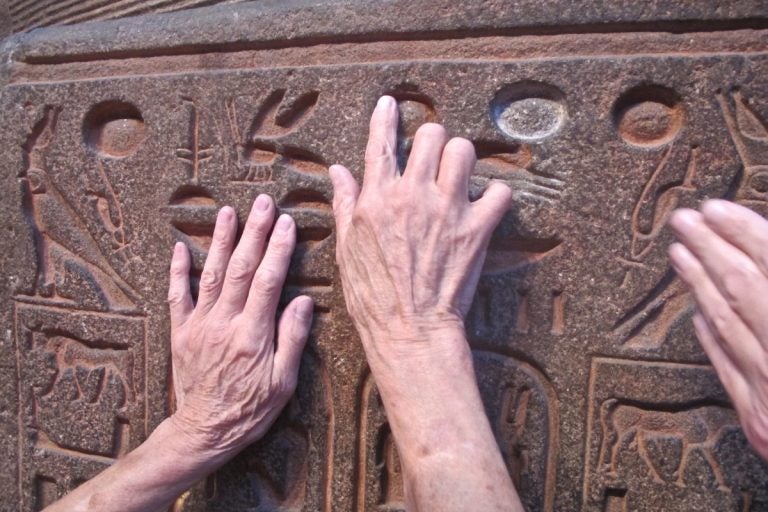
Not this Saturday at the Penn Museum, which is hosting its third Tactile Trip Around the World. All visitors will be able to touch and hold replica artifacts from the museum's Rome and Egypt collections. Visitors with visual impairments will be able to touch actual artifacts, including a 13-ton Egyptian sphinx, the largest in North America.

"All touch is damaging to artifacts," says Kevin Schott, the museum's education programs manager, but it poses the least threat to unpainted stone such as the sphinx. The museum limits those interactions to 200 a year during special programs like this one — and during tactile tours that anyone can schedule. Schott says granting this access specifically to those with vision loss opens up conversations that wouldn't be possible otherwise.

"Suddenly you put people with vision loss in the primary position, where they have information that others don't. So they can tell you if it's cool or if it's warm, if it's smooth or if it's rough," he said. With conserved artifacts that are a combination of the original material and a modern epoxy, "they can tell what is real and what is not, even though, visually, it matches completely."

The event is open to the public, though visitors must register online in advance. Schott encourages attendees with visual impairments to reach out to him directly to talk about accommodations. Attendance is included with regular museum admission, and discounted for people with vision loss. Personal attendants accompanying visually impaired guests are admitted at no charge.


--   Sent from my Linux system.

Egypt inaugurates touring exhibition of 190 ancient Egyptian artefacts in Italy - Politics - Egypt - Ahram Online


http://english.ahram.org.eg/NewsContent/1/64/306059/Egypt/Politics-/Egypt-inaugurates-touring-exhibition-of--ancient-E.aspx

Egypt inaugurates touring exhibition of 190 ancient Egyptian artefacts in Italy

Mohamed Al-Agroudy, Monday 2 Jul 2018
Egypt
Egyptian exhibition of Pharaonic artifacts in Italy (Photo: Mohamed Al-Agroudy)


Egyptian officials inaugurated on Monday in Viterbo, Italy the start of an exhibit of 190 ancient Egyptian artefacts as part of a cultural exhibition that is touring Italian cities for six months.

Egyptian antiquities ministry official Amr El-Tibi said that the exhibit includes the most important artefacts from the tomb of Tutankhamun, including the king's famous golden death mask, his war chariot and his bed.

The exhibit also includes a model of the cemetery at the Valley of the Kings in Luxor as well as replicas of the famous bust of Queen Nefertiti.

Egyptian ambassador to Rome Hisham Badr said during a speech at the inauguration that such events serve to boost relations between Egypt and Italy. Badr added that the exhibition reveals the interest of the Italian people in the Egyptian civilisation.

Bishop of Viterbo Cardinal Fumagalli, who recently returned from a religious pilgrimage to Egypt, called on Italians to visit Egypt to witness the country's unique and culturally diverse history.

The bishop said that Egypt is the cradle of human civilisation, the sanctuary of the Holy Family of Jesus Christ, and a safe destination for tourists.

Badr said that the cultural exhibition includes a series of artistic and cultural events, the most prominent of which are exhibits of replicas of ancient Egyptian and Coptic artefacts.

The cultural exhibition also features performances by Egyptian folklore ensembles, Badr said, adding that the event represents an important example of cultural cooperation between the two countries.

Eugenio Benedetti, president of the Italian NGO Benedetti, described the exhibition as a message and invitation for Italians to visit Egypt, which is considered a friendly country.

Benedetti added that Egypt is a safe country, stressing that it has not waged war against any country and is a friend of all nations.

--   Sent from my Linux system.

Archaeologists unearth 8.6 foot tall sarcophagus buried in Egypt beside a massive stone head | Daily Mail Online


http://www.dailymail.co.uk/sciencetech/article-5910269/Archaeologists-unearth-8-6-foot-tall-sarcophagus-buried-Egypt-massive-stone-head.html

Mystery of Alexandria's largest coffin: Archaeologists unearth 8.6-foot-long sarcophagus buried in Egypt 2,000 years ago beside a massive stone head

  • Experts say black granite sarcophagus found in Alexandria measures 8.6 ft long
  • It was buried 5m deep during Ptolemaic period, which lasted from 332-30 BCE
  • Archaeologists also found alabaster head, likely representing the tomb's owner

Egyptian archaeologists have discovered what's thought to be the largest granite sarcophagus ever found in Alexandria, measuring nearly nine feet long.

The massive stone casket was buried more than 16 feet beneath the surface alongside a huge alabaster head – likely belonging to the man who owned the tomb.

Experts say the ancient coffin has remained untouched since its burial thousands of years ago during the Ptolemaic period.

According to the archaeologists who led the                        dig, the black granite sarcophagus stands at 185                        centimeters tall (6 feet), 265cm long (8.6 ft),                        and 165 cm wide (5.4 ft). It's said to be the                        largest ever found in Alexandria 
According to the archaeologists who led the dig, the black granite sarcophagus stands at 185 centimeters tall (6 feet), 265cm long (8.6 ft), and 165 cm wide (5.4 ft). It's said to be the largest ever found in Alexandria 

Researchers working under the Supreme Council of Antiquities discovered the ancient tomb during an excavation in the Sidi Gaber district of Alexandria.

The team was inspecting a resident's land ahead of digs planned for the foundation of his building at Al-Karmili Street when they stumbled upon the remarkable Ptolemaic burial 5 meters deep.

The Ptolemaic period lasted roughly 300 years, from 332-30 BCE, making this particular site more than 2,000 years old.

According to the archaeologists who led the dig, the black granite sarcophagus stands at 185 centimeters tall (6 feet), 265cm long (8.6 ft), and 165 cm wide (5.4 ft).

A layer of mortar identified between the lid and body of the stone coffin indicates it has not been opened since it was sealed off, says Dr. Ayman Ashmawy, Head of the Ancient Egyptian Antiquities Sector.

Just who is buried inside, however – and the identity of the man in the alabaster carving – remains a mystery.

The massive stone casket was buried more                          than 16 feet beneath the surface alongside a                          huge alabaster head – likely belonging to the                          man who owned the tomb. Experts say the ancient                          coffin has remained untouched since its burial                          thousands of years ago
The massive stone casket was buried more than 16 feet beneath the surface alongside a huge alabaster head – likely belonging to the man who owned the tomb. Experts say the ancient coffin has remained untouched since its burial thousands of years ago

The massive stone casket was buried more than                        16 feet beneath the surface alongside a huge                        alabaster head – likely belonging to the man who                        owned the tomb
The massive stone casket was buried more than 16 feet beneath the surface alongside a huge alabaster head – likely belonging to the man who owned the tomb

Back in May, the Antiquities Ministry announced the discovery of yet another Ptolemaic find.   

The team unearthed the ruins of a huge Roman bath at the San El-Hagar archaeological site.

Alongside the 52-foot-long red brick structure, archaeologists also found pottery vessels, terracotta statues, bronze tools, a chunk of engraved stone, and a statue of a ram.

The most remarkable artifact, however, is among the smallest.

A gold coin depicting the face of King Ptolemy III, a 3rd century BCE ruler said to be an ancestor of Cleopatra, was also discovered at the site.

Researchers working under the Supreme Council                        of Antiquities discovered the ancient tomb during                        an excavation in the Sidi Gaber district of                        Alexandria. The team was inspecting a resident's                        land ahead of digs planned for the foundation of                        his building at Al-Karmili Street
Researchers working under the Supreme Council of Antiquities discovered the ancient tomb during an excavation in the Sidi Gaber district of Alexandria. The team was inspecting a resident's land ahead of digs planned for the foundation of his building at Al-Karmili Street

According to the Egyptian Ministry of Antiquities, the coin was made during the reign of King Ptolemy IV, in memory of his father.

It measures 2.6 centimeters across, and weighs roughly 28 grams. On the side opposite the portrait, letters translating to 'Land of Prosperity' were engraved, along with the name of the king.

The huge red brick building was likely part of a Greco-Roman era bath, says Dr. Ayman Ashmawy, Head of the Ancient Egyptian Antiquities.

It is roughly 16 meters long and 3.5 meters wide.

As work continues at the archaeological site, the researchers hope to uncover more details about the building and its function many centuries ago.

Excavations over the last few years have unearthed countless remarkable artifacts from ancient Egypt, which the country hopes will spur tourism to the area. 

The huge red brick building was likely part                        of a Greco-Roman era bath, says Dr. Ayman Ashmawy,                        Head of the Ancient Egyptian Antiquities. It is                        roughly 16 meters long and 3.5 meters wide

The huge red brick building was likely part of a Greco-Roman era bath, says Dr. Ayman Ashmawy, Head of the Ancient Egyptian Antiquities. It is roughly 16 meters long and 3.5 meters wide

The most remarkable artifact, however, is                        among the smallest. A gold coin depicting the face                        of King Ptolemy III, a 3rd century ruler said to                        be an ancestor of Cleopatra, was also found at the                        site

The most remarkable artifact, however, is among the smallest. A gold coin depicting the face of King Ptolemy III, a 3rd century ruler said to be an ancestor of Cleopatra, was also found at the site

WHAT IS EGYPT'S VALLEY OF THE KINGS?

The Valley of the Kings in upper Egypt is one of the country's main tourist attractions, situated next to the Giza pyramid complex.

The majority of the pharaohs of the 18th to 20th dynasties, who ruled from 1550 to 1069 BC, rested in the tombs which were cut into the local rock.

The royal tombs are decorated with scenes from Egyptian mythology and give clues as to the beliefs and funerary rituals of the period.

The majority of the pharaohs of the 18th                            to 20th dynasties, who ruled from 1550 to 1069                            BC, rested in the tombs which were cut into                            the local rock. Pictured are statues of                            goddesses at the site

The majority of the pharaohs of the 18th to 20th dynasties, who ruled from 1550 to 1069 BC, rested in the tombs which were cut into the local rock. Pictured are statues of goddesses at the site

Almost all of the tombs were opened and looted centuries ago, but the sites still give an idea of the opulence and power of the Pharaohs.

The most famous pharaoh at the site is Tutankhamun, whose tomb was discovered in 1922.

Preserved to this day, in the tomb are original decorations of sacred imagery from, among others, the Book of Gates or the Book of Caverns.

These are among the most important funeral texts found on the walls of ancient Egyptian tombs.

The Valley of the Kings in upper Egypt is                            one of the country's main tourist attractions,                            situated next to the Giza pyramid complex. The                            most famous pharaoh at the site is                            Tutankhamun, whose tomb was discovered in                            1922

The Valley of the Kings in upper Egypt is one of the country's main tourist attractions, situated next to the Giza pyramid complex. The most famous pharaoh at the site is Tutankhamun, whose tomb was discovered in 1922

--   Sent from my Linux system.

Sotheby's auction vies with Christie's on selling Egyptian antiquities in London - Egypt Today


https://www.egypttoday.com/Article/4/53190/Sotheby-s-auction-vies-with-Christie-s-on-selling-Egyptian
An Egyptian Limestone Relief of Meruka, Prophet of Khufu,          late 5th/early 6th Dynasty, circa 2350-2250 B.C. - An Egyptian Limestone Relief of Meruka, Prophet of Khufu, late 5th/early 6th Dynasty, circa 2350-2250 B.C. -

Sotheby's auction vies with Christie's on selling Egyptian antiquities in London

Mon, Jul. 2, 2018
CAIRO – 2 July 2018: Sotheby's auction on Sunday vies with Christie's auction on selling Egyptian antiques on the same day and time in London.

Sotheby's auction sells the Egyptian artifacts under the title "Antiquates", while Christie's auction sells them under "Sculpture and old arts".

One of the most prominent artifacts exhibited in the Sotheby's auction is an ancient limestone statue called Nakht-ankh which dates back to 1800 – 1700 BC, with an estimated price of $ 1- 1.5 million.

Sotheby's auction also exhibited a multicolored mummy mask dating back to 1075 - 1716 BC, with an estimated price £100,000 - £ 150,000.

Also, the auction exhibited an 18th Dynasty limestone statue from the reign of Apries, 589-570 BC, with an estimated value of £ 120,000- 180,000 and a wooden piece of a mummy of a girl from the Roman era, with an estimated value of £60,000 – 90,000.

Furthermore, the auction exhibited many small Pharaonic statues, including a bronze statue of an Egyptian member of the Amon family, dating back to 946 to 600 BC, with an estimated value of £7,000 - £10,000.

a
An Egyptian Basalt Bust of Tuthmosis III, 18th Dynasty, reign of Tuthmosis III, 1479-1426 B.C. - CC

Christie's auction offered an Egyptian fossil limestone jar, from the first and second dynasties, dating back to 3000-2650 BC, as well as an Egyptian anorthosite gneiss bowel, from the first and second dynasties, dating back to 3000 – 2650BC.

a
An Egyptian Fragmentary Black Basalt Head of a Man, 12th Dynasty, period of Amenemhat III, 1818-1772 B.C.- screen shot from Sotheby'a auction website

--   Sent from my Linux system.

The God statue Discovered in the First Ancient Egyptian Pyramid | Luxor Times


http://luxortimesmagazine.blogspot.com/2018/07/the-god-statue-discovered-in-first.html


During the restoration work of Djoser (Zoser) step pyramid in Sakkara, a bronze statue of the ancient Egyptian God Osiris was found.


The team working at the site discovered the statue during the restoration and preservation work of the west side of the pyramid.

Dr. Mostafa Waziry, Secretary General of the Supreme Council of Antiquities, said that the statue was found inside a small hole (gap) between the large stone blocks of the pyramid's façade while removing the debris.
The Statue represents God Osiris standing holding a feather in one hand and sceptre in the other hand wearing Atef crown. The statue has traces of gypsum in some parts.

The statue measures 63 cm height (2 feet and 1 inch) and 15 cm width at the widest part.
Mr. Sabry Farag, General Director of Sakkara antiquities, said that the statue dated to late period and it was probably put in this gap by one of the priests to keep it safe and as a symbol of Osiris relation to the resurrection.
Osiris statue is now at the restoration lab in Sakkara's antiquities storehouse.

#Egypt #Cairo #Sakkara #StepPyramid #Pyramids #AncientEgypt #Osiris #Discovery #History #Saqqara

Posted by

--   Sent from my Linux system.

Egypt Revamps Historical Landmarks | Al Bawaba


https://www.albawaba.com/editorchoice/egypt-embarks-upbeat-historical-landmarks-1152602

Egypt Revamps Historical Landmarks

Published July 1st, 2018 - 10:38 GMT via SyndiGate.info


The Baron's              Palace(Twitter)
The Baron's Palace(Twitter)

Minister of Antiquities Khaled Al-Anany announced that the next period will witness substantial discoveries and openings.

In his first statement since being reinstated in Mustafa Madbouly's government, Anany told press that the new government is very keen on revolutionizing historical areas and providing the correct advertising for them abroad, to show Egypt as a safe and attractive country to the world.

He added that several important historical sites will be opened or partially opened by the end of the year including: The Baron's Palace, Mohamed Ali Palace and Al-Kebash Road. Anany also announced the engineering plan for renovating the Pyramids area will be done by July, except for cables. As for the Grand Egyptian Museum (GEM) logo he admitted: "I am not totally satisfied with the current logo.

However, this is only a temporary logo to announced the opening of the first phase.

On the other hand, why didn't anyone notice that all except two museums in Egypt have no logos to begin with?" The minister then announced that a series of international competitions will be launched to design logos for all the museums.

Back to GEM, the minister declared that the museum's first phase will be over by the end of 2018. The museum will receive its first display window, which is being transported from Germany, within the next few days,he added. He also announced that President Abdel Fattah Al-Sisi ordered the museum to be funded directly through the state budget, giving it a LE100 million/month budget.

Finally, Anany announced that Egypt is about to construct its first antique reproduction factory, with a LE one million budget, to cover productions to be sold locally and internationally. All samples will have the Supreme Council of Antiquities' stamp.

--   Sent from my Linux system.

Sunday, July 1, 2018

Egypt Egypt prepares for tourism influx


http://www.ttnworldwide.com/Article/280108/-Egypt-prepares-for-tourism-influx-
Egypt prepares for tourism influx
July 2018 247

The Grand Egyptian Museum (GEM), the largest and most significant cultural project in process globally, is going to be partially opened in the first quarter of 2019, with the first phase completed by the end of 2018.

The Grand Egyptian Museum will witness for the first time the display of all Tutankhamun's artefacts gathered in one place. GEM's lobby will host the statue of King Ramesses II and the column of his son King Merneptah, the grand staircase will include 87 royal statues and large architectural elements including a statue of Kings Khafre, Menkaure, Senusret, Akhenaten and Amenhotep III.

Last month, Egypt's tourism minister Dr Rania Al Mashat, said, "Egypt is the world's capital of cultural tourism. [Visitors] will witness chapters of civilisation unfold with 50,000 pieces of unique artefacts, housed in a modern architectural building that will utilise state of the art technology to educate in an engaging way. The location of the GEM with the stunning Great Pyramid of Giza as a backdrop, will be a sight to behold for visitors and hugely uplifting and inspirational for all, whatever their age and wherever they're from."

To complement the GEM, the Giza plateau is undergoing a renovation project to include boutique hotels, restaurants and cinemas. "Interactive technology will be used to communicate antiquities in an engaging and enjoyable way that we have not done before. This will have a profound and positive impact on tourism in our country," promised the country's first lady tourism minister, who has been in office since this January.

"Younger generations and millennials who seek state-of-the-art interactivity to gain an authentic experience of an ancient world. They represent the fastest-growing demographic of travellers around the world, a community that we must, and will, look to attract."

Arab tourism represents around 30 per cent of total tourists to Egypt with the lion share being from the GCC, and the future outlook is positive according to the minister, with the first quarter this year witnessing a steep increase in tourist numbers.

In 2010, 14.7 million tourists visited Egypt. In the first quarter of 2018, the inflow was 2.38 million, which represents an increase of 37 per cent compared to last year. The revenues of the Egyptian tourism industry increased by 83 per cent in this period to $2.2 billion, according to official data.

Some eight million visitors set foot in Egypt last year. The first quarter of 2018 was quite positive for the country and that positive performance is forecast to continue for the remainder of 2018. Travel and tourism contributed $19.4 billion to Egypt's gross domestic product (GDP) in 2017 – about 9 per cent of total GDP – according to the World Travel and Tourism Council (WTTC).

Egypt has recorded the second highest number of major hotels in Africa, following South Africa, according to a report from global real estate consultancy Knight Frank. Egypt has 300 chain hotels and resorts across major cities, including Sharm El Sheikh
and Hurghada.

Fairmont Citystars Sharm El Sheikh is slated to open in 2018, and several Marriott- and Hilton-branded properties opening in development across Egypt. Rotana has signed on an agreement for a new 200-room, five-star hotel in New Cairo City. This is Rotana's second outpost in the country and will bring the company's total inventory in the country to 726 keys.

In 2017, Egypt's hotels reported a 55-per cent occupancy rate with ADR reaching $66, despite dropping tourist numbers following the Russian plane crash in October 2015 and the 2011 revolution. However, according to WTTC, Egypt in 2017 was the world's number one nation for growth in direct contribution of travel and tourism to GDP (+72.9 per cent), leisure travel spending (+80.4 per cent) and employment (+33.5 per cent).  


--   Sent from my Linux system.

In pics: Antique sarcophagus found by security forces in Alexandria - Egypt Today


https://www.egypttoday.com/Article/4/53155/In-pics-Antique-sarcophagus-found-by-security-forces-in-Alexandria
A 30-ton archaeological sarcophagus was found below a          building in Alexandria governorate, Egypt - Ministry of          Antiquities official Facebook page A 30-ton archaeological sarcophagus was found below a building in Alexandria governorate, Egypt - Ministry of Antiquities official Facebook page

In pics: Antique sarcophagus found by security forces in Alexandria

Sun, Jul. 1, 2018

CAIRO – 1 July 2018: A 30-ton archeological sarcophagus was found below a building in Alexandria governorate, Egypt, by the security forces on Sunday.

Mostafa Waziri, General Secretary of the Supreme Council of Antiquities announced.

a


Inspection of the sarcophagus revealed that it is made of black granite of about 265 meters in length and it has a height of 185 cm; the security forces coordinated with the Engineering Department of the Armed Forces, as well as the Tourism police to extract the sarcophagus.

Ayman Ashmawy Head of the Ancient Egyptian Antiquities Sector said that the tomb was found at a depth of 5 m beneath the surface of the land. It is noted that there is a layer of mortar between the lid and the body of the sarcophagus indicating that it had not been opened since it was closed in antiquity.

Alexandria is full of ancient Egyptian antiquities, which makes citizens illegally dig to search for these monuments below their buildings.

In 2015, the security forces arrested three brothers with 35 artifacts in their possession; the brothers were digging below their homes in search for more artifacts.

a
--   Sent from my Linux system.

Interview: 1st Chinese archaeological mission in Egypt to commence in Sept.: antiquities minister - Xinhua | English.news.cn


http://www.xinhuanet.com/english/2018-07/01/c_137293837.htm

Interview: 1st Chinese archaeological mission in Egypt to commence in Sept.: antiquities minister

Source: Xinhua| 2018-07-01 20:31:43
EGYPT-CAIRO-ANTIQUITIES MINISTER-INTERVIEW

Egyptian Antiquities Minister Khaled al-Anany receives an interview with Xinhua in Cairo, Egypt, on June 28, 2018. Egyptian Antiquities Minister Khaled al-Anany said in a recent interview with Xinhua that the first-ever Chinese archaeological mission in Egypt will start working this September. (Xinhua/Ahmed Gomaa)

CAIRO, July 1 (Xinhua) -- Egyptian Antiquities Minister Khaled al-Anany said in a recent interview with Xinhua that the first-ever Chinese archaeological mission in Egypt will start working this September.

"The Chinese mission has completed all the procedures to work in Egypt ... their work will start in September in Upper Egypt's city of Luxor," al-Anany told Xinhua.

He added that the mission has chosen Luxor as it is rich in many uncovered ancient Egyptian antiquities.

The minister hailed the cooperation between Egypt and China as both countries have deep roots in their ancient civilizations, mainly in the archaeological field, saying Egypt is proud of its strong ties with China.

"We send many experts to China every year to exchange experience," he revealed.

China now holds the world's leading three-dimensional remote sensing and imaging technology, as well as advanced indoor testing and analysis techniques, which will allow Chinese archaeologists to help their Egyptian counterparts discover buried treasures.

In another interview with Xinhua, Wang Wei, the former head of the institute of archaeology under the Chinese Academy of Social Sciences (CASS) said the CASS will collaborate with Egyptian experts to carry out archaeological excavations, cultural relics protection, safety monitoring and control in key sites in Egypt.

He also said that the Chinese institute will help train Egyptian experts in the protection of archaeological discoveries.

Egypt has been working hard to preserve its archaeological heritage and discover the secrets of Pharaohs and other ancient civilizations across the country in a bid to revive the country's ailing tourism sector which has been suffering an acute recession over the past few years due to political turmoil and relevant security issues.

Official Egyptian statistics revealed that Egypt's tourism revenues jumped 123.5 percent year-on-year to 7.6 billion U.S. dollars in 2017.

However, these figures remain below the benchmark in 2010 when tourists visiting Egypt brought in around 12.5 billion dollars in revenue.

Speaking about the financial situation of his ministry, al-Anany said, for the first time in years, the ministry's income has climbed to reach 65 million Egyptian pounds (3.64 million dollars) per year, adding that the ministry's income is used in the restoration and development of archaeological sites.

However, the minister said the debts of the ministry have so far reached 6 billion pounds, as the Egyptian Ministry of Finance spends about 75 million pounds per month to pay the salaries of the 32,414 employees of his ministry.

Al-Anany said the ministry, backed by the government and other international donors, is doing its best to uncover and preserve the country's antiquities, adding that this will help Egypt revive its tourism sector, one of the main pillars of the country's economy.

He revealed that opening of several archaeological projects across Egypt will be witnessed after getting the necessary funding for their completion.

"An important archaeological discovery will be announced on July 14," he said.

Speaking about the under-construction Grand Egyptian Museum (GEM) near Cairo, the minister said the first phase of the project will be finished by the end of this year, and it will be ready for opening during the first quarter of 2019.

The GEM can accommodate 100,000 artifacts: 50,000 will be in constant display and another 50,000 will be stored in modern storehouses. And 30,000 artifacts have never been displayed before.

The total area of the grand museum, initiated in 2001, is about half a million square meters.

Meanwhile, Al-Anany said Egypt is keen on fighting illicit trafficking and the robbery of archaeological objects as well as retrieving all of its smuggled ancient artifacts, saying the ministry has retrieved a large number of Egyptian relics from Italy days ago.

KEY WORDS:antiquities
--   Sent from my Linux system.

Osiris statuette discovered between blocks of Saqqara step pyramid - Ancient Egypt - Heritage - Ahram Online


http://english.ahram.org.eg/NewsContent/9/40/305974/Heritage/Ancient-Egypt/Osiris-statuette-discovered-between-blocks-of-Saqq.aspx

Osiris statuette discovered between blocks of Saqqara step pyramid

Nevine El-Aref , Sunday 1 Jul 2018
osiris
osiris statuette
During restoration work being carried out on the eastern side of the King Djoser Step Pyramid in Saqqara, archaeologists discovered a statuette of Osiris.

Head of the Saqqara archaeological site Sabri Farag said that the statuette was discovered in a small crevasse between the huge blocks of the pyramid's eastern façade.

The statuette depicts Osiris, the god of resurrection and eternity, with the double crown, holding a feather in one hand and a sceptre in the other.

"The statue was probably concealed in this area by a priest of Saqqara in antiquity," Farag said, adding that the artefact is undergoing restoration.

osiris
the hole where the statuette was found

--   Sent from my Linux system.