Archaeologists have recently unearthed a treasure trove of ancient goodies at the Sa El-Hagar excavation site in the fertile Nile Delta of Lower Egypt, according to an announcement made by Egypt's Ministry of Antiquities last week.
Inside the ancient remains of a vast red-bricked building, they discovered a huge collection of gold coins, bronze tools, pottery vessels, hieroglyphic-engraved stones, and a terracotta statue of a ram (pictured below). Dr Ayman Ashmawy, Head of the Ancient Egyptian Antiquities, believes the 16-meter-long (52-feet) structure was a part of a bathhouse dating back to the Greco-Roman era.
A more precise dating was made thanks to a gold coin depicting King Ptolemy III, who ruled Egypt from 246 to 222 BCE, with a particularly spiky-looking crown. On the other side of the coin, there's a symbol that appears to be a cornucopia, also known as a horn of plenty, an emblem used in classical antiquity and the present-day to symbolize prosperity and nourishment.
The coin is no larger than a US quarter. Egypt's Ministry of Antiquities
The coin is believed to have been forged during the reign of his son, King Ptolemy IV, who commissioned the coins in memory of his late father. It might be over 2,000 years old, but it's still got its shine.
Alexander the Great conquered Egypt in 332 BCE, bringing a dose of Greek culture to the land. One of Alexanders seven "bodyguards", Ptolemy was set up as the governor of Egypt, establishing the Ptolemaic dynasty that ruled until around 30 BCE when they were eventually toppled by the Romans. The end of this period is most widely known by the story of the dynasty's last and notable ruler, Cleopatra VII. As famously depicted in two of Shakespeare's tragedy, she was an esteemed diplomat and lover of Roman leaders Julius Caesar and Mark Anthony.
The past few years have seen a constant stream of ancient treasures being unearthed by Egypt's Ministry of Antiquities. Just this month, they concluded an ambitious project that hoped to settle rumors of a hidden chamber behind the tomb of King Tutankhamun. The final conclusion of the survey came as a huge surprise to the Egyptologists and archaeologists who made the sensational and controversial claim.
Check out some of the rest of the team's recent discoveries in the images below.
The miniature statue depicts a ram. Egypt's Ministry of Antiquities Egypt's Ministry of Antiquities Egypt's Ministry of Antiquities
Earliest Version of Our Alphabet Possibly Discovered
By Owen Jarus, Live Science Contributor |
One side of the inscribed 3,400-year-old piece of pottery may show an ancient forerunner to our alphabet sequence.
Credit: copyright Nigel Strudwick. No reproduction without permission
The earliest example of our alphabet — a possible mnemonic phrase that helped someone remember "ABCD" — has been discovered on a 3,400-year-old inscribed piece of limestone from ancient Egypt, a scholar believes.
Three of the words start with the ancient equivalent of B, C and D, creating what may be a mnemonic phrase.
Thomas Schneider, a professor of Egyptology and Near Eastern Studies at the University of British Columbia, reported the discovery in a paper published recently in the Bulletin of the American Schools of Oriental Research. This discovery "would be the first historical attestation of 'our' alphabet sequence," he told Live Science in an email.
Modern-day scholars sometimes call the early ancestor of our ABCD alphabet sequence the "abgad" sequence, because this phrase mentions some of the first letters of the early version of our alphabet. Until this discovery, the oldest example of this sequence had only dated back about 3,200 years, Schneider wrote in his paper. [Cracking Codes: 5 Ancient Languages Yet to Be Deciphered]
The alphabet that we use today is derived from that used by the Phoenicians, a civilization that flourished between roughly 3,500 and 2,300 years ago in the Eastern Mediterranean. They used what scholars call a Semitic language, a term that refers to a branch of languages that trace their origins to the Middle East, each sharing some similar words. The early forerunner to our alphabet was written in Semitic languages. Few texts that are written in Semitic languages date back 3,400 years or more, however.
Earliest ABCDs?
A team of archaeologists from the Cambridge Theban Tombs Project, led by Nigel Strudwick, discovered the inscribed piece of limestone in 1995 in a tomb that belonged to an Egyptian official named Sennefer, and recently Schneider studied and deciphered it. While the text is written in hieratic — a form of Egyptian hieroglyphic writing — "all [the] words appear to be of foreign linguistic origin" and are mostly Semitic, wrote Schneider in his paper.
One side of the limestone piece contains a series of Egyptian hieroglyphic symbols that represent the words "bibiya-ta" (a word that can mean "earth snail"), "garu" (a word that can mean "dove") and "da'at" (a word that can mean "kite"), Schneider wrote in his paper. More than 3,000 years ago, the "g" would have represented the sound that "c" does today, Schneider told Live Science. This means that the first letter of each of these words is the ancient equivalent of "BCD." [Photos: 5,000-Year-Old Hieroglyphs Discovered in Sinai Desert]
There are symbols in front of these three words that are harder to interpret, but they could spell out "elta'at" (a word that can mean "gecko" or "lizard"), Schneider wrote in his paper.
It's possible that all the signs together formed the phrase "and the lizard and the snail, and the dove and the kite …" wrote Schneider in the paper — a phrase that may have helped the person who wrote the text to remember the proper order of the ancient forerunner of today's alphabet.
Another alphabetic sequence
The other side of the inscribed piece of limestone also contains a series of Semitic words written in hieratic, Schneider said. They spell out the words "hahāna lāwī ḥelpat mayyin leqab." The first letters of the first four words in that series — the letters "hlhm" — represent the first few letters of another ancient alphabetic sequence, one that never became as popular as the ancient forerunner to our alphabet.
These words form a phrase that means, "to make pleasant the one who bends reed, water [according] to the Qab." The "qab" is a unit of measurement that equals about 1.2 liters, Schneider wrote. This phrase likely helped the person who wrote this inscription to remember the first few letters of this alphabetic sequence, Schneider said.
Ben Haring, a senior university lecturer in Egyptology at Leiden University, was the first to recognize the "hlhm" sequence on this limestone piece and published a paper on it in 2015 in the Journal of Near Eastern Studies.
Semitic alphabet practice?
Whoever wrote these inscriptions 3,400 years ago may have been trying to remember the start of both alphabetic sequences, Schneider said. Sennefer was an official who dealt with Egyptian foreign affairs and likely understood the Semitic languages that were used in the Eastern Mediterranean, Schneider said.
When Sennefer's tomb was being constructed, perhaps the scribes helping to build the tomb were trying to learn the languages, and one of them wrote these words down as a practice exercise, Schneider told Live Science.
Schneider's article was recently published, and it remains to be seen how scholars will react to his findings.
Haring, who identified the "hlhm" sequence, said that he welcomes Schneider's work, but is cautious about the idea that the other side of the limestone piece bears evidence of the ancient forerunner to our modern alphabet sequence. A major problem with research into this piece of limestone is the lack of texts written in Semitic dating back 3,400 years, Haring said. This means that when scholars analyze the words, they have to use Semitic texts from later periods to understand them, even though their meanings could have been different 3,400 years ago, Haring said.
When Haring published his "hlhm" finding in 2015, he published it as a suggestion — even he wasn't convinced of his own discovery at the time. He said that since that time, his finding has received widespread acceptance among scholars. It remains to be seen if Schneider's finding will receive the same acceptance.
Editor's Note: The inscription was written on a piece of limestone not on a piece of pottery, as was previously indicated.
A large collection of Egyptian antiquities uncovered during a clean-up of a Sydney home has been donated to a university archaeological museum.
Rosemary Beattie recalls the oddity of being shown what was supposedly a mummified cat during childhood visits to her grandmother's house.
"We'd come and have a look and I'd think, 'Alright, OK, fine, that's the cat'," Ms Beattie said.
"But then I'd go and roll the cannonballs on the back verandah; that was much more my style."
The linen-wrapped item was one of the many antiquities her grandfather, Dr John Basil St Vincent Welch, brought back from his time serving as a medical officer in World War I.
Family members suggested the items be donated to the University of Sydney where both of the men had studied.
Archaeologist Candace Richards was ecstatic to learn about the existence of the collection.
"I was obviously very excited, confused and really intrigued by what could actually be in this home," said Ms Richards, the assistant curator of the university's Nicholson Museum.
"We do know that a lot of soldiers, especially in WWI and WWII, did buy genuine artefacts and we know there are lots of fakes out there."
The museum has since catalogued the 185 artefacts, which range from small amulets, scarab beetles, a coffin fragment, ceramic items and bronze Roman coins.
It is believed some objects date back to the first millennium BC.
"It's incredibly rare in Australia; we do have items from other WWI diggers but nothing on this scale."
One long-shaped object wrapped in linen and covered in resin is thought to be a mummified cat.
It will undergo medical imaging scans to confirm if does contain a feline within the wrapping.
"You can't unwrap these sorts of things because that destroys the artefact in itself," she said.
"But through these technologies that we use in medical science all the time, we can actually use them in Egyptology as well and understand more about those artefacts."
It is expected that many of the items will be displayed in an exhibition at a new museum facility expected to be completed by 2020.
Other relics found in the house included 500 photographic glass negative plates, swords, and a hand grenade originally kept by her father who served during WWII.
Medals belonging to two German soldiers will be personally returned to their rightful owners.
Ms Beattie's mother died soon after the Egyptian artefacts were donated, but the gesture has inspired her to uncover more about her family's history.
"Sadly [my grandfather] was never really talked about because he died, when my father was five or six weeks old, from influenza," she said.
"So we didn't really know much about this incredible man and we're now at this stage discovering he was fascinating and it's just sort of opened up a great big world to us."
Archaeologists have discovered the sprawling, 3,300-year-old tomb of an army general named Iwrhya at the ancient Egyptian site of Saqqara.
Hieroglyphic inscriptions found on the tomb walls say that Iwrhya "is a high army General, and High steward of the domain of Amun [and] High steward of the estates of Ramesses II in the domain of Amun," the Egyptian antiquities ministry announced in a statement today (May 8). Amun was an important godin Egypt (revered as the king of gods) around 3,300 years ago.
The tomb contains a number of rooms, including chapels, a forecourt and a room that excavators call the "statue room."
The art found in the statue room portrays the owner's military actions and foreign relations with neighboring countries, according to the statement. These scenes include "mooring boats taking down their loads of Canaanite wine jars," the statement said. The Canaaniteslived in modern-day Israel and Palestine, and were, at times, ruled by the Egyptians.
Additionally, a block "discovered in the sand [that was] probably detached from the northern wall shows quite an exceptional scene of an infantry unit and charioteers crossing a waterway with crocodiles," the statement said. Analysis of that scene suggests the crossing took place somewhere on the eastern border of Egypt, according to the statement.
Excavations are ongoing, and human remains have yet to be found in the tomb. It's possible that the tomb was used to bury multiple family members, such as Iwrhya's son, Yuppa, and grandson, Hatiay — both of whom were mentioned in the inscriptions. It's also possible that Iwrhya may have been of foreign descent, according to the statement.
A team led by Ola El Aguizy, a professor of Egyptology at Cairo University, discovered and excavated the tomb during the 2017-2018 field season. It is located at Saqqara to the south of a pyramid built by a pharaoh named Unas, who reigned more than 4,300 years ago. Saqqara contains a vast amount of archaeological remains that encompass thousands of years of Egyptian history.
Münster University archaeologists post research data from Sudan online
Geoinformation system allows interested parties to look at findings
University of Münster
IMAGE: Squares lined with stones and filled with gravel, and with mats or palm leaves as a bed, served as sleeping places in the Bayuda Desert in Sudan. The large number... view more
Graves, small huts or stone-lined sleeping places from antiquity and the Middle Ages: the "Wadi Abu Dom Itinerary" archaeological project being undertaken at the University of Münster's Institute of Egyptology and Coptology (Germany) is now putting its data online, gathered between 2009 and 2016 during field research in Sudan. Academics, as well as anyone in the general public who is interested, can use a browser-based geoinformation system (WebGIS: http://wadi-abu-dom.de/web-gis-2/) to take a look at the findings.
"By providing free access to the data, our aim is not only to meet today's expectations as regards making research transparent", explains project leader Prof. Angelika Lohwasser from the Institute of Egyptology and Coptology. "What we are also hoping for is a rapid and uncomplicated exchange of data." The WebGIS was developed in collaboration with the Institute of Geoinformatics and is currently also being used by Münster University archaeologists in the excavations at Doliche, in modern Turkey, which are being undertaken by the Asia Minor research unit.
A comprehensive field inspection, as well as aerial surveys of the riverbank areas of the dried-up Wadi Abu Dom river system in the Bayuda Desert in Sudan - rivers which only sporadically contain water - were all carried out as part of the "Wadi Abu Dom Itinerary" research project. In doing so, the team of twelve mapped all the structures of cultural and historical relevance visible on the surface of the terrain. All archaeological findings are shown as geospatial point data and area data in Web GIS and arranged by category. In addition, users can access further information for all the findings, and, in many cases, photos too.
Digital working methods were already playing an important role during the field research. The project team recorded the archaeological data while on the terrain, using small computers and a mobile GIS. This not only speeded up the work process, but also made scientific evaluation work easier.
Not only academics, but also non-specialists who are interested can temporarily upload their own data into the application and compare them with those from the "Wadi Abu Dom Itinerary" project. This is a fast, uncomplicated way of seeing whether, and in what form, the relevant archaeological findings have already been recorded by the Münster team of researchers. "In addition to an easy link-up with research projects both at home and abroad", says Angelika Lohwasser, "what we're hoping for is public involvement. Anyone anywhere in the world who is interested, who has visited Sudan as a tourist or who is exploring these remote areas with the aid of programmes such as Google Earth, can compare any structures they have found which might be of archaeological relevance with the results gathered by the specialists. If they are not sure about something, they can contact us and - in the sense of 'people's science', in the best sense of the term - help us to complete our picture of the cultural history of Sudan."
###
The project was funded by the German Research Foundation and the Qatar Museums Authorities (Qatar-Sudan Archaeological Project).
Disclaimer: AAAS and EurekAlert! are not responsible for the accuracy of news releases posted to EurekAlert! by contributing institutions or for the use of any information through the EurekAlert system.
■ Nicky Nielsen, lecturer in egyptology, University of Manchester
WHEN the ancient Egyptian priest and landowner Heqanakhte wrote a series of rather acerbic letters to his extended family sometime during the 12th Dynasty (1991-1802BC), he could not have known that he was creating the framework around which the British crime writer Agatha Christie (1890-1976) would, some 4,000 years later, weave one of the world's first historical crime novels.
Death Comes As The End (1944) is the only one of Christie's novels not to be set in the 20th century and not to feature any European characters. The death of a priest's concubine sets off a series of murders within the family and, as in Christie's more familiar 20th-century whodunnits, the scene is soon littered with bodies. The book is due to be adapted for the screen by the BBC in 2019.
While there are numerous plot parallels in the Heqanakhte Letters (as these papyri would come to be known), the letters themselves provide an unparalleled glimpse into land management and everyday family life in ancient Egypt. In the letters, Heqanakhte provides his children with meticulous calculations of crop yields and instructions for land investments followed by the stern injunction that he would consider any deviation from his instructions akin to theft.
The letters also contain allusions to some disharmony within the family caused by the recent addition of Heqanakhte's second wife to the household, much like in the novel where the arrival of Imhotep's concubine Nofret provokes murderous hatred.
Inspiration: Heqanakht Letter I, Rogers Fund and Edward S. Harkness Gift, 1922 PICTURE: NEW YORK METROPOLITAN MUSEUM OF ART
The Heqanakhte Letters are trivial in their content but unique in their form: It is very rare for this level of detail concerning the family dynamics to survive the thousands of years that separate us from Middle Kingdom Egyptians. The letters were found in the 1920s by American archaeologists from the Metropolitan Museum of Art while excavating the tomb of the Middle Kingdom vizier Ipi near modern-day Luxor. Translations of the papyri and scholarly investigations followed shortly afterwards, a study that continues to this day.
Christie in Egypt
Christie certainly knew a thing or two about both ancient and modern Egypt. She first visited the country as a young woman in the winter of 1910, staying with her mother Clara for three months at Cairo's glitzy Gezirah Palace Hotel. The experience had a clear impact on her — her first (unpublished) novel Snow Upon The Desert (1910) was set in Cairo.
Later, she drew further on her experience of life in Egypt and the experience of tourists visiting the country during the first half of the 20th century when writing the short story The Adventure Of The Egyptian Tomb (1923) and, 14 years later, Death On The Nile, which follows the orotund Belgian detective Hercule Poirot as he attempts to solve the (some might argue needlessly complicated) murder of a wealthy heiress honeymooning in the Land of Pharaohs. In other words, peak Christie.
Adventures abroad: Agatha Christie with Max Mallowan at Tell Halaf in Syria
Christie's marriage to British archaeologist Max Mallowan in 1930 reinforced her fascination with the ancient Near East and ancient Egypt. The marriage — and the financial success of her novels — provided her with ample opportunity to travel both as a tourist and an archaeologist in the region, experiences that in turn resulted in the autobiographical Come Tell Me How You Live (1946) and inspired further travels for her fictional Belgian detective in Murder In Mesopotamia (1936) and Appointment With Death (1938).
Bringing Egypt to life
However, it was her friendship with the Egyptologist Stephen Glanville, a professor at University College London who served with Mallowan during World War II, that prompted her to explore the possibility of writing a historical whodunnit, moving her narrative from Art Deco drawing rooms to the dusty desert on the Theban West bank. Death Comes As The End was written by Christie during the height of war and, as Christie herself states in the author's note, 'the inspiration of both characters and plot was derived' from the Heqanakhte letters. Glanville served as a historical sounding board and consultant, a role for which he was eminently suited, having written the seminal book Daily Life in Ancient Egypt in 1930.
While the book received praise from critics upon its publication in 1944, it did cause some ructions in Christie's own family life. Mallowan was not altogether happy that she had collaborated with Glanville. He wrote to Glanville expressing concern about the work, to which Glanville rather pointedly replied: 'I am not clear whether you are afraid that the book will damage her reputation as a detective story writer, or whether you think that archaeology should not demean itself by masquerading in a novel.'
Death Comes As The End is not among Christie's most famous works, but it remains a fascinating experiment: a marriage between archaeology, Egyptology and fiction writing, a formula many later authors have dutifully followed. Along with Christie's other works set in Egypt and the Near East it is also a tangible testament to the enduring fascination Western societies have for these ancient cultures.
Left to right: Possible brother of Snefrusonb, unknown male, unknown head, Prince Sneferu-seneb, Princess Meritites. Public Domain
In 1894, the French archaeologist Jacques de Morgan made a perplexing discovery in the royal necropolis of Dashur. In a tomb dating around the reign of Snefru (beginning 2613 B.C.) during Egypt's fourth dynasty, he found an odd sculpture of a human head. This object, known as a reserve head, has puzzled and inspired scholars for over a century.
In total, 31 reserve heads have been discovered. Of these, 27 were found in tombs at the royal necropolis of Giza, 15 miles southwest of Cairo. The sculpted heads, found in tombs of aristocrats and members of the royal family, including Princess Meretites III, share many common features. Sculpted during the Old Kingdom (2613-2181 B.C.), the heads are often made of limestone, with the bottom of the neck working as a sort of base to allow the object to stand. The features are soft and at times personalized (perhaps to resemble the deceased inhabitant), and the hair is always shaved or cropped close. There is evidence that at least some of the heads were painted. The remnants of plant-based red paint on one head has led to the hypothesis that it was for some reason painted entirely in a bold red.
Grave robbers and thrill seekers have looted and scattered the heads over millennia. However, according to Nicholas Picardo, Professor of Near Eastern Languages and Civilizations at Harvard, and a research associate at the institution's Giza Project, researchers have been able to pin down the heads' original locations.
"Although all known heads had been disturbed from their exact original placements before their discovery in modern times, all signs point to them having been set up somewhere in the underground sections of tombs, somewhere from the burial shaft to the subterranean burial chamber," he says. "As a general rule, funerary statues went above ground, ideally in a chapel that was part of the tomb's superstructure or in a small room built specifically to contain it. Placement underground is quite odd."
The heads' functions have been harder to pin down. "In a sense, all tomb statues were stand-ins, or 'reserves,' for people whose mortal lives had ended," Picardo says. "However, the 'reserve heads' specifically got their name from an early theory that they were spares—or again, 'reserves'—to replace a dead person's actual head in case it was lost or destroyed." Mummies were often tampered with post-entombment, as a result of natural occurrences or grave robberies.
While this theory has fallen out of favor, it is in a sense accurate. "They were physical representations of the deceased that could be embodied by one aspect of a person's 'spirit' (for lack of a better modern word) when it crossed back into the mortal plane of existence from the afterlife," says Picardo.
Complicating everything is the fact that a number of the heads seem to have been intentionally mutilated. According to Catharine H. Roehrig, Egyptologist and curator at the Metropolitan Museum of Art in New York, the most common disfigurements include the removal or destruction of the statues' ears. Many heads also feature scratches or gouges tracing from the top of the head down to the nape of the neck.
A male reserve head found in the shaft of a tomb c. 1915. Public Domain
There have been several theories put forward to explain the damage. Peter Lacovara, Director of The Ancient Egyptian Heritage and Archaeology Fund, believes the heads were actually sculptors' guidelines or molds, and thus easily damaged. A bit of plaster on one of the statues has led some to believe that it was perhaps used to make uniform plaster molds of the deceased. And Egyptologist Roland Tefnin surmises that the heads had been symbolically "killed" to protect the deceased.
Picardo's theory is somewhat similar. He believes the reason the heads were mutilated has more to do with where the objects were placed—underground, in a sealed off, sacred area— than their functions as tomb statuary. "Just like the buried Egyptian was thought to reanimate in the afterlife after proper burial," Picardo says, "apparently other things could also 'come to life,' so to speak, in that potent, sacred space."
"If a reserve head was thought to depict the deceased Egyptian essentially already in a decapitated state, and their placement in tomb space meant that this could become a terrible reality in the next life, then some sort of fix would have been in order—if not elimination of the reserve heads altogether," he explains. "Damaging them in relatively minor ways may have accomplished this corrective without destroying them completely."
Whatever the reserve heads' real meaning, they offer a personalized, human glimpse at the faces of ancient Egypt. One of Picardo's favorite statues is of a man known as Nefer/Nofer, now at the Museum of Fine Arts in Boston, which has eight reserve heads in its collection. "He has a prominent and particularly shaped nose, a feature that appears also in relief decoration from his tomb chapel. This points to Egyptian sculptors of this time actually trying to capture individual likenesses in the statues they were crafting, as opposed to more idealized or standardized representations of the human form, as was the general rule," Picardo says. "Although … having a fairly prominent nose myself, it may be that I just identify with him a little."
Egypt becomes first Arab country to chair UNESCO subcommittee of 1970 cultural property treaty
Egypt was unanimously selected on Friday to be the head of UNESCO's subcommittee, the 1970 Convention on the Means of Prohibiting and Preventing the Illicit Import, Export, and Transport of Ownership of Cultural Property, which is an international treaty, according to state-owned EgyNews. The selection makes Egypt the first Middle Eastern country to head the committee …
Egypt was unanimously selected on Friday to be the head of UNESCO'ssubcommittee, the 1970 Convention on the Means of Prohibiting and Preventing the Illicit Import, Export, and Transport of Ownership of Cultural Property, which is an international treaty, according to state-owned EgyNews.
The selection makes Egypt the first Middle Eastern country to head the committee and it will do so for a year.
Egypt's Ambassador to France and Permanent Representative to UNESCO Ihab Badawi said that this reflects the appreciation other participating countries feel towards the role Egypt plays in promoting international efforts to prevent illegal trade of cultural properties.
He also added that the Egyptian delegation to UNESCO will focus on intensifying the work of the committee to achieve a breakthrough in its field internationally, especially with the important attention Egypt pays to retrieving all of its illegally smuggled artefacts.
Before the selection, Egypt participated in the 21st Session of the Intergovernmental Committee for Promoting the Return of Cultural Property to its Countries of Origin or its Restitution in case of Illicit Appropriation last week, where it offered its vision for enhancing the committee's procedures in preventing artefact smuggling and discussed options to prevent online trade of illegal antiquities.
The treaty, signed in 14 November 1970, includes 136 countries. The treaty has several committees, and the subcommittee Egypt is currently chairing is the treaty's latest, formed in 2013.
The treaty focuses on the required procedures and rules in order to prevent a country from forcibly losing its cultural property whether through occupation or theft.
Cultural property is defined, according to the treaty, as the possessions countries decide hold importance for history, art, literature, antiquities, and education. That includes discovered antiquities, parts of ancient art sculptures or paintings, coins, ancient handmade products, and rare inscriptions.
2,200-year-old gold coin depicting King Ptolemy III discovered in Egypt
A 2,200-year-old gold coin depicting ancient King Ptolemy III Euergetes, who born in Kos, Greece in 284 B.C. and was an ancestor of Cleopatra, ruling Egypt from 246 B.C. to 222 B.C, has been unearthed by archaeologists in Egypt.
The coin from the 3rd century B.C, was discovered during the excavation of a large, unearthed, red brick building from the Greco-Roman period at the San El-Hagar archaeological site in Northern Egypt.
Archaeologists excavating the site from the Greco-Roman period in Egypt
One side of the coin shows the face of King Ptolemy III Euergetes wearing a crown and the other side depicts a symbol of prosperity in the shape of cornucopia surrounded by the King's name.
Egyptian Ministry of Antiquities said the coin was made sometime during the reign of King Ptolemy IV in memory of his father, in the period of 221 B.C. to 205 B.C.
The value of the coin has not yet been revealed.
Other items discovered at the site were bronze tools, pottery, a stone fragment engraved with hieroglyphs, a small statue of a ram at the site in the Nile Delta and terracotta statues.
Plans have been made by the archeologists to continue their excavation work to find out more about the building.
Antonia Komarkowski is a second year student at the University of Sydney majoring in Modern Greek & Media & Communications. She is also on the Hellenic Club Sydney Youth Board. From a young age she loved dancing, public speaking, presenting, performing, m'cing, reading & writing. Antonia also has a passion for her Greek culture, which started at a very young age. Her parents say, "She could Greek Dance before she could run." She loves learning about Greece's rich history, traditions, music &language & teaches Greek dancing. Seeing kids smile every time they dance makes her ecstatic- as she knew that feeling. GCT is happy to have Antonia on board as a permanent writer.
More than 30 Ramadan soap operas are airing this year, tackling topics from terrorism and corruption to revolution and the police.
Sunday 03/06/2018
From the studio to the courthouse. Billboards for TV Ramadan series are seen in the streets of Cairo, on May 15. (AFP)
CAIRO - No sooner had the television series "Roba Rumi" ("Quarter of a Kilo of Rumi Cheese") begun airing than it was the target of several lawsuits.
The court cases were filed by people who say the series, one of many airing during Ramadan, humiliates them. The plaintiffs include lawyers who allege the series makes fun of them, antiquities specialists who claim the drama accuses them of corruption and historians who say the programme incites disrespect for the ancient Egyptian civilisation.
"The viewers need to understand that we have deep respect for everybody in society," said Bayoumi Fouad, who plays one of the main characters in "Roba Rumi." "This is a mere work of art that mimics reality but in a comic manner and everybody knows this."
These are among the controversies that Ramadan soap operas have generated this year, a by-product of special programmes, often featuring some of Egypt's biggest stars, that run every night during Ramadan.
One of the series threatened to cause a diplomatic row between Egypt and Sudan for portraying a Sudanese village as a hotspot for Islamist terrorists. The Sudanese government summoned the Egyptian ambassador in Khartoum to protest the way "Abu Omar al-Masri" portrayed parts of Sudan and accused the series of defaming the Sudanese people.
The diplomatic furore forced the show's network, On-E, to issue a statement seeking to calm tensions. "The makers of 'al-Masri' series understand well the importance of art in bringing people together and do not aim to provoke any crises," the statement said. "They also understand the importance of Egyptian-Sudanese relations and the crucial strategic partnership between the two countries."
"Roba Rumi" tells the story of a low-ranking antiquities official, played by Fouad, who tries to steal an antiquity from a newly discovered tomb to solve his financial problems. However, Fouad's character is struck by the "curse of the pharaohs" and is transformed into a rat. The series focuses on his two inept sons' attempts to break the curse and return their father to human form.
Another Ramadan series in hot water is "Khefet Yad" ("Sleight of Hand"), in which a character disguises himself as a Coptic priest while running from police, which angered many Coptic Christians. It led scriptwriter and actor Mufid Mounir to say the programme "meant no offence and that respect towards the clergy is obligatory even in a comedy series aiming for fun."
At a time when there has been international attention on the freedom of expression in Egypt, the issue of Ramadan series seeking to spark a debate on real-world ills, such as corruption, poverty and terrorism, is a hot-button issue.
Entertainment critics say art should be viewed with a mind towards artistic rules, not by rules of society.
"Everybody watching knows that these are works of art that should not be judged by the rules of reality," said TV critic Tarek al-Shennawi, ¨but the fact that all these objections are raised shows there is little tolerance for criticism in our country."
Soap operas have long been a major part of Ramadan in Egypt.
More than 30 Ramadan soap operas are airing this year, tackling topics from terrorism and corruption to revolution and the police.
TV producer Essam Shaaban estimated the amount of money spent on soap operas this year was $56.5 million. "The producers have made huge profits as well," Shaaban said. "A large number of the soap operas succeeded in securing broadcast deals with a large number of private channels, including other Arabic countries' channels."
Most of the Ramadan soap operas are aired on privately owned channels. They have earned $120 million through deals with advertising agencies, local media said.
These massive figures are reviving hopes that Egypt can return to its traditional leading role in Arab culture, particularly in terms of its film and television industry. While Egyptian entertainment had once enjoyed a peerless position, deteriorating artistic qualities of Egyptian works allowed for cultural influences from other countries, particularly Turkey and Lebanon, to step in.
Some of the works aired this year, critics said, showed that Egyptian drama is coming back very strongly.
"Some of the works are very good and demonstrate a real departure from the artistic decades of the past," Shennawi said. "The same works will also give rise to a new generation of TV professionals who will take this country's dramas many steps forward in the coming years."
However, growing intolerance to artistic creativity upsets actors such as Fouad, who said he was disappointed by angry reaction to his work.
To avoid trouble, he suggested — sarcastically — that producers get approval from the professional unions before turning the scripts into TV programmes.
"Artists want to live their life in peace," Fouad said. "I cannot go to jail for playing a role in a TV work."
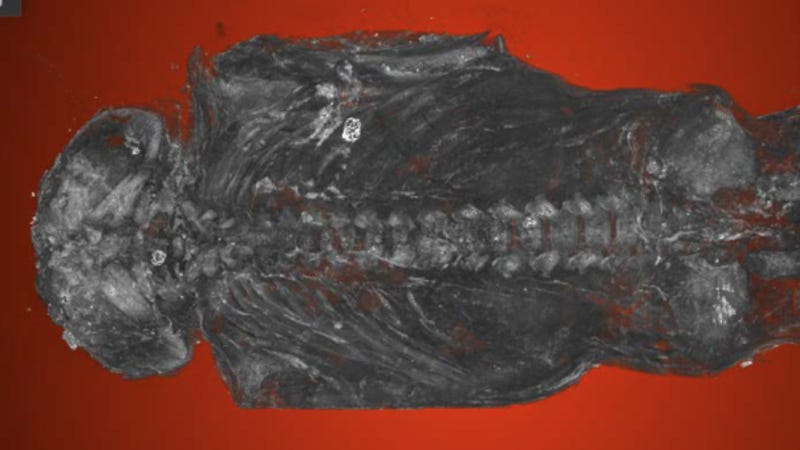
Friday 2:15pm Definitely not a bird: Micro-CT scan shows the mummified stillborn human baby. Image: Maidstone Museum UK/Nikon Metrology UK
High-resolution micro-CT scanning has shown that an Egyptian mummy thought to be a bird is really a stillborn human baby, a surprising discovery that's providing a rare glimpse into the complex cultural practices that existed some 2,100 years ago.
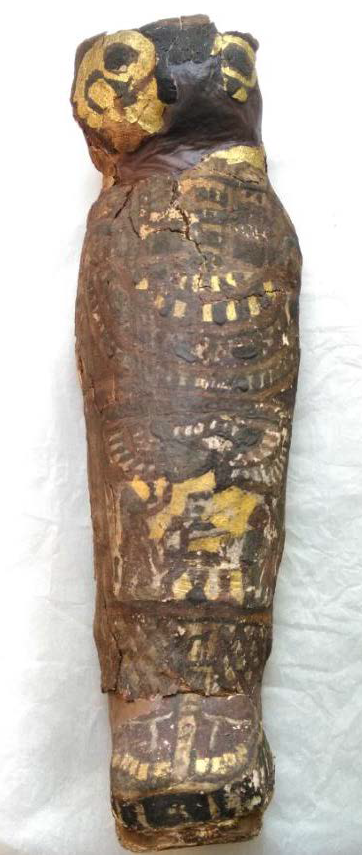
For the Western University anthropologists who analyzed the mummy, it's a fascinating glimpse into ancient Egypt, but for the family who endured this loss, it was a heart-wrenching tragedy—so much so that the family took the time to wrap the stillborn baby in cloth and place the remains inside a small coffin for posterity.
The coffin. Image: Western University
But had it not been for the CT scan in 2016 of a 2,300-year-old mummy known as Ta-Kush, the discovery of this stillborn baby would likely not have happened. While working on Ta-Kush, curators at the Maidstone Museum decided to scan a bunch of other artifacts, including a strange, tiny coffin labeled, "A mummified hawk with linen and cartonnage, Ptolemaic period (323 BC - 30 BC)." To their surprise, the scans did not reveal a bird, but instead the distinct outlines of a premature human baby.
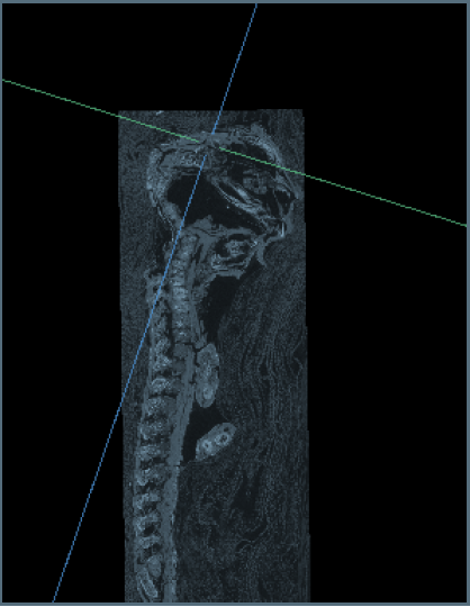
When it comes to visual detail, CT scans are good but not great, prompting Western University anthropologist Andrew Nelson to take a closer look using high-resolution micro-CT scanning. Opening the coffin and handling the remains was not considered an option, given the fragile state of the mummy, but micro-CT scans are the next best thing, as they allow scientists to zoom in and out of solid objects. The updated analysis was recently presented at the Extraordinary World Congress on Mummy Studies in the Canary Islands, and the new scans are considered the highest-resolution images ever taken of a mummified Egyptian fetus.
The preliminary analysis done in 2016 suggested the baby was stillborn, but not much was known outside of that. Nelson and his team of interdisciplinary experts identified the baby as a male who was between 23 to 28 weeks of gestation at the time of miscarriage, and not 20 weeks as previously suggested. What's more, the fetus suffered from a severe form of anencephaly, a condition in which the brain and skull fail to develop normally.
Detailed micro-CT scan of the stillborn baby, showing the malformed skull. Image: Maidstone Museum UK/Nikon Metrology UK
Its fingers and toes had formed normally, but the skull was in bad shape. The upper portion of the skull hadn't developed, the arches in its vertebrae hadn't closed, and its ear bones were located at the back of its head. The fetus also lacked bones to form the broad roof and sides of the skull. "In this individual, this part of the [skull] never formed and there probably was no real brain," said Nelson in a press release.
Such finds are rare, as only a half dozen mummified Egyptian stillborn babies are known to exist. It's also one of only two known anencephalic mummies, the other one having been discovered back in the early 19th century. For scientists, the question now is why this family took the extra time, energy, and effort to mummify a miscarried baby.
"As an anthropologist I'm interested in what that means culturally," Nelson said in an interview accompanying the press release. "But certainly fetuses had a role in magic in ancient Egypt, and so there may have been an aspect of that in play here. It would have been a tragic moment for the family to lose their infant and to give birth to a very strange-looking fetus, not a normal-looking fetus at all. So this was a very special individual."
And for archaeologists, this study imparts an important lesson: Don't always believe the label.


 The coffin. Image: Western University
 Detailed micro-CT scan of the stillborn baby, showing the malformed skull. Image: Maidstone Museum UK/Nikon Metrology UK