CAIRO – 3 May 2018: Minister of Antiquities Khaled al-Anani will inaugurate on Saturday May 5, the fourth International Tutankhamun Conference, organized by the Grand Egyptian Museum (GEM) at Le Méridien Pyramids Hotel.
As part of the conference, the GEM will receive the last historic chariot of King Tutankhamun which will be moved from the Military Museum in Saladin Citadel.
The Grand Egyptian Museum has been organizing the conference since 2015 to discuss the best methods to restore and preserve Tutankamun's funerary collection, ensure its safe transportation from the Egyptian Museum in Tahrir Square to the GEM, and to come up with the best display techniques to present the Golden King's collection at new permanent exhibition halls at the GEM.
On October 3, 2017, the Grand Egyptian Museum team packaged the second historic chariot and bed of Tutankhamun to transport them to the Grand Egyptian Museum (GEM), located two kilometers from the Giza Pyramids.
The repair team used modern materials and methods in the process of packing and moving the bed. They used precise air lifters that facilitated moving the bed from the base area without exerting any mechanical stress on it. Previous studies on the internal structure and wooden joints of the king's bed have been implemented using an X-ray device, which greatly helped to identify the weak points in the bed and determine the amount of intervention needed to maintain it during the transfer process.
The treasures of King Tutankhamun were exhibited in the Egyptian Museum located in Tahrir Square since their discovery inside King Tutankhamun's tomb in the Valley of Kings on the western bank of Luxor in 1922.
In earlier statements, Minister of Antiquities Anani said that 50 percent of the work needed to build the new museum has been finalized and that the first phase will be inaugurated in 2019. The first phase will include a room for Tutankhamun's relics.
The museum is expected to be one of the largest museums in the world.
Some 42,000 out of 100,000 artifacts were moved to the Grand Museum which plans to hire international companies for service management, Anani stated during a press conference in the Cabinet.
CAIRO - 3 May 2018: Head of the projects sector at the Ministry of Antiquities Waad Allah Abul Ella visited Kom El-Shoqafa archaeological site Wednesday to supervise the project which aims to lower the groundwater table at the site.
This project is part of the restoration work to convert Kom El-Shoqafa archaeological site into an open-air museum.
Abul Ella said that Kom El-Shoqafa archaeological site has suffered from rising groundwater level since its discovery in 1892, and that the lower level of the site has been submerged with water; he earlier urged the ministry to launch a project to lower the groundwater table and to establish pull wells at a depth of 20 meters as a preliminary solution until experts finish the necessary studies to start launching the project. Funerary art in the catacombs - Photo courtesy of Ancient history Facebook page
He remarked that the implementation of the project started in November 2017, including the establishment of six wells at a depth of about 40 meters and the installment of submersible pumps with an electronic control system in the site. Frescoes in Tigrane Tomb, Catacombs kom El-Shoqafa seen in a photo taken on Sept. 4, 2017 – CC via Wikimedia Commons/Ibrahim el-Mezayen
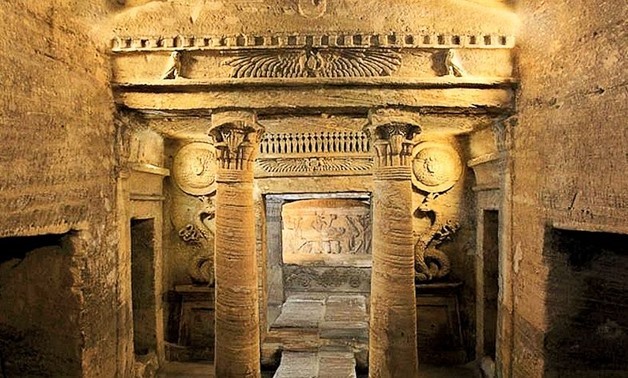
In this regard, he referred that the Ministry of Antiquities has cooperated with the U.S. Agency for International Development to undertake all the necessary studies on the project. Pillars inside the catacombs – Photo courtesy of Ancient history Facebook page Kom El-Shoqafa, which is considered one of the Seven Wonders of the Medieval World, consists of a series of catacombs, artifacts of the ancient Egyptian funeral cult, along with several remains from the Greek and Roman eras.
The catacombs at the site reach 100 feet down into the ground of solid rock. On entering the catacombs of Kom El Shoqafa, a circular staircase that takes visitors several levels deep into the ground is found. Sarcophagus showing Egyptian god and priests offering sacrifices is seen in the photo taken on April 4, 2007 – CC via Wikimedia Commons/Jerrye & Roy Klotz, MD Mostafa Waziri, secretary-general of the Supreme Council of Antiquities, said in a press statement issued on January 16, that the ministry will form a committee to plan for displaying the artifacts in Kom El Shoqafa, Alexandria.
He added that the restoration of Kom El-Shoqafa is part of the ministry's latest plan to renovate the abandoned archaeological sites.
In the same context, Aymen Ashmawi, head of the Ancient Egyptian Antiquities Department at the Ministry of Antiquities, said that the archaeological site will be divided into four sections: the first being dedicated to funerary structures, the second to religious buildings; the third to civil edifices, and the fourth will serve as a temporary exhibition.
The first section will include 34 sarcophagi; the tomb of "El-Ibrahimi" after reconstruction and an abundant cemetery after being rehabilitated.
The second section will comprise of a collection of sphinx statues and the remains of Semouha temple, while the third section will include remains of crowns, statues and pillars.
If you live in Egypt and find yourself curious about its antiquities throughout the eras, then it is recommended that you pay a visit to the National Museum of Egyptian Civilisation (NMEC) and have it among one of the local destinations on your touring list.
The NMEC is not as famous as the Egyptian Museum in Tahrir Square and the Grand Egyptian Museum (GEM) under construction near the pyramids of Giza. However, the NMEC is located across a rare natural lake called Ain El-Sira.
It is situated in Cairo near the archaeological site of Egypt's first Islamic capital of Fustat, and near the area known as Coptic Cairo and Amr ibn Al-Aas Mosque. In addition, the museum is located on an area of 135,000 sqm.
The site is visually connected to all historical urban sites of ancient greater Cairo: to the far west, you will find the pyramid of Saqqara and the pyramids of Giza.
Photo Handout to DNE
Nearer west to the museum stands the Babylon Fortress from the Roman period and Coptic churches , while Islamic Cairo to the north, evident in Saladin Citadel in the north-east, draw the cultural image and visualise the landscape of Egypt up until modern times.
The NMEC is not fully opened yet; some halls are still under construction, but the museum welcomes visitors to enjoy the currently exhibited monuments. Therefore, if you decide to go, include it as part of your tour of the ancient Cairo area.
The currently opened halls and significant location provide a premium location for sightseeing.
Mahrous Said Mahrous, general director of the NMEC, said that the history of the museum began in the 1980s when the United Nations Educational, Scientific, and Cultural Organisation (UNESCO) organised the campaign for saving Nubian antiquities behind the High Dam by establishing two museums: the Nubian Museum in Aswan and the NMEC in Giza.
The UNESCO is involved in boosting technical support in terms of trainings and exhibition development, part of the UNESCO aimed at preserving Egypt's cultural heritage, which was launched in the 1960s.
Mahrous told Daily News Egypt that the Nubian Museum was opened in 1997, while the NMEC was planned to be established in the El Gezira area in Giza, but the location was changed to El-Fustat since the Opera House was decided to be built in that initial location instead.
He said that the NMEC has a magnificent location overlooking the Ain El-Sira lake. The area was allocated in 2002, while construction work began in 2004, he said, noting that the first phase of construction ended in 2011, executed with a EGP 376m budget.
"In 2010, the second phase of the NMEC construction work was announced to be executed by Egypt's General Intelligence Service (GIS) for EGP 333m. The GIS built the infrastructure and basic construction," noted Mahrous.
Photo Handout to DNE
Additionally, Mahrous added that the museum includes antiquity storehouses, a centre for receiving antiquities, documentary centre, control room, and royal mummies storehouse, mentioning that the NMEC is a megaproject with a construction budget around EGP 3bn.
"We opened a temporary hall last year, displaying handicraft antiquities. Anyone can come and enjoy the antiquities' beauty, while three other halls will be opened by the end of 2018," said Mahrous.
He clarified that the cost of the three planned halls is about EGP 606m, including the royal mummies hall, the core exhibition hall, and 4 MW power plants, noting that the museum already has a 10 MW power plant, but the expansions require greater power capacity.
"By opening the three planned halls, we will show 50% of the museum's overall capacity, then the rest of the museum will be finished as soon as possible according to the cabinet's directives," said Mahrous.
Mahrous added that the next period will witness the speeding up of the constructions work and implementing a study on antiquity availability to set the museum exhibition scenario via a Japanese company contracting with an Egyptian consultant.
"In two years, the project will be fully opened if the funds are available," said Mahrous, adding that the project is locally financed and there is no intention to collaborate with foreign partners up until now, to the contrary of the GEM project, which is co-financed by Japan.
"I cannot predict the needed finance for implementing the rest of the project because the prices are unpredictable nowadays, especially that we import many accessories that are needed for the showcases for example," mentioned Mahrous, adding that Egypt has the antiquities, but it needs to gain more experience on the know-how from abroad.
Photo Handout to DNE
The NMEC is the first museum of civilisation in the Arab world and the only museum in Egypt that gives an overview of all the eras of Egyptian civilisation, ranging from the prehistory period to present day, as a layered cumulative product of the interaction of the Egyptian people on their land throughout history, taking a multidisciplinary thematic approach designed to highlight Egypt's tangible and intangible heritage.
Moreover, the NMEC is an important cultural, educational, recreational, and research centre for local and international visitors and scholars.
The museum gathers about 50,000 objects including archaeological and ethnographic artefacts, paintings and jewellery, and intangible masterpieces ranging from prehistory to the present day.
The museum's exhibition galleries are nine halls including the core exhibition, thematic galleries, royal museum gallery, temporary exhibition gallery, and a gallery about Cairo.
The exhibitions and galleries at the NMEC are designed for visitors to walk through Egyptian civilisation chronologically.
The core exhibition hall highlights the principle achievements of Egyptian civilisation in a chronological approach featuring the main historical periods: prehistoric, Pharaonic, Greek-Roman, Coptic, Islamic, modern, and contemporary.
The thematic galleries include six principle themes from the dawn of civilisation, the Nile, writing, state and society, material culture, beliefs, and thoughts.
The royal mummies gallery holds all royal mummies that will be displayed in a unique way of exhibition, accompanied by multi-touch interactive tables and a 3D interactive hologram.
The temporary exhibition gallery will house short-term displays and exhibits, while the Cairo gallery will offer a magnificent view displaying all Cairo landmarks. Visitors can also see the features of old and modern Cairo through panorama technology, multimedia, and sound and light show.
The NMEC will host cultural events and festivals on its premises, while site facilities include a big conference room of 23 seats with three translation cabins, a lecture hall of 187 seats, theatre of 486 seats with four translation cabins, cinema of 332 seats, museum education centre with five classes, VIP lounge, print house, big gift shop, lakeside cafes and restaurants, a library, and 42 shops.
Meanwhile, the NMEC is dedicated to preserving, protecting, and disseminating the rich and vibrant heritage of one of the oldest civilisations in the world. The museum, along with its internationally recognised research and conservation centre, have been established with the purpose of raising awareness and understanding of Egyptian history and society via exhibitions, research, cultural events, and publications.
The museum is designed as an inclusive and educational institution. It is going to be at the forefront of dialogue, debate, and exchange of ideas about the interconnectivity of history, tradition, culture, and modernity.
To ensure all NMEC visitors enjoy a lively and comfortable tour, special care to visitors with disabilities is provided by offering them the appropriate facilities.
Visitors with disabilities are led by a museum guide, to be able to explore collections via accessible itineraries that allow them to discover and interact with the exhibits and galleries.
Visitors with impaired hearing can take part in guided tours, given in different languages including sign language.
The NMEC offers brilliant activities for not only traditional tourists seeking a historical adventure, but also for children and families looking for memorable learning experiences, triggering imagination via introducing and unfoldingprevious eras.
"Sharing knowledge is the greatest of all callings. There's nothing like it in the land."
University of Alabama at Birmingham (UAB) professor of anthropology Sarah Parcak told this ancient Egyptian quote to a crowd of listeners during a 2012 TED talk (which has since been viewed over 1 million times) on her work to detect hidden archaeological sites with satellites and Infra-red technology, also known as "space archeology," and Parcak does just that.
Parcak was born in Bangor, Maine, earned her bachelor's degree in near Eastern languages and civilizations at Yale University in 2001, and her Master's and Ph.D in Egyptian archaeology from Trinity College at Cambridge.
Parcak has since directed multiple surveys and excavation projects from the Sinai Peninsula, and the Nile's East Delta to Romania, Nabetaea, Tunisia and Italy.
Her work has been featured in three documentaries, the 2011 documentary Egypt: What Lies Beneath, the 2012 documentary Rome's Lost Empire and Vikings Unearthed. Parcak's team of archaeologists at UAB has claimed the discovery of 17 pyramids, more than 1,000 tombs and 3,000 settlements in the vicinity of Sa el-HagarIn, and in 2015 she collaborated on the identification of a possible Norse settlement in Newfoundland.
But the spotlight really hit her in 2016 when she won the 2016 TED prize, a coveted prize of $1 million, which she used to fund the Global Xplorer platform; a web-based platform designed to "revolutionize how modern archaeology is done altogether, by creating a global network of citizen explorers."
The first goal of Global Xplorer is to map out the entire country Peru — the home of Machu Picchu, the Nazca lines and other archaeological wonders waiting to be discovered.
"We will do nothing less than use state-of-the-art technologyto map an entire country," said Parcak at the TED Summit in 2016. "This is a dream started by Hiram Bingham,but we are expanding it to the world,making archaeological exploration more open, inclusive,and at a scale simply not previously possible."
One of Parcaks goals is to preserve the history, and save sites in the middle-east from looters, "the past few years have been horrific for archaeology. I've spent a lot of time, as have many of my colleagues, looking at the destruction," Parcak said when she accepted the TED prize in 2016. "This Prize is not about me. It's about our field. It's about the thousands of men and women around the world, particularly in the Middle East, who are defending and protecting sites."
Parcak's work has led to many discoveries and excavated an abundant amount of historical sites otherwise lost to the modern world, she is also bringing together "citizen scientists" from around the globe to learn, and work together to open windows to the past for our modern world.
For her service to our world, the students at the University of Alabama, and for her relentless pursuit of unearthing the past for our modern eyes, Sarah Parcak is doubtlessly an Alabamawoman of influence.
How 2 Massive Carvings Found Near Egypt Pyramid Were Rescued from Looters
By Owen Jarus, Live Science Contributor |
This Amenemhat I carving dates back about 4,000 years and was discovered near the pyramid of Amenemhat I.
Credit: Photo courtesy Mohamed Youssef Ali
Two massive limestone blocks decorated with hieroglyphs and carved images have been discovered beside the Pyramid of Amenemhat I at Lisht in Egypt.
Archaeologists led by Mohamed Youssef Ali, of Egypt's Ministry of Antiquities, rescued the blocks from looters who were digging near the pyramid in January 2011, a discovery reported recently in the Egyptian Archaeology magazine.
The rescue effort was dangerous, as the archaeologists essentially risked their lives to carry them out of the desert, an act that required both physical grit and ingenuity. [The 25 Most Mysterious Archaeological Finds on Earth]
Pharaoh suckling a goddess
One of the blocks is nearly 5 feet by 2 feet (1.5 by 0.5 meters) and shows pharaoh Amenemhat I (reign circa 1981-1952 B.C.) suckling a goddess identified as the "Wadjet of Buto" in hieroglyphs engraved into the block. The fertility god Khnum stands beside the pharaoh and the goddess, saying, "I give to you water. The entourage of the gods," according to translated hieroglyphs.
The colors on the Amenemhat I carving are well preserved, particularly its blue background.
Credit: Photo courtesy Mohamed Youssef Ali
The scene suggests that Khnum and the Wadjet of Buto are the parents of pharaoh Amenemhat I, Ali said. The "water" likely symbolizes Khnum's sperm, which impregnates the goddess, allowing for the pharaoh to be born, Ali said. Pharaohs are normally shown as adults and not infants, which may explain why Amenemhat is suckling the goddess even though he is depicted as a grown man, according to Ali.
Ali noted that this block was part of a larger carving. Another block from this carving was discovered at Lisht in 1908 by archaeologists with the Metropolitan Museum of Art. That block has an image of the sky god Horus on it and is now on display at the Met Fifth Avenue in Gallery 108, according to the Met's website.
Another mysterious block
Ali's team also rescued another limestone block near the pharaoh's pyramid in January 2011. That block "shows a group of six foreigners, perhaps Libyan men, with three children," Ali wrote in the Egyptian Archaeology article. The block, which is nearly 5 feet wide and 2 feet high (1.5 by 0.5 meters), likely dates back centuries before the Amenemhat I block, Ali noted.
"The men are bare-chested over short kilts, and have beards and long hair. There are no inscriptions on the block to inform us who these people were, and whether this scene relates to a specific event, such as a war or a trading mission," Ali wrote in the article.
Rescue excavations in progress by the pyramid of Amenemhat I at Lisht.
Credit: Photo courtesy Mohamed Youssef Ali
"It was the first month of the January revolution in Egypt, the ministry of the interior withdrew all the troops from the country, the police station was burned by the revolutionaries and the prisoners escaped from the prison, everything and every place became unsafe in Egypt, everybody was trying to protect his home and his family from the criminals who were escaping from the prisons who attacked the houses for the sake of food, money and sex, too," Ali told Live Science. In this chaos, looters started digging at Dahshur and Lisht.
Ali said he heard that two groups of looters were digging by the Pyramid of Amenemhat I. The two groups were arguing over who should take possession of the looted artifacts, and one of the groups had called the military in hopes of exchanging the blocks for a reward.
It was a dangerous situation. "No one can help me or protect me and my team if I decided to go to Lisht," Ali said. Despite the danger, he and his team, which included two other archaeologists and two unarmed guards, went to investigate.
One of the looters, a young guy who had called the military, guided Ali's team to the place where the two limestone blocks were found. The looter asked Ali about receiving a reward from the government for showing the team the spot holding the limestone blocks. "I answered him, 'Yes, of course you will have a reward,'" Ali said, knowing that the government could not pay an award.
"I was a liar, [but] I had to," Ali said. A government law stipulates that an award could be paid to someone who finds artifacts in their house but not at an archaeological site, Ali said.
Once they had excavated the two blocks, Ali's team decided to take them to a storage facility at Dahshur. However, the car Ali was using couldn't "carry these huge stones, and the other [problem] is the second group of looters waiting for us on the way to Dahshur," Ali said.
This second group of looters, who were unaware that Ali's car could not handle the stones, would be waiting to ambush Ali's team when they left the pyramid.
One of the team members "gave me a very good idea to resolve this problem and secure the monuments and save our souls at the same time," Ali said. "He is from the village [located near the pyramid] and knows a good car used to move the vegetables from the village to the city every day. We hired it and [towed the blocks] upon it and moved to Dahshur; and we left my car in front of the pyramid," fooling the second group of looters into believing the team was still at the pyramid, Ali said.
The plan worked and the team, along with the two blocks, arrived safely at the storage facility in Dahshur.
Ali is the general director at the Ministry of Antiquities and the general director at the Registration Department at the Giza Pyramids.
Dr. Diana Craig Patch is a wonderful speaker. Please come on Sunday and hear the stories behind some of the new objects at the Met.
Glenn
The American Research Center in Egypt, Northern California Chapter, and the Near Eastern Studies Department, University of California, Berkeley, invite you to attend a lecture by Dr. Diana Craig Patch, Metropolitan Museum of Art:
Egyptian Stories Revealed: The Met's Exciting New Acquisitions
Sunday, May 6, 3 pm Room 20 Barrows Hall UC Berkeley Campus
(Near the intersection of Bancroft Way and Barrow Lane)
Many of the objects in the Met's Egyptian collection are old favorites with our visitors:William, the blue hippo, the exquisite lips of a queen in yellow jasper, the graceful models from Meketre's tomb, or the serene-looking statue of Hatshepsut in indurated limestone.The stories that these pieces tell about ancient Egypt are well known.This presentation shares new narratives developed by our curators that were uncovered as they studied a number of recent acquisitions. These fascinating objects open new windows into the ongoing study of ancient Egyptian culture.
About the Speaker:
Diana Craig Patch, Lila Acheson Wallace Curator in Charge, is an Egyptologist specializing in archaeology, who received her PhD from the University of Pennsylvania. During her tenure at the Met, Patch has curated The Dawn of Egyptian Art (2012), an exhibition that demonstrated how Predynastic art contributed to the foundation of Pharaonic culture, and the exhibition Cleopatra's Needle (2013–14), which celebrated the Central Park icon. Additionally, she co-curated the reinstallation of the Predynastic and Early Dynastic gallery (2003). Patch has taught courses at the Institute of Fine Arts, City University of New York, and Rutgers University, and also lectures extensively. For the past thirty-five years, Patch has carried out fieldwork in Egypt and currently is co-director of the Joint Expedition to Malqata—a project for mapping, excavating, and restoring the festival city of Amenhotep III in western Thebes. ----------
Parking is available in U.C. lots after 5 p.m. on weekdays and all day on weekends for a fee. Ticket dispensing machines accept either $5 bills or $1 bills, and debit or credit cards. The Underhill lot can be entered from Channing way off College Avenue. Parking is also available in lots along Bancroft, and on the circle drive in front of the Valley Life Sciences building.
Last month, I returned from fieldwork at El Kurru, the Kelsey's excavation project in Sudan. It was a good season overall, but also a bit odd. It felt to me like a season where almost nothing worked out the way we'd planned. For example, the conservation worklist included stabilization of cracked columns in the funerary temple with a lime-based mortar. I've done work like this on many other projects and expected it to go smoothly, but it didn't. Amaris Sturm — conservation intern this year at El Kurru, and a National Endowment for the Humanities Fellow in conservation at the Winterthur/University of Delaware Program in Art Conservation — ended up testing twenty-six (!) different grout mixtures before hitting on one we were happy with. For other team members, equipment was delayed or couldn't get through customs, supplies didn't arrive, and work plans had to be altered mid-season.
In retrospect, it was a season of significant progress on multiple fronts, but at the time … at the time, I often felt like nothing was working and it was seriously frustrating. When I think about it now, my time onsite this year was a small lesson in persistence and a demonstration of the power of kaizen. This philosophy (which originated in the U.S. but became popular in Japan following WWII) advocates continuous improvement by making small changes or taking small steps. In Arabic, people often say, "shwaya-shwaya" to mean, "a little bit," or "little-by-little." For me, it was a shwaya-shwaya season, and in the end we accomplished most of what we'd set out to do.
Amaris Sturm at work in the El Kurru funerary temple. Photo by Suzanne Davis.
BY SEBASTIAN ENCINA, Collections Manager
Digital
photography has made documenting our lives a much easier
endeavor. Now, anyone with a cell phone can capture almost any
moment with photos and even movies. Digital photography has become
ubiquitous, and sharing these files becomes increasingly more
feasible.
Archaeologists are using this tool more and more on
their excavations, and even the Kelsey Museum has gone fully
digital. The Kelsey used to insist on film photography when
documenting its collections, but greater access to storage space
and proper archival methods for digital photography has paved the
way for this change.
The same option was not available,
obviously, to those who came before us. George R. Swain,
University of Michigan photographer from 1913 to 1947, had to use
the methods available to him at the time. This meant taking his
wood view camera with him on his travels through the
Mediterranean, along with hundreds of glass plates. These plates
were heavy, and he often needed help carrying them (often his son
provided this service).
His view camera was not Swain's only tool
in the field. In the 1920s, easier means of photography were
available, though they were of lesser quality. Thanks to the
innovations of George Eastman, film photography had become
popular. Film rolls were small and easy to carry, but one was
limited by the number of frames on each roll, and the
photographer couldn't see what they captured until later, when
the film was developed. Swain carried a film camera, likely a
Kodak (the model is lost to us), and often he had others do the
same. He would take meticulous notes about who shot what, when,
and where. These notes are reflected in our current records.
The
Kodak shots often captured scenes that are less formal but
equally as important. The glass slides were reserved for artifacts
and excavations; the Kodak captured everything else, including
people, humorous moments, animals, and anything else happening
during the excavations and travels.
For this month's "From the
Archives," we present one roll of Swain's film that reflects
this. In April 1920, only 98 years ago, Swain and company
traveled to Dimé, in the Fayum region of Egypt, likely on a
reconnaissance mission to see where Michigan could excavate in
years to come. Dimé was eventually excavated, but was not one of
the original projects of the 1924 season. In this roll, we see
what Swain encountered during this trip. People holding fish. The
train and the train station. Farmers working the fields. A
village scene. Dr. Askren posing. Hiking over the sands.
Fortunately
for us, making this kind of trip is easier now without having to
haul so much photography equipment (though we are lost without
an energy source). Swain did not have the luxury, but we are
thankful for the work he did to capture these moments.
Ancient market Egypt is land of opportunity for Irish exporters
Egypt can claim to be one of the oldest, if not the oldest, export markets in the world. Photo: Reuters
Mike Hogan
In an era in which there is much talk of emerging markets for exporters, Egypt can claim to be one of the oldest, if not the oldest, export markets in the world. The pharaohs of ancient Egypt governed a nation that imported huge quantities of wood, metal and precious stones from neighbouring kingdoms.
Today, as throughout history, Egypt is a key geographical gateway with a land connection to the continent of Africa and the Middle East and, through the Suez Canal, the sea lanes of Asia and the Mediterranean.
Ireland's trading relationship with Egypt is more recent, developing in the 1970s and 1980s with the export of cattle and beef, evolving into a market worth over €100m for exporters today.
Much of this trade collapsed in the aftermath of the Arab Spring and the period of political turmoil that followed.
However, with the devaluation of the Egyptian Pound in late 2016, and a sustained period of economic liberalisation, Egypt's economy rebounded. It is now growing at 5.5pc, the fastest in the Arab world. Egypt is attracting renewed interest, with over 30 Enterprise Ireland-supported companies attending a 'Doing Business in Egypt' event in Dublin on April 16. Clearly, there is optimism that Ireland can reclaim lost exports and widen its portfolio into sectors such as food products, ICT, life sciences, education services, travel tech and agritech.
Cork's Mervue Laboratories are active in the Egyptian animal nutrition market, aiming to double exports over the next three years. Commercial director William Twomey says: "Egypt has massive potential and must be a target market for any serious animal health company. It can also be used as a gateway to surrounding markets, which is very attractive."
While Irish eyes tend to focus on South Africa and Nigeria as Africa's biggest economies, Egypt is the continent's second-largest economy.
This status was buoyed by the discovery of the offshore Zohr natural gas 'superfield' in 2015.
Egypt's economy should be understood within a wider context. It is a lower middle-income country akin to Vietnam and Indonesia, with a population of over 100 million. Unique in the Middle East, it has a sophisticated industrial base producing white goods, textiles, industrial goods, electronics and components, and an emerging automotive sector.
Within these sectors lie strong opportunities for Ireland's industrial sub-supply and services sectors. Openet and Openmind Networks from Ireland's telecoms cluster already sell to Egyptian mobile operators, and with Egyptians spending $6.1bn per annum on media and recreation, there is scope to expand our digital content solutions.
Egypt maintains a strong position in the fast-growing global halal pharmaceuticals and cosmetics sector. It is the fourth-largest Muslim consumer food market, behind Indonesia, Turkey, and Pakistan.
Egypt has already been targeted as a key market for Irish dairy product exports, and the rapid expansion of its retail sector, including large scale shopping malls and the emergence of hyperstore operators, will potentially generate opportunities for the wider Irish food sector.
Thomas Cook brought its first tourists to Egypt in 1869. The country's rich cultural heritage and beach resorts contributed a record 19.5pc of GDP in 2007. Since then, its tourist sector has suffered shocks, due to terrorist attacks and the downing of a Russian Metrojet airliner in 2015. That triggered the cancellation of flights from key markets such as Russia and the UK. As the security situation stabilises, tourism has started to recover, with revenues jumping 123pc in 2017, and higher-spending German and Russian tourists set to return in 2018. The tourism sector is ripe for modernisation, presenting a clear opportunity for the Irish tourism and travel tech cluster.
Enterprise Ireland's own travel plans include sectoral visits for Irish companies in autumn 2018 with the goal of re-establishing Egypt as an important Irish export destination.
Mike Hogan is manager, Middle East & North Africa, at Enterprise Ireland
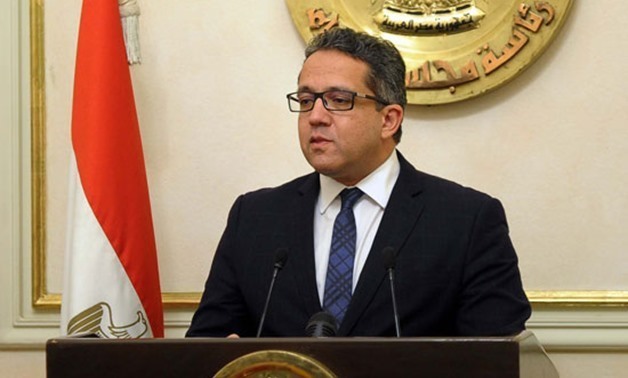 FILE - Egyptian Minister of Antiquities, Khaled al-Anani


 Diana Craig Patch, Lila Acheson Wallace Curator in Charge, is an Egyptologist specializing in archaeology, who received her PhD from the University of Pennsylvania. During her tenure at the Met, Patch has curated


