| Hi Glenn, Salima Ikram uploaded papers on Academia.edu. 2013. "A Possible Panel of Arachnids in Kharga Oasis (Egypt's Western Desert)." Sahara 24: 95-100. 2001. "The Iconography of the Hyena in Ancient Egypt." MDAIK 57: 127-140. Thanks, P.S. A study recently published in PLOS ONE found that papers uploaded to Academia.edu receive a 69% boost in citations over 5 years. See the study and data here. |
Wednesday, March 2, 2016
Fwd: Salima Ikram uploaded papers


Swiping a Priceless Antiquity ... With a Scanner and a 3-D Printer - The New York Times
http://www.nytimes.com/2016/03/02/arts/design/other-nefertiti-3d-printer.html?hp&action=click&pgtype=Homepage&clickSource=story-heading&module=mini-moth®ion=top-stories-below&WT.nav=top-stories-below&_r=0
Swiping a Priceless Antiquity ... With a Scanner and a 3-D Printer

Then last December, in the tradition of Internet activism, they released the data to the world, allowing anyone to download the information for free and create their own copies with 3-D printers.
On Thursday, German museum authorities responded publicly for the first time. They were not amused.
Birgit Jöbstl, a spokeswoman for the Prussian Cultural Heritage Foundation, which oversees the national museum system in Germany, cast doubt on the quality and authenticity of the scan, saying in an email that the museum had “noticed the ‘artistic intervention’ regarding the Nefertiti bust, but sees no necessity to react.”
“Legal steps are not currently being undertaken as the scan seems to be of minor quality,” the official said, adding that “a detailed comparison with the museum’s own 3-D data has not yet been made.”
The artists, Nora al-Badri and Jan Nikolai Nelles, contended that their scanning data was accurate and several independent experts praised the quality of the data.
Don Undeen, the senior manager of the MediaLab at the Metropolitan Museum of Art in New York, called it a “very good model” coming from consumer-level technology. “I’m glad to see the bust of Nefertiti join the ever-growing online collection of scanned art objects,” he said.
The artists’ project, “The Other Nefertiti,” confronts what they see as cultural theft and persisting colonialist notions of national ownership by making the object widely available.
It’s also a potent example of the way 3-D scanning technologies, which are becoming cheaper and more accessible, present cultural institutions with new opportunities, as well as new challenges.
“The Nefertiti stands for millions of stolen and dead objects, which are buried in museums,” Mr. Nelles, said in a recent interview at a cafe in the Berlin neighborhood of Friedrichshain.
The Nefertiti bust, added Ms. Badri, a German of Iraqi descent, “is special because it is not only an ancient artifact, but also a media icon with its own social power.”
Considered the jewel of Germany’s state museum antiquities collection, the bust adorns posters and billboards throughout this capital. The artists argue that the Neues Museum presents the artifact without sufficient explanation of how it was obtained or of its contentious status.
The original bust, a remarkably well-preserved depiction of the royal wife of the Egyptian Pharaoh Akhenaten, was removed from Egypt shortly after its discovery in Amarna, in what is now Minya province, by German archaeologists in 1912. Egyptian authorities say the artifact was taken illegally and have repeatedly called for its repatriation. The German museum representative, Ms. Jöbstl, said “the Egyptian state has never filed a restitution claim.”

The Neues Museum argues that its acquisition of the Nefertiti artifact in 1913 was “legally indisputable.” Opponents of repatriation make the further case that as the centerpiece of the museum’s collection, the bust is secure and accessible to millions of visitors from across the globe who are able to view it in the context of one of the world’s great antiquities collections.
Ms. Badri and Mr. Nelles planned their project for a year and a half. Ms. Badri concealed the scanning device — a modified version of the Kinect, a motion sensor developed by Microsoft for the Xbox 360 that can be purchased for around $100 — underneath a blue cashmere scarf, circling and scanning the artifact whenever the guards would congregate to chat with one another, while Mr. Nelles filmed, during the October visit.
The artists then handed the data off to be assembled by outside experts — hackers who declined to be identified. Two months later, they leaked the resulting 3-D data set to the public under a Creative Commons license at Europe’s largest hacker conference, the Chaos Communication Congress, in Hamburg. Within 24 hours, at least 1,000 people had downloaded the torrent.
Ms. Badri and Mr. Nelles took their copies to Egypt on a trip funded by the Goethe-Institut. (“We didn’t tell them what we were presenting until we were already there,” Mr. Nelles said.)
They buried the first copy, made of polymer resin, in the desert. The artists then filmed a staged discovery of the second, made of gypsum and painted to look like the original, and donated it to the American University in Cairo.
Some institutions take a relatively open approach to scanning technology. The Art Institute of Chicago and the Met encourage visitors to scan objects in their collections. The British Museum hosted a “scanathon” for which museumgoers were asked to use scanning devices and smartphones to create a crowd-sourced digital archive, and the Musée du Louvre in Paris held a similar series of digital workshops.
Like the Neues Museum, these institutions have produced their own high quality 3-D scans for internal conservation, reproduction and research purposes without making the data accessible to the public.
The Prussian Cultural Heritage Foundation says it “hasn’t yet discussed a policy on scanning.” Last year, the foundation produced a limited edition of 100 painted 3-D-printed copies of the Nefertiti bust at the Replica Workshop of the National Museums of Berlin, which it sells for 8,900 euros (about $9,650) each.
“Right now there’s this boom of 3-D scanning to reproduce cultural heritage,” said Morehshin Allahyari, an Iranian-born artist who uses scanning technologies to recreate artifacts destroyed by ISIS. “But few people are talking about who the images belong to.”
Tuesday, March 1, 2016
Karnak Temple complex, a photo from Luxor, Inland | TrekEarth
A wonderful series of Karnak photos starts here:
http://www.trekearth.com/gallery/Africa/Egypt/Inland/Luxor/Karnak/photo1513030.htm
http://www.trekearth.com/gallery/Africa/Egypt/Inland/Luxor/Karnak/photo1513030.htm
Museum objects transmit vivid stories - The West Australian
https://au.news.yahoo.com/thewest/entertainment/a/30982995/museum-objects-transmit-vivid-stories/
Museum objects transmit vivid stories

We continue our series in which we look at each of the works in A History of the World in 100 Objects. The exhibition from the British Museum runs at the WA Museum, Perth, until June 18.
'In week two, we look at objects 2 0-29. '
' : The First Cities (3000–700 BC)'
'20. Lunula (‘little moon’ in Latin), 2400–2000 BCE, Mangerton, Kerry, Ireland, Gold.'© Trustees of the British Museum
Over 80 gold lunulae have been found in Ireland. But how were they worn? What did they symbolise? They were probably worn as jewellery, and their skilled craftsmanship suggests they were prestige items. But there is no evidence of a complex social hierarchy or of developed cities, usually associated with the appearance of gold in prehistoric societies.
'21. Statue of Ramesses II, about 1280 BCE, Temple of Khnum, Elephantine, Egypt. Granite. © Trustees of the British Museum'

Ramesses II was one of Egypt’s most successful pharaohs, ruling from about 1279 BCE for 66 years and presiding over a golden age of prosperity and imperial power across the kingdom. He consolidated his reputation by erecting numerous statues of himself throughout a united Upper and Lower Egypt, and adding his name to statues of his predecessors.
' : Power and Philosophy 700 BCE – 100 CE'
'22. Gold Coin of Croesus, about 550 BCE, minted in Lydia (modern Turkey). © Trustees of the British Museum'

One of the earliest coins in the world, this was minted during the reign of King Croesus of Lydia (modern Turkey) or shortly afterwards. Before coinage, precious metals like gold and silver were traded by weight. The first coins followed this system since their value was in their weight.
'23. Assyrian Relief, gypsum, 700–695 BCE, Kouyunjik (Nineveh), Iraq. © Trustees of the British Museum'

This relief, one of many celebrating the military campaigns of the Assyrian king Sennacherib, decorated a royal building at his capital of Nineveh. It depicts two Assyrian army guardsmen, an Aramean archer and a spearman from the Levant. The Assyrians established a mighty empire, controlling land from Egypt to modern Iran, through the power of their army.
'24. Shabti of Taharqo, granite, c. 664 BCE, Sudan. © Trustees of the British Museum'

The ancient Kingdom of Kush, based in what is now mostly Sudan, ruled the joint kingdoms of Egypt and Kush from about 747 to 656 BCE (the 25th Dynasty). They adopted Egyptian traditions including the placement of shabtis in the tombs of important people to work for the deceased in the afterlife. This shabti is from the tomb of the Kushite King Taharqo in Nubia.
'25. Zoroastrian Figures, gold, 500–400 BCE, found near the Oxus River, on the border of Tajikistan and Afghanistan. © Trustees of the British Museum'

2,500 years ago the Persian Empire was the world superpower. While the state religion was Zoroastrianism, Persians were relatively tolerant of other faiths. These precious gold figures represent Zoroastrian priests or worshippers, holding bundles of sticks for burning, reflecting the sacredness of fire. Their mouths are covered to prevent their breath polluting the sacred flames.
'26. Coin with Head of Alexander, silver, minted 305–281 BCE, Turkey. © Trustees of the British Museum'

This coin depicts Alexander the Great, King of Macedon. It was minted forty years after his death by Lysimachus, one of his generals. After Alexander's death in 323 BCE his empire was divided amongst his warring generals and Lysimachus became King of Thrace, an area now straddling Greece, Bulgaria and Turkey. Use of Alexander’s image on his coinage helped legitimise Lysimachus' authority and right to power through association with Alexander.
'27. Funerary Stela, limestone, 100 BCE–100 CE, Egypt. © Trustees of the British Museum'

Ptolemy, one of Alexander the Great's Greek generals, was the first ruler of Egypt’s powerful Ptolemaic dynasty. This funerary stela, for a man named Didymos, has three scripts —Greek, the official state language, Egyptian hieroglyphs and Demotic, the everyday script used by literate Egyptians. This ensured effective communication with wider Egyptian society. When Cleopatra VII, the latest queen of the Ptolemy line, died in 30 BCE, Egypt became part of the Roman Empire.
'28. Head of Augustus, bronze, glass, calcite, 27-25 BCE, Meroë, Sudan. © Trustees of the British Museum'

Caesar Augustus — the first Roman emperor — communicated his personal authority to his subjects by erecting statues across his empire. Until his death aged 76, these statues depicted him as a young man in his prime, an enduring symbol of his and Roman power. Some of these statues were erected in Egypt which Augustus (then known as Octavian) had conquered for Rome by defeating Cleopatra VII and her lover the Roman general Mark Antony. In 25 BCE, six years after Augustus seized Egypt, the Queen of Kush invaded Egypt from the south, capturing many towns and forts, her army carrying several statues of Augustus off as plunder. In the early 1900s CE, this decapitated head from a bronze statue was discovered underneath the steps of a temple to Victory in the Kushite capital Meroë. Was this deliberate, to ensure it was permanently below the feet of its Meroitic captors?
'29. Carving from the Great Stupa of Amaravati, limestone, 200–240 CE (carving), India. © Trustees of the British Museum'

Amaravati was one of the most important Buddhist sites in ancient India. At its heart was the great stupa — a mound built to house a relic of the Buddha. This carved drum slab, an element of the original splendid sculptural decoration, depicts the stupa itself protected by a five-headed serpent, as well as guardian lions. Scenes from the life of the Buddha are shown in miniature on the stupa exterior.
Ancient Egypt exhibit to open in Turin, Pompeii and Naples - Culture - ANSAMed.it
http://www.ansamed.info/ansamed/en/news/sections/culture/2016/02/25/ancient-egypt-exhibit-to-open-in-turin-pompeii-and-naples_703f15b1-eecd-4856-8561-05ffc8cc7b25.html
Ancient Egypt exhibit to open in Turin, Pompeii and Naples
Joint research project to showcase influences on Italy
(ANSAmed) - ROME, FEBRUARY 25 - Three exhibitions on ancient Egypt and its influences in Italy will be opening in Italy this year as part of a larger project to showcase relations between the two countries through the centuries.
The first will be in Turin, in the 600 square meters of the Museo Egizio's first floor that has just be reopened to the public. Some 330 finds, from refined frescoes of Pompeii to three entirely reconstructed tombs, will from March 5 be showcasing the loves, fashions and in some cases the obsessions of the Classical world, fascinated as it was with the culture of nearby Egypt. From April 16, the newly reopened areas of Pompeii's Palestra Grande will once again be filled with Egyptian statues, and new routes will lead visitors to the discovery of the Temple of Isis and the many domus (residences), such as that of Loreius Tiburtinus, where luxury was expressed through 'Egyptian-style' decoration. The National Archaeological Museum of Naples will also be reopening its Egyptian collection to the public on October 8. Spread out between Turin, Pompeii and Naples and the first step of a new, joint research project between the three institutions, the project - 'Egitto Pompei' - will showcase influxes and spiritual, social, political and artistic influences from cults and fashions born in or that transited through Egypt. ''This is only the first step of a much longer plan to show what the relationship between Italy and Egypt'' has been throughout the centuries, Museo Egizio director Christian Greco said, as well as ''the beginning of collaboration between different cultural bodies that we would like to see continue'', Fondazione Egizio president Evelina Christillin added.
''This is proof,'' Culture Minister Dario Franceschini said, ''that three institutions can build a project of international appeal that is important for scholars as well as acting as a tourist attraction.'' (ANSAmed).
The first will be in Turin, in the 600 square meters of the Museo Egizio's first floor that has just be reopened to the public. Some 330 finds, from refined frescoes of Pompeii to three entirely reconstructed tombs, will from March 5 be showcasing the loves, fashions and in some cases the obsessions of the Classical world, fascinated as it was with the culture of nearby Egypt. From April 16, the newly reopened areas of Pompeii's Palestra Grande will once again be filled with Egyptian statues, and new routes will lead visitors to the discovery of the Temple of Isis and the many domus (residences), such as that of Loreius Tiburtinus, where luxury was expressed through 'Egyptian-style' decoration. The National Archaeological Museum of Naples will also be reopening its Egyptian collection to the public on October 8. Spread out between Turin, Pompeii and Naples and the first step of a new, joint research project between the three institutions, the project - 'Egitto Pompei' - will showcase influxes and spiritual, social, political and artistic influences from cults and fashions born in or that transited through Egypt. ''This is only the first step of a much longer plan to show what the relationship between Italy and Egypt'' has been throughout the centuries, Museo Egizio director Christian Greco said, as well as ''the beginning of collaboration between different cultural bodies that we would like to see continue'', Fondazione Egizio president Evelina Christillin added.
''This is proof,'' Culture Minister Dario Franceschini said, ''that three institutions can build a project of international appeal that is important for scholars as well as acting as a tourist attraction.'' (ANSAmed).
New scans of King Tut's tomb may reveal hidden chamber - CBS News
http://www.cbsnews.com/news/king-tuts-tomb-new-scans-may-reveal-hidden-chamber/
New scans of King Tut's tomb may reveal hidden chamber

The sarcophagus of King Tut is seen in his underground tomb in the famed Valley of the Kings in Luxor, Egypt Sunday, Nov. 4, 2007.
AP Photo/Ben Curtis
On April 2, a new series of radar scans will be performed on King Tutankhamun's tomb to search for hidden chambers that may contain an undiscovered royal burial, Egypt's antiquities ministry has announced.
The announcement comes after stories were published in numerous media outlets last week claiming that Egypt's tourism minister, Hisham Zazou, had told the Spanish news outlet ABC that the chambers had been proven to exist and contain numerous treasures.
"The Ministry of Antiquities has not issued any statement concerning the results that have been reached so far," the ministry said in a statement released to Live Science. "Further radar examinations will be performed on April 2, and a press conference will be held afterwards to announce the results of the scan." [See Photos of King Tut's Mummy & His Burial]

Last year, University of Arizona Egyptologist Nicholas Reeves published findings suggesting that there are hidden chambers behind a wall in Tutankhamun's tomb. These chambers, he believes, hold the burial of Queen Nefertiti, the wife of Akhenaten, a pharaoh who was Tutankhamun's father.
"We could be faced, for the first time in recent history, with the intact burial of an Egyptian pharaoh in the Valley of the Kings," Reeves told Live Science last year.
Scans performed by Factum Arte, a company commissioned to scan Tutankhamun's tomb, show unusual lines and abnormalities in the plaster of the tomb, Reeves said, adding that these features indicate that a wall was built over a doorway in ancient times.
Some of the artifacts in Tutankhamun's tomb were originally made for Nefertiti but were buried with Tutankhamun after the boy king's death, Reeves found.
Radar scans performed on the tomb last year suggest that a void could exist behind the wall. Egypt's former antiquities minister, Zahi Hawass, urged that the claims be viewed cautiously. He noted that the geology of the Valley of the Kings can lead radar to produce false positives showing a tomb when, in fact, there is only a natural feature.
Reeves did not immediately respond to Live Science's requests for comment on the latest developments.
Tourism disaster
Tourism has long been a major industry in Egypt. Since the revolution that toppled former Egyptian President Hosni Mubarak in 2011, Egypt's tourism industry has struggled, archaeologists have told Live Science. The political instability over the past five years has meant that the number of visitors to Egypt has yet to return to its prerevolution levels.
Additionally, recent terrorist attacks -- including the bombing of a Russian plane in the Sinai Desert, an attack carried out by the Islamic State group, or ISIS -- have made it difficult for the Egyptian government to convince tourists that the country is safe to visit, according to these archaeologists.
Egyptian officials hope that, if a hidden tomb is discovered, it will spur tourists to return to Egypt, bringing badly needed revenue and jobs to the country.
Follow Live Science @livescience, Facebook & Google+. Original article on Live Science.
Antiquities Minister inspects restored Zahir Baybars Mosque | Cairo Post
http://thecairopost.youm7.com/news/196876/news/antiquities-minister-inspects-restored-zahir-baybars-mosque
Antiquities Minister inspects restored Zahir Baybars Mosque
Feb. 29, 2016 15:20

Antiquities Minister inspects restored Zahir Baybars Mosque
CAIRO: Antiquities Minister Mamdouh el-Damaty inspected the Mosque of al-Zahir which is currently under restoration, the ministry announced on its Facebook page Monday.

Antiquities Minister inspects restored Zahir Baybars Mosque – Courtesy of Antiquities ministry Face book page
Damaty was accompanied by Dr. Mustafa Amin, the Secretary-General of the Supreme Council of Antiquities and the engineer and Said Helmy, the president of the Islamic and Coptic monuments in the ministry, and Ahmed Mutawa, Director of Islamic and Coptic monuments management sector.

Antiquities Minister inspects restored Zahir Baybars Mosque – Courtesy of Antiquities ministry Face book page
The Standing Committee of Islamic Archaeology received approval in February to use clay brick in the construction of the pillars of the mosque, which is the closest thing to the materials used to create the original mosque, Damaty noted.
The minister also ordered the restoration of the Sakakini Palace.
An introduction to Amara West: podcasts | Amara West project blog
http://blog.amarawest.britishmuseum.org/2016/02/29/an-introduction-to-amara-west-podcasts/
tfushiya wrote:
An introduction to Amara West: podcasts Tomomi Fushiya (University of Leiden) and Neal Spencer (Keeper, Department of Ancient Egypt & Sudan, British Museum)

Ladies on Ernetta island reading the Arabic Amara West book
The ancient town of Amara West is now a windswept place hidden behind dunes along the left bank of the Nile. The last years have seen aspects of the ancient town brought to life through work on the ancient houses, what people ate, what diseases they suffered from, their religious beliefs and even how paint was prepared. But how is this new information conveyed to the local communities?
Alongside a series of lectures, and the distribution of a free Arabic book summarising research on Amara West, we have also installed illustrated panels in a visitor orientation area built beside the ancient town.
We know that people from Abri and Ernetta island occasionally visit the site, for example during the Eid festivals. The visitor orientation area offers a place sheltered from sun (and wind!), where visitors can rest and read – in Arabic or English – about some of the discoveries, and the history of exploration. It is also a space where we plan to host school visits in future seasons.

School teacher from Ernetta reading information panels in Amara West visitor centre
One of our Sudanese colleagues suggested we make audio versions of the panels. Smartphones are increasingly common, and are used for sharing videos, What’s App messages or music. A few men keep images of saqiya (waterwheel) and old style Nubian houses on their phones. They exchange images of traditional objects and architecture in a ‘Nubian heritage’ group through an app. We’ve now created podcast versions of the panels – in English or Arabic – which can be used by anyone visiting the site, or indeed anyone else interested in ancient Amara West!
These short films (between 2 and 3 minutes each) can be watched in high resolution (for desktop or tablets) or in a mobile version.
1) A pharaonic town in Nubia
Arabic (high quality – mobile) English (high quality – mobile)2) A planned town
Arabic (high quality – mobile) English (high quality – mobile)3) Life in the ancient town
Arabic (high quality – mobile) English (high quality – mobile)4) Nubian culture in Amara West
Arabic (high quality – mobile) English (high quality – mobile)5) Eating and health
Arabic (high quality – mobile) English (high quality – mobile)6) Preparing for the afterlife
Arabic (high quality – mobile) English (high quality – mobile)7) From ancient town to archaeological site
Arabic (high quality – mobile) English (high quality – mobile)There’s more to do. The local language in Ernetta and Abri is Nubian, though nearly everyone speaks Arabic. Nubian is mainly a spoken language today. As few people write and read it, neither in Arabic characters nor Old Nubian characters, we hope to create a Nubian-language podcast soon, in collaboration with the owner of a ‘heritage café’ in Abri, Fekry Hassan Taha.
The podcasts were made possible through the support of the Qatar-Sudan Archaeological Project.


Amara West 2016: beneath pyramid G322 | Amara West project blog
http://blog.amarawest.britishmuseum.org/2016/02/29/amara-west-2016-beneath-pyramid-g322/
nealspencer wrote:
Amara West 2016: beneath pyramid G322 Mohamed Saad, National Corporation of Antiquities and Museums (Sudan)
Our expectations before starting excavation in the pyramid tomb G322 in cemetery D were very high. It features a superstructure comprising an offering court, a funerary chapel above the shaft and a pyramid, all made from mud bricks. A gate made of sand sone once provided access to the interior of a chapel of 5.1×4.5m. The substructure is cut into schist bedrock, with a shaft covered by large schist stones, one of which still lay across the the east side. The entrance to the three burial chambers is located 3.3m below the surface, on the western side.
This year, we were finally able to enter the burial chambers, protected by metal shoring to protect us from stone fragments falling from the ceiling of the chamber. The first chamber was robbed but most of individuals were still in situ. The most recent burial, Sk322-7, was a child placed on a layer of sand directly behind the entrance. It was wrapped in a coffin made from doum-palm wood. Associated with the body we found traces of textile and some blue beads near the child’s right arm. Underneath Sk322-7, I exposed an adult individual next to the fully preserved bottom of an anthropoid wooden coffin covered with painted plaster. Maickel, our conservator, consolidated the whole piece and is now trying to expose the remaining decorating. Some ivory beads were also found around the skeleton.
A second intact adult individual was found at the western side of the chamber. A small scarab, made from ivory, was found by his arm. Moreover, the first chamber held a large number of beautiful, intact vessels, which would have once held food offerings. I recovered seven plates, a big jar, two beer jars and a very nice imported bottle. Some of them clearly date to the 19th dynasty, placing the tomb in the early phase of occupation of Amara West.
Alongside regular updates on the blog, follow the season on Twitter: @NealSpencer_BM and #amarawest. More images on instagram:


Animal mummies: contents revealed part I | In the Artifact Lab
mollygleeson wrote:
http://www.penn.museum/sites/artifactlab/2016/02/27/animal-mummies-contents-revealed-part-i/
Animal mummies: contents revealed part I We x-rayed several animal mummies last week.

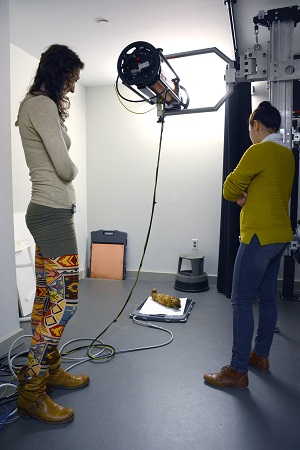
Here we are checking in on our patient. Isn’t this little kitty mummy so cute, just lying there on the x-ray plate?
Most of these mummies were on display in the Secrets and Science gallery until 2 weeks ago and several of them are going back on display soon. So now is our time to learn as much about them as possible!
We teamed up with Dr. Kate Moore, CAAM teaching specialist and zooarchaeologist, to see if we can figure out what is under the wrappings of these little (and a couple really little) mummies.
I’m going to divide the information about this project into 2 different posts. For this first post, I’m going to show side-by-side images of the some of the mummies and their x-rays, and welcome readers to make some guesses as to what is inside. I’ll follow this post by providing some information on what we think we are seeing, and some outstanding questions we still have.
You can find out more information about these little mummies by searching our Collections Database online (and also by looking at our Current in the Lab tab on this blog). We’ll blog about our interpretations soon.




http://www.penn.museum/sites/artifactlab/2016/02/27/animal-mummies-contents-revealed-part-i/
Subscribe to:
Posts (Atom)