This Drilled Cow Bone May Have Been an Ancient Egyptian Cop's Whistle
The artifact, found 17 years ago, was recently replicated and tested by researchers
/https://tf-cmsv2-smithsonianmag-media.s3.amazonaws.com/accounts/headshot/Sonja_headshot.png)
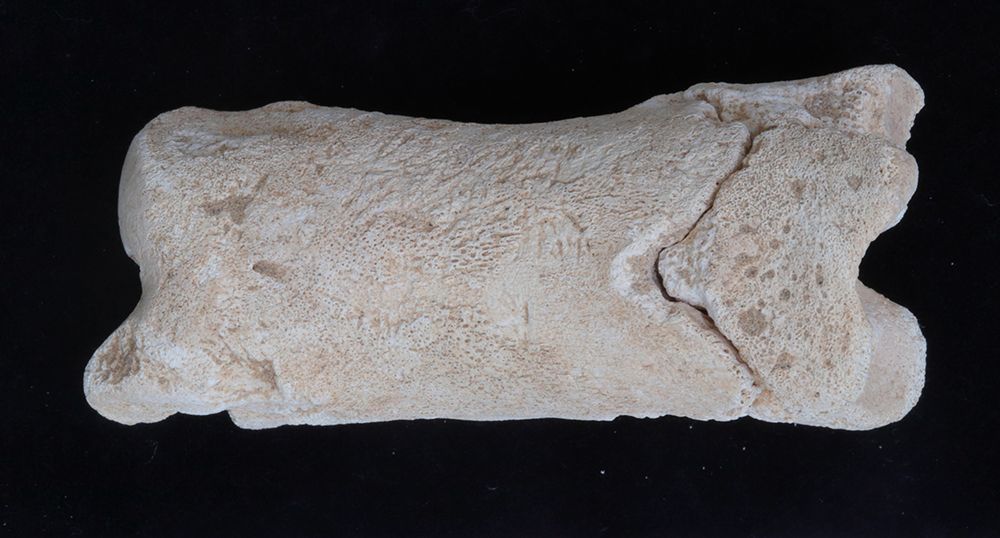
A carved-out cow bone found in Egypt is actually an ancient whistle, once used by an Egyptian "police officer." This officer didn't use the whistle to direct traffic, though. He was guarding a royal tomb.
The perforated toe bone was discovered back in 2008, according to a study recently published in the International Journal of Osteoarchaeology. It was excavated from the ancient city of Akhetaten, which was founded in 1347 B.C.E. by Pharaoh Akhenaten—husband of Nefertiti and father of King Tut. The capital filled with royal houses, temples and tombs was only briefly occupied; Akhetaten was abandoned in 1332 B.C.E. Today, its ruins are known as Tell el-Amarna.
The carved bone is "very unique," study coauthor Michelle Langley, an archaeologist at Griffith University in Australia, tells Live Science's Laura Geggel. Nothing like it has ever been found in ancient Egyptian ruins. The "very unassuming artifact" has a single drilled hole and "fits comfortably in your palm," Langley says.
Upon examination, the study authors suspected the piece was a phalangeal whistle. Langley tells Live Science that the artifact reminded her of Stone Age bone whistles found in Europe. The researchers tested out their hypothesis: Using a fresh cow bone, they replicated the Egyptian artifact and discovered that the "natural form of the end of the bone creates the perfect surface to rest your lower lip so you can blow across the hole," Langley tells Live Science.
/https://tf-cmsv2-smithsonianmag-media.s3.amazonaws.com/filer_public/85/8e/858e710a-d375-46c5-8437-1b734462b905/unnamed_3.jpeg)
The tombs of Tell el-Amarna include officials' graves, located in hills east of the city, and the tomb of Akhenaten's family. Drawings and paintings on tombs walls have helped archaeologists learn how the city looked and functioned well over 3,000 years ago. The pharaoh's family tomb was decorated with a scene of worship for Aten, the sun god—the only accepted deity under Akhenaten's rule.
The whistle was excavated from Tell el-Amarna Stone Village, one of two workers' settlements on the outskirts of the town. As the researchers write, this community was likely "heavily policed," because the workers were close to—and likely labored inside—the royal tombs. The village contained a web of roads, and the whistle was found in a structure that the researchers think could have been a checkpoint for people entering and exiting.
"This area appears to have been heavily policed in order to keep the sacred location of the tomb known and accessed by only those that need to know and go there," Langley tells Live Science. "The whistle being used by a policeman or guard makes the most sense."
Langley notes that another village of tomb workers—Deir el-Medina, near the Valley of the Kings—was similarly policed. Historians know from ancient records and artworks that Egyptians had law enforcement: They employed the Medjay, a semi-nomadic desert people skilled in combat, "as a kind of elite police force," Langley tells Live Science. By the New Kingdom era, the term "Medjay" meant any kind of police. Akhetaten even had a "chief of police" named Mahu, whose tomb is decorated with a scene of police apprehending men who'd tried to sneak into the capital.
The researchers write that findings from Stone Village shed light on the daily life of an ancient community of workers. Their task was to move between "everyday life and the realm of the dead," per the study. The bone whistle is a humble representation of their lives—of how powerful Egyptians maintained control of workers in a "tense" situation.
"Not all that was made and used by Dynastic Egyptians was made from heated, transformed and molded materials," the researchers write. "Even the most basic, uncooked bone could represent a significant insight into the Egyptian past."
-- Sent from my Linux system.

No comments:
Post a Comment