Archaeologists have discovered a rare gold coin with an Egyptian queen that's more than 2,200 years old!
In the Middle East, a team of archaeologists dug up a gold coin minted more than 2,200 years ago bearing the face of Egyptian queen Berenice II. Dated to the 3rd century BC, it sheds new light on the links between the city and the powerful Ptolemaic kingdom, the Greek kingdom located in Egypt.
Beneath the dust of an excavation site, a golden flash shed some light on history, shattering the certainties of Ancient Egypt researchers. A rare gold coin, minted in Alexandria between 246 and 241 BC, has been found in the soil of the Middle East. It bears the face of Berenice II, wife of the Egyptian king Ptolemy III, and until now had never been identified outside Egypt.
According to specialists, this discovery is more than just an archaeological treasure: it helps fit together the vast jigsaw of political and cultural relations in the Eastern Mediterranean during the Hellenistic period.
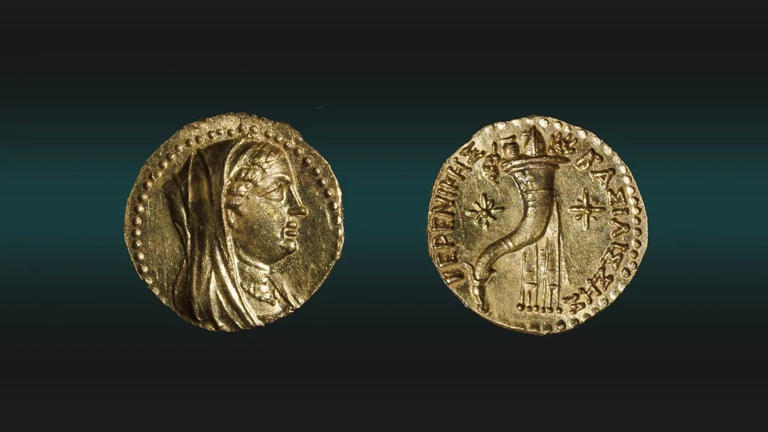
The obverse and reverse of the 3 rd century gold coin, with the face of the Egyptian queen Berenice II © City of David / Eliyahu Yanai
A gold coin dating back 22 centuries
The coin was found in 2025 during a routine sifting operation at the site of the Givati car park, in the heart of Old Jerusalem. The perfectly preserved drachma fits with a royal coinage issued in Alexandria during the reign of Ptolemy III.
Until now, only about twenty similar coins have been found anywhere in the world, all of them from Egypt and with no precise archaeological context. This makes it a unique piece: it allows us to directly link an artefact with a place and a time, giving historians a rare key to understanding exchanges and influences in the region.
The portrait of a powerful queen
The coin's obverse depicts Berenice II wearing a crown and veil, and adorned with a necklace. The reverse features a cornucopia surrounded by two stars and the Greek inscription Basileisses – 'of the queen'. This is a striking detail for specialists: in most cases, the name of the male sovereign is the one stamped on coinage.
The choice to honour Berenice reflects her unique political role. During the Third Syrian War, when Ptolemy III was campaigning, she would have exercised power as regent. This coin therefore reflects an authority assumed in her own name, a rare case in Ptolemaic Egypt where women rarely occupied such a prominent position on the political scene.
Through its symbolism, this coin illustrates a moment when an Egyptian queen asserted the power of her crown well beyond domestic or dynastic representation, by having her face and title inscribed in the monetary circuit.
A bridge between cities
Beyond the item itself, this discovery places Jerusalem in a wider network of exchanges than previously imagined. The presence of an Egyptian coin of this type in the city implies direct or indirect contacts with the Ptolemaic court: the movement of soldiers, emissaries or local elites with links to Alexandria.
Far from being isolated, the city thus appears to have been integrated into the larger regional dynamics. This coin bears witness to the interactions between two major hearts of the Hellenistic world, confirming that the city was involved in the geopolitical issues of the day.
Archaeologists see this as clear example of how a simple artefact can completely change the reading of history: a tiny coin, but bringing with it a story that links the eastern Mediterranean of the 3rd century BC to a contemporary excavation in the heart of Jerusalem.
-- Sent from my Linux system.

No comments:
Post a Comment