Search This Blog

Thursday, April 24, 2025

May 4 2025 – Lecture: Teaching Ma’at in Prison – ARCE-NorCal

https://arce-nc.org/upcoming-events/teaching-maat-in-prison/

May 4 2025 – Lecture: Teaching Ma'at in Prison

The American Research Center in Egypt, Northern California chapter, and the UC Berkeley Department of Middle Eastern Languages and Cultures invite you to attend a lecture by Dr. Rita Lucarelli, UC Berkeley:

"Teaching Ma'at in Prison"
Sunday May 4, 2025, 3 PM Pacific Daylight Time
Room 56 Social Sciences Building, UC Berkeley

This is an in-person lecture and is not virtual. No registration is required.
The lecture will be recorded.

About the Lecture:

The lecture will discuss the innovative experience of teaching a course on Ancient Egypt at San Quentin State Prison, focusing on the engagement of incarcerated students with the subject matter. Dr. Lucarelli will detail the significance of discussing concepts such as Ma'at, justice, and ethics within the context of both ancient Egyptian culture and the contemporary experiences of the students. The results indicate that the study of Egyptology offers meaningful insights for rehabilitation and education, breaking the boundaries of the prison environment and facilitating a unique learning atmosphere.
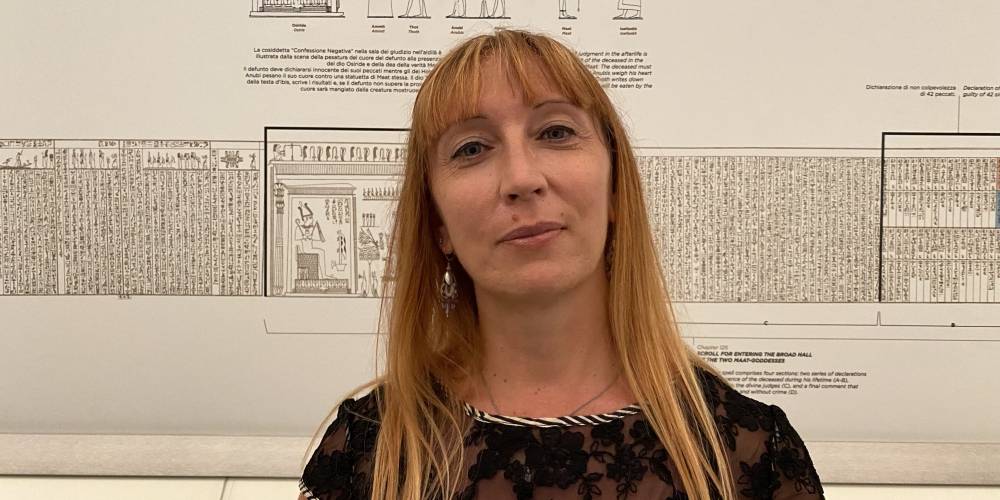
About the Speaker:

Dr. Rita Lucarelli is an Associate Professor of Egyptology in the Department of Middle Eastern Languages and Culture, and the Class of 1939 Chair of Undergraduate Education. She is the Faculty Curator of Egyptology at the Phoebe A. Hearst Museum of Anthropology and a Fellow of the Digital Humanities at UC Berkeley. She is presently working at a project aiming at realizing 3D models of ancient Egyptian coffins, the Book of the Dead in 3D. She is also completing a new monograph on demonology in ancient Egypt entitled Agents of punishment and protection: ancient Egyptian Demonology in the First Millenium BCE. Dr. Lucarelli teaches, lectures and researches Egyptomania and the reception of ancient Egypt in the contemporary world, in particular on the representation of ancient Egypt in Afrofuturism. She also teaches courses of Egyptology, Comparative Religion and Interdisciplinary Writing at San Quentin State Prison through the Mount Tamalpais College (https://www.mttamcollege.org/).

Dr. Lucarelli studied at the University of Naples "L'Orientale," Italy, where she received her MA degree in Classical Languages and Egyptology. She holds her Ph.D. from Leiden University, the Netherlands. Her Ph.D. thesis was published as The Book of the Dead of Gatseshen: Ancient Egyptian Funerary Religion in the 10th Century BC. She worked as a Research Scholar and a Lecturer at the Department of Egyptology of Bonn University, where she was part of the team of the "Book of the Dead Project".

—————-

Parking is available in UC lots all day on weekends, for a fee. Ticket dispensing machines accept debit or credit cards. Parking is available in lots around the Social Sciences Building, and in lots along Bancroft. A map of the campus is available online at http://www.berkeley.edu/map/ .

About Northern California ARCE:

For more information, please visit https://facebook.com/NorthernCaliforniaARCE/, https://arce-nc.org/, https://www.youtube.com/@NorthernCaliforniaARCE, https://khentiamentiu.org and https://bsky.app/profile/khentiamentiu.bsky.social. To join the chapter or renew your membership, please go to https://arce.org/membership/ and select "Berkeley, CA" as your chapter when you sign up.

  

Sunday, April 20, 2025

Pharaonic Hieroglyphic Inscription of Ramses III Found in Southern Jordan - Arkeonews

https://arkeonews.net/pharaonic-hieroglyphic-inscription-of-ramses-iii-found-in-southern-jordan/

Pharaonic Hieroglyphic Inscription of Ramses III Found in Southern Jordan

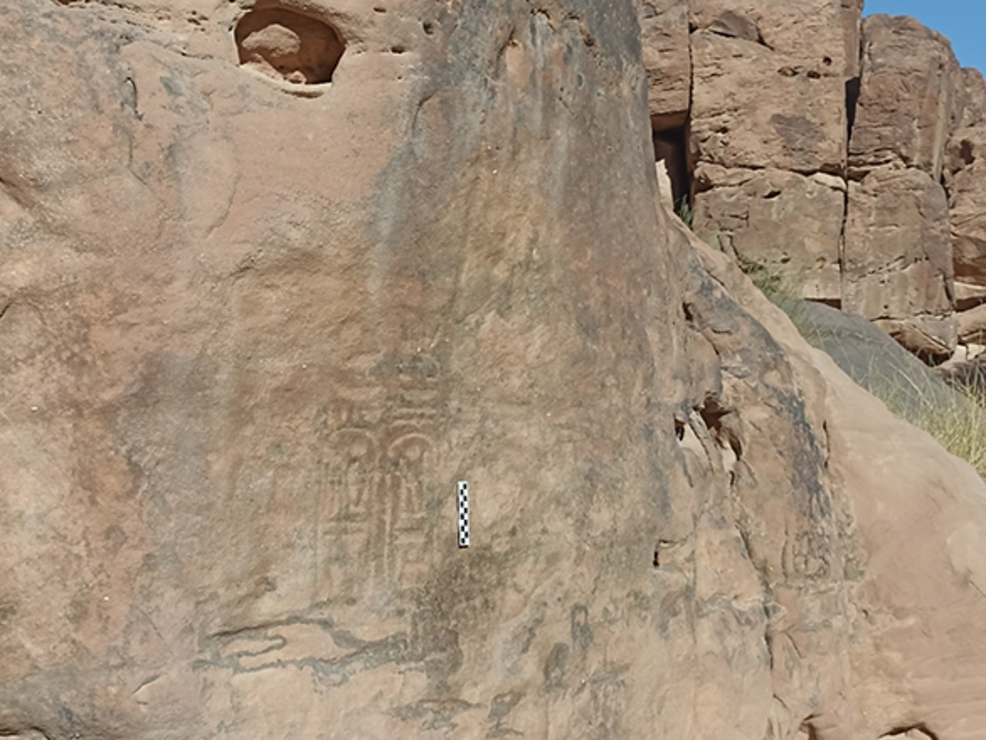
An image shows the hieroglyphic inscription bearing the royal cartouche of Pharaoh Ramses III (1186–1155 BC) discovered in the Wadi Rum Reserve in southern Jordan (Credit: Ministry of Tourism and Antiquities


In a remarkable archaeological breakthrough, a hieroglyphic inscription bearing the royal cartouche of Pharaoh Ramses III (1186–1155 BC) has been discovered in the Wadi Rum Reserve in southern Jordan.

This finding, announced by Minister of Tourism and Antiquities Lina Annab during a press briefing, is hailed as a pivotal moment in understanding the historical connections between ancient Egypt, Jordan, and the Arabian Peninsula.

Minister Annab, accompanied by esteemed Egyptian archaeologist Dr. Zahi Hawass, emphasized the uniqueness of the inscription, stating, "This is the first of its kind to be found in Jordan and provides rare, tangible evidence of Pharaonic Egypt's historical presence in the region." She described the discovery as a "qualitative addition" to Jordan's rich collection of inscriptions, reinforcing the Kingdom's status as an "open library" of cultural heritage.

The inscription, located southeast of the Wadi Rum Reserve near the Jordanian-Saudi border, includes two cartouches that bear the birth name and throne name of Ramses III, a significant ruler of Egypt's Twentieth Dynasty. Dr. Hawass highlighted the importance of this find, suggesting that it could lead to a deeper understanding of Egypt's interactions with the southern Levant and the Arabian Peninsula over 3,000 years ago.

"This discovery is crucial," Hawass stated, calling for organized excavations at the site to potentially uncover further artifacts that could shed light on the historical relations between Jordan and Egypt. The collaborative effort between Jordan and the Saudi Heritage Commission aims to trace evidence of Ramses III's campaigns in the region, marking a significant step in archaeological research.

Pharaoh Ramses III, who reigned from 1186 to 1155 BC, is often regarded as the last great monarch of the New Kingdom of Egypt. He is best known for his military campaigns against the Sea Peoples, which were a confederation of naval raiders who threatened Egypt's stability during his reign. Ramses III is also celebrated for his extensive building projects, including the construction of the magnificent temple complex at Medinet Habu, which served as a mortuary temple and a testament to his power. Ramses III's legacy is significant, as he is often seen as a symbol of Egypt's resilience in the face of external threats.

The discovery has been met with enthusiasm from the archaeological community, with Dr. Aktham Owaidi, Acting Director General of the Department of Antiquities, praising the collaboration and the importance of cultural and scientific exchange. He noted that Jordan's wealth of archaeological treasures continues to serve as a beacon of heritage both regionally and globally.

Jordanian archaeologists, including Professor Ahmed Lash and Dr. Ali Manaseer, have been actively involved in documenting the inscription, which represents a vital aspect of the region's written heritage. Their efforts, in partnership with local authorities, reflect a commitment to preserving shared cultural history.

Minister Annab expressed her gratitude for Dr. Hawass's contributions to archaeology and heritage preservation, underscoring the importance of such collaborations in enhancing the understanding of ancient civilizations. The formal announcement of the discovery will be made once further research and analysis are completed, allowing for a comprehensive interpretation of its significance.

This remarkable find not only enriches Jordan's archaeological narrative but also reinforces the Kingdom's role as a significant player in the historical tapestry of the region, highlighting the enduring connections that have shaped its cultural landscape.


--   Sent from my Linux system.

Saturday, April 19, 2025

Tomb of prince Waser-If-Re unearthed in Saqqara - Ancient Egypt - Antiquities - Ahram Online

https://english.ahram.org.eg/NewsContent/9/40/544833/Antiquities/Ancient-Egypt/Tomb-of-prince-WaserIfRe-unearthed-in-Saqqara.aspx

Tomb of prince Waser-If-Re unearthed in Saqqara

Nevine El-Aref , Friday 18 Apr 2025

The Egyptian archaeological mission, a collaboration between the Supreme Council of Antiquities and the Zahi Hawass Foundation for Archaeology and Heritage, headed by renowned Egyptologist Zahi Hawass, uncovered the tomb of Prince Waser-If-Re.

`

Waser-If-Re is the son of King Userkaf, the founding monarch of Egypt's Fifth Dynasty. His tomb was found alongside several significant artefacts spanning the Old Kingdom and the Late Period.

Zahi Hawass announced the groundbreaking discovery in the Saqqara necropolis.

Egypt's Minister of Tourism and Antiquities, Sherif Fathy, praised the discovery made entirely by an Egyptian team. He described the discovery as "a milestone in uncovering new layers of Egypt's rich and ancient history," highlighting the national pride in such locally led archaeological achievements.

One of the most remarkable elements of the discovery is the unearthing of a massive false door made of pink granite, the first of its kind in both size and material to be found in Egypt. Standing 4.5 metres tall and 1.15 metres wide, the door is inscribed with hieroglyphic texts detailing the prince's titles, including "Hereditary Prince," "Governor of Buto and Nekheb," "Royal Scribe," "Vizier," "Judge," and "Chanting Priest."

Zahi Hawass revealed that the mission found a statue ensemble depicting King Djoser, his wife, and their ten daughters for the first time. Preliminary analysis suggests these statues were initially housed in a chamber near Djoser's Step Pyramid and relocated to Prince Waser-If-Re's tomb during the Late Period. The reasons behind this transfer are currently under investigation.

Among the other significant finds are a red granite offering table measuring 92.5 cm in diameter, inscribed with detailed lists of ritual offerings, and a black granite statue of a standing male figure, measuring 1.17 metres tall, inscribed with his name and titles. The statue is believed to date back to Egypt's 26th Dynasty, further suggesting the tomb was repurposed in later periods.

A secondary granite entrance on the eastern façade of the tomb was located, bearing inscriptions of the tomb owner and a cartouche of King Neferirkare. In addition, the mission found a group of 13 statues carved from pink granite in the tomb—the first of their kind in Saqqara—placed on high-backed chairs. Among them are statue heads believed to represent the tomb owner's wives, while two headless figures and a toppled black granite statue measuring 1.35 metres were also found in the same context.

Excavations are ongoing as the mission continues to explore what is now considered one of the most distinctive tombs uncovered in the Saqqara region. The area remains central to understanding Egypt's dynastic and cultural evolution.


 Short link:


--   Sent from my Linux system.

Thursday, April 17, 2025

Isis-Renenutet Hymns in Narmouthis - VIP visiting prof. lecture!

Dear Egyptology friends,

I am writing to draw your attention to the upcoming lecture on Tuesday, April 29th:

In a small Egyptian village in the Fayyum, there are four Greek hymns inscribed on the gates to the temple of Isis-Hermonthis (the Eg. Isis-Renenutet). These elegiac and hexameter verses end with the statement: 

"Reliably learning these facts from men who study history, I myself have set them all up on inscribed pillars and translated into Greek for Greeks the power of a prince who was a god, power such as no other mortal has possessed. Isidoros wrote it."

Allegedly, the author of these hymns, Isidoros, translated Egyptian texts about Sesostris and Renenutet.


To find out who Isidoros was and why he wrote these Greek hymns to an Egyptian snake goddess Iset-Renenutet (Ἵσις-Θερμοῦθις), attend this lecture by Dr Anastasia Maravela (University of Oslo) who will be delivering a presentation about these fascinating inscriptions from Egypt. 

Reuse of Greek Epic Tradition in the Poetic Dedication of Isidoros at Narmouthis
Tuesday, April 29th, 2025
4PM | 3335 Dwinelle

If you'd like to preview the hymns, I attach links to the Greek text and the English translation (+ on that same website with the English translation, there are links to two notable commentaries/essays on the inscriptions!). 

--
Leah Packard Grams | [she/her]
Ancient History & Mediterranean Archaeology PhD student
Center for the Tebtunis Papyri
Unceded xučyun (Huichin) Ohlone land
UC Berkeley

Sunday, April 13, 2025

Northern Cal. Egyptology Lecture May 4 by Rita Lucarelli: Teaching Ma'at in Prison


The American Research Center in Egypt, Northern California chapter, and the UC Berkeley Department of Middle Eastern Languages and Cultures invite you to attend a lecture by
Dr. Rita Lucarelli, UC Berkeley:


Teaching Ma'at in Prison

Sunday May 4, 2025, 3 PM Pacific Daylight Time
Room 56 Social Sciences Building, UC Berkeley

This is an in-person lecture and is not virtual. No registration is required.
The lecture will be recorded.


About the Lecture:

The lecture will discuss the innovative experience of teaching a course on Ancient Egypt at San Quentin State Prison, focusing on the engagement of incarcerated students with the subject matter. Dr. Lucarelli will detail the significance of discussing concepts such as Ma'at, justice, and ethics within the context of both ancient Egyptian culture and the contemporary experiences of the students. The results indicate that the study of Egyptology offers meaningful insights for rehabilitation and education, breaking the boundaries of the prison environment and facilitating a unique learning atmosphere.


Egyptian Museum Turin, facsimile of the                              Book of the Dead of Iuefankh
About the Speaker:

Dr. Rita Lucarelli is an Associate Professor of Egyptology in the Department of Middle Eastern Languages and Culture, and the Class of 1939 Chair of Undergraduate Education.  She is the Faculty Curator of Egyptology at the Phoebe A. Hearst Museum of Anthropology and a Fellow of the Digital Humanities at UC Berkeley. She is presently working at a project aiming at realizing 3D models of ancient Egyptian coffins, the Book of the Dead in 3D. She is also completing a new monograph on demonology in ancient Egypt entitled Agents of punishment and protection: ancient Egyptian Demonology in the First Millenium BCE. Dr. Lucarelli teaches, lectures and researches Egyptomania and the reception of ancient Egypt in the contemporary world, in particular on the representation of ancient Egypt in Afrofuturism. She also teaches courses of Egyptology, Comparative Religion and Interdisciplinary Writing at  San Quentin State Prison through the Mount Tamalpais College (https://www.mttamcollege.org/).

Dr. Lucarelli studied at the University of Naples "L'Orientale," Italy, where she received her MA degree in Classical Languages and Egyptology. She holds her Ph.D. from Leiden University, the Netherlands.  Her Ph.D. thesis was published as The Book of the Dead of Gatseshen: Ancient Egyptian Funerary Religion in the 10th Century BC. She worked as a Research Scholar and a Lecturer at the Department of Egyptology of Bonn University, where she was part of the team of the "Book of the Dead Project".

-----------

Parking is available in UC lots all day on weekends, for a fee. Ticket dispensing machines accept debit or credit cards. Parking is available in lots around the Social Sciences Building, and in lots along Bancroft. A map of the campus is available online at http://www.berkeley.edu/map/ .


About Northern California ARCE:

For more information, please visit https://facebook.com/NorthernCaliforniaARCE/, https://arce-nc.org/, https://www.youtube.com/@NorthernCaliforniaARCE, https://khentiamentiu.org and https://bsky.app/profile/khentiamentiu.bsky.social. To join the chapter or renew your membership, please go to https://arce.org/membership/ and select "Berkeley, CA" as your chapter when you sign up.