https://www.ft.com/content/80cb7564-8514-11e9-a028-86cea8523dc2
Tutankhamun bust set to reach £4m at Christie's auction
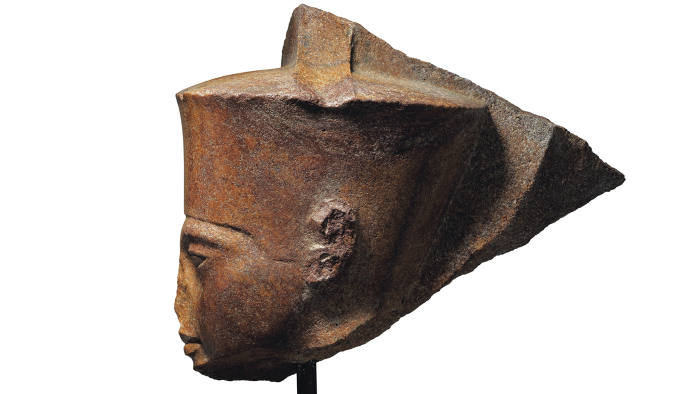 The bust, which is a fragment of a larger statue, shows Tutankhamun as Amun, the most important god of the era © Christie
With the distinctive almond-shaped eyes and drooping lower lip of the famed boy king, the quartzite fragment of a larger statue shows Tutankhamun as Amun, the most important god of the era. Depictions of Egyptian deities commonly carried the likeness of the living pharaoh as a propaganda tool for driving home the ruler's power and divine status.
It is the first time that the head, owned by a private collection, has appeared on the open market since 1985. Experts at the London arm of auction house Christie's, where the statue will be sold on July 4, believe the statue would once have been housed at the Temple of Karnak in Upper Egypt, where other statues showing Tutankamun's likeness have previously been found.
Coming to the throne at the age of nine, Tutankhamun ruled for less than 10 years to 1323BCE. But his place in the cultural consciousness was secured after Egyptologist Howard Carter discovered his still-intact royal tomb in 1922, laden with gold, jewellery and finely wrought objects. The sensational find unleashed "Tut-mania" around the world, with Egyptian themes and motifs adopted by architects, fashion houses and jewellers.
Sculptures from the 20-year "Amarna period" preceding Tutankhamun's reign are highly sought as it was a period of religious and artistic revolution when court sculptors rejected standardised motifs to capture individual features in a much more realistic way.
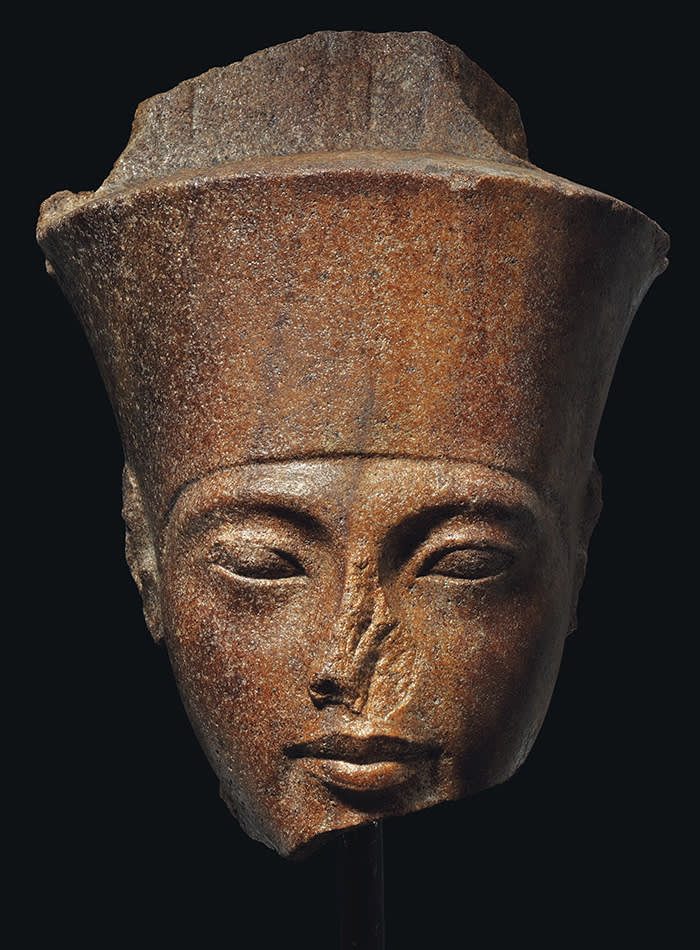 Egyptian head with features of Tutankhamun for sale at Christie's. The innovative realistic representation of the period makes such pieces highly sought after today © Christie's
Laetitia Delaloye, head of the antiquities department at Christie's London, said artists retained the new style even after Tutankhamun restored older religious traditions. "The beauty of the lines and the way it's carved are a testament to the Amarna style," she said.
The high estimate on the artefact, which is being sold by a private collection known as the Resandro Collection, also reflects the fact that statues of Tutankhamun very seldom appear on the market, since most are now housed in museums.
Ancient objects increasingly attract demands for repatriation when they come up for sale. Christie's faced protests last year when it sold an Assyrian relief from the royal palace of Nimrud for $31m — three times its estimate — to an anonymous buyer. Iraq's ministry of culture had denounced the sale, asking for the work to be sent back to the country. Christie's denied any legal basis for repatriation.
Egypt has regulated the sale of its cultural heritage since 1835, and brought in laws in 1983 banning the removal of artefacts from the country. More recently it has strengthened legislation in a bid to clamp down on the trade in illicit objects.
It is not known when and where the Tutankhamun head was found, but its provenance goes back to the 1960s, when Christie's said it formed part of the collection of Prince Wilhelm von Thurn und Taxis, a German collector. It subsequently passed through the hands of dealers until bought by the current owners in 1985.
The head's existence is well known among scholars: it has been lent for museum exhibitions in Germany and Spain and has been documented in academic studies of ancient Egyptian art since the 1980s.
Christie's said it was in frequent contact with the Egyptian authorities about its planned sales of antiquities, adding that it would send details of the head and other artefacts in the sale to the authorities on publication of the sale catalogue early this week.
No comments:
Post a Comment